


 Top Rated Course

We may not have the course you’re looking for. If you enquire or give us a call on +1 6474932992 and speak to our training experts, we may still be able to help with your training requirements.
Agile vs Traditional Project Management: Comparing Approaches
David Evans 08 May 2026Agile and Traditional Project Management differ in approach, Agile focuses on flexibility and adaptability and Traditional follows a structured, linear process. Agile adapts through iterative cycles, while Traditional follows fixed planning and stages. Agile works well for uncertain projects, whereas Traditional suits predictable tasks.

Training Outcomes Within Your Budget!
We ensure quality, budget-alignment, and timely delivery by our expert instructors.
Table of Contents

Imagine managing a project with a strict deadline, budget, and detailed plan. This is where Traditional Project Management rules. But what if your team needs to move quickly, adapt constantly, and innovate on the fly? That’s when Agile takes centre stage. Choosing between these two approaches lies at the core of Agile vs Traditional Project Management.
In this blog, you’ll explore Agile vs Traditional Project Management, their pros and cons, a detailed comparison, how to choose the right approach, when to switch methods, why Agile suits growing industries, and common mistakes to avoid.
Table of Contents
1) What is Agile Project Management?
2) Advantages of Agile Project Management
3) Disadvantages of Agile Project Management
4) What is Traditional Project Management?
5) Advantages of Traditional Project Management
6) Disadvantages of Traditional Project Management
7) Agile vs Traditional Project Management: Detailed Comparison
8) Agile vs Traditional Project Management: Key Similarities
9) How to Choose Between Agile vs Traditional Project Management?
10) Why Agile is the Right Choice for a Growing Industry?
11) Can I Switch Between Traditional and Agile During a Project?
12) What Common Mistakes do People Make When Choosing a Project Management Methodology?
13) Conclusion
What is Agile Project Management?
Agile Project Management (APM) is a way to do projects that is easy and flexible. Instead of following a long plan from start to finish, work is split into small parts called sprints. This helps teams change plans quickly, get feedback often, and finish small pieces one by one.
Agile was first used for making software but now helps in many jobs like marketing and building in many organisations. It works because people in the team talk a lot and work together. Agile cares about what the customer wants and gives them useful results fast. This way, projects can change when needed and still succeed.

Advantages of Agile Project Management
Here are some advantages of Agile Project Management:
1) Agile is easy to change and helps teams adjust during the project
2) Work is split into small parts called sprints, making teamwork better
3) Problems are found and fixed early
4) Less time is needed to plan at the start, so the work finishes faster
5) Costs are lower and the project gives more value
6) Customers often give feedback to help make the project better
7) Team members work well together
8) Helps the team keep focused and finish the work on time
Disadvantages of Agile Project Management
Here are the main disadvantages of Agile Project Management, clearly and simply stated:
1) Not well-suited for large, complex projects
2) Documentation done during the project can slow progress
3) Difficult to accurately predict costs, timelines, and workload
4) Requires constant collaboration, which can be demanding
5) Tracking progress through many small cycles is challenging
6) Projects risk extending without clear deadlines
7) Scope creep and loss of focus may occur
8) Maintaining a consistent product design can be hard
9) Technical debt might be overlooked, causing extra work later
10) Managing large features can be difficult
11) Success depends on strong planning and clear communication
12) Limited time for thorough design and iteration
Enhance your team to work faster, smarter, and with greater clarity. Join our Agile for Teams Training now!
What is Traditional Project Management?
Traditional Project Management, or the Waterfall method, is doing work step by step. You finish one part like planning, then design, then building, then testing before starting the next. It is good for projects that are clear and easy to plan.
The Project Manager makes a detailed plan and checks that work is done on time and is not too expensive. Everyone has a clear job, which helps teams work well but makes changing plans hard. The manager looks for problems early and plans to stop them, checking often during the project.
Key Points:
1) Work is done in order, one step at a time
2) Best for projects with clear and fixed plans
3) Detailed planning before starting work
4) The Project manager controls time and cost
5) Team members have specific, fixed roles
6) Hard to change the plan once started
7) Risks are found early and managed carefully
Advantages of Traditional Project Management
Traditional Project Management is a simple and well-known way to do projects. Here are some important points:
1) It works well for big and hard projects that need careful control and planning
2) Lots of planning is done before starting to set clear goals for everyone
3) This helps everyone understand the project and follow the plan
4) It helps find and manage risks and plan the budget well
5) All steps are written down so the team can follow them, and checks are easier
6) Everyone has a clear job and knows what to do
7) Progress is checked at each step to keep the project on time
8) Many people know this method, so teams and leaders feel confident using it
Disadvantages of Traditional Project Management
Traditional Project Management has some disadvantages. Here are the main points:
1) It is not very flexible and does not allow easy changes during the project
2) The project manager must approve all changes, which can slow things down
3) It’s not suitable for large projects because it limits easy changes
4) This can make it hard to keep up with new or changing needs in the project
5) There is little room for creativity and innovation since every step is planned in advance
6) Customer input is mostly early, so results may miss their needs
7) The sequential steps can make the project take longer to finish
8) Sometimes paperwork gets more attention than actual work and solving problems
Learn the application of Lean-Agile principles to deliver customer value efficiently. Join our SAFe® Agile Product Management Training now!
Agile vs Traditional Project Management: Detailed Comparison
Agile and Traditional Project Management are two popular methods used to manage projects efficiently in many organisations. Here’s a look at the key differences between these two approaches:

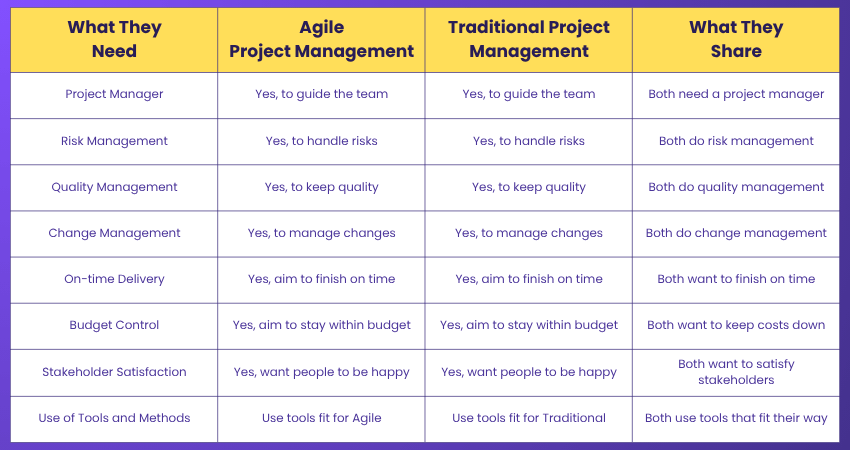
Agile vs Traditional Project Management: Key Similarities
Agile and Traditional Project Management are two ways to do projects. Agile is about being flexible, working as a team, and changing plans fast. Traditional follows a set plan, step by step. Even though they are different, they have some things in common.
How to Choose Between Agile vs Traditional Project Management?
Choosing between Traditional and Agile Project Management depends on the project’s needs, team skills, and available resources. Understanding their differences helps you choose the best fit.
Traditional Project Management is good when:
1) The project has clear and fixed requirements that won’t change much
2) Detailed planning and documentation are needed before starting
3) The project follows a step-by-step, predictable timeline
4) The focus is on sticking to a strict plan and hitting set milestones
5) Customer involvement and feedback are limited during the project
6) The team is experienced with this structured way of working
7) The project needs tight control and predictable results
Agile Project Management works best when:
1) Project requirements might change or evolve during the work
2) Flexibility is important to meet customer needs and market changes
3) The project uses short cycles (iterations) with regular feedback and improvements
4) The team values working together, talking often, and managing themselves
5) The goal is to give working products quickly and satisfy customers
6) Customers give feedback often throughout the project
7) The team is open to change and iterative work
Build adaptive leadership skills to thrive in complex business environments. Join our Agile Programme Management (AgilePgM®) Course now!
Why Agile is the Right Choice for a Growing Industry?
As industries grow and change, Traditional project methods often struggle to keep pace. Agile stands out by being flexible, promoting strong teamwork, and putting customers first. Let’s look at some key reasons why Agile works so well for growing industries:
1) Faster Time-to-market
Agile breaks work into small parts so companies can finish and share new things fast. This helps them change quickly when needed. This way, they can be faster than others.
2) Adapting to Change
Agile lets teams make better work little by little. It helps when things change a lot. This makes sure the work always fits what people need now.
3) Better Teamwork and Productivity
Teams work together and share jobs in short times. This helps everyone do their part. They can fix problems fast by talking and helping each other.
4) Managing Risks Better
Agile works in small steps, so problems are found and fixed early. Teams check how they did and try to do better. This helps stop big problems later.
5) Focus on Customers
Agile listens to customers a lot and changes work based on what they say. This helps make things that customers really like. It also keeps customers happy and trusting the team.
Can I Switch Between Traditional and Agile During a Project?
Yes, you can change or mix Traditional and Agile ways during a project. This works well if some parts need strict steps and others need flexibility. But changing too much can cause confusion. So, it’s better to plan how to use both, like using Traditional for hardware and Agile for software.
What Common Mistakes do People Make When Choosing a Project Management Methodology?
A common mistake is picking Agile or Traditional without thinking about what the project needs. It’s important to know what the project really requires before choosing. Another mistake is not talking enough with the people involved. No matter which way you choose, good communication and support from everyone are very important to make the project successful.
Conclusion
Choosing the right Project Management method is key to success. Understanding the differences between Agile vs Traditional Project Management helps you pick the best fit for your project’s needs. Whether you need flexibility or a clear plan, both methods have strengths. By aligning your choice with your project goals and team, you can improve efficiency, collaboration, and deliver better results every time.
Learn how to manage time, cost, and risk effectively in Agile projects. Join our Agile Project Management Foundation (AgilePM® V3) Course now!
Frequently Asked Questions
How do Agile Project Metrics Differ from Traditional Methods?

Agile project metrics focus on flexibility and results, tracking work completed in sprints, task progress, and customer satisfaction.
Traditional metrics focus on following the original plan, measuring schedule and budget changes, and hours worked. Agile values outcomes, while Traditional stresses sticking to timelines and budgets.
What's the Difference Between Project Management and Agile Project Management?
Project Management means planning and completing projects using different ways. Agile Project Management is a special method that focuses on being flexible, working as a team, and delivering work in small parts step by step. It helps teams adjust and improve the project as they go.
What are the Other Resources and Offers Provided by The Knowledge Academy?
The Knowledge Academy takes global learning to new heights, offering over 3,000 online courses across 490+ locations in 190+ countries. This expansive reach ensures accessibility and convenience for learners worldwide.
Alongside our diverse Online Course Catalogue, encompassing 19 major categories, we go the extra mile by providing a plethora of free educational Online Resources like Blogs, eBooks, Interview Questions and Videos. Tailoring learning experiences further, professionals can unlock greater value through a wide range of special discounts, seasonal deals, and Exclusive Offers.
What is The Knowledge Pass, and How Does it Work?
The Knowledge Academy’s Knowledge Pass, a prepaid voucher, adds another layer of flexibility, allowing course bookings over a 12-month period. Join us on a journey where education knows no bounds.
What are the Related Courses and Blogs Provided by The Knowledge Academy?
The Knowledge Academy offers various Agile Training, including the Agile Project Management Foundation (AgilePM® v3) Training, Agile Project Management Practitioner (AgilePM® v3) Training, and the Agile Programme Management (AgilePgM®) Training. These courses cater to different skill levels, providing comprehensive insights into Project Coordinator Salary.
Our Project Management Blogs cover a range of topics related to Agile vs Traditional Project Management, offering valuable resources, best practices, and industry insights. Whether you are a beginner or looking to advance your Project Management skills, The Knowledge Academy's diverse courses and informative blogs have got you covered.

David Evans


Certified Project Trainer and Agile Delivery Expert
David Evans brings over a decade of hands-on experience in project delivery, Agile transformation, and team leadership. With a background in technology and business consulting, David has led cross-functional teams through Agile and Waterfall projects in both public and private sectors. He combines technical knowledge with practical insights to help readers navigate the challenges of modern project environments.

Upcoming Project Management Resources Batches & Dates
Date
 AgilePM® Foundation & Practitioner (AgilePM® v3)
AgilePM® Foundation & Practitioner (AgilePM® v3)
Mon 28th Sep 2026
AgilePM® Foundation & Practitioner (AgilePM® v3)
Mon 14th Dec 2026

 If you wish to make any changes to your course, please


