


 Top Rated Course

We may not have the course you’re looking for. If you enquire or give us a call on +32 35001305 and speak to our training experts, we may still be able to help with your training requirements.
What is Strategic Planning and Why is it Important?
Charlotte Wilson 25 March 2026Strategic planning is the process of defining long-term goals, setting direction, and allocating resources while aligning teams through SWOT analysis and vision. It helps organisations stay focused, agile, and competitive in changing markets. It also supports more informed decision-making and sustainable long-term business growth.

Training Outcomes Within Your Budget!
We ensure quality, budget-alignment, and timely delivery by our expert instructors.
Table of Contents
Organisations today operate in fast-changing environments where clear direction is essential for success. Having a structured approach to setting goals and making decisions helps teams stay aligned and focused. This is where understanding 'What is Strategic Planning' becomes important.
By defining priorities, allocating resources, and guiding long-term vision, strategic planning supports consistent growth and adaptability. To see how it works in practice and why it matters, let’s explore its key elements and benefits.
Table of Contents
1) What is Strategic Planning?
2) Why is Strategic Planning Important?
3) Types of Strategic Planning
4) Steps in the Strategic Planning Process
5) Various Strategic Planning Frameworks
6) Common Challenges in Strategic Planning
7) Conclusion
What is Strategic Planning?
Strategic Planning involves using resources effectively to set objectives, define actions, and achieve organisational goals. It strengthens decision-making, minimises risks, and identifies growth opportunities. For example, Apple’s unified strategy enabled the successful iPhone launch and sustained market leadership.

Why is Strategic Planning Important?
Strategic Planning is an important part of businesses, organisations, and individuals as it ensures long-term success. Let's see why it matters below:
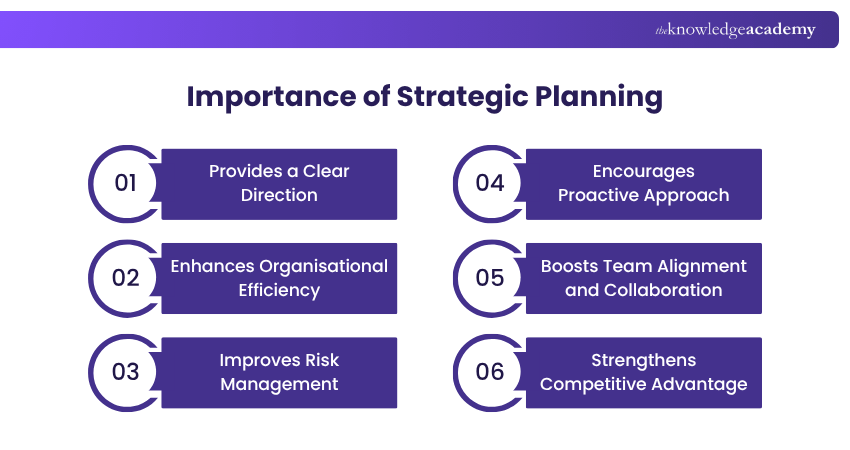
1) Provides a Clear Direction
a) Defines Vision and Goals: Aligns objectives with the organisation’s mission for focused growth and direction.
b) Guides Decision-making: Provides a framework for making well-informed strategic business decisions.
2) Enhances Organisational Efficiency
a) Resource Optimisation: Promotes efficient use of time, budget, and workforce resources.
b) Avoids Redundancies: Reduces operational inefficiencies and process overlaps.
3) Improves Risk Management
a) Identifies Potential Risks: Enables organisations to anticipate challenges and plan contingencies.
b) Prepares for Uncertainties: Mitigates risks from market changes and economic downturns.
4) Encourages Proactive Approach
a) Anticipates Market Trends: Adapting to the changing industry and keeping businesses ahead of competitors.
b) Supports Innovation: Promotes ongoing improvement and innovation in technology.
5) Boosts Team Alignment and Collaboration
a) Enhances Communication: Aligns all departments toward shared organisational goals.
b) Increases Employee Engagement: Inspires employees with clear purpose and motivation.
Advance your skills through our Personal Development Courses – Join now!
6) Strengthens Competitive Advantage
a) Differentiation from Competitors: Enables businesses to create distinctive value propositions.
b) Improves Market Positioning: Helps organisations refine their strategies to better target customers and capture greater market share.
Types of Strategic Planning
Strategic Planning is broadly divided into three levels: Business-Level, Corporate-Level, and Functional-Level. Each level plays a crucial role in guiding an organisation toward achieving its goals efficiently.
1) Business-level Strategic Planning
Business-level Strategic Planning focuses on how a company competes within a specific market. It defines target audiences, competitive advantages, and key actions to achieve success.
2) Corporate-Level Strategic Planning
Corporate-level Strategic Planning outlines the overall direction of the organisation. It focuses on long-term goals, growth decisions, and resource distribution across all business units.
Learn about different budgeting techniques with our Introduction to Managing Budgets Course – Join today!
3) Functional-level Strategic Planning
Functional-level Strategic Planning focuses on specific departments such as marketing, finance, or operations. It translates higher-level strategies into actionable plans to improve efficiency and achieve organisational goals.
Steps in the Strategic Planning Process
Strategic Planning involves different approaches and steps, depending on the specific needs of a business. Below are its key steps:
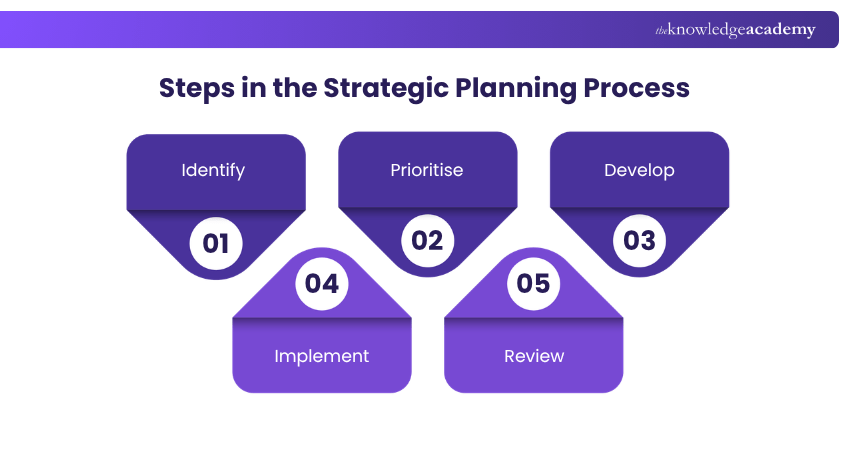
Step 1: Identify
This stage focuses on assessing the organisation’s current position using internal data, past strategies, and external market insights. It involves analysing performance, competitors, and trends to understand opportunities and challenges. A clear long-term vision is also defined at this stage to guide future direction.
Step 2: Prioritise
In this step, organisations set and rank strategic goals based on impact, urgency, and alignment with the overall vision. Priorities are selected carefully to ensure focus on high-value initiatives. Resource needs, timelines, and key performance indicators (KPIs) are also identified.
Step 3: Develop
This phase involves creating detailed action plans and strategies to achieve the defined goals. Responsibilities are assigned, and short-term tactical plans are designed to support long-term objectives. It ensures clarity on how the strategy will be executed across teams.
Step 4: Implement
Here, the strategic plan is put into action by communicating it across the organisation and aligning teams to deliver on objectives. Processes, policies, and systems are established to support execution. Responsibilities are delegated, and progress tracking mechanisms are introduced.
Step 5: Review
The final step involves monitoring performance against KPIs and evaluating overall progress. Organisations regularly review outcomes to identify gaps or improvements. Based on insights, the strategy is refined to stay aligned with changing conditions and goals.
Learn how to handle stress with our Stress Management Course – Register today!
Various Strategic Planning Frameworks
Different Strategic Planning frameworks offer structured ways to analyse situations, set goals, and guide decision-making. The following frameworks highlight widely used approaches that help organisations plan, compete, and achieve long-term success.
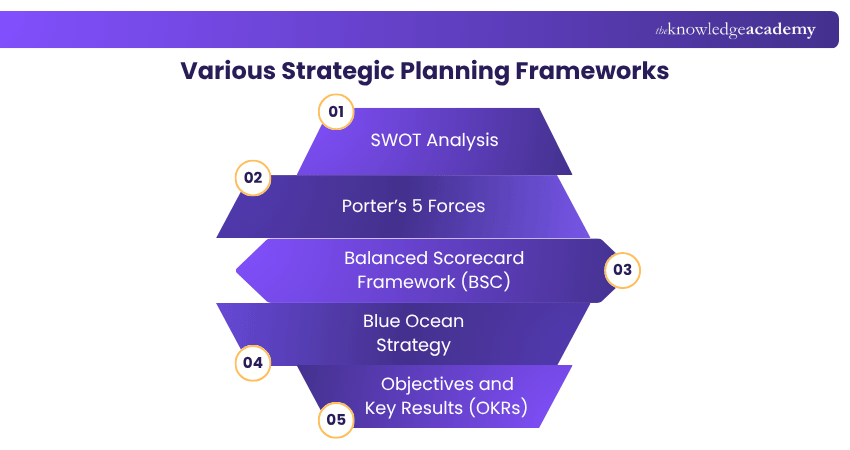
1) SWOT Analysis
SWOT Analysis helps organisations assess internal strengths and weaknesses alongside external opportunities and threats. It provides a clear view of current position and market conditions. This framework is often used early in planning to identify improvements and growth areas.
2) Porter’s 5 Forces
Porter’s 5 Forces analyses the competitive environment within an industry. It examines competition, new entrants, supplier power, customer power, and substitutes. This helps organisations understand market dynamics and shape effective competitive strategies.
3) Balanced Scorecard Framework (BSC)
The Balanced Scorecard translates strategic goals into measurable actions. It links objectives with performance measures, initiatives, and tasks. This ensures alignment across teams and supports ongoing performance tracking.
4) Blue Ocean Strategy
Blue Ocean Strategy focuses on creating new market spaces rather than competing in existing ones. It encourages innovation and differentiation to unlock new demand. This approach helps organisations achieve growth by redefining competition.
5) Objectives and Key Results (OKRs)
OKRs is a framework for setting clear goals and measurable outcomes. Objectives define what to achieve, while key results track success through metrics. It improves focus, alignment, and transparency across the organisation.
Common Challenges in Strategic Planning
Strategic planning can face several challenges that hinder effective execution and results. The following are some common pitfalls organisations encounter during the planning process.
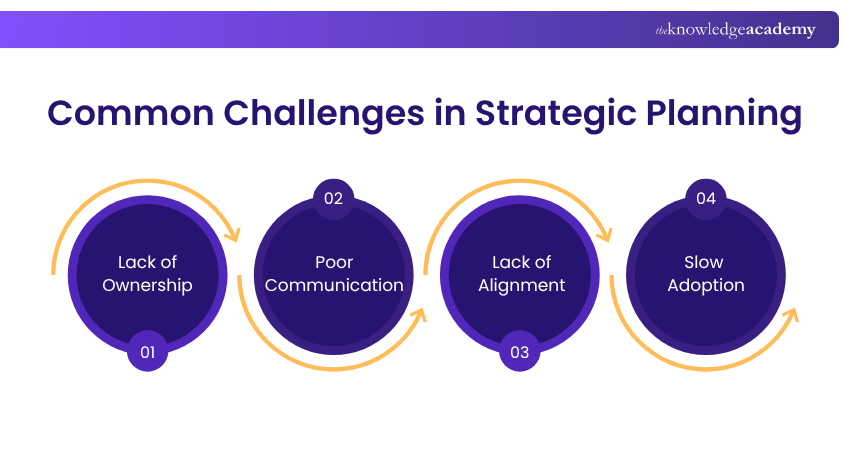
1) Lack of Ownership
A clear owner is essential to drive strategy execution and ensure accountability. Without defined responsibility, plans can become disjointed and lack follow-through. Assigning ownership helps maintain focus and commitment to strategic goals.
2) Poor Communication
Effective communication is critical for collaboration and successful planning. Without clear information sharing, teams may struggle to contribute or understand priorities. This can lead to confusion, misaligned efforts, and weak execution.
3) Lack of Alignment
Strategic plans require alignment across teams and leadership to be effective. Without input and agreement from different parts of the organisation, strategies can become fragmented. This reduces overall impact and weakens execution.
4) Slow Adoption
Even strong strategies can fail if they are not implemented quickly. Delays in adoption can make plans outdated in fast-changing environments. Ensuring timely execution helps keep strategies relevant and actionable.
Conclusion
Strategic Planning enables organisations to set clear direction, align resources, and respond effectively to change. Understanding What Is Strategic Planning helps businesses overcome challenges and apply the right frameworks for success. With the right approach, it supports consistent growth and long-term value creation.
Learn techniques for prioritising tasks with our Time Management Training – Sign up today!
Frequently Asked Questions
What are the 3 Ideas of Strategic Planning?

During the development phase of Strategic Planning, organisations typically adopt one of three approaches. A business growth strategy focuses on expansion and innovation, a stability strategy maintains current performance levels, while a retrenchment strategy aims to reduce costs and restructure operations for sustainability.
What are the Pillars of Strategy?
A successful Strategic Planning process rests on three essential pillars. Strategy planning establishes clear goals and direction; strategy execution ensures effective implementation across all levels. Strategy evaluation measures outcomes to refine future plans and drive continuous improvement.
What are the Other Resources and Offers Provided by The Knowledge Academy?
The Knowledge Academy takes global learning to new heights, offering over 3,000+ online courses across 490+ locations in 190+ countries. This expansive reach ensures accessibility and convenience for learners worldwide.
Alongside our diverse Online Course Catalogue, encompassing 17 major categories, we go the extra mile by providing a plethora of free educational Online Resources like Blogs, eBooks, Interview Questions and Videos. Tailoring learning experiences further, professionals can unlock greater value through a wide range of special discounts, seasonal deals, and Exclusive Offers.
What is The Knowledge Pass, and How Does it Work?
The Knowledge Academy’s Knowledge Pass, a prepaid voucher, adds another layer of flexibility, allowing course bookings over a 12-month period. Join us on a journey where education knows no bounds.
What are the Related Courses and Blogs Provided by The Knowledge Academy?
The Knowledge Academy offers various Personal Development Courses, including the Attention Management Training, Active Listening Training, and Supervisor Training. These courses cater to different skill levels, providing comprehensive insights into Becoming Smarter.
Our Business Skills Blogs cover a range of topics related to Strategic Planning, offering valuable resources, best practices, and industry insights. Whether you are a beginner or looking to advance your Analytical Thinking skills, The Knowledge Academy's diverse courses and informative blogs have got you covered.

Charlotte Wilson


Soft Skills and Business Training Manager
Charlotte Wilson is an expert in soft skills development, with over 14 years of experience helping individuals and teams improve communication, productivity and emotional intelligence in the workplace. Her training content is focused on enhancing interpersonal effectiveness and fostering positive, collaborative environments across all levels of an organisation.
View Detail
Upcoming Business Skills Resources Batches & Dates
Date
 Strategic Planning and Thinking Course
Strategic Planning and Thinking Course
Fri 18th Sep 2026
Strategic Planning and Thinking Course
Fri 4th Dec 2026

 If you wish to make any changes to your course, please


