


 Top Rated Course

We may not have the course you’re looking for. If you enquire or give us a call on +32 35001305 and speak to our training experts, we may still be able to help with your training requirements.
What is Agile Release Train (ART): Principles, Roles and Benefits
Sophia Ellis 26 February 2026An Agile Release Train (ART) aligns multiple Agile teams to deliver value predictably in SAFe, working in Programme Increments with cross-functional expertise. It provides collaboration across roles, reduces dependencies, and enables faster delivery. Ultimately, you can achieve scalability, transparency, and customer-centric outcomes.

Training Outcomes Within Your Budget!
We ensure quality, budget-alignment, and timely delivery by our expert instructors.
Table of Contents

Turning ideas into working software requires both structure and adaptability. That’s why Agile methodologies have become the standard for managing projects. But what happens when you need to scale up these Agile practices for larger organisations and more complex projects? This is where the concept of the Agile Release Train (ART) comes into play.
An Agile Release Train (ART) is a crucial concept in the Scaled Agile Framework, involving a structured, organised, and efficient team of Agile teams. In this blog, we'll discuss What is an Agile Release Train and break down the key elements of an ART, its roles, its characteristics, and the benefits it brings to the table. So read on and master the art behind ART!
Table of Contents
1) What is an Agile Release Train?
2) Principles of Agile Release Train (ART)
3) Agile Release Train (ART) Responsibilities
4) Roles of Agile Release Train
5) Characteristics of Agile Release Train (ART)
6) Benefits of Implementing an Agile Release Train
7) What’s the Difference Between an ART and a Scrum Team?
8) What is the Difference Between Release and Sprint in Agile?
9) Conclusion
What is an Agile Release Train?
An Agile Release Train (ART) is a long-lived, multiple virtual Agile teams that collaboratively build, develop, and deliver continuous value on a long scale. It is a key component of the Scaled Agile Framework (SAFe). Each ART typically consists of five to 12 cross-functional teams like Developers, Testers, UX Designers, and Business Analysts, aligned to a shared mission and value stream.
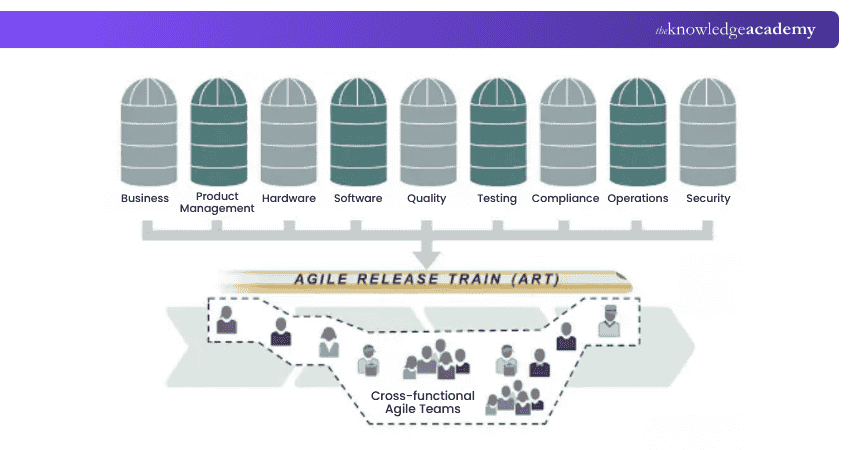
Operating within a value stream, an ART works through fixed timeframes known as Programme Increments (PIs). During each PI, teams collaboratively plan and review progress for alignment and predictability. Even more, ART enhances the reliable delivery of customer value across large-scale Agile environments.

Principles of Agile Release Train (ART)
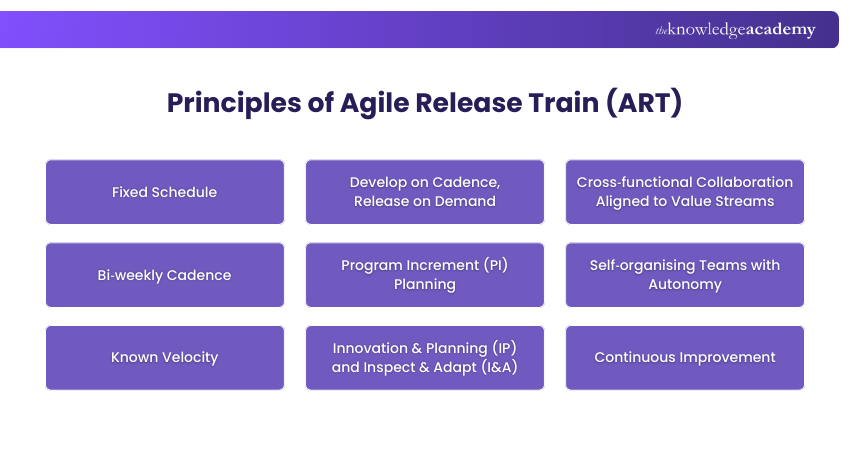
The principles provide a clear framework for synchronising efforts, reducing dependencies, and keeping the entire organisation moving in the same direction. By understanding and applying these principles, businesses can achieve faster delivery cycles, stronger collaboration, and greater adaptability. Here are the key principles:
1) Fixed Schedule
Every ART follows a set timetable called a Programme Increment (PI), usually lasting eight to 12 weeks. This cycle keeps multiple Agile teams working in sync, providing a predictable delivery rhythm that stakeholders can rely on. The fixed schedule reduces uncertainty and makes planning more effective at the portfolio level.
2) Bi‑weekly Cadence
Within each PI, work progresses in short, two‑week sprints. At the end of each sprint, teams contribute to an integrated system increment. This ensures frequent visibility of progress, early detection of issues, and continuous stakeholder feedback.
3) Known Velocity
ART teams estimate their capacity based on historical performance data, creating a known velocity. This predictable pace allows realistic workload planning for each PI and helps avoid overcommitment while maintaining steady, sustainable delivery.
4) Develop on Cadence, Release on Demand
Development follows the fixed PI schedule, but releases can happen whenever features are ready. This flexibility means business owners can bring value to market at the optimal time without waiting for the end of a PI, improving responsiveness to market changes.
5) Programme Increment (PI) Planning
PI Planning is a cornerstone event where all ART members typically 50 to 125 people, collaborate to align objectives, prioritise the backlog, and identify dependencies. This shared understanding ensures everyone is working toward the same vision and goals for the upcoming PI.
6) Innovation & Planning (IP) and Inspect & Adapt (I&A)
At the end of each PI, the ART dedicates time to the Innovation & Planning iteration. This allows for learning, experimentation, technical debt reduction, and preparing for the next PI. The Inspect & Adapt workshop then reviews the PI results, addresses problems, and implements process improvements.
7) Cross‑functional Collaboration Aligned to Value Streams
An ART unites multiple Agile teams from different disciplines development, Quality Assurance (QA), User Experience (UX), and Business Analysis into a single value‑aligned unit. This eliminates silos and ensures every team’s efforts contribute directly to delivering business value within the same value stream.
8) Self‑organising Teams With Autonomy
Teams within the ART have the autonomy to decide how best to achieve their objectives while staying aligned with the overall train’s goals. This autonomy fosters innovation, speeds up problem-solving, and reduces bottlenecks caused by excessive approvals.
9) Continuous Improvement
ARTs embed feedback loops through system demos, retrospectives, and metrics tracking. Lessons learned are immediately applied in future PIs, creating a culture of ongoing improvement and adaptability, which is essential for long-term business agility.
Boost your Agile knowledge - Start learning today with Agile for Teams Training for a more adaptive future!
Agile Release Train (ART) Responsibilities
An Agile Release Train (ART) in the context of the Scaled Agile Framework (SAFe) has several key responsibilities to ensure the successful delivery of value in a large-scale Agile environment. These responsibilities include:
1) Delivering Value: The primary responsibility of an ART is to deliver value to customers and stakeholders. This involves the regular delivery of working, tested and potentially shippable solutions. The ART works collaboratively to achieve this goal.
2) PI Planning: The ART participates in Programme Increment (PI) planning, a critical event that occurs at the start of each PI. During PI planning, the ART aligns priorities, identifies features and stories to be delivered, and establishes a plan for the upcoming PI.
3) Inspect and Adapt (I&A): The ART conducts regular Inspect and Adapt (I&A) workshops at the end of each Programme Increment. During I&A, the ART reviews the PI's accomplishments, identifies areas for improvement, and adapts their plans and practices accordingly. This continuous improvement process is vital for optimising performance.
4) Alignment: Ensuring alignment with the organisation's strategic objectives and portfolio priorities is a key responsibility of the ART. This involves regularly reviewing the organisation's strategy and making sure that the work being performed on the ART is aligned with these strategic goals.
5) Dependency Management: Managing dependencies among teams and between features is a critical responsibility of the ART. This includes identifying and addressing cross-team dependencies, ensuring that dependencies do not impede progress, and taking steps to resolve or minimise them.
6) Backlog Refinement: The ART actively participates in backlog refinement sessions to ensure that the backlog contains well-defined, prioritised features and stories. This helps the teams plan their work effectively and maintain a constant flow of work.
7) Collaboration: Promoting collaboration and a sense of shared purpose among the Agile teams within the ART is crucial. Teams should work together closely, share knowledge, and help each other to ensure the success of the entire ART.
8) Problem-solving: Teams on the ART should be encouraged and empowered to address issues and solve problems as they arise. This includes resolving impediments, improving processes, and finding innovative solutions to challenges.
9) Customer Focus: Maintaining a strong customer focus is essential. The ART should continuously engage with customers and stakeholders to understand their needs and gather feedback to guide the development of solutions.
10) Economic Prioritisation: The ART should prioritise work based on economic considerations. This means that they should focus on high-value items, considering both the cost and the potential benefits of delivering specific features or capabilities.
11) Transparency and Reporting: The ART should maintain transparency in all its activities. This includes providing visibility into the progress, impediments, and performance metrics to stakeholders and leadership.
Unlock the power of Agile Product Management with our SAFe® Agile Product Management Training!
Roles of Agile Release Train
An Agile Release Train (ART) brings together multiple Agile teams, each playing a vital role in delivering value efficiently and predictably. In the Scaled Agile Framework (SAFe), these roles ensure alignment, collaboration, and smooth execution.
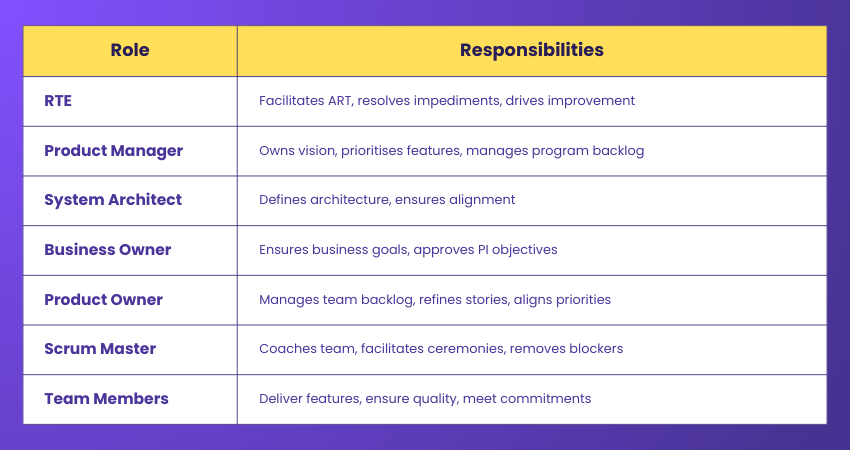
1) Release Train Engineer (RTE): They serve as the ART’s servant leader and facilitator, managing execution and resolving impediments.
2) Product Manager: They own the product vision and strategy, prioritises the features and manages the programme backlog at the ART level.
3) System Architect: They define and maintain the technical and architectural vision, thus ensuring system-wide alignment.
4) Business Owner: They are the executive stakeholder who ensures business objectives are met and also approves PI objectives.
5) Product Owner: They manage the team backlog, refine user stories and align team priorities with the ART’s goals.
6) Scrum Master: They coach teams, facilitates Agile ceremonies and removes blockers.
7) Team Members (Developers & Testers): Deliver features, ensure quality, identify dependencies, and meet PI commitments.
Characteristics of Agile Release Train (ART)
An Agile Release Train in the context of the Scaled Agile Framework (SAFe) exhibits several characteristics that distinguish it from traditional Project or Programme Management. These characteristics are essential for ensuring the coordinated delivery of value. Here are the main characteristics::
1) Cross-functional Teams: ARTs consist of multiple Agile teams. Each offers a diverse set of skills necessary to develop, test and deliver a complete solution. These teams are self-organising and cross-functional, which reduces the need for handoffs and dependencies.
2) Programme Increment (PI): ARTs operate within fixed, time-boxed Programme Increments, which typically lasts for eight to 12 weeks. This regular cadence provides a predictable rhythm for planning, execution and inspecton of the work.
3) PI Planning: PI planning is a significant event in the ART. It's a face-to-face meeting where all the teams come together to plan and prioritise the work for the upcoming Programme Increment. This ceremony helps ensures the commitment to common objectives.
4) Value Stream or Solution-centric: ARTs are organised around a specific value stream or a solution. This means that the teams within the ART work together to deliver features and user stories that contribute to a coherent solution that addresses customer needs.
5) Inspect and Adapt (I&A): This continuous improvement process is vital for optimising team performance. During this event, teams review their work, identify areas for improvement and adapt their plans for the next PI.
6) Alignment With Strategic Objectives: ARTs align with the organisation's strategic objectives and portfolio priorities. This ensures that the work being done on the ART directly supports the organisation's overarching goals.
7) Release on Demand: ARTs keep focus on the ability to release value to customers on demand. This involves having a well-orchestrated Continuous Delivery Pipeline which ensures that the solution is always in a release-ready state.
8) Collaboration and Transparency: Collaboration and transparency are two of the biggest characteristics of ARTs. Teams work closely together, communicate more openly and share information to avoid misunderstandings and encourage shared goals.
Gain AgilePM® expertise and drive project success. Join our Agile Project Management Practitioner (AgilePM®) Course today!
Benefits of Implementing an Agile Release Train
Implementing an Agile Release Train (ART) offers organisations several important advantages that improve delivery, collaboration, and business agility.
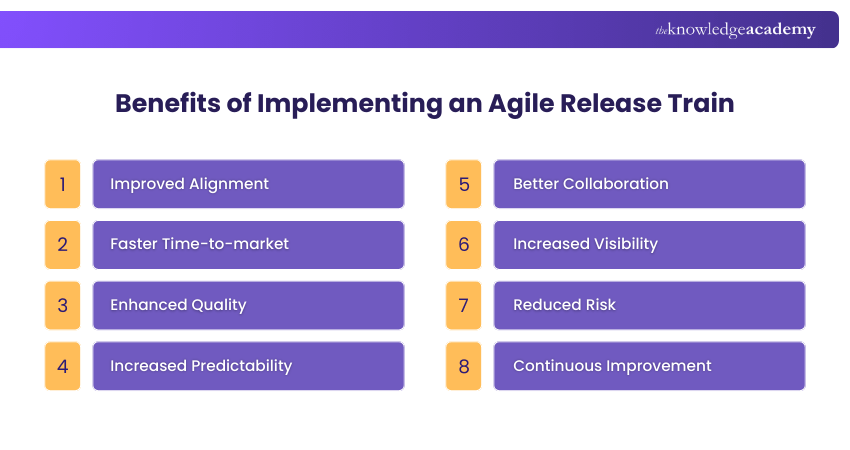
1) Improved Alignment: ART ensures that all the teams work toward a shared objectives. This helps in reducing waste and increasing efficiency.
2) Faster Time-to-market: ART delivers products and features more quickly through regular, time‑boxed increments. This creates a strong competitive edge.
3) Enhanced Quality: ART uses continuous integration, frequent demos and feedback loops to improve the quality of products.
4) Increased Predictability: The fixed Programme Increment (PI) schedules provide stakeholders with crystal clear timelines.
5) Better Collaboration: ART encourages strong cross‑team communication and coordination, especially when it comes to managing dependencies.
6) Increased Visibility: ART offers transparent progress tracking so that the stakeholders can make better informed decisions.
7) Reduced Risk: The structured planning and regular review cycles in ART help mitigate the risks of project failure.
8) Continuous Improvement: The retrospectives and Inspect & Adapt (I&A) events in ART drive ongoing process and outcome enhancements.
Discover our Agile Programme Management (AgilePgM®) Training - Empower your career with proven methods and strategies!
What's the Difference Between an ART and a Scrum Team?
An Agile Release Trainis a long‑lived team of multiple Agile teams. Each team usually has 50 to 125 people working together to deliver value at scale in SAFe. On the other hand, the Scrum team is a small, cross‑functional group (typically five to nine members) that’s focused on delivering work within short sprints.
What is the Difference Between Release and Sprint in Agile?
A sprint is a short, fixed‑length iteration (usually one to four weeks) where teams complete planned work. Whereas a release is the delivery of a product or feature to end‑users, which can occur after one or several sprints depending on readiness and business needs.
Conclusion
The Agile Release Train (ART) is the driving force behind large-scale Agile delivery, bringing structure, collaboration, and shared values across multiple teams. Being aware of What is an Agile Release Train helps align strategy, execution, and continuous improvement, thereby aiding organisations to scale Agile successfully. Embracing this approach ensures faster delivery and sustainable growth across projects.
Ensure continuous value delivery across your organisation with our Certified SAFe® for Teams Training – Explore now!
Frequently Asked Questions
What is the Difference Between ART and PI?

An Agile Release Train (ART) is a long‑lived team of multiple Agile teams working together to deliver value at scale in SAFe. A Programme Increment (PI) is a time‑boxed planning and execution cycle, usually eight to 12 weeks, during which the ART delivers incremental value.
How Many Sprints are in One Release?
The number of sprints in a release depends on the project and framework used. In SAFe, a Programme Increment (release cycle) typically contains four to six two‑week sprints plus an innovation and planning iteration, while in Scrum, a release can happen after any sprint if the product is ready.
What are the Other Resources and Offers Provided by The Knowledge Academy?
The Knowledge Academy takes global learning to new heights, offering over 3,000+ online courses across 490+ locations in 190+ countries. This expansive reach ensures accessibility and convenience for learners worldwide.
Alongside our diverse Online Course Catalogue, encompassing 17 major categories, we go the extra mile by providing a plethora of free educational Online Resources like Blogs, eBooks, Interview Questions and Videos. Tailoring learning experiences further, professionals can unlock greater value through a wide range of special discounts, seasonal deals, and Exclusive Offers.
What is The Knowledge Pass, and How Does it Work?
The Knowledge Academy’s Knowledge Pass, a prepaid voucher, adds another layer of flexibility, allowing course bookings over a 12-month period. Join us on a journey where education knows no bounds.
What are the Related Courses and Blogs Provided by The Knowledge Academy?
The Knowledge Academy offers various Agile Training, including the Agile Change Agent Course, Agile User Stories Course and the Agile Project Management Foundation (AgilePM® V3) Course. These courses cater to different skill levels, providing comprehensive insights into Agile Project Management.
Our Project Management Blogs cover a range of topics related to Agile Release Train, offering valuable resources, best practices, and industry insights. Whether you are a beginner or looking to advance your Agile skills, The Knowledge Academy's diverse courses and informative blogs have got you covered.
Upcoming Project Management Resources Batches & Dates
Date
 AgilePM® Foundation & Practitioner (AgilePM® v2)

 If you wish to make any changes to your course, please


