


 Top Rated Course


We may not have the course you’re looking for. If you enquire or give us a call on +1 7204454674 and speak to our training experts, we may still be able to help with your training requirements.
Simulated Annealing: Process, Benefits and Applications
Richard Harris 03 February 2026Curious about smart problem-solving techniques? Simulated Annealing is a powerful optimisation algorithm used to find near-optimal solutions in complex search spaces. Learn how it works with examples and discover how this method mimics the cooling of metals to solve tough computational problems efficiently.

Training Outcomes Within Your Budget!
We ensure quality, budget-alignment, and timely delivery by our expert instructors.
Table of Contents

In this blog, we’ll dive deep into how Simulated Annealing (SA) works, its algorithmic steps, real-world applications, and why it stands out in the world of optimisation. Whether you’re tackling logistics, machine learning, or scheduling challenges, understanding SA can unlock new levels of efficiency and Problem-Solving power. Let’s explore how heating things up can help us cool down to the best possible solutions!
Table of Contents
1) What is Simulated Annealing?
2) How Does Simulated Annealing Work?
3) Simulated Annealing Algorithm
4) Example Simulated Annealing
5) Benefits of Simulated Annealing
6) Limitations of Simulated Annealing
7) Applications of Simulated Annealing
8) Simulated Annealing vs Other Optimisation Algorithms
9) What is the Cooling Schedule in Simulated Annealing?
10) Conclusion
What is Simulated Annealing?
Simulated Annealing is a powerful optimisation algorithm used to find near-optimal solutions in complex search spaces. It is inspired by the annealing process in metallurgy, where metal is heated and then slowly cooled to remove defects and achieve a stable structure. The algorithm starts with a high level of randomness to explore a wide range of possibilities.
Over time, this randomness gradually reduced, allowing the algorithm to focus on refining and improving the solution. This method is particularly useful in escaping local minima, making it well suited for solving challenging combinatorial problems where traditional techniques may struggle.

How Does Simulated Annealing Work?
Simulated Annealing begins with an initial solution and a high temperature, which slowly decreases according to a cooling schedule. As the temperature lowers, the algorithm becomes less likely to accept worse solutions, allowing it to focus on refining the best candidates. The process continues until a stopping condition is met, such as reaching a minimum temperature or completing a set number of iterations.
Initialisation
The algorithm starts with an initial solution and an initial temperature. The temperature plays a key role in determining how likely it is to accept poorer solutions early on, helping the search escape local optima.
Neighborhood Search
At each iteration, a new candidate solution is created by slightly modifying the current one. This small change is known as a perturbation, and it helps the algorithm explore nearby possibilities in the solution space.
Objective Function Evaluation
The new solution is then evaluated using an objective function. If the new solution performs better than the current one, it replaces it as the current solution.
Acceptance Probability
If the new solution is worse, it can still be accepted with a certain probability. This probability is based on the difference in performance and the current temperature, allowing the algorithm to occasionally accept worse solutions and avoid becoming stuck in local optima.
Join our Python Course and master the skills to build powerful applications. Start your journey today!
Simulated Annealing Algorithm
Simulated Annealing follows a structured yet flexible approach. Let’s break it down into steps:
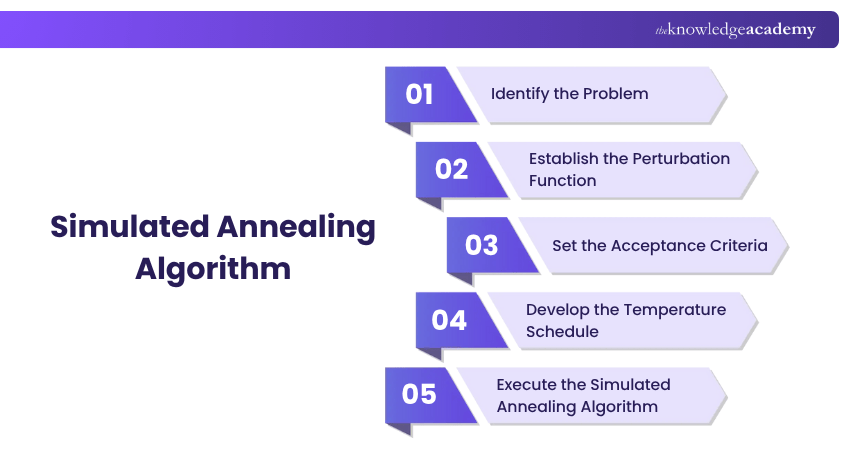
1) Identify the Problem
Before diving in, you need to define what you're optimising. Whether it's finding the shortest route for a delivery truck, arranging schedules efficiently, or designing the most aerodynamic car, you must clarify the objective function—what determines a "good" solution.
Imagine a city planner optimising traffic flow. The goal is clear: Minimise congestion and travel time. This becomes the function SA aims to optimise.
2) Establish the Perturbation Function
Once the problem is defined, we need a way to make small changes to a given solution. These changes are called perturbations.
For example, in a travelling salesperson problem (TSP), where the goal is to find the shortest route between multiple cities—a perturbation could be swapping the order of two cities in the route.
Choosing the right perturbation function is crucial; it should make meaningful adjustments without completely overhauling the solution each time.
3) Set the Acceptance Criteria
Here’s where SA gets interesting. Unlike traditional algorithms that only accept better solutions, SA sometimes accepts worse solutions to avoid getting trapped in local optima. The probability of accepting a worse solution is based on the following equation:
Where:
a) Is the change in the objective function (how much worse the new solution is)
b) Is the current temperature
c) is Euler’s number (around 2.718)
When the temperature is high, worse solutions are more likely to be accepted. As the temperature decreases, the algorithm becomes more selective.
4) Develop the Temperature Schedule
Just like real Annealing, the cooling process must be gradual. The temperature schedule determines how quickly we cool down. A simple cooling function is:
Where (typically between 0.8 and 0.99) controls the cooling rate.
If the temperature drops too fast, the algorithm might get stuck in a bad solution. If it cools too slowly, it might take forever to find the best solution.
5) Execute the Simulated Annealing Algorithm
Once all components are in place, the algorithm runs iteratively:
1) Start with an initial solution and temperature.
2) Make a small perturbation.
3) Evaluate the new solution.
4) Secide whether to accept it based on the acceptance criteria.
5) Reduce the temperature.
6) Repeat until the temperature reaches near zero or no further improvements occur.
At the end of this process, we (hopefully) have an optimised solution!
Build dynamic websites with our PHP Course- Join Now!
Example Simulated Annealing
Let’s take a simple example: Optimising Warehouse Layout.
Imagine a warehouse manager trying to minimise the time workers take to pick and pack orders. The manager initially arranges items randomly but uses Simulated Annealing to improve the layout.
1) Start with a random layout.
2) Swap the positions of two frequently picked items.
3) Evaluate if it reduces total walking time.
4) If it's better, accept the change; if it's worse, accept it with some probability.
5) Gradually reduce temperature and refine changes.
6) Eventually, we reached an optimal arrangement.
This method has been applied in Logistics, urban planning, and even sports scheduling!
Benefits of Simulated Annealing
Why should you consider using SA? Here are some of its strengths:
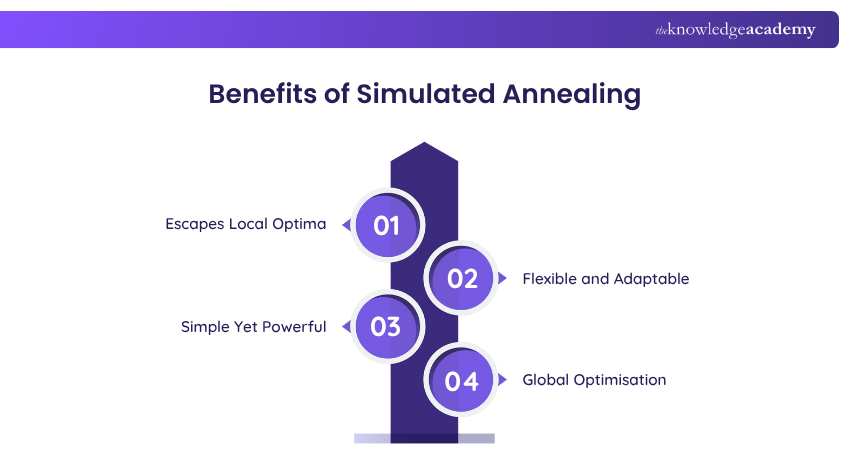
a) Escapes Local Optima
Unlike greedy algorithms, which may settle for a nearby peak, SA explores a broader solution space, ensuring better optimisation.
b) Flexible and Adaptable
SA can be applied to a wide range of problems—logistics, finance, Artificial Intelligence, and more. If there’s an optimisation problem, SA might help.
c) Simple Yet Powerful
Despite its theoretical complexity, SA is easy to implement. With just a few lines of code, you can run SA on various problems.
Global Optimisation
With the right cooling schedule, Simulated Annealing can converge towards a global optimum. This makes it suitable for problems where traditional methods struggle to escape suboptimal solutions.
Create seamless UIs with React elements - Sign up for our ReactJS Course Now!
Limitations of Simulated Annealing
However, SA isn’t perfect. Here are some drawbacks:
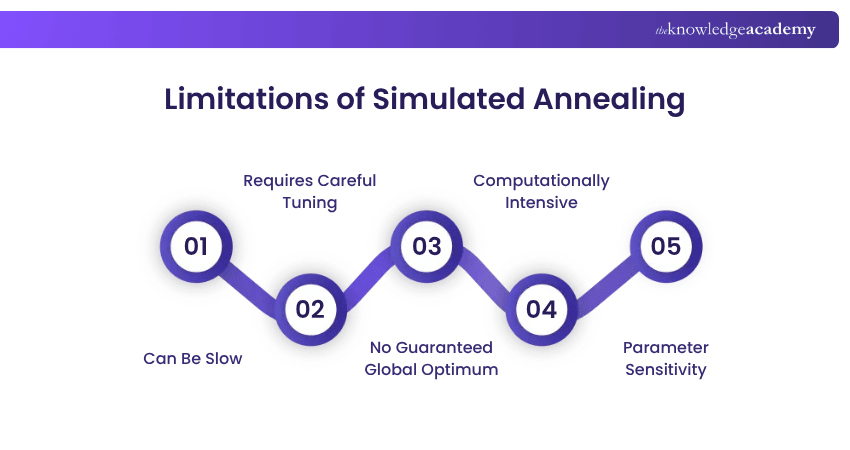
Can Be Slow
Simulated Annealing can take a long time to find a good solution, especially if the cooling schedule is slow. This may be a drawback for problems where quick results are essential.
Requires Careful Tuning
The effectiveness of the algorithm depends heavily on parameters like the initial temperature, cooling rate, and number of iterations. Poor tuning can lead to subpar results or unnecessary computation.
No Guaranteed Global Optimum
Although it can get close to the global optimum, Simulated Annealing does not guarantee it. The final outcome depends on the cooling schedule and the randomness introduced during the search.
Computationally Intensive
The algorithm may perform a large number of iterations, especially on complex problems. This can lead to high computational costs, making it less suitable for time-sensitive applications.
Parameter Sensitivity
Simulated Annealing is sensitive to the choice of parameters. Small changes in settings can significantly affect performance, which may require extensive experimentation to optimise.
Level up your career with Swift Training - Join now!
Applications of Simulated Annealing
Simulated Annealing is applied in many fields due to its effectiveness in solving complex optimisation problems. In operations research, it is used to address the Travelling Salesman Problem by finding near-optimal routes that minimise travel distance. In electronic design automation, it helps in VLSI design by optimising the layout of circuit components to reduce area and signal delay. Its flexibility also makes it valuable in scheduling applications, such as job and resource allocation.
In machine learning, Simulated Annealing is used for hyperparameter tuning, especially when dealing with large and irregular search spaces. It also finds use in computational biology, where it aids in predicting protein folding patterns by minimising the energy state of molecular conformations, helping researchers understand biological processes more accurately.
Simulated Annealing vs Other Optimisation Algorithms
Simulated Annealing is one of many techniques used to tackle optimisation problems. To understand its strengths and limitations, it helps to compare it with other widely used algorithms.
Simulated vs Genetic Algorithm
Simulated Annealing uses a single evolving solution, while Genetic Algorithms work with multiple solutions. SA is simpler and faster for smaller problems, whereas GAs offer better exploration and perform well on large, complex optimisation landscapes.
Simulated vs Gradient Descent
Simulated Annealing escapes local minima by accepting worse solutions, making it suitable for non-convex problems. Gradient Descent is faster on smooth functions but can get stuck in local optima due to its strict downhill search behaviour.
What is the Cooling Schedule in Simulated Annealing?
The cooling schedule in Simulated Annealing determines how temperature decreases over time. It controls the balance between exploration and refinement. Common schedules include linear, exponential, and logarithmic. A well-tuned schedule improves solution quality, while a poor one may lead to premature convergence or inefficient computation.
Enhance your skills in handling Big Data with our MapReduce Training, Sign up Now!
Conclusion
Simulated Annealing is a versatile optimisation technique inspired by nature's quest for stability. It's widely used across industries, from logistics to AI, for its ability to escape local optima and solve complex problems. While not always the fastest, its effectiveness makes it a key tool in optimisation. So, when faced with a tricky problem, think like a metalworker: heat things up, explore possibilities, and cool down to a refined solution!
Learn all about Programming in D with our course in D Programming Language Training - join today!
Frequently Asked Questions
Is Simulated Annealing multi-objective?

Simulated Annealing is primarily a single-objective optimisation technique. However, it can be adapted for multi-objective problems using approaches like weighted aggregation, Pareto dominance, or multiple runs with different parameters.
How is Simulated Annealing Different From Hill Climbing?
Simulated Annealing differs from Hill Climbing by allowing occasional acceptance of worse solutions. This helps it escape local optima, whereas Hill Climbing only accepts better moves, making it more likely to get stuck in suboptimal solutions.
What are the Other Resources and Offers Provided by The Knowledge Academy?
The Knowledge Academy takes global learning to new heights, offering over 3,000+ online courses across 490+ locations in 190+ countries. This expansive reach ensures accessibility and convenience for learners worldwide.
Alongside our diverse Online Course Catalogue, encompassing 19 major categories, we go the extra mile by providing a plethora of free educational Online Resources like Blogs, eBooks, Interview Questions and Videos. Tailoring learning experiences further, professionals can unlock greater value through a wide range of special discounts, seasonal deals, and Exclusive Offers.
What is The Knowledge Pass, and How Does it Work?
The Knowledge Academy’s Knowledge Pass, a prepaid voucher, adds another layer of flexibility, allowing course bookings over a 12-month period. Join us on a journey where education knows no bounds.
What are the Related Courses and Blogs Provided by The Knowledge Academy?
The Knowledge Academy offers various Programming Training, including the Python Course, PHP Course, and ReactJS Course. These courses cater to different skill levels, providing comprehensive insights into Programming Languages.
Our Programming & DevOps Blogs cover a range of topics, offering valuable resources, best practices, and industry insights. Whether you are a beginner or looking to advance your Programming skills, The Knowledge Academy's diverse courses and informative blogs have got you covered.

Richard Harris


Senior Full Stack Developer and Technology Educator
Richard Harris is a highly experienced full-stack developer with deep expertise in both frontend and backend technologies. Over his 12-year career, he has built scalable web applications for startups, enterprises and government organisations. Richard’s writing combines technical depth with clear explanations, ideal for developers looking to grow in modern frameworks and tools.


 If you wish to make any changes to your course, please


