


 Top Rated Course


We may not have the course you’re looking for. If you enquire or give us a call on +1 7204454674 and speak to our training experts, we may still be able to help with your training requirements.
Data Science Vs Statistics: Understanding the Differences
Sophia Ellis 25 February 2026Statistics is a field of Mathematics that collects and interprets quantitative data, and Data Science employs modern methods to extract knowledge from vast data sets. This blog explores the key distinctions between Data Science Vs Statistics, including their industry applications, toolsets, and data collection approach. Read on!

Training Outcomes Within Your Budget!
We ensure quality, budget-alignment, and timely delivery by our expert instructors.
Table of Contents

Have you ever wondered if Data Science and Statistics are two sides of the same coin? Well, the answer to the Data Science Vs Statistics debate is a little more complicated. While both fields are rooted in the art of decoding data, their goals and approaches can differ substantially. Data Science is the cutting-edge blend of Coding, Machine Learning, and Big Data, while Statistics is the classic foundation of Data Analysis and mathematical rigour.
If you're facing any indecision regarding choosing among these two, then this blog is here to guide you. It explores the unique points of focus, roles, toolsets, real-world applications and more in this exciting Data Science Vs Statistics debate. So read on and learn how these fields shape the modern data-driven world!
Table of Contents
1) What is Data Science?
2) What are Statistics?
3) Objectives and goals of Data Science
4) Objectives and goals of Statistics
5) Key differences between Data Science vs Statistics
6) Which is Better: Data Science or Statistics?
7) Is There a Lot of Math in Data Science and Statistics?
8) Can I Become a Data Scientist With a Statistics Degree?
9) Conclusion
What is Data Science?
Data Science is an interdisciplinary field that blends various techniques and processes to extract knowledge and insights from structured and unstructured data. It encompasses;
a) Data collection
b) Data cleaning
c) Data Analysis
d) Data interpretation
It often employs advanced tools and algorithms for predictive modelling. It helps to uncover patterns, trends, and valuable information from data.
What is Statistics?
Statistics, on the other hand, is a branch of Mathematics that focuses on
a) Gathering data
b) Organising data
c) Analysing data
d) Interpreting data
e) Presenting data.
It is integral to scientific research and has been widely used in diverse fields for centuries. Statistics has been used for hypothesis testing, sample analysis, and drawing conclusions from data.

Objectives and Goals of Data Science
Discussed below are the objectives and goals of Data Science in the contemporary world.
a) Data-driven Decision-making: Data Science is instrumental in facilitating data-driven decision-making across various industries. It enables businesses to make informed choices by providing insights and evidence based on Data Analysis.
b) Optimising Processes: Data Science plays a crucial role in optimising processes. For example, in manufacturing, it can be used to improve production efficiency, reduce waste, and enhance product quality by analysing data from sensors and machines.
c) Personalisation: Data Science is crucial in customising customer experiences. For instance, online merchants utilise data to propose products to customers by analysing their past behaviour and preferences. This not only enhances customer satisfaction but also leads to a growth in sales.
d) Identifying and Preventing Fraud: Data Science is employed to detect and prevent fraudulent activities. In the financial sector, it helps identify suspicious transactions by analysing patterns and anomalies, ultimately safeguarding against fraud.
e) Healthcare and Medical Insights: Data Science is used to analyse medical data, such as patient records and medical imaging, to assist in diagnosing diseases, predicting patient outcomes, and improving healthcare practices.
f) Customer Insights: Data Science helps businesses get knowledge about customer behaviour and preferences, enabling them to tailor marketing strategies, product development, and customer service.
g) Cost Reduction: Data Science can lead to cost reduction by optimising processes, reducing waste, and preventing errors. This is particularly important in manufacturing and supply chain management.
Objectives and Goals of Statistics
Here, we discuss the objectives and goals of Statistics
a) Uncertainty Analysis: Statistics quantifies uncertainty. It provides methods for calculating Confidence intervals, which delivers a range of values within which a parameter is likely to fall. This helps decision-makers evaluates the level of confidence in their estimates.
b) Relationship Analysis: Statistics explores relationships between variables, including techniques like correlation analysis to determine how two variables are related and regression analysis to model dependencies. One such method, Spearman’s Rank Correlation, is particularly useful for measuring the strength and direction of a monotonic relationship between ranked variables.

c) Quality Control: In industrial settings, Statistics is employed for quality control. It helps ensure that products meet predefined quality standards and identifies deviations from those standards.
d) Data Reduction: Statistics plays a role in reducing the complexity of data. Through techniques like principal component analysis and factor analysis, it condenses data into a smaller set of variables while preserving its essential information.
e) Research and Experimentation: Statistics is a fundamental tool for researchers conducting experiments. It helps design experiments, analyse results, and draw meaningful conclusions, making it essential in fields such as medical research and social sciences.
f) Public Policy and Decision-making: Governments and policymakers use Statistics to inform their decisions. For example, census data is analysed to allocate resources, plan infrastructure, and determine social policies.
g) Financial Analysis: In finance, Statistics is employed for risk assessment, portfolio optimisation, and asset valuation. It helps investors and financial institutions make informed decisions.
Take the next step in mastering Predictive Analytics with our Predictive Analytics Training! Sign up now!
Key Differences Between Data Science vs Statistics
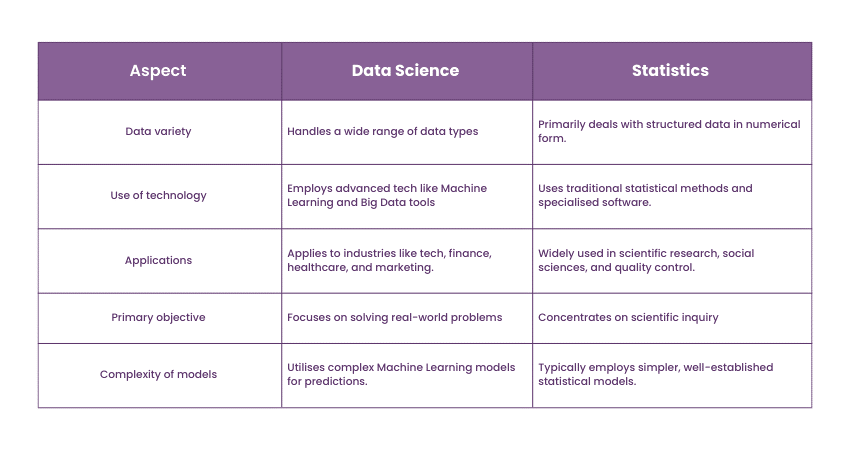
As mentioned above, Data Science and Statistics share similarities but differ in focus and application. Let's explore the main distinctions between these two Data Analysis fields, ranging from their data types to their industry applications:
Scope and Focus
Data Science is highly adaptable and often deals with vast and complex datasets, including unstructured data like text, images, and audio. The emphasis in Data Science is on
a) Solving real-world problems
b) Building predictive models
c) Enhancing data-driven decision-making.
Statistics has a narrower focus. It primarily deals with structured data and is focused on
a) Summarising data
b) Analysing data
c) Interpreting data
It places a strong emphasis on hypothesis testing and inferential Statistics to draw conclusions about populations based on sample data.
Data Types
Data Science deals with various data types, including structured and unstructured data. It can handle text, images, audio, and more. Data Scientists often work with Big Data, which may not conform to traditional statistical assumptions.
Statistics typically deals with structured numerical data. While it handles a variety of data types, its traditional application is in analysing numerical data. Statistical assumptions like normal distribution and independence may limit their applicability to some data types.
Dive into the data world - Master probability and Statistics by signing up for our Probability and Statistics for Data Science Training!
Tools and Techniques
Data Science uses diverse tools and techniques, including deep learning, data mining, and machine learning algorithms. Tools like Python, R, and data visualisation libraries are commonly used. Data Scientists often write code to create custom models and analyses.
Statistics uses classical statistical methods such as
a) T-tests
b) Chi-squared tests
c) Regression Analysis
Statistical software like SPSS, SAS, and STATA is frequently used. Statisticians typically apply well-established statistical tests and procedures.
Experimentation Vs Prediction
Data Science primarily leans towards prediction as a fundamental objective. It is a predictive model that is trained on historical data to make forecasts about future events or trends. This predictive aspect is instrumental in various fields such as e-commerce, the finance sector, the healthcare sector, etc.
Statistics, on the other hand, often emphasises experimentation and hypothesis testing. It is concerned with drawing conclusions from data based on the principles of statistical inference and Probability Distribution theory.
Take your data skills to the next level with our Advanced Data Science Certification Course! Register now!
Data Volume
Data Science frequently deals with large datasets, often referred to as "Big Data." It uses techniques to handle and process substantial volumes of data efficiently.
Statistics can work with both small and large datasets but is traditionally applied to smaller, carefully collected samples. The comparison between Big Data Vs Small Data is particularly relevant here, as this experimental aspect is fundamental in various research and analytical domains.
Model Complexity
Data Science often involves complex machine learning models and algorithms. Data Scientists may use deep neural networks, random forests, and other sophisticated techniques.
Statistics typically uses simpler models, such as linear regression and traditional statistical tests. The emphasis is on the interpretability of results and making assumptions explicit.
Data Collection Approach
Data Science often involves collecting data from a broad variety of sources, including social media, sensors, and user interactions. It may also deal with real-time data streaming and unstructured data. Data Scientists frequently work with "messy" data that requires extensive preprocessing.
Statistics typically involves collecting structured data through well-defined experiments, surveys, or sampling methods. Data collection in Statistics is more controlled and adheres to specific methodologies to ensure data quality and minimise biases.
Exploratory Vs Confirmatory
Data Science often adopts an exploratory approach. It explores data to uncover patterns and relationships without specific preconceived hypotheses. It embraces data exploration and feature engineering.
Statistics generally follows a confirmatory approach. It starts with well-defined hypotheses and aims to test these hypotheses using statistical tests. The focus is on hypothesis confirmation or rejection.
Interpretation and Communication
Data Science places significant emphasis on data visualisation and storytelling. Data Scientists use data visualisation tools to present their findings in an easily understandable and visually appealing manner. The ability to communicate complex results to non-technical stakeholders is essential.
While visualisation is important in Statistics, it typically involves more detailed statistical reports. Statisticians often write formal reports and academic papers to convey their results to a technical audience.
Career Roles and Titles
Data Science has given rise to various job roles, including Machine Learning Engineer, Data Scientist, and Data Analyst. These Data Science Roles often require skills in coding, machine learning, and data engineering.
Statisticians typically hold titles such as Statistician, Biostatistician, or Statistician Analyst. Their roles are more traditional and centred around Data Analysis and Statistical Modelling.
Toolsets
Data Scientists frequently utilize programming languages like Python and R Programming, along with machine learning libraries such as TensorFlow and scikit-learn. Additionally, they work with Big Data processing tools like Hadoop and Spark. How Difficult is R Programming in comparison to other languages? It depends on the user’s familiarity with statistical computing and data analysis concepts.
Statisticians rely on specialised statistical software packages like SPSS, SAS, and R for Data Analysis. These tools are designed to support traditional statistical methods.
Industry Application
Data Science finds applications in various industries, including tech, finance, healthcare, e-commerce, and marketing. It's used for tasks like recommendation systems, fraud detection, and natural language processing.
Statistics has long been applied in traditional fields such as
a) Scientific research
b) Government
c) Education
d) Social sciences
It is foundational in research and policy decision-making.
Unlock the world of data with the Statistics PDF. Download now to sharpen your statistical skills!
Which is Better: Data Science or Statistics?
The better among both can be stated depending on the context of usage, the specific work requirements, and goals. Data science is an interdisciplinary field primarily concerned with Big Data handling and predictive modelling. On the other hand, Statistics provides a combination of Statistics and Mathematics for inference and testing. Therefore, it's crucial to understand the following considerations before judging the right choice:
1) Scope of Analysis: Data science is appropriate for analysing and extracting insights from vast and complex datasets and allows the usage of advanced computational techniques. Meanwhile, Hypothesis Testing in Data Science is a suitable choice if the focus is on hypothesis testing, experimental design, and understanding the relationships within data.
2) Industry Applications: Industries such as finance, healthcare, and technology that deal with predictive modelling and machine learning leverage Data Science. Academics, traditional research disciplines, and Social Sciences need Statistics.
3) Skill Set: Data Scientist Skills involve Programming, Big Data technologies, and Machine Learning. Statisticians focus on mathematical rigour, statistical theory, and experimental design.
Is There a Lot of Math in Data Science and Statistics?
Yes, a significant amount of math is involved in Data Science and Statistics. Key mathematical concepts such as Linear Algebra, Statistics, Calculus, and Probability are foundational to these fields.
Can I Become a Data Scientist With a Statistics Degree?
Yes, you can become a Data Scientist with a Statistics degree. Generally, Data Scientists major in Statistics, Computer Science, or Mathematics.
Unlock key data science insights—download the Data Science Notes PDF now!
Conclusion
In conclusion, Data Science and Statistics are distinct yet interconnected fields, each playing distinct roles in understanding and leveraging data. While Statistics lays down the foundational theories for Data Analysis, Data Science extends these principles with cutting-edge technology such as Machine Learning. Understanding the differences between Data Science Vs Statistics will help you make smarter business decisions and unlock new data-driven possibilities'
Unlock the world of data with our courses on Data Science Training. Join today to take your career forward!
Frequently Asked Questions
How Does the Use of Machine Learning Distinguish Data Science From Statistics?

While Statistics lays the theoretical foundation for Data Analysis, Data Science employs Machine Learning (ML) to build practical, scalable solutions for real-world problems. This integration of ML enables Data Science to go beyond traditional statistical methods and tackle more complex datasets.
Which is More Relevant for Businesses Today: Data Science or Statistics?
Data Science generally has more relevance in modern businesses than traditional Statistics. This is because Data Science covers a broader range of techniques, including Big Data Analytics, Machine Learning, and Data Visualisation.
What are the Other Resources and Offers Provided by The Knowledge Academy?
The Knowledge Academy takes global learning to new heights, offering over 3,000+ online courses across 490+ locations in 190+ countries. This expansive reach ensures accessibility and convenience for learners worldwide.
Alongside our diverse Online Course Catalogue, encompassing 17 major categories, we go the extra mile by providing a plethora of free educational Online Resources like Blogs, eBooks, Interview Questions and Videos. Tailoring learning experiences further, professionals can unlock greater value through a wide range of special discounts, seasonal deals, and Exclusive Offers.
What is The Knowledge Pass, and How Does it Work?
The Knowledge Academy’s Knowledge Pass, a prepaid voucher, adds another layer of flexibility, allowing course bookings over a 12-month period. Join us on a journey where education knows no bounds.
What are the Related Courses and Blogs Provided by The Knowledge Academy?
The Knowledge Academy offers various Data Science Courses, including the Python Data Science Course and the Advanced Data Science Certification Course. These courses cater to different skill levels, providing comprehensive insights into What is Data Reconciliation.
Our Data, Analytics & AI Blogs cover a range of topics related to Data Science, offering valuable resources, best practices, and industry insights. Whether you are a beginner or looking to advance your Data Science skills, The Knowledge Academy's diverse courses and informative blogs have got you covered.

 If you wish to make any changes to your course, please


