


 Top Rated Course

We may not have the course you’re looking for. If you enquire or give us a call on +44 20 4538 6376 and speak to our training experts, we may still be able to help with your training requirements.
12 Essential Management Theories Used by Managers
William Brown 20 December 2025Management Theories are structured frameworks of ideas that help managers lead effectively by addressing structure, efficiency, and employee motivation. They are grouped into classical, behavioural, and modern categories, each with distinct principles. These theories also help address challenges and improve productivity.

Training Outcomes Within Your Budget!
We ensure quality, budget-alignment, and timely delivery by our expert instructors.
Table of Contents
What separates good managers from great ones? It’s the ability to lead with clarity, purpose, and a proven approach. Rather than relying solely on personality or experience, great managers use structured systems to guide their decisions. This is where Management Theories come in. They support effective leadership, smarter choices, and smooth day-to-day operations.
In this blog, we’ll explore 12 key Management Theories that have shaped the way organisations function. You’ll discover their core elements, practical benefits, and how they still apply in the current workplace landscape. Whether you're a new supervisor or a seasoned leader, this is your chance to lead smarter, not harder.
Table of Contents
1) What are Management Theories?
2) Benefits of Management Theory
3) 12 Management Theories
4) Why Management Theories are Essential for Manager and Organisations?
5) Tips for Using Management Theories
6) Why are Management Theories Important?
7) How do Management Theories Apply in Modern Business?
8) Conclusion
What are Management Theories?
Management Theories are conceptual frameworks that provide strategies for effectively managing a company. These theories offer a range of guidelines and principles that can be applied to modern businesses.
While professionals often adopt elements from multiple Management Theories, they tend to select and integrate the ideas that align most closely with the Functions of Management, their specific organisational culture, and the needs of their employees. This tailored approach allows them to create a management style that is both effective and adaptable, ensuring the best possible outcomes for their company.

Benefits of Management Theory
Understanding and applying Management Theories can offer several advantages for leaders and organisations. Here are the key benefits of Management Theory:
1) Improves Decision-making: Provides structured approaches for solving problems and setting goals.
2) Enhances Organisational Efficiency: Streamlines processes and resource allocation for better productivity.
3) Clarifies Roles and Responsibilities: Defines clear structures and expectations within teams.
4) Supports Strategic Planning: Helps managers develop long-term visions and action plans.
5) Boosts Employee Motivation: Applies motivational models to increase engagement and performance.
6) Encourages Consistency and Standardisation: Promotes uniform practices across departments and teams.
12 Management Theories
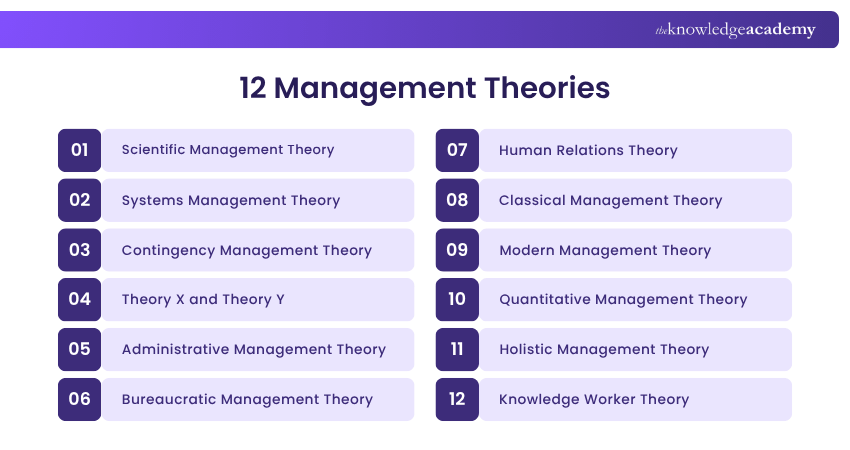
Even though some Management Theories were created long ago, their principles can still work well in today's tech-savvy business world. Let's dig into 12 theories that you should know about:
1) Scientific Management Theory
In the late 1800s, Frederick Taylor was one of the first to take a scientific approach to Management Theory, which was all about maximising productivity. He thought using the scientific method to perform workplace tasks instead of relying on team members' judgment could boost productivity.
Taylor also believed that simplifying tasks, giving team members thorough training, and promoting cooperation between supervisors and employees could improve productivity.
2) Systems Management Theory
The Systems Management Theory views an organisation as a complex, unified system. It states that all components such as employees, departments, workgroups, and business units need to work together harmoniously to achieve optimal performance.
It emphasises the importance of collaboration, especially between managers and business units, and considers both internal and external influences. By promoting coordination, this theory ensures that changes in one area are understood with their impact on the entire system.
3) Contingency Management Theory
Contingency Management Theory, introduced by Fred Fiedler in the 1960s, argues that there is no one-size-fits-all approach to management. Effective leadership depends on adapting to situations by considering factors such as organisational size, technology, and leadership levels.
Managers need to stay adaptable, selecting and using the management style that best fits changing conditions in the organisation, or team. The theory emphasises situational awareness and encourages practical decision-making based on real-world factors. This promotes a dynamic approach to leadership, enabling effective response to change and uncertainty.
4) Theory X and Theory Y
In 1960, Douglas McGregor introduced Theory X and Theory Y in his book "The Human Side of Enterprise" to describe two types of workers and the required Leadership Styles. Theory X workers need structure and direction, while Theory Y workers are self-motivated and thrive in a participative environment.
McGregor's idea of different management styles still makes sense, but in real life, employees and managers usually don't fit into the extreme categories he described. This view also ignores how managers and workers can affect each other. For example, someone naturally driven can lose motivation if they experience excessive Micromanagement in the workplace.
Enhance your team's productivity with our Performance Management Training – Register today!
5) Administrative Management Theory
Administrative Management Theory, developed by Henri Fayol in the early 20th century, focuses on the principles and functions of management necessary to run an organisation efficiently. It emphasises planning, organising, commanding, coordinating, and controlling as core managerial activities.

Fayol also introduced 14 key principles which laid the foundation for modern management practices and highlighted the importance of clear structure and authority in achieving organisational goals. It encourages a top-down approach where leadership plays a central role in maintaining order and productivity.
6) Bureaucratic Management Theory
Bureaucratic Management Theory was developed by Max Weber to establish a structured and formalised approach to organisation and leadership. It emphasises a clear hierarchy, well-defined roles, strict rules, and impersonal relationships to ensure efficiency and consistency.
Weber believed that organisations should operate on rational-legal authority rather than personal or traditional influence. This theory promotes merit-based hiring and advancement, ensuring decisions are made fairly and predictably. While criticised for being overly rigid, it remains influential in large organisations and public administration.
7) Human Relations Theory
Human Relations Theory was developed by Australian Psychologist and Researcher George Elton Mayo in the 1930s, based on the findings of the Hawthorne Studies. It emphasises that employees are not solely motivated by pay or working conditions, but also by social needs, personal attention, and a sense of belonging.
Mayo’s work showed that recognising employees as individuals with emotional and social needs can significantly boost morale and productivity. This theory encourages supportive leadership, open communication, and a people-focused workplace culture.
8) Classical Management Theory
The Classical Management Theory only cares about making money and treating workers like cogs in a machine. It's all about raising as much profit as possible, upping productivity, streamlining operations, and having a straightforward leadership setup. It thinks giving out fat paychecks or bonuses will make people work harder and get more done.
While there are better fits for today's businesses, things like a transparent chain of command, splitting up tasks, and spelling out everyone's job can still be helpful.
9) Modern Management Theory
Modern Management Theory is different from classical management. It's about the idea that employees aren't just in it for the paycheck; they're also into being happy and satisfied and having work that fits with their lifestyle.
So, managers using this style tap into technology to figure out what their employees need and to implement things that support them and help them get even better at what they do.
Drive lasting impact across your organisation with our Personal & Organisational Development Training – Join now!
10) Quantitative Management Theory
Quantitative Management Theory focuses on applying mathematical models, statistics, and data-driven techniques to improve decision-making and problem-solving in organisations. It emerged during World War II to optimise military logistics and was later adopted in business for managing operations, production, and resources more efficiently.
This theory uses tools like linear programming, forecasting, inventory models, and simulation to support planning, scheduling, and performance analysis. It is widely used in operations research, supply chain management, budgeting, and quality control.
11) Holistic Management Theory
The Holistic Management Theory, also known as integral theory or the organisations as learning systems theory, is based on the idea that businesses work better when all the parts are connected and working together.

According to this theory, management should be transparent, set clear goals, and unite employees around a common purpose. This approach focuses on continuous learning and change, emphasising teamwork, sharing information, and empowering individuals.
12) Knowledge Worker Theory
Peter Drucker developed the Knowledge Worker Theory, which became popular in the latter half of the 20th century as organisations began to adopt his ideas of balancing business needs with the community.
According to this theory, employees are seen as valuable assets with skills that must be managed and developed. It is up to management to train employees and provide them with learning opportunities through external resources to fill any skill gaps.
Maximise your efficiency and achieve more with our Productivity and Time Management Course – Sign up soon!
Why Management Theories are Essential for Manager and Organisations?
Management Theories help companies focus, communicate, and grow. By applying Management Theory in the workplace, leaders can focus on their main goals. When a management style or theory is implemented, it automatically streamlines the organisation's top priorities.
Management Theory also facilitates communication with coworkers, helping us work more efficiently. By integrating the Communication Pyramid, understanding Management Theory allows us to make assumptions about management styles and goals, saving time during daily organisational interactions and meetings.
Tips for Using Management Theories
Here are some tips for effective usage of Management Theories:
1) Evaluate your workplace environment, team dynamics, and leadership style
2) Empower employees by giving them decision-making responsibilities
3) Pay close attention to employees’ needs, motivations, and feedback
4) Decide whether authoritarian or participative management fits your team best
5) Combine principles from different theories to suit your objectives
6) Maintain a clear and consistent set of rules and expectations
7) Regularly collect feedback to refine and adjust your management approach
Why are Management Theories Important?
Management Theories provide structured frameworks that guide leaders in planning, organising, and decision-making. They help improve efficiency, communication, and team motivation. By applying these theories, managers can solve problems effectively, adapt to change, and align their teams with organisational goals.
How do Management Theories Apply in Modern Business?
Modern organisations combine different Management Theories to remain effective and competitive. They use ideas from classical models like Taylor’s focus on efficiency, Mayo’s emphasis on human relations, and modern contingency approaches. These approaches help address challenges such as remote work, digital transformation, and changing employee expectations for flexibility, purpose, and well-being.
Conclusion
Management Theories are the practical tools that shape how people work, collaborate, and thrive within organisations. As workplaces become more people-focused, diverse, and digitally driven, managers must strike the right balance between structure and empathy while maintaining efficiency and flexibility. By blending these theories with real-world awareness, you can lead with purpose and create environments where teams feel empowered to succeed.
Gain confidence to lead effectively in any business environment with our Management Courses - Explore immediately!
Frequently Asked Questions
What are the Challenges of Implementing Management Theories?

Implementing Management Theories can be challenging due to organisational resistance, rigid structures, or a mismatch between theory and real-world dynamics. Adapting theories to diverse teams, evolving technologies, and changing business environments also requires flexibility, ongoing training, and thoughtful leadership.
Can Management Theories be Adapted to Different Industries?
Yes! Management Theories can be totally tweaked to fit different industries. The basic principles stay the same, but you can customise them to tackle the specific challenges and opportunities in different sectors. It's important to understand the unique context and needs of each industry to apply the theories effectively.
What are the Other Resources and Offers Provided by The Knowledge Academy?
The Knowledge Academy takes global learning to new heights, offering over 3,000 online courses across 490+ locations in 190+ countries. This expansive reach ensures accessibility and convenience for learners worldwide.
Alongside our diverse Online Course Catalogue, encompassing 19 major categories, we go the extra mile by providing a plethora of free educational Online Resources like Blogs, eBooks, Interview Questions and Videos. Tailoring learning experiences further, professionals can unlock greater value through a wide range of special discounts, seasonal deals, and Exclusive Offers.
What is The Knowledge Pass, and How Does it Work?
The Knowledge Academy’s Knowledge Pass, a prepaid voucher, adds another layer of flexibility, allowing course bookings over a 12-month period. Join us on a journey where education knows no bounds.
What are Related Courses and Blogs Provided by The Knowledge Academy?
The Knowledge Academy offers various Management Courses, including the Introduction to Management Course, Certified Artificial Intelligence (AI) for Managers Training and the Introduction to Managing People Course. These courses cater to different skill levels, providing comprehensive insights into Operational Efficiency.
Our Business Skills Blogs cover a range of topics related to Management Theories, offering valuable resources, best practices, and industry insights. Whether you are a beginner or looking to advance your Management Skills, The Knowledge Academy's diverse courses and informative blogs have got you covered.

William Brown


Senior Business Analyst and Strategic Advisor
William Brown is a senior business analyst with over 15 years of experience driving process improvement and strategic transformation in complex business environments. He specialises in analysing operations, gathering requirements and delivering insights that support effective decision making. William’s practical approach helps bridge the gap between business goals and technical solutions.
View Detail
Upcoming Business Skills Resources Batches & Dates
Date
 Introduction to Management
Introduction to Management
Fri 27th Mar 2026
Introduction to Management
Fri 15th May 2026
Introduction to Management
Fri 14th Aug 2026
Introduction to Management
Fri 6th Nov 2026

 If you wish to make any changes to your course, please


