
ISO 9001 Training

Online Instructor-led (1 days)

Classroom (1 days)

Online Self-paced (8 hours)

ISO 9001 Foundation Exam

ISO 9001 Foundation Course Outline

Module 1: Introduction  

  • Scope   
  • Normative References  
  • Terms and Definitions  

Module 2: Context of the Organisation  

  • Understanding the Organisation and Its Context   
  • Understanding the Needs and Expectations of Interested Parties   
  • Determining the Scope of the Quality Management System   
  • Quality Management System   

Module 3: Leadership  

  • Leadership and Commitment   
  • Quality Policy   
  • Roles, Responsibilities and Authorities   

Module 4: Planning  

  • Actions to Address Risks and Opportunities   
  • Quality Objectives and Planning to Achieve Them   
  • Planning of Changes   

Module 5: Support 

  • Resources   
  • Competence  
  • Awareness   
  • Communication   
  • Documented Information   

Module 6: Operation 

  • Operational Planning and Control   
  • Requirements for Products and Services   
  • Design and Development of Products and Services   
  • Control of Externally Provided Processes, Products and Services   
  • Production and Service Provision   
  • Release of Products and Services   
  • Control of Nonconforming Outputs   

Module 7: Performance Evaluation

  • Monitoring, Measurement, Analysis and Evaluation   
  • Internal Audit   
  • Management Review   

Module 8: Improvement  

  • Continual Improvement   
  • Nonconformity and Corrective Action 

Show moredown

Who Should Attend this ISO 9001 Foundation Training? 

This ISO 9001 Foundation Training is suitable for professionals who want to develop a structured understanding of quality management principles and Quality Management System requirements. It is particularly relevant to professionals involved in quality, operations, compliance, and organisational improvement, such as: 

  • Quality Officers 
  • Quality Assurance Professionals 
  • Quality Control Professionals 
  • Compliance Officers 
  • Operations Managers 
  • Internal Auditors 
  • Process Improvement Professionals 
  • Quality Management Professionals 

Prerequisites for the ISO 9001 Foundation Training 

There are no formal prerequisites to attend this ISO 9001 Foundation Training. However, a basic understanding of organisational processes or quality management would be beneficial for delegates. 

ISO 9001 Foundation Training Overview 

ISO 9001 Foundation Training introduces the fundamental requirements and principles of Quality Management Systems. It helps delegates understand how ISO 9001 supports consistent processes, customer requirements, and continual improvement within organisations. 

Delegates will learn how organisational context, leadership, planning, operations, and performance evaluation contribute to an effective Quality Management System. They will also develop knowledge of risk, audits, corrective action, and continual improvement. 

This 1-Day course offered by The Knowledge Academy helps delegates apply ISO 9001 principles in workplace settings. They will be better equipped to support quality processes and organisational improvement. 

ISO 9001 Foundation Training Course Objectives 

  • To understand the purpose and key requirements of ISO 9001 
  • To identify organisational context and Quality Management System scope 
  • To recognise leadership responsibilities and quality objectives 
  • To apply planning, resource, communication, and documentation principles 
  • To examine operational controls and product and service requirements 
  • To evaluate performance, corrective action, and continual improvement 

Learning Outcomes of this ISO 9001 Foundation Training 

Upon completing this ISO 9001 Foundation Training, delegates will understand how key Quality Management System requirements support consistent organisational processes and quality objectives. They will also be better equipped to support operational controls, performance evaluation, corrective actions, and continual improvement activities.

Show moredown

What’s Included in this ISO 9001 Foundation Training? 

  • ISO 9001 Foundation Examination 
  • World-Class Training Sessions from Experienced Instructors 
  • ISO 9001 Foundation Certificate 
  • Digital Delegate Pack 

Show moredown

ISO 9001 Foundation Exam Information

To achieve the ISO 9001 Foundation, candidates will need to sit for an examination. The exam format is as follows: 

  • Question Type: Multiple Choice 
  • Total Questions: 30 
  • Total Marks: 30 Marks 
  • Pass Mark: 50%, or 15/30 Marks 
  • Duration: 40 Minutes  
  • Open Book/ Closed Book: Closed Book

Show moredown

Online Instructor-led (5 days)

Classroom (5 days)

Online Self-paced (40 hours)

ISO 9001 Lead Auditor Exam

ISO 9001 Lead Auditor Training Course Outline 

Module 1: Introduction 

  • Scope
  • Normative References
  • Terms and Definitions

Module 2: Context of the Organisation

  • Understanding the Organisation and Its Context
  • Understanding the Needs and Expectations of Interested Parties
  • Determining the Scope of the Quality Management System
  • Quality Management System

Module 3: Leadership

  • Leadership and Commitment
  • Quality Policy
  • Roles, Responsibilities and Authorities

Module 4: Planning

  • Actions to Address Risks and Opportunities
  • Quality Objectives and Planning to Achieve Them
  • Planning of Changes

Module 5: Support

  • Resources
  • Competence
  • Awareness
  • Communication
  • Documented Information

Module 6: Operation

  • Operational Planning and Control
  • Requirements for Products and Services
  • Design and Development of Products and Services
  • Control of Externally Provided Processes, Products and Services
  • Production and Service Provision
  • Release of Products and Services
  • Control of Nonconforming Outputs

Module 7: Performance Evaluation

  • Monitoring, Measurement, Analysis and Evaluation
  • Internal Audit
  • Management Review

Module 8: Improvement

  • Continual Improvement
  • Nonconformity and Corrective Action

Module 9: Fundamentals of Quality Management System Auditing

  • Purpose and Objectives of QMS Auditing
  • First-Party, Second-Party and Third-Party Audits
  • Quality Management System Audit Concepts
  • Role of Auditing in QMS Effectiveness

Module 10: Principles of Auditing

  • Integrity and Professional Conduct
  • Fair Presentation
  • Due Professional Care
  • Confidentiality and Independence

Module 11: Evidence-Based Auditing

  • Evidence-Based Audit Approach
  • Objective Evidence and Audit Evidence
  • Verification and Corroboration of Evidence
  • Sufficiency and Appropriateness of Audit Evidence

Module 12: Risk-Based Auditing

  • Risk-Based Audit Thinking
  • Identifying Audit Risks and Opportunities
  • Determining Audit Priorities
  • Integrating Risk Considerations into Audit Activities

Module 13: Audit Programme Management

  • Establishing Audit Programme Objectives
  • Determining Audit Programme Scope
  • Audit Programme Resources and Responsibilities
  • Monitoring and Reviewing the Audit Programme

Module 14: Audit Programme Planning

  • Determining Audit Frequency and Priorities
  • Considering Process Importance
  • Considering Previous Audit Results
  • Addressing Changes Affecting the Audit Programme

Module 15: Auditor Competence

  • Auditor Knowledge and Skills
  • QMS and Audit Competence
  • Maintaining Auditor Competence
  • Evaluating Auditor Performance

Module 16: Lead Auditor Responsibilities

  • Responsibilities of the Lead Auditor
  • Managing Audit Team Activities
  • Coordinating Audit Team Communication
  • Maintaining Objectivity and Impartiality

Module 17: Audit Team Selection and Management

  • Selecting Appropriate Auditors
  • Assigning Audit Responsibilities
  • Managing Auditor Independence
  • Coordinating Multi-Auditor Activities

Module 18: Audit Initiation

  • Establishing Initial Contact with the Auditee
  • Determining Audit Feasibility
  • Confirming Audit Objectives, Scope and Criteria
  • Establishing Audit Arrangements

Module 19: Audit Preparation

  • Reviewing Relevant QMS Information
  • Developing the Audit Plan
  • Preparing Audit Working Documents
  • Allocating Time and Audit Responsibilities

Module 20: Audit Objectives, Scope and Criteria

  • Establishing Audit Objectives
  • Defining Audit Scope and Boundaries
  • Determining Audit Criteria
  • Establishing Audit Evidence Requirements

Module 21: Opening the Audit

  • Purpose of the Opening Meeting
  • Confirming Audit Arrangements
  • Introducing the Audit Team and Responsibilities
  • Establishing Communication and Reporting Arrangements

Module 22: Conducting the Audit

  • Collecting Audit Evidence
  • Interviewing Relevant Personnel
  • Observing Processes and Activities
  • Reviewing Relevant Documented Information

Module 23: Process-Based Auditing

  • Understanding the Process Approach
  • Auditing Process Inputs and Outputs
  • Evaluating Process Sequence and Interaction
  • Assessing Process Performance and Controls

Module 24: Auditing Organisational Context and Leadership

  • Auditing Organisational Context
  • Auditing Interested Party Requirements
  • Auditing QMS Scope
  • Auditing Leadership and Quality Policy

Module 25: Auditing Planning and Support

  • Auditing Risks and Opportunities
  • Auditing Quality Objectives and Planning
  • Auditing Resources and Competence
  • Auditing Awareness, Communication and Documented Information

Module 26: Auditing Operational Processes

  • Auditing Operational Planning and Control
  • Auditing Customer and Product or Service Requirements
  • Auditing Design and Development
  • Auditing External Provider Controls

Module 27: Auditing Performance and Improvement

  • Auditing Monitoring, Measurement, Analysis and Evaluation
  • Auditing Customer Satisfaction
  • Auditing Internal Audit and Management Review
  • Auditing Continual Improvement and Corrective Action

Module 28: Audit Findings and Nonconformities

  • Identifying Conformity and Nonconformity
  • Evaluating Audit Findings Against Audit Criteria
  • Recording Objective Evidence
  • Formulating Clear and Defensible Findings

Show moredown

Who Should Attend this ISO 9001 Lead Auditor Training?

This ISO 9001 Lead Auditor Training is suitable for professionals who want to strengthen their knowledge of Quality Management System auditing and audit leadership. It is particularly relevant to professionals responsible for quality and organisational improvement, such as:

  • Quality Managers
  • Quality Assurance Managers
  • Internal Auditors
  • Lead Auditors
  • Compliance Managers
  • Quality Management Professionals
  • Process Improvement Managers
  • Audit Programme Managers

Prerequisites for the ISO 9001 Lead Auditor Training

There are no formal prerequisites to attend this ISO 9001 Lead Auditor Training. However, prior knowledge of Quality Management Systems, ISO 9001 requirements, or auditing principles would be beneficial for delegates.

ISO 9001 Lead Auditor Training Overview

ISO 9001 Lead Auditor Training develops advanced knowledge of Quality Management System auditing and the responsibilities involved in leading audits. It helps delegates understand how audits are planned, conducted, managed, and evaluated against defined criteria.

Delegates will develop skills in audit planning, evidence collection, risk-based auditing, process evaluation, team coordination, and reporting audit findings. They will also learn how to assess conformity, identify nonconformities, and support effective audit programme management.

This 5-Day course offered by The Knowledge Academy helps delegates lead and manage Quality Management System audits effectively. They will be better equipped to evaluate audit evidence, coordinate audit teams, assess organisational processes, and report clear audit findings.

ISO 9001 Lead Auditor Training Course Objectives

  • To explain the key requirements and principles of ISO 9001
  • To apply auditing principles when planning and conducting QMS audits
  • To evaluate objective evidence and identify conformity and nonconformity
  • To plan and manage audit programmes using risk-based approaches
  • To lead audit teams and coordinate audit activities effectively
  • To assess organisational processes and formulate clear audit findings

Learning Outcomes of this ISO 9001 Lead Auditor Training

Upon completing this ISO 9001 Lead Auditor Training, delegates will be able to plan, conduct, and manage Quality Management System audits using structured auditing approaches. They will also be better equipped to lead audit teams, evaluate objective evidence, assess process effectiveness, identify nonconformities, and communicate clear audit findings.

Show moredown

What’s Included in this ISO 9001 Lead Auditor Training?

  • ISO 9001 Lead Auditor Examination
  • World-Class Training Sessions from Experienced Instructors
  • ISO 9001 Lead Auditor Certificate
  • Digital Delegate Pack

Show moredown

ISO 9001 Lead Auditor Exam Information 

To achieve the ISO 9001 Lead Auditor, candidates will need to sit for an examination. The exam format is as follows: 

  • Question Type: Multiple Choice 
  • Total Questions: 30 
  • Total Marks: 30 Marks 
  • Pass Mark: 50%, or 15/30 Marks 
  • Duration: 40 Minutes
  • Open Book/ Closed Book: Closed Book

Show moredown

Online Instructor-led (2 days)

Classroom (2 days)

Online Self-paced (16 hours)

ISO 9001 Internal Auditor Exam

ISO 9001 Internal Auditor Training Course Outline

Module 1: Introduction

  • Scope
  • Normative References
  • Terms and Definitions

Module 2: Context of the Organisation

  • Understanding the Organisation and Its Context
  • Understanding the Needs and Expectations of Interested Parties
  • Determining the Scope of the Quality Management System
  • Quality Management System

Module 3: Leadership

  • Leadership and Commitment
  • Quality Policy
  • Roles, Responsibilities and Authorities

Module 4: Planning

  • Actions to Address Risks and Opportunities
  • Quality Objectives and Planning to Achieve Them
  • Planning of Changes

Module 5: Support

  • Resources
  • Competence
  • Awareness
  • Communication
  • Documented Information

Module 6: Operation

  • Operational Planning and Control
  • Requirements for Products and Services
  • Design and Development of Products and Services
  • Control of Externally Provided Processes, Products and Services
  • Production and Service Provision
  • Release of Products and Services
  • Control of Nonconforming Outputs

Module 7: Performance Evaluation

  • Monitoring, Measurement, Analysis and Evaluation
  • Internal Audit
  • Management Review

Module 8: Improvement

  • Continual Improvement
  • Nonconformity and Corrective Action

Module 9: Fundamentals of Quality Management System Auditing

  • Purpose and Objectives of QMS Auditing
  • First-Party, Second-Party and Third-Party Audits
  • Quality Management System Audit Concepts
  • Role of Auditing in QMS Effectiveness

Module 10: Principles of Auditing

  • Integrity and Professional Conduct
  • Fair Presentation
  • Due Professional Care
  • Confidentiality and Independence

Module 11: Evidence-Based Auditing

  • Evidence-Based Audit Approach
  • Objective Evidence and Audit Evidence
  • Verification and Corroboration of Evidence
  • Sufficiency and Appropriateness of Audit Evidence

Module 12: Risk-Based Auditing

  • Risk-Based Audit Thinking
  • Identifying Audit Risks and Opportunities
  • Determining Audit Priorities
  • Integrating Risk Considerations into Audit Activities

Module 13: Audit Programme Management

  • Establishing Audit Programme Objectives
  • Determining Audit Programme Scope
  • Audit Programme Resources and Responsibilities
  • Monitoring and Reviewing the Audit Programme

Show moredown

Who Should Attend this ISO 9001 Internal Auditor Training?

This ISO 9001 Internal Auditor Training is suitable for professionals involved in quality, compliance, auditing, and process improvement activities. It is particularly relevant to those responsible for reviewing Quality Management System processes and supporting internal audit activities, including:

  • Internal Auditors
  • Quality Officers
  • Quality Assurance Professionals
  • Compliance Officers
  • Quality Coordinators
  • Process Improvement Professionals
  • Operations Managers
  • Quality Management Professionals

Prerequisites for the ISO 9001 Internal Auditor Training

There are no formal prerequisites to attend this ISO 9001 Internal Auditor Training. However, a basic understanding of Quality Management Systems, ISO 9001 requirements, or organisational processes would be beneficial for delegates.

ISO 9001 Internal Auditor Training Overview

ISO 9001 Internal Auditor Training develops knowledge of Quality Management System requirements and the principles used when conducting internal audits. It covers audit fundamentals, auditing principles, evidence-based and risk-based auditing, and audit programme management.

Delegates will develop skills in evaluating audit evidence, applying audit principles, identifying risks, and reviewing organisational processes. They will also understand how audit programmes are structured and how findings support quality management activities.

This 2-Day course offered by The Knowledge Academy helps delegates conduct internal Quality Management System audits more effectively. They will be better equipped to assess evidence, identify audit priorities, and support improvements within organisational processes.

ISO 9001 Internal Auditor Training Course Objectives

  • To explain the key requirements and principles of ISO 9001
  • To identify the purpose and objectives of Quality Management System auditing
  • To apply auditing principles when evaluating organisational processes
  • To assess objective evidence using evidence-based auditing approaches
  • To identify audit risks and determine appropriate audit priorities
  • To understand audit programme objectives, scope, resources, and responsibilities

Learning Outcomes of this ISO 9001 Internal Auditor Training

Upon completing this ISO 9001 Internal Auditor Training, delegates will be able to support structured internal Quality Management System audits and evaluate relevant audit evidence. They will also be better equipped to apply risk-based thinking, identify audit priorities, assess QMS effectiveness, and contribute to continual improvement.

Show moredown

What’s Included in this ISO 9001 Internal Auditor Training?

  • ISO 9001 Internal Auditor Examination
  • World-Class Training Sessions from Experienced Instructors
  • ISO 9001 Internal Auditor Certificate
  • Digital Delegate Pack

Show moredown

ISO 9001 Internal Auditor Exam Information

To achieve the ISO 9001 Internal Auditor, candidates will need to sit for an examination. The exam format is as follows: 

  • Question Type: Multiple Choice 
  • Total Questions: 30 
  • Total Marks: 30 Marks 
  • Pass Mark: 50%, or 15/30 Marks 
  • Duration: 40 Minutes 
  • Open Book/ Closed Book: Closed Book

Show moredown

Online Instructor-led (3 days)

Classroom (3 days)

Online Self-paced (24 hours)

ISO 9001 Lead Implementer Exam

ISO 9001 Lead Implementer Training Course Outline

Module 1: Introduction

  • Scope
  • Normative References
  • Terms and Definitions

Module 2: Context of the Organisation

  • Understanding the Organisation and Its Context
  • Understanding the Needs and Expectations of Interested Parties
  • Determining the Scope of the Quality Management System
  • Quality Management System

Module 3: Leadership

  • Leadership and Commitment
  • Quality Policy
  • Roles, Responsibilities and Authorities

Module 4: Planning

  • Actions to Address Risks and Opportunities
  • Quality Objectives and Planning to Achieve Them
  • Planning of Changes

Module 5: Support

  • Resources
  • Competence
  • Awareness
  • Communication
  • Documented Information

Module 6: Operation

  • Operational Planning and Control
  • Requirements for Products and Services
  • Design and Development of Products and Services
  • Control of Externally Provided Processes, Products and Services
  • Production and Service Provision
  • Release of Products and Services
  • Control of Nonconforming Outputs

Module 7: Performance Evaluation

  • Monitoring, Measurement, Analysis and Evaluation
  • Internal Audit
  • Management Review

Module 8: Improvement

  • Continual Improvement
  • Nonconformity and Corrective Action

Module 9: Fundamentals of Quality Management System Auditing

  • Purpose and Objectives of QMS Auditing
  • First-Party, Second-Party and Third-Party Audits
  • Quality Management System Audit Concepts
  • Role of Auditing in QMS Effectiveness

Module 10: Principles of Auditing

  • Integrity and Professional Conduct
  • Fair Presentation
  • Due Professional Care
  • Confidentiality and Independence

Module 11: Evidence-Based Auditing

  • Evidence-Based Audit Approach
  • Objective Evidence and Audit Evidence
  • Verification and Corroboration of Evidence
  • Sufficiency and Appropriateness of Audit Evidence

Module 12: Risk-Based Auditing

  • Risk-Based Audit Thinking
  • Identifying Audit Risks and Opportunities
  • Determining Audit Priorities
  • Integrating Risk Considerations into Audit Activities

Module 13: Audit Programme Management

  • Establishing Audit Programme Objectives
  • Determining Audit Programme Scope
  • Audit Programme Resources and Responsibilities
  • Monitoring and Reviewing the Audit Programme

Module 14: Audit Programme Planning

  • Determining Audit Frequency and Priorities
  • Considering Process Importance
  • Considering Previous Audit Results
  • Addressing Changes Affecting the Audit Programme

Module 15: Auditor Competence

  • Auditor Knowledge and Skills
  • QMS and Audit Competence
  • Maintaining Auditor Competence
  • Evaluating Auditor Performance

Module 16: Lead Auditor Responsibilities

  • Responsibilities of the Lead Auditor
  • Managing Audit Team Activities
  • Coordinating Audit Team Communication
  • Maintaining Objectivity and Impartiality

Module 17: Audit Team Selection and Management

  • Selecting Appropriate Auditors
  • Assigning Audit Responsibilities
  • Managing Auditor Independence
  • Coordinating Multi-Auditor Activities

Module 18: Audit Initiation

  • Establishing Initial Contact with the Auditee
  • Determining Audit Feasibility
  • Confirming Audit Objectives, Scope and Criteria
  • Establishing Audit Arrangements

Module 19: Audit Preparation

  • Reviewing Relevant QMS Information
  • Developing the Audit Plan
  • Preparing Audit Working Documents
  • Allocating Time and Audit Responsibilities

Show moredown

Who Should Attend this ISO 9001 Lead Implementer Training?

This ISO 9001 Lead Implementer Training is suitable for professionals involved in quality management, auditing, compliance, and organisational improvement. It is particularly relevant to professionals responsible for supporting Quality Management System activities, including:

  • Quality Managers
  • Quality Assurance Managers
  • Compliance Managers
  • Internal Auditors
  • Quality Management Professionals
  • Process Improvement Managers
  • Audit Programme Managers
  • Operations Managers

Prerequisites for the ISO 9001 Lead Implementer Training

There are no formal prerequisites to attend this ISO 9001 Lead Implementer Training. However, prior knowledge of Quality Management Systems and ISO 9001 standards would be beneficial for delegates.

ISO 9001 Lead Implementer Training Overview

ISO 9001 Lead Implementer Training develops advanced knowledge of Quality Management System requirements and related auditing principles. It covers organisational context, leadership, planning, operations, evidence-based and risk-based auditing, audit programme management, and audit preparation.

Delegates will develop skills in evaluating audit evidence, identifying risks, establishing audit priorities, and understanding audit programme responsibilities. They will also gain knowledge of auditor competence, team coordination, audit initiation, and planning activities.

This 3-Day course offered by The Knowledge Academy helps delegates strengthen their understanding of ISO 9001 and Quality Management System activities. They will be better equipped to evaluate QMS requirements, support audit planning, assess evidence, and contribute to effective quality management practices.

ISO 9001 Lead Implementer Training Course Objectives

  • To explain the key requirements and principles of ISO 9001
  • To evaluate Quality Management System processes and audit evidence
  • To apply evidence-based and risk-based auditing principles
  • To plan audit programmes and determine suitable audit priorities
  • To understand auditor competence, responsibilities, and team coordination
  • To prepare audit activities by defining objectives, scope, criteria, and resources

Learning Outcomes of this ISO 9001 Lead Implementer Training

Upon completing this ISO 9001 Lead Implementer Training, delegates will understand key Quality Management System requirements and structured auditing approaches. They will also be able to evaluate audit evidence, identify audit risks, understand audit programme responsibilities, and support effective audit initiation and preparation activities.

Show moredown

What’s Included in this ISO 9001 Lead Implementer Training?

  • ISO 9001 Lead Implementer Examination
  • World-Class Training Sessions from Experienced Instructors
  • ISO 9001 Lead Implementer Certificate
  • Digital Delegate Pack

Show moredown

ISO 9001 Lead Implementer Exam Information 

To achieve the ISO 9001 Lead Implementer, candidates will need to sit for an examination. The exam format is as follows: 

  • Question Type: Multiple Choice 
  • Total Questions: 30 
  • Total Marks: 30 Marks 
  • Pass Mark: 50%, or 15/30 Marks 
  • Duration: 40 Minutes  
  • Open Book/ Closed Book: Closed Book

Show moredown

Not sure which course to choose?

Speak to a training expert for advice if you are unsure of what course is right for you. Give us a call on +44 20 4538 6376 or Enquire.

What is ISO 9001?

ISO 9001 is a globally recognised standard for Quality Management Systems (QMS) that helps organisations establish consistent processes and meet applicable requirements. It focuses on improving quality management practices, operational effectiveness, and customer satisfaction.

The ISO 9001 Training by The Knowledge Academy helps professionals understand Quality Management System principles and their practical application. It develops knowledge that supports QMS implementation, auditing, documentation, performance evaluation, and continual improvement.

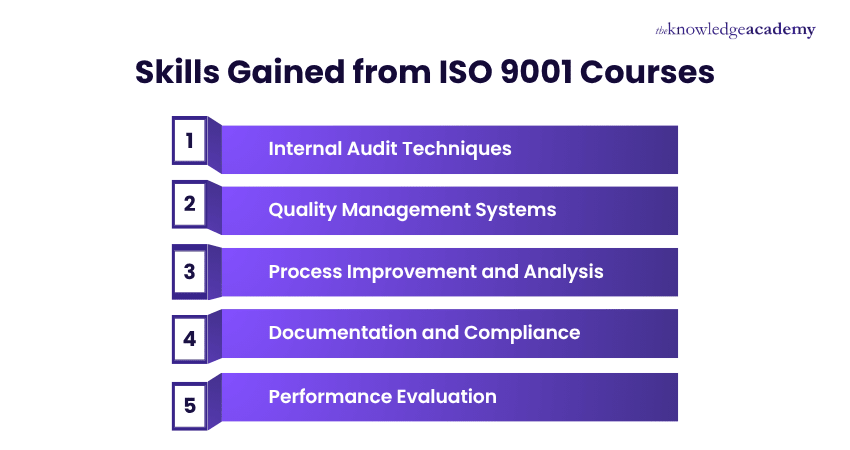
Skills Gained from ISO 9001 Training Courses

Skills Acquired from ISO 9001 Courses

Our ISO 9001 Courses help professionals develop practical knowledge for supporting, implementing, and evaluating Quality Management Systems. Key skills developed through the training include:

  • Internal Audit Techniques: Develop knowledge of planning, conducting, documenting, and supporting structured Quality Management System audits.
  • Quality Management Systems: Understand how QMS requirements support consistent processes, quality objectives, and organisational performance.
  • Process Improvement and Analysis: Develop the ability to evaluate processes, identify improvement opportunities, and support continual improvement.
  • Documentation and Compliance: Understand how documented information supports Quality Management System requirements and consistent organisational practices.
  • Performance Evaluation: Learn how monitoring, measurement, audits, and management reviews support QMS performance and improvement.

How does ISO 9001 Training Support Your Career and QMS Goals?

Our ISO 9001 Courses support professionals in building quality management knowledge that can strengthen career development and contribute to organisational QMS objectives. Key areas supported through the training include:

  • Career Development: Build relevant quality management knowledge that supports progression into quality, compliance, auditing, and operational roles.
  • QMS Contribution: Develop the understanding needed to support Quality Management System activities across different organisational functions.
  • Professional Confidence: Strengthen knowledge of ISO 9001 principles, requirements, and quality practices for greater confidence in quality-focused responsibilities.
  • Process Improvement: Build the ability to contribute to process consistency, continual improvement, and better organisational performance.
  • Quality Responsibilities: Develop knowledge that supports auditing, compliance, monitoring, and other quality management responsibilities.
  • Organisational Goals: Apply ISO 9001 knowledge to support quality objectives, customer satisfaction, and continual improvement initiatives.
Show more blue-arrow

Package deals for ISO 9001 Training

Our training experts have compiled a range of course packages on a variety of categories in ISO 9001 Training, to boost your career. The packages consist of the best possible qualifications with ISO 9001 Training, and allows you to purchase multiple courses at a discounted rate.

Swipe for more. Don’t miss out!

ISO 9001 Training FAQs

ISO 9001 Courses provide structured training in Quality Management Systems and the requirements of the ISO 9001 Standard. They cover areas such as QMS fundamentals, implementation, internal auditing, lead auditing, compliance, and continual improvement.

The right ISO 9001 Course depends on your experience and responsibilities. We offer Foundation, Internal Auditor, Lead Auditor, and Lead Implementer Training, allowing you to choose a course that matches your learning and QMS goals. Our team can also help you identify the most suitable option.

Our ISO 9001 Training helps delegates strengthen quality management, auditing, documentation, and process improvement skills. It can also support better efficiency, risk control, customer confidence, and continual improvement. These capabilities are useful across a wide range of organisations.

Our ISO 9001 Courses help teams understand how the Standard applies to their organisation and day-to-day processes. Depending on the course, delegates develop knowledge of QMS implementation, internal auditing, documented information, risk-based thinking, and performance evaluation, helping them support effective QMS practices within the organisation.

No prior ISO knowledge is required to attend the ISO 9001 Courses. However, a basic understanding of Quality Management concepts can be beneficial, particularly for more advanced training.

Internal Auditor Training focuses on evaluating an organisation’s own Quality Management System. It develops skills in audit planning, audit techniques, findings, and follow-up activities. Lead Auditor Training goes further by developing the skills required to lead audit teams, manage audit activities, prepare reports, and support certification audits.

ISO 9001 is a voluntary Quality Management Standard that organisations can adopt to establish and improve their Quality Management System. While it is not generally a legal requirement, it helps organisations strengthen processes, maintain consistent quality, and demonstrate their commitment to meeting customer requirements.

ISO 9001 Training helps delegates understand the requirements of the Standard and how they apply within a Quality Management System. Depending on the course, delegates develop knowledge of QMS implementation, documented information, internal auditing, and continual improvement, helping their organisation prepare for an external ISO 9001 Certification audit.

You will be able to access the course material through the ‘MyTKA Training Portal’, where all training resources and learning materials are available in one convenient location. The portal is designed to provide easy access to your course content, helping you learn at your own pace. You can review the materials as often as needed throughout your learning journey.

Yes, The Knowledge Academy provides a self-paced option for ISO 9001 Courses, allowing delegates to study at their own convenience. We also offer an online instructor-led option for delegates who prefer live trainer guidance, structured sessions, and interactive learning support.

ISO 9001 is used across industries such as manufacturing, healthcare, construction, IT, engineering, logistics, education, and professional services. It is suitable for any organisation that wants to improve quality, process consistency, and customer satisfaction.

ISO 9001 provides a structured framework for managing quality consistently. It supports stronger processes, customer focus, efficiency, documentation, and continual improvement. This can help organisations improve performance and build greater stakeholder confidence.

Yes, The Knowledge Academy offers 24/7 support via phone & email before attending, during, and after the course.  Our customer support team is available to assist and promptly resolve any issues you may encounter.

ISO 9001 Courses can support career development in roles such as Quality Manager, Internal Auditor, Compliance Officer, and QMS Consultant. These skills are relevant across industries including manufacturing, IT, healthcare, and logistics.

Yes, small businesses can benefit from ISO 9001 Training. It can help them improve processes, strengthen customer confidence, and build a more structured Quality Management System. These improvements do not necessarily require large teams or extensive resources. The Knowledge Academy.

The Knowledge Academy’s ISO 9001 Training starts with the fundamental concepts before progressing to more advanced topics. This makes it easier for delegates to build their understanding step by step. No prior ISO knowledge is required for most courses.

If you encounter any difficulties accessing your training, please reach out to The Knowledge Academy's support team. Our team is committed to providing timely assistance and ensuring you have uninterrupted access to your learning resources.

Yes, delegates receive a certificate of completion after completing their ISO 9001 Course. It recognises the training completed and provides evidence of their professional development in ISO 9001 and Quality Management Systems.

ISO 9001 is a formal Quality Management Standard with defined QMS requirements. Total Quality Management is a broader management philosophy centred on organisation-wide quality and continual improvement. ISO 9001 therefore provides a more structured framework for audits, requirements, and QMS evaluation.

The Knowledge Academy stands out as a prestigious training provider known for its extensive course offerings, expert instructors, adaptable learning formats, and industry recognition. It's a dependable option for those seeking this certification.

The Knowledge Academy is one of the Leading global training provider for ISO 9001 Training.

The training fees for ISO 9001 Training in Qatar starts from $3195

Show more down

Why we're the go to training provider for you

icon

Best price in the industry

You won't find better value in the marketplace. If you do find a lower price, we will beat it.

icon

Trusted & Approved

Recognised by leading certification bodies, we deliver training you can trust.

icon

Many delivery methods

Flexible delivery methods are available depending on your learning style.

icon

High quality resources

Resources are included for a comprehensive learning experience.

barclays Logo
deloitte Logo
Thames Water Logo

"Really good course and well organised. Trainer was great with a sense of humour - his experience allowed a free flowing course, structured to help you gain as much information & relevant experience whilst helping prepare you for the exam"

Joshua Davies, Thames Water

santander logo
bmw Logo
Google Logo
cross

Upgrade Your Skills. Save More Today.

superSale Unlock up to 40% off today!

* WHO WILL BE FUNDING THE COURSE?

close

close

Thank you for your enquiry!

One of our training experts will be in touch shortly to go over your training requirements.

close

close

Press esc to close

close close

Back to course information

Thank you for your enquiry!

One of our training experts will be in touch shortly to go overy your training requirements.

close close

Thank you for your enquiry!

One of our training experts will be in touch shortly to go over your training requirements.