




We may not have the course you’re looking for. If you enquire or give us a call on +49 8000101090 and speak to our training experts, we may still be able to help with your training requirements.
Functions of Management: Essential Aspects of Management Functions
ByNilotpal SarmahLast updated on: 22 September 2026
Functions of Management include planning, organising, leading, and controlling. These core activities help businesses operate efficiently and achieve their goals. Managers use these functions to allocate resources, coordinate team efforts, monitor performance, and make strategic decisions that drive business success and growth.

What ensures a business stays focused, organised, and moving in the right direction? The answer lies in the core Functions of Management: planning, organising, leading, and controlling. These functions provide structure and clarity to daily operations.
They help managers allocate resources, guide teams, and evaluate performance effectively. In this blog, you'll discover how mastering these essential management functions can improve decision-making, drive productivity, and support long-term business success.
What are the Functions of Management?
The Functions of Management refer to the core activities managers perform to ensure smooth and effective business operations. These include planning, organising, leading, and controlling. Each function plays a critical role in aligning resources, guiding teams, and achieving organisational goals through structured processes and informed decisions.
Planning sets goals and outlines the steps to achieve them. Organising arranges resources effectively, while leading motivates and directs employees. Controlling involves tracking progress and making necessary adjustments. Together, these functions create a continuous management cycle that drives performance, supports accountability, and ensures long-term success across all levels of an organisation.

Functions of Management With Examples
Here are the basic Functions of Management with Examples. Let us dive into the four Functions of Management in detail:
Planning
Planning involves setting clear objectives and identifying the strategies required to achieve them. It helps organisations anticipate future needs and allocate resources effectively. This Function of Management ensures direction, focus, and preparedness in business operations.
Example of Planning Functions
For example, a company may set quarterly sales targets and design a marketing strategy to meet them. Budgets and timelines are then aligned with these plans.
Organising
Organising is the process of arranging people, tasks, and resources to implement plans efficiently. It involves defining roles, delegating responsibilities, and establishing systems for coordination. This function creates a structure that supports smooth execution.
Example of Organising Functions
For instance, a project manager may assign tasks based on team strengths and set deadlines. Required tools and resources are then distributed accordingly.
Leading
Leading centres on motivating and guiding employees toward achieving organisational goals. It includes effective communication, team building, and conflict resolution. Strong leadership fosters engagement, trust, and high performance within teams.
Example of Leading Functions
A team leader, for example, may hold regular meetings and offer feedback to boost morale. Recognising achievements further encourages employee commitment.
Controlling
Controlling involves monitoring actual performance and comparing it with set objectives. It helps managers identify deviations, implement corrective actions, and ensure accountability. This function keeps operations aligned with goals and standards.
Examples of Controlling Functions
For example, a finance manager might analyse monthly expenses against the budget. Adjustments are made to address overspending or inefficiencies.
Advantages of Management Functions
The Function of Management are the backbone of effective and efficient business operations. Here's how:Planning helps in setting objectives and determining the best course of action to achieve them. Organising ensures efficient allocation of resources and assignment of tasks. It helps create a structure that facilitates the accomplishment of goals.
Further, leading motivates and influences employees to enhance productivity and morale. Finally, controlling monitors performance, ensuring activities align with plans and enabling corrective actions when necessary. Collectively, these Functions of Management improve operational efficiency, enhance decision-making, and drive strategic alignment. They ultimately contributing to sustained organisational success.
Take your Leadership skills to the next level with our Senior Management Training - Join today!
Challenges of Management Functions
In this dynamic and competitive business world, the Function of Management play a vital role in helping the company manage and enhance its operations. While these functions have several benefits, they also have several challenges. The following are some of the key challenges:
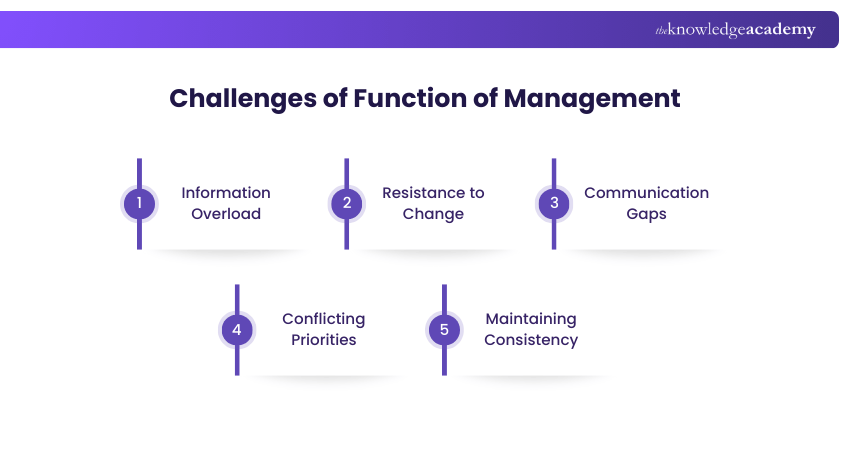
a) Information overload: In the digital age, managers often face information overload, making it difficult to process and analyse relevant data for planning purposes.
b) Resistance to change: Employees might resist implementing new plans and strategies. This resistance might be the strongest from older employees accustomed to existing practices, leading to delays and reduced enthusiasm for change.
c) Communication gaps: Miscommunication and misunderstandings between different departments can hinder effective coordination.
d) Conflicting priorities: Departments or teams may have conflicting priorities or objectives, making aligning efforts towards common goals challenging.
e) Maintaining consistency: Coordinating activities across diverse teams and locations requires consistent communication and effort to ensure uniformity.
New to management? Elevate your managerial capabilities with our specialised Management Training for New Managers Course.
Tips for applying the four Functions of Management
Effective Management relies on mastering the four fundamental functions: planning, organising, leading, and controlling. However, one must learn how to excel in these management areas. Here's how:
a) Planning: Start with clear objectives and develop comprehensive strategies to achieve them. Utilise forecasting and SWOT analysis to anticipate challenges and opportunities. Regularly review and adjust plans as needed to stay aligned with organisational goals.
b) Organising: Establish a clear structure and allocate resources efficiently. Define roles and responsibilities, fostering collaboration and accountability. Utilise tools like organisational charts to visualise hierarchies and communication channels.
c) Leading: Inspire and motivate employees to perform at their best. Practice effective communication, Active Listening, and empathy. Lead by example, demonstrating integrity and professionalism. Provide mentorship and opportunities for professional development.
d) Controlling: Implement systems to monitor progress and ensure adherence to standards while leveraging the benefits of management software. Set clear performance metrics and regularly assess outcomes. Take corrective action when necessary, addressing deviations from plans and fostering a culture of continuous improvement.

Nilotpal Sarmah is a Senior Content Writer with 11+ years of overall experience spanning engineering, operations and content development. His technical knowledge and extensive writing experience enable him to simplify specialised topics across IT and Tech, Business Skills, Project Management, Health and Safety, and ISO and Compliance.
View Detail

 If you wish to make any changes to your course, please


