


 Top Rated Course

We may not have the course you’re looking for. If you enquire or give us a call on +918037244591 and speak to our training experts, we may still be able to help with your training requirements.
Chain of Thought Prompting: Meaning and Benefits
Lily Turner 21 April 2026Chain of Thought Prompting is a technique in AI that helps machines solve problems by breaking tasks into smaller steps. This method ensures clearer, more accurate outcomes. It also enhances human problem-solving by structuring thinking, making it a valuable tool in various fields like education, technology, and content creation.

Training Outcomes Within Your Budget!
We ensure quality, budget-alignment, and timely delivery by our expert instructors.
Table of Contents

If you’ve ever used Artificial Intelligence (AI), you’ve likely noticed how its responses vary depending on the question. The key to better answers lies in understanding how AI works and guiding it through the right steps with effective prompts. This is where Chain of Thought Prompting comes into play.
It acts as a guide for AI, breaking down complex problems into manageable steps. This approach improves AI responses and problem-solving, whether in AI development, teaching, or content creation. Let’s explore how Chain of Thought Prompting is transforming our thinking and creativity.
Table of Contents
1) What is Chain of Thought Prompting?
2) How Does Chain of Thought Prompting Work?
3) Variants of Chain of Thought
4) Benefits of Chain of Thought Prompting
5) Limitations of Chain of Thought Prompting
6) Applications of Chain of Thought Prompting
7) Conclusion
What is Chain of Thought Prompting?
Chain of Thought Prompting is a cognitive technique gaining popularity in AI and human-computer interaction. It breaks down complex problems into lesser, manageable steps, guiding users or systems through structured reasoning. This step-by-step process helps both AI and humans solve challenges more effectively and logically.
AI is particularly in natural language processing and machine learning; Chain of Thought Prompting improves model output by guiding step-by-step reasoning. Rooted in cognitive psychology, this approach enhances understanding, clarity, and communication by organising thoughts into discrete steps, fostering better attention to detail and deeper comprehension.

How Does Chain of Thought Prompting Work?
Chain of Thought Prompting helps AI think in a clear and organised way by breaking down problems into smaller, logical steps. There are different ways to do this, from clear instructions to more subtle hints. Here's how it works:
Explicit Instructions
a) This method gives direct, step-by-step instructions for thinking.
b) It makes sure the process is clear and organised with no confusion.
c) This method ensures the AI follows a logical order.
Example: In solving a math problem, the prompt might say, First, find the variables. Then, break down the problem into smaller parts.
Implicit Instructions
a) These instructions are less direct and don't tell the AI exactly what to do.
b) The AI needs to figure out the steps on its own based on its training.
c) While this approach allows for creativity, it can be harder to predict or control the results.
Example: The prompt might ask, Explain the steps involved in solving this problem, and the AI will determine how to break it down.
Demonstrative Examples
a) This method shows the AI an example of the desired reasoning process before asking it to replicate it.
b) It’s especially helpful for training AI, as exposure to structured examples improves future performance.
c) Once the model understands the method, it can apply the same reasoning to new problems.
Example: You might provide a solved problem and illustrate how the solution was obtained step by step.
Enhance AI's understanding across diverse inputs with our Generative AI in Prompt Engineering Training - Register today!
Variants of Chain of Thought
Chain of Thought Prompting typically breaks down a process into steps, but there are several variants, each with specific uses and benefits:
Zero-shot Chain of Thought
a) In this variant, the model is given a new task it has never encountered and must reason step by step.
b) It relies on the model's pre-trained knowledge and ability to generalise from past learning to new situations.
c) This approach is useful for handling a wide range of potential problems without needing to be trained on every scenario.
Example: The AI applies its prior knowledge to tackle novel challenges without detailed guidance.
Automatic Chain of Thought
a) This type of chain of thought allows the AI to automatically generate reasoning steps without user guidance.
b) It mimics human-like problem-solving processes efficiently, reducing the need for detailed instructions.
c) However, it can sometimes result in unpredictable or less transparent outputs, depending on the complexity of the task and the model's training.
Example: The AI independently breaks down problems into steps without being explicitly told how.
Multimodal Chain of Thought
a) A multimodal chain of thought combines different types of input, such as text, images, and audio, to guide reasoning.
b) This variant is useful when solving problems that involve more than one form of data.
Example: An AI tasked with analysing a picture and a text would use both visual and linguistic cues in its reasoning.
Benefits of Chain of Thought Prompting
Implementing Chain of Thought Prompting has brought significant advantages. In both AI development and human learning. Here are the key benefits:

Encourages Diversity
a) Chain of Thought Prompting fosters diversity by offering different ways to approach a problem.
b) Different tasks may require different thought processes, promoting creativity and flexibility.
Example: In creative tasks like content generation, this approach allows for varied perspectives, leading to more innovative solutions.
Multi-step Reasoning
a) This method encourages breaking complex tasks into smaller steps, making it easier to follow the process and help to understand.
b) It improves the overall efficiency of problem-solving by tackling one part at a time, reducing being overwhelmed, and increasing focus on each step.
Example: In tasks like solving math problems or strategic planning, this helps clarify the solution by allowing the reasoning to unfold in layers.
Improved Prompt Outputs
a) Chain of Thought Prompting results in more coherent and well-organised outputs.
b) Guiding AI through logical reasoning leads to higher-quality responses, especially in tasks like text generation or answering questions.
Example: AI produces clear, structured results when writing content or answering queries, ensuring the output is logical and easy to understand.
Enhanced Transparency and Understanding
a) The main benefit of Chain of Thought Prompting is that it makes the reasoning process more transparent.
b) This helps both AI and humans understand how conclusions are made, which is crucial in decision-making and ethical AI.
Example: In AI decision-making, this transparency allows users to trace the steps that led to a conclusion, ensuring accountability and trust.
Limitations of Chain of Thought Prompting
Despite its numerous benefits, Chain of Thought Prompting also has several limitations that need to be considered. These challenges must be addressed to fully maximise the potential of this technique.
Performance Variability
a) Inconsistent performance across different tasks
b) Success varies with problem complexity
c) Results can be unpredictable and incoherent
Model Dependency
a) Effectiveness depends on the specific model
b) Different models produce varied results
c) High-performing models handle tasks efficiently
Prompt Generation
a) Crafting effective prompts can be challenging
b) Incorrect prompts lead to incomplete reasoning
c) Requires understanding of the model’s processing nuances
Balancing Trade-offs
a) Balance detail and conciseness in prompts
b) Too much detail confuses the model
c) Simplicity may result in inadequate output
Enhance AI-driven optimisation with our AI Tools In Performance Marketing Training - join now!
Applications of Chain of Thought Prompting
The versatility of Chain of Thought Prompting allows it to be applied through a vast range of fields. Here are some of the most notable areas where it has been successfully implemented:
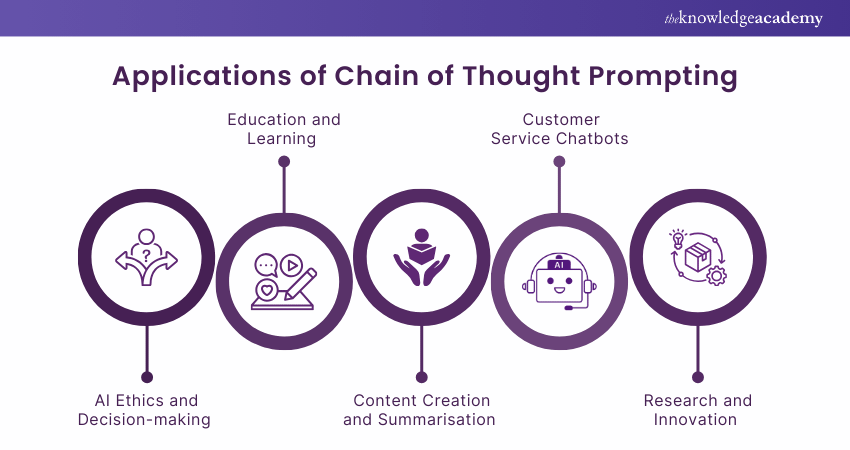
AI Ethics and Decision-making
a) Ensures AI systems make transparent, logical decisions
b) Guides AI in articulating ethical decision steps
Example: AI models articulate their reasoning in medical ethics decisions, making their choices transparent and justifiable.
Education and Learning
a) Breaks down complex problems into manageable steps
b) Encourages deeper engagement and improves learning outcomes
Example: Students solve math problems by breaking them into smaller steps, improving comprehension and retention.
Content Creation and Summarisation
a) Helps generate coherent, logical outputs for content
b) Ensures well-organised and meaningful results for readers
Example: A summarisation tool breaks down research papers into concise, logically structured summaries for quick understanding.
Customer Service Chatbots
a) Improves AI chatbot responses with logical steps
b) Enhances user satisfaction with relevant, accurate answers
Example: A chatbot guides a customer through troubleshooting steps for a product, providing clearer solutions.
Research and Innovation
a) Guides structured problem-solving in research and innovation
b) Fosters creativity and leads to breakthroughs
Example: Researchers use step-by-step logical reasoning to develop new drug treatments, ensuring thorough evaluation at each stage.
Conclusion
Chain of Thought Prompting transforms problem-solving by breaking tasks into manageable steps, enhancing clarity, creativity, and efficiency. It drives progress in AI, education, content creation, and more, enhancing reasoning, decision-making, and innovation. Despite challenges, its impact on transparency and structured thinking is undeniable.
Transform AI responses with precision prompts with our ChatGPT Prompt Engineering Certification - join today!
Frequently Asked Questions
What is the Thread of Thought Prompting?

Thread of thought prompting refers to the practice of guiding someone or something through a series of connected ideas or reasoning steps to solve a problem or reach a conclusion. It’s like Chain of Thought Prompting but may focus more on the continuity of thought rather than the explicit reasoning process.
What is the Difference Between a Chain of Thought and a Thread of Thought?
While both involve a step-by-step process of reasoning, a chain of thought typically refers to more structured, logical steps in problem-solving, while the thread of thought emphasises the flow and connection between ideas over time.
What are the Other Resources and Offers Provided by The Knowledge Academy?
The Knowledge Academy takes global learning to new heights, offering over 3,000+ online courses across 490+ locations in 190+ countries. This expansive reach ensures accessibility and convenience for learners worldwide.
Alongside our diverse Online Course Catalogue, encompassing 17 major categories, we go the extra mile by providing a plethora of free educational Online Resources like Blogs, eBooks, Interview Questions and Videos. Tailoring learning experiences further, professionals can unlock greater value through a wide range of special discounts, seasonal deals, and Exclusive Offers.
What is The Knowledge Pass, and How Does it Work?
The Knowledge Academy’s Knowledge Pass, a prepaid voucher, adds another layer of flexibility, allowing course bookings over a 12-month period. Join us on a journey where education knows no bounds.
What are the Related Courses and Blogs Provided by The Knowledge Academy?
The Knowledge Academy offers variousArtificial Intelligence Tools Training, including the ChatGPT Prompt Engineering Certification and ChatGPT Course, and the Generative AI in Business Training Course. These courses cater to different skill levels, providing comprehensive insights into What is ChatGPT.
Our Data, Analytics & AI Blogs cover a range of topics related to Artificial Intelligence, offering valuable resources, best practices, and industry insights. Whether you are a beginner or looking to advance your Data Analytics & AI skills, The Knowledge Academy's diverse courses and informative blogs have got you covered.

Lily Turner


Senior AI/ML Engineer and Data Science Author
Lily Turner is a data science professional with over 10 years of experience in artificial intelligence, machine learning, and big data analytics. Her work bridges academic research and industry innovation, with a focus on solving real-world problems using data-driven approaches. Lily’s content empowers aspiring data scientists to build practical, scalable models using the latest tools and techniques.
View Detail
Upcoming Data, Analytics & AI Resources Batches & Dates
Date
 ChatGPT Prompt Engineering Certification
ChatGPT Prompt Engineering Certification
Fri 21st Aug 2026
ChatGPT Prompt Engineering Certification
Fri 11th Dec 2026

 If you wish to make any changes to your course, please


