


 Top Rated Course

We may not have the course you’re looking for. If you enquire or give us a call on +30 2111995372 and speak to our training experts, we may still be able to help with your training requirements.
Financial Modelling Skills | Key Skills Guide
The Knowledge Academy 18 April 2026Financial Modelling is vital for anyone who wants to work in finance, accounting, or business. This entails developing mathematical representations that depict the financial status and performance of a company, project, or investment. This blog will explore the top Financial Modelling Skills you must master to become a successful Financial Analyst.

Training Outcomes Within Your Budget!
We ensure quality, budget-alignment, and timely delivery by our expert instructors.
Table of Contents
If you are interested in pursuing a career in finance, accounting, or business, you might have heard of Financial Modelling. But what exactly is Financial Modelling, and why is it so important? Financial Modelling is the process of creating and analysing mathematical models that represent the financial performance and situation of a company, project, or investment. Financial Modelling Skills are essential for anyone who wants to work as a Financial Analyst, Consultant, Manager, or Investor. This blog will discuss the top Financial Modelling Skills you need to master to excel in your field.
Table of Contents
1) What is Financial Modelling?
2) Financial Modelling Skills
a) Accounting
b) Forecasting
c) Managing spreadsheets
d) Audit oversight
e) Problem-solving
f) Presentation
g) Technology
h) Solution-oriented
i) Attention to details
j) Excel skills
k) Analytical skills
3) Conclusion
What is Financial Modelling?
Financial Modelling is the art and science of building and manipulating mathematical models that represent the financial performance and situation of a company, project, or investment. Financial Models are usually built using spreadsheet software, such as Microsoft Excel, and contain various inputs, assumptions, calculations, outputs, and charts.
Financial Models vary in complexity, ranging from straightforward to intricate, based on their intended purpose and extent. Build a Financial Model effectively to ensure accuracy and reliability. Some common types of Financial Models are:
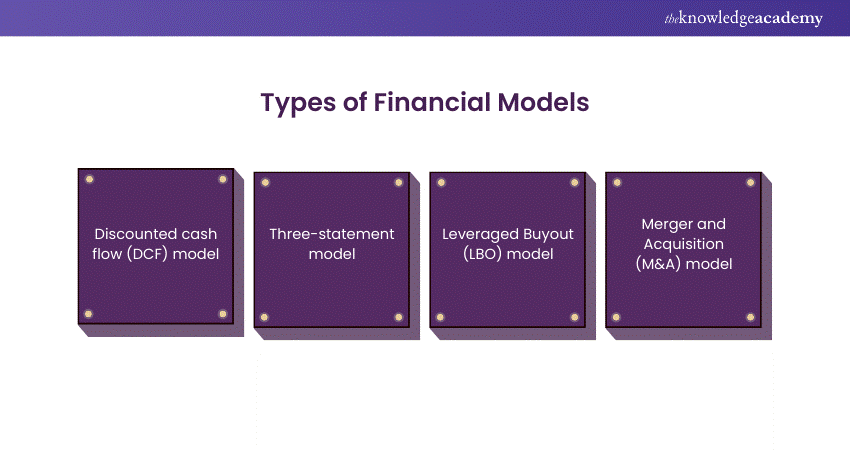
a) Discounted cash flow (DCF) model: A DCF model estimates the present value of a company, project, or investment based on its expected future cash flows and a discount rate. A DCF model is often used for valuation, Capital Budgeting, and investment analysis.
b) Three-statement model: A three-statement model integrates a company's income statement, balance sheet, and cash flow statement into one consolidated spreadsheet. A three-statement model is often used for financial reporting, analysis, and planning, and can be a key skill for those looking to understand the Financial Modelling Salary and career prospects in this field.
c) Leveraged Buyout (LBO) model: An LBO model represents the purchase of a company using a mix of debt and equity financing. An LBO model is often used for private equity, mergers and acquisitions, and corporate finance.
d) Merger and Acquisition (M&A) model: An M&A model evaluates the financial impact of combining two or more companies. An M&A model is often used for strategic planning, mergers and acquisitions.

Financial Modelling Skills
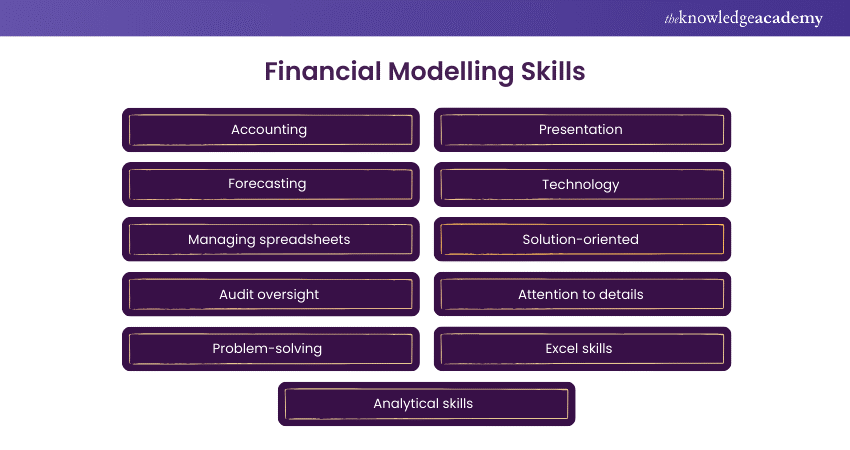
To build and use Financial Models effectively, you need skills covering technical and non-technical aspects of Financial Modelling. Here are the top Financial Modelling Skills that you should master:
Accounting
Accounting involves recording, summarising, and reporting a company's financial transactions and events. Accounting provides the foundation for Financial Modelling, as it helps you understand the financial statements, accounting principles, and accounting standards that are used to build and analyse Financial Models. Accounting skills are essential for Financial Modelling, as they enable you to:
a) Interpret and extract relevant information from a company's financial statements, such as revenues, expenses, assets, liabilities, and equity.
b) Apply the appropriate accounting principles and standards to a company's financial transactions and events, such as Accruals, matching, revenue recognition, and depreciation.
c) Adjust a company's financial statements for non-recurring, non-cash, and non-operating items, such as extraordinary items, stock-based compensation, and interest income.
d) Reconcile a company's financial statements to ensure they are consistent, accurate, and complete.
Forecasting
Forecasting is estimating the future outcomes and trends of a company, project, or investment based on historical data, assumptions, and scenarios. Forecasting is a key component of Financial Modelling, as it helps you project the future performance and situation of a company, project, or investment. Forecasting skills are essential for Financial Modelling, as they enable you to:
a) Collect and analyse historical data and identify the drivers and trends that affect the financial performance and situation of a company, project, or investment, such as sales growth, profit margin, and capital structure.
b) Develop and justify reasonable and realistic assumptions and scenarios that reflect the expectations and uncertainties of the future, such as market size, market share, and inflation rate.
c) Apply various forecasting techniques and methods to estimate the future values and outcomes of the financial variables and indicators of a company, project, or investment, such as revenues, expenses, cash flows, and net present value.
d) Assess and contrast the outcomes and consequences of various projections and scenarios, and conduct sensitivity and scenario analyses to determine how alterations in assumptions and variables affect the forecasts and results.
Managing spreadsheets
Managing spreadsheets is the skill of using spreadsheet software, such as Microsoft Excel, to create, edit, and manipulate Financial Models. Managing spreadsheets is a fundamental skill for Financial Modelling, as it helps you build and use Financial Models efficiently and effectively. Managing spreadsheets skills are essential for Financial Modelling, as they enable you to:
a) Design and structure Financial Models clearly, logically, and consistently, using best practices and conventions, such as naming cells and formulas and creating tabs.
b) Format and present Financial Models in a professional, attractive, and user-friendly using features and tools such as fonts, colours, borders, and charts.
c) Test and debug Financial Models to ensure they are error-free, reliable, and robust, using techniques and tools such as auditing, tracing, and error checking.
d) Optimise and automate Financial Models to improve their speed, performance, and functionality, using features and tools such as functions, macros, and pivot tables.
Audit oversight
Audit oversight is reviewing and verifying Financial Models' accuracy, validity, and quality. Audit oversight is an important skill for Financial Modelling, as it helps you ensure that the Financial Models are reliable, credible, and compliant. Audit oversight skills are essential for Financial Modelling, as they enable you to:
a) Check and validate Financial Models' sources, inputs, assumptions, calculations, outputs, and charts using methods and tools such as cross-referencing, documentation, and data validation.
b) Identify and correct any errors, inconsistencies, or discrepancies in Financial Models using techniques and tools, such as error messages, circular references, and breakpoints.
c) Review and evaluate Financial Models' logic, methodology, and approach using criteria and standards such as reasonableness, realism, and alignment.
d) Report and communicate the audit oversight process's findings, issues, and recommendations using formats and tools such as summaries, comments, and annotations.
Transform your financial skills: Join our cutting-edge Accounting and Finance Training!
Problem-solving
Problem-solving is identifying, analysing, and solving problems that arise in Financial Modelling. Problem-solving is an essential skill for Financial Modelling, as it helps you overcome the challenges and difficulties you encounter. Problem-solving skills are essential for Financial Modelling, as they enable you to:
a) Define and understand the problems you face in Financial Modelling, such as errors, inconsistencies, discrepancies in the Financial Model, gaps, uncertainties, or ambiguities in the data, assumptions, or scenarios.
b) Explore and investigate the possible causes and effects of the problem using methods and tools such as root cause analysis, fishbone diagram, and Pareto chart.
c) Generate and evaluate the possible solutions and alternatives to the problem using methods and tools such as brainstorming, SWOT analysis, and decision matrix.
d) Implement and monitor the chosen solution and alternative to the problem using methods and tools such as an action plan, feedback, and control chart.
Presentation
Presentation is the skill of communicating and explaining the Financial Models and their results and implications to the intended audience. Presentation is a vital skill for Financial Modelling, as it helps you convey and demonstrate the value and relevance of the Financial Models and their results and implications. Presentation skills are essential for Financial Modelling, as they enable you to:
a) Prepare and organise the Financial Models and their results and implications in a clear, concise, and coherent manner, using formats and tools such as summaries, highlights, and key takeaways.
b) Visualise and illustrate the Financial Models and their results and implications in a compelling, attractive, and engaging manner using features and tools such as charts, graphs, and tables.
Step Into financial mastery: Join our premier Financial Management Course now!
Technology
Technology is the skill of using and leveraging the latest technologies and tools available and relevant for Financial Modelling. Technology is a valuable skill for Financial Modelling, as it helps you enhance and improve the quality, efficiency, and effectiveness of the Financial Models and their results and implications. Technology skills are essential for Financial Modelling, as they enable you to:
a) Learn and master the most popular and widely used technologies and tools for Financial Modelling, such as Microsoft Excel, VBA, Python, R, and SQL.
b) Explore and discover the latest emerging technologies and tools for Financial Modelling, such as artificial intelligence, machine learning, big data, and cloud computing.
c) Apply and integrate the appropriate and relevant technologies and tools for Financial Modelling, depending on the purpose and context of the Financial Model, such as using Python for data analysis, VBA for automation, and SQL for database management.
d) Innovate and create new and novel technologies and tools for Financial Modelling based on your needs and requirements, such as developing your functions, macros, or applications.
Solution-oriented
Solution-oriented is focusing on finding and delivering the best and most optimal solutions and outcomes for the problems and challenges you face in Financial Modelling. Solution-oriented is an important skill for Financial Modelling, as it helps you achieve and exceed the expectations and goals of the Financial Models and their results and implications. Solution-oriented skills are essential for Financial Modelling, as they enable you to:
a) Define and understand the objectives and goals of the Financial Models and their results and implications, such as valuation, budgeting, forecasting, decision-making, and risk management.
b) Identify and prioritise the key issues and challenges you face in Financial Modelling, such as data quality, model complexity, or scenario uncertainty.
c) Develop and implement the best and most optimal solutions and outcomes for the issues and challenges you face in Financial Modelling, such as data cleaning, model simplification, or scenario optimisation.
d) Measure and examine the performance and effectiveness of the solutions and outcomes you deliver in Financial Modelling using metrics and indicators such as accuracy, reliability, and robustness.
Attention to details
Attention to detail is the skill of paying close and careful attention to the details and nuances of the Financial Models and their results and implications. This High-Income Skills is crucial for Financial Modelling, as it helps you ensure that the Financial Models and their results and implications are accurate, valid, and consistent. Attention to detail skills is essential for Financial Modelling, as they enable you to:
a) Notice and observe the details and nuances of the Financial Models and their results and implications, such as inputs, assumptions, calculations, outputs, and charts.
b) Verify and confirm the details and nuances of the Financial Models and their results and implications using methods and tools such as cross-checking, documentation, and data validation.
c) Correct and improve the details and nuances of the Financial Models and their results and implications, using techniques and tools such as error correction, consistency check, and quality improvement.
d) Maintain and update the details and nuances of the Financial Models and their results and implications, using methods and tools such as version control, change management, and data refresh.
Excel skills
Excel skills are the skill of using and mastering Microsoft Excel, the most popular and widely used spreadsheet software for Financial Modelling. Excel skills are fundamental for Financial Modelling, as they help you build and use Financial Models effectively and efficiently. Excel skills are essential for Financial Modelling, as they enable you to:
a) Create and edit Financial Models in Excel using features and tools such as cells, ranges, formulas, functions, and worksheets.
b) Format and present Financial Models in Excel using features and tools such as fonts, colours, borders, and charts
c) Test and debug Financial Models in Excel using features and tools such as auditing, tracing, and error checking.
d) Optimise and automate Financial Models in Excel using features and tools such as macros, VBA, and pivot tables.
Analytical skills
Analytical skills use and apply logical and critical thinking to Financial Models and their results and implications. Analytical skills are vital for Financial Modelling, as they help you understand and interpret Financial Models and their results and implications, which are often key topics in Financial Modelling Interview Questions. Analytical skills are essential for Financial Modelling, as they enable you to:
a) Analyse and interpret the Financial Models and their results and implications using methods and tools such as ratios, trends, and benchmarks.
b)Synthesise and summarise the Financial Models and their results and implications using methods and tools, such as key points, insights, and recommendations.
c) Compare and contrast the Financial Models and their results and implications using methods and tools, such as differences, similarities, and trade-offs.
d) Critique and evaluate the Financial Models and their results and implications using methods and tools, such as strengths, weaknesses, opportunities, and threats.
Advance your career with expert Accounting Training – Join now!
Conclusion
Financial Analyst Skills include Financial Modelling, a powerful and versatile ability that can help you achieve various financial, accounting, and business objectives. Financial Analyst Skills in financial modeling combine both technical and non-technical abilities that enable you to build and use financial models effectively and efficiently. This blog discusses the top Financial Analyst Skills you need to master to become a successful financial analyst. We hope this blog has helped you understand and appreciate the importance and value of Financial Analyst Skills in financial modeling.
Unlock your financial expertise: Join our comprehensive Financial Modelling Course today!
Frequently Asked Questions
What are the benefits of Financial Modelling Skills?

Financial Modelling Skills can help you:
a) Enhance your career prospects and opportunities
b) Improve your decision-making and problem-solving abilities
c) Increase your knowledge and understanding of finance, accounting, and business concepts and principles
How can I improve my Financial Modelling Skills?
You can improve your Financial Modelling Skills by:
a) Practising and applying your Financial Modelling Skills to real-world cases and scenarios in finance, accounting, and business.
b) Learn and update your Financial Modelling Skills with the latest technologies and tools in finance, accounting, and business.
What are the other resources and offers provided by The Knowledge Academy?
The Knowledge Academy takes global learning to new heights, offering over 3,000+ online courses across 490+ locations in 190+ countries. This expansive reach ensures accessibility and convenience for learners worldwide.
Alongside our diverse Online Course Catalogue, encompassing 19 major categories, we go the extra mile by providing a plethora of free educational Online Resources like Blogs, eBooks, Interview Questions and Videos. Tailoring learning experiences further, professionals can unlock greater value through a wide range of special discounts, seasonal deals, and Exclusive Offers.
What is Knowledge Pass, and how does it work?
The Knowledge Academy’s Knowledge Pass, a prepaid voucher, adds another layer of flexibility, allowing course bookings over a 12-month period. Join us on a journey where education knows no bounds.
What are related Accounting & Finance courses and blogs provided by The Knowledge Academy?
The Knowledge Academy offers various Accounting & Finance Courses, including Financial Modelling, Payroll and Financial Management. These courses cater to different skill levels, providing comprehensive insights into Financial Management.
Our Business Skills covers a range of topics related to Financial Management, offering valuable resources, best practices, and industry insights. Whether you are a beginner or looking to advance your Financial Management skills, The Knowledge Academy's diverse courses and informative blogs have you covered.

The Knowledge Academy


Global Training Provider
The Knowledge Academy is a world-leading provider of professional training courses, offering globally recognised qualifications across a wide range of subjects. With expert trainers, up-to-date course material, and flexible learning options, we aim to empower professionals and organisations to achieve their goals through continuous learning.

Upcoming Accounting and Finance Resources Batches & Dates
Date
 Financial Modelling Course
Financial Modelling Course
Fri 3rd Jul 2026
Financial Modelling Course
Fri 2nd Oct 2026

 If you wish to make any changes to your course, please


