


 Top Rated Course


We may not have the course you’re looking for. If you enquire or give us a call on +30 2111995372 and speak to our training experts, we may still be able to help with your training requirements.
Difference Between Cost Accounting and Management Accounting
Olivia Taylor 10 February 2026Cost Accounting tracks and analyses costs to control spending, while Management Accounting uses cost and financial data to make strategic decisions. While Cost Accounting ensures cost control, Management Accounting supports broader business planning and strategy. Together, both systems are essential for effective Business Management.

Training Outcomes Within Your Budget!
We ensure quality, budget-alignment, and timely delivery by our expert instructors.
Table of Contents
Do you believe that all accounting serves the same purpose? Think again, the differences could reshape your business strategy. When it comes to business finance, not all accounting methods have the same purpose. Two of the most inevitable, yet often confused, are Cost Accounting and Management Accounting.
Whether you're aiming to cut down operational costs or shape a long-term strategy, the right approach matters. So, what exactly sets them apart, and how do they work together to build a smarter business framework? Let’s break it down in this blog on the Difference Between Cost Accounting and Management Accounting. Read ahead!
Table of Contents
1) What is Cost Accounting?
2) What is Management Accounting?
3) Understanding the Difference Between Cost Accounting and Management Accounting
4) What Does a Cost and Management Accountant do?
5) How do Cost Accounting and Management Accounting Complement Each Other?
6) Conclusion
What is Cost Accounting?
Cost Accounting focuses on recording, analysing, and summarising the costs associated with a company's processes, services, and products. It helps businesses calculate and control expenses, plan strategies, and make informed decisions about cost improvements, including marginal cost adjustments.
Unlike Financial Accounting, which is reported annually, Cost Accounting provides continuous insights into production costs, including raw materials, labour, and overhead costs. This enables organisations to assess costs at each production stage and their impact on overall operations.
Functions of Cost Accounting
Cost Accounting plays an important role in managing and optimising a company's financial performance. By providing detailed insights into the cost structure of products and services, it supports strategic decision-making and financial control. Here are the key functions of Cost Accounting:

a) Calculating Cost
Cost Accounting determines the per-unit cost of each product, serving as the foundation for other cost-related functions. This method accurately figures out production costs, allowing firms to assess and manage their expenses effectively.
b) Controlling Cost
It identifies areas where operational costs can be controlled, assisting companies in staying within budget constraints. This function optimises resource allocation and enhances overall efficiency by limiting unnecessary expenses.
c) Reducing Cost
Cost Accounting helps pinpoint unwarranted expenses and develop strategies to mitigate them. By addressing these costs, it plays a crucial role in maximising profit margins and improving the company's financial health.

Advantages of Cost Accounting
Cost Accounting offers several benefits that enhance a company's Financial Management and operational efficiency. They are:
a) Informed Decision-making: Cost Accounting provides detailed insights into the costs associated with products and services. This helps businesses to make informed decisions regarding pricing, budgeting, and financial planning.
b) Enhanced Cost Control: By identifying cost variances and inefficiencies, Cost Accounting helps organisations control and reduce expenses, leading to better resource allocation and increased profitability.
c) Profitability Analysis: It assists in determining the profitability of individual products or services, allowing companies to focus on high-margin items and discontinue or improve less profitable ones.
d) Budgeting and Forecasting: Accurate cost data aids in creating realistic budgets and financial forecasts, enhancing strategic planning and financial stability.
e) Performance Evaluation: Cost Accounting enables businesses to evaluate performance at various levels of production and management, facilitating performance improvement and operational efficiency.
Disadvantages of Cost Accounting
While Cost Accounting provides valuable insights, it also has limitations that can impact its effectiveness.
a) Complexity and Cost: Implementing a comprehensive Cost Accounting system can be complex and costly. This requires significant resources and expertise to manage and maintain.
b) Limited Scope: While effective for internal cost analysis, Cost Accounting does not always capture the broader financial context or external factors influencing profitability, potentially leading to incomplete financial insights.
c) Focus on Historical Data: Cost Accounting often relies on historical data, which may not always reflect current market conditions or future trends, potentially affecting the relevance of cost analysis.
d) Potential for Misinterpretation: Misinterpretation of cost data can occur if not analysed correctly, leading to misguided decisions and strategies that may not address underlying issues.
e) Resource-intensive: The detailed tracking and analysis required can be resource-intensive, potentially diverting focus from other critical areas of Business Management.
Compliant financial practices across your organisation with our Accounting and Finance Policies Course – Register today!
What is Management Accounting?
Management Accounting, also known as Managerial Accounting, is an accounting system designed to collect, analyse, and interpret financial, qualitative, and statistical data. This system supports management in making informed decisions about business operations. Essentially, Management Accounting focuses on delivering insights tailored to the needs of specific managers and departments.
By utilising financial data, Management Accounting generates detailed reports such as budget forecasts, cost analysis, and variance analysis. A Management Accountant plays a crucial role in this process, ensuring that relevant financial insights support business decisions. Notably, Cost Accounting is considered a subset of Management Accounting.
Functions of Management Accounting
Management Accounting provides essential information and data to plan and manage organisational operations effectively. It assists in organising resources, both human and non-human and analyses functions and responsibilities to improve efficiency and maximise profits. Here are the key functions of Management Accounting.

a) Forecasting Cash Flow
Management Accounting plays a crucial role in forecasting a firm’s future cash flow. Analysing financial trends and employing budgeting measures helps predict future cash flow and guide investment and production decisions.
b) Analysing Performance Variance
Management Accounting focuses on predictive analysis and addressing variances between estimated and actual costs. Through Effective Management accounting techniques, firms can bridge the gap between these costs.
c) Facilitating Production-oriented Decisions
Data from Management Accounting aids business owners in evaluating the cost and profit implications of managerial decisions. This information helps determine whether to produce raw materials in-house or outsource them for cost-effective production.
Advantages of Management Accounting
Management Accounting offers several benefits that enhance decision-making and operational efficiency:
a) Informed Decision-making: It provides detailed and timely financial information tailored to specific managerial needs, enabling more accurate and informed decisions.
b) Performance Monitoring: Through various tools and techniques, such as budgetary control and variance analysis, Management Accounting helps monitor and improve organisational performance.
c) Resource Optimisation: By analysing costs and profitability, it assists in optimal resource allocation and improves the efficiency of operations.
d) Future Planning: Management Accounting aids in forecasting and budgeting, helping businesses plan for future financial needs and strategic initiatives effectively.
e) Cost Control: It identifies areas of inefficiency and suggests cost reduction strategies, which can lead to significant savings and enhanced profitability.
Disadvantages of Management Accounting
Despite its benefits, Management Accounting has some limitations:
a) Subjectivity: The information provided can be influenced by the manager’s subjective judgments, potentially leading to biased or inaccurate reports.
b) Costly Implementation: Developing and maintaining a comprehensive Management Accounting system can be expensive and resource-intensive.
c) Complexity: The system's complexity may require specialised skills and training, which can be a challenge for smaller organisations or those with limited resources.
d) Limited Historical Perspective: Unlike Financial Accounting, which focuses on historical data, Management Accounting may not always provide a full historical perspective, potentially affecting long-term strategic planning.
e) Data Overload: The extensive amount of data generated can sometimes overwhelm managers, making it difficult to focus on key performance indicators and actionable insights.
Gain the skills needed to evaluate business performance with our Accounting and Financial Statement Analysis Training – Join now!
Understanding the Difference Between Cost Accounting and Management Accounting
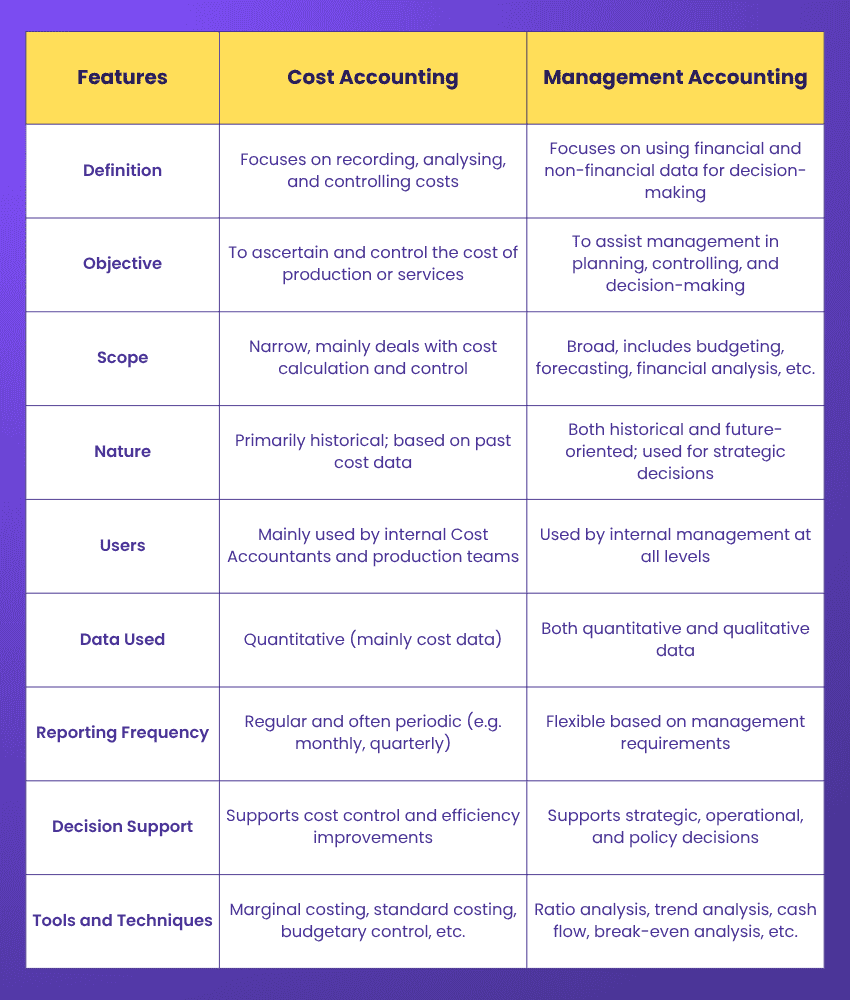
Cost Accounting and Management Accounting each serve distinct functions in Financial Management. This table outlines their key Difference Between Cost Accounting and Management Accounting, including their purpose, application, and impact on decision-making.
What Does a Cost and Management Accountant do?
A Cost and Management Accountant analyses, records, and reports financial data to help organisations control costs and make informed decisions. They prepare cost sheets, set budgets, analyse variances, and support pricing strategies. Their role combines technical accounting skills with strategic insight to improve efficiency, profitability, and overall financial health across departments.
How do Cost Accounting and Management Accounting Complement Each Other?
Although Cost Accounting and Management Accounting are distinct, they work closely together to achieve an organisation’s financial goals. Cost Accounting provides detailed cost data, such as overheads or production expenses.
On the other hand, Management Accounting uses this data to make informed decisions about budgeting, planning, and strategy. Together, they support both short-term cost control and long-term financial planning, driving smarter business outcomes.
Conclusion
For today’s business leaders, the ability to know the Difference Between Cost Accounting and Management Accounting isn’t just a technical skill. It is a strategic advantage. Embracing both empowers leaders to steer their organisations with clarity, confidence, and foresight. Ultimately, having a clear idea of both Cost and Management Accounting helps businesses stay agile, resilient, and future-ready.
Ready to build a strong foundation in finance? Explore our Accounting Courses for strategic decision-making!
Frequently Asked Questions
What are the Different Types of Cost Accounting?

The main types of cost accounting include:
1) Standard Cost Accounting
2) Marginal Cost Accounting
3) Activity-Based Cost Accounting
4) Environmental Cost Accounting
5) Lean Cost Accounting
Each method helps businesses analyse costs differently to control expenses, set prices, and improve decision-making efficiency.
Who Uses Management Accounting?
Management Accounting is used by internal Managers, Executives, and Business Owners. It provides them with detailed financial reports and analysis to aid in strategic planning, performance evaluation, and decision-making within the organisation.
What are the Other Resources and Offers Provided by The Knowledge Academy?
The Knowledge Academy takes global learning to new heights, offering over 3,000+ online courses across 490+ locations in 190+ countries. This expansive reach ensures accessibility and convenience for learners worldwide.
Alongside our diverse Online Course Catalogue, encompassing 19 major categories, we go the extra mile by providing a plethora of free educational Online Resources like Blogs, eBooks, Interview Questions and Videos. Tailoring learning experiences further, professionals can unlock greater value through a wide range of special discounts, seasonal deals, and Exclusive Offers.
What is The Knowledge Pass, and How Does it Work?
The Knowledge Academy’s Knowledge Pass, a prepaid voucher, adds another layer of flexibility, allowing course bookings over a 12-month period. Join us on a journey where education knows no bounds.
What are the Related Courses and Blogs Provided by The Knowledge Academy?
The Knowledge Academy offers various Accounting Courses, including Accounting Course, Inventory Accounting and Costing Course and Accounting and Financial Statement Analysis Course. These courses cater to different skill levels, providing comprehensive insights into What is Corporate Finance.
Our Accounting and Finance Blogs cover a range of topics related to Accounting, offering valuable resources, best practices, and industry insights. Whether you are a beginner or looking to advance your Accounting and Finance Skills, The Knowledge Academy's diverse courses and informative blogs have got you covered.

Olivia Taylor


Chartered Accountant and Financial Training Specialist
Olivia Taylor is a qualified chartered accountant with over a decade of experience in financial management, auditing and corporate reporting. Having worked with leading firms in both the public and private sectors, Olivia brings clarity to complex financial topics. Her writing focuses on helping professionals build confidence in key areas of accounting, compliance and financial planning.
View Detail

 If you wish to make any changes to your course, please


