


 Top Rated Course

We may not have the course you’re looking for. If you enquire or give us a call on +33 805638382 and speak to our training experts, we may still be able to help with your training requirements.
What is an End User: A Comprehensive Overview
Richard Harris 10 February 2026End users are individuals who directly interact with software, hardware, or digital services, using features to meet specific needs in product development. Understanding their needs and preferences is essential to creating user-friendly and practical business solutions that elevate the user experience in new and exciting ways.

Training Outcomes Within Your Budget!
We ensure quality, budget-alignment, and timely delivery by our expert instructors.
Table of Contents

Behind the success of every sleek app, smart device, or any exciting product is the end user. They’re the final destination in a product’s journey, the ones who interact with it on a daily basis. Essentially, it's the end user's needs that shape the design and functionality of a product. This blog explores What is an End User, why they matter so much, and how understanding them can transform your design from good to unforgettable. So read on!
Table of Contents
1) What is an End User?
2) Types of End Users
3) The Role of End Users in Product Development
4) How to Enhance the End User Experience?
5) Challenges in Understanding End Users
6) What is an example of an end user application?
7) What is the difference between user and end user?
8) Conclusion
What is an End User?
End user are the individuals who actually use a product, service, or system, as opposed to customers who purchase it. For example, a company may buy computers (the customer), but the employees who use them daily are the end users. Products are designed with end user in mind to ensure usability and effectiveness. Understanding their needs and preferences is crucial for creating user-friendly products that truly meet their requirements.
Focusing on end user helps businesses build stronger customer relationships, increase satisfaction, and drive better outcomes. End users provide essential feedback that can lead to product improvements and innovation. By listening to their insights, companies can refine their offerings, leading to better product adoption, higher customer loyalty, and long-term success. Satisfying end users not only solves immediate problems but also helps anticipate future needs, contributing to a stronger brand reputation and sustainable business growth.

Types of End Users
In any product or service, end users can be categorised based on how they interact with the system and their expertise level. Understanding these types helps tailor solutions to meet their needs and enhance their overall experience.
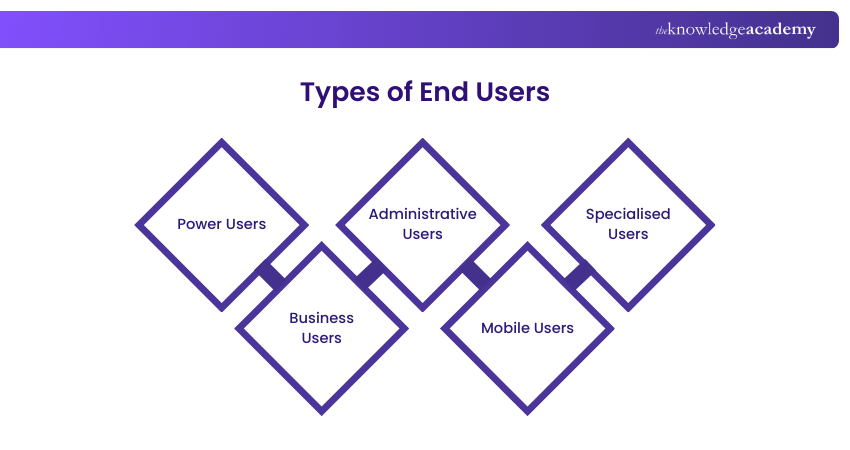
1) Power Users
Power users are highly proficient with the product or service and often utilise advanced features to maximise its potential. They are typically experts or enthusiasts who require high performance, customisation options, and efficiency. Power users provide valuable feedback on the products for their development and aid in expanding the product's possibilities.
2) Business Users
Business users are professionals who use the product or service to improve their productivity and streamline business operations. Therefore, they need reliability, integration with other business tools, and user-friendliness to perform their daily tasks efficiently. However, they might not need advanced features but a product that supports their work and contributes to achieving business goals.
3) Administrative Users
Administrative users are responsible for managing the system, including user access, configuration, and maintenance. They need robust tools to control settings, ensure security, and monitor system performance. These users often require detailed reporting and analytics to manage operations smoothly, which is critical to the overall system’s stability and security.
4) Mobile Users
Mobile users rely on the product or service in transit, using mobile devices to access features and functionalities. They need seamless, intuitive interfaces and fast performance optimised for smaller screens and varying network conditions. These users value portability and accessibility, making it essential for products to offer reliable and user-friendly mobile experiences.
5) Specialised Users
Specialised users possess expertise in specific domains and use the product or service for niche purposes. They require highly specialised features and customisations tailored to their unique needs. These users often work in fields such as engineering, healthcare, or research, where precision and functionality are critical. Products must cater to their specialised requirements for optimal performance.
Elevate your spreadsheets and presentation with the power of LibreOffice! Learn how in our LibreOffice Training - Sign up now!
The Role of End Users in Product Development
End users play a key role in product development because their feedback helps shape and improve the product. They don’t just use it; they help make it better. Their ideas and experiences can guide changes and updates. Here’s how end users are important at different stages of creating and developing a product:
1) Collecting Feedback
a) End users provide direct feedback, which helps identify a product’s strengths and weaknesses.
b) Their input on the usability, performance, and experience helps you make sure the product meets expectations and follows the EULA.
c) This feedback reveals real-world issues that may not be noticeable during early development.
d) Then Developers and Designers can use this input to refine the product's features and improve satisfaction.
e) Ongoing feedback helps the product grow in line with user needs. This creates a more user-focused and successful solution.
2) Testing the Product
a) End users play a key role in testing the product during its development phase.
b) Unlike controlled internal testing, their testing happens in real-world conditions.
c) They help identify bugs, usability problems and unexpected behaviours that may not appear in test environments.
d) The end users' involvement in beta testing or pilot programs helps Developers make needed improvements before launch.
e) This practical feedback ensures the product is functional, easy to use, and reliable for end users.
3) Influencing Design and Functionality
a) Based on their needs and preferences, end users have a strong influence on a product’s design and features.
b) Their real-world challenges help Developers shape the product in a manner that fits practical use.
c) Designers can create simpler, more intuitive interfaces by observing how end users interact with the product.
d) Their input often leads to useful changes, such as adding features or simplifying existing ones.
Master the G suite and collaborate Smarter! Sign up for our Google G Suite Training now!
How to Enhance the End User Experience?
End user experience is critical to the success of any product or service. However, improving this experience requires a blend of thoughtful design, consistent performance, and active user engagement. Here are some key strategies to enhance the End user experience:
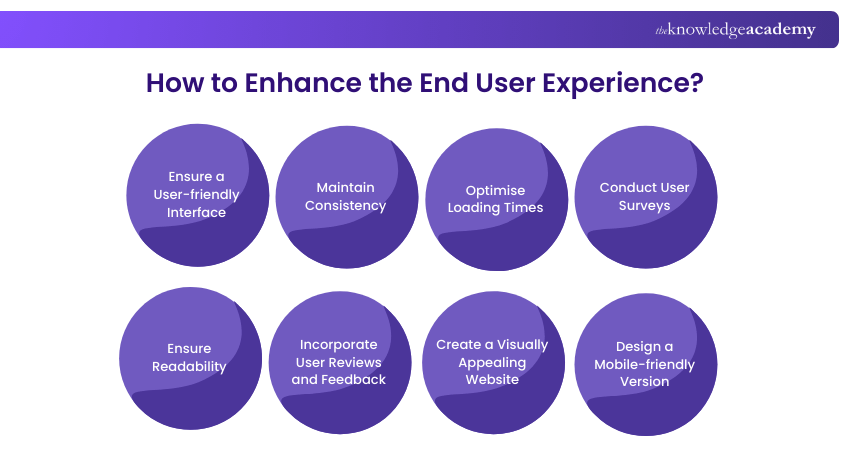
1) Ensure a User-friendly Interface
A user-friendly interface is a key element of a positive end user experience. That's why you must simplify the navigation, use clear labels and make sure that key features are easily accessible. An intuitive design goes a long way in reducing confusion and allowing users to interact with the product effortlessly.
2) Maintain Consistency
Consistency in design and functionality across platforms and devices is important because it promotes familiarity and trust. Maintaining a consistent look and feel means users don't take much time learning how to navigate and use the product, leading to a smoother experience.
3) Optimise Loading Times
Fast loading times are crucial in keeping users engaged. Ensure that your website or application opens quickly, as delays can frustrate users and result in higher bounce rates. You must optimise scripts, images and other elements to improve speed.
4) Conduct User Surveys
Regular user surveys offer valuable insights into user satisfaction and areas for improvement. By actively seeking feedback, you can address user concerns and refine the product to meet their needs better.
5) Ensure Readability
Clear and concise content improves readability, making it easier for users to understand information. You should utilise legible fonts, appropriate text sizes, and sufficient contrast to ensure that content is accessible to all users.
6) Incorporate User Reviews and Feedback
Incorporating user reviews and feedback into your product development process is crucial. This will help you adjust based on real user experiences. Additionally, it will improve the product's quality and reassure users about their valuable opinions.
7) Create a Visually Appealing Website
A good-looking website improves the user experience by keeping people interested and making it easier to use. You must use a mix of pleasant colours, nice visuals, and smart design choices to draw in and keep visitors.
8) Design a Mobile-friendly Version
With skyrocketing usage of mobile devices, designing a mobile-friendly version of your application or website is imperative. You must ensure that your product is responsive, with touch-friendly navigation and layouts that work seamlessly on smaller screens.
Challenges in Understanding End Users
Understanding users is a complex process that involves accurately interpreting their needs, behaviours, and preferences. However, you might be subjected to numerous challenges that hinder this understanding. Here are some of the key challenges that businesses may face:
1) Gathering and Analysing Data
a) The first step to gathering accurate data is to jave advanced tools and techniques. This step can be costly and time-consuming.
b) If the data volume is large, it can overwhelm the team. This can be a hindrance to spotting useful insights.
c) This may cause important data points to be missed or misunderstood during analysis.
d) Poor data interpretation can result in decisions that don’t match user needs.
e) This can result in products that fail to meet user expectations and preferences.
2) Misinterpreting User Feedback
a) Poor analysis can lead businesses to act on outlier opinions instead of the majority’s needs.
b) User feedback may get influenced by emotions or specific unexpected situations. This will make them less reliable.
c) Taking feedback at face value without any context can lead to wrong conclusions.
d) This can lead to products that only serve a limited group of users.
e) Consequently, broader market needs may get overlooked or ignored.
What is an Example of an End User Application?
Microsoft Word or Google Docs are prominent examples of User Applications. They help users create and edit documents. Other examples include web browsers like Chrome and Firefox, media players like VLC and iTunes, and mobile apps such as Facebook, Instagram, or games like Candy Crush.
What is the Difference Between User and End User?
A user is any individual who interacts with a product, regardless of whether it was made for them. An end user is the specific person the product was designed for. While all end users are users, not all users are end users. For example, kids watching a cartoon are end users, and their parents are just users.
Conclusion
End users may be the last in the chain, but they’re the most important link. Their needs, habits, and feedback shape how products evolve and succeed. Understanding What is an End User helps businesses design better, more user-friendly solutions. In the end, it’s the end user who truly brings a product’s purpose to life.
Learn how to build dashboards that drive interaction and action! Sign up for our Building Interactive Dashboards Training now!
Frequently Asked Questions
How to Identify End Users?

To identify end users, you should analyse who directly interacts with your product or service. This can be achieved by using user research, surveys, and feedback from current or potential users to understand their needs and behaviours. Additionally, you can leverage observing real-world usage to pinpoint end users effectively.
What is the End User Process?
The end user process involves creating and refining products or services based on their needs, behaviours, and feedback. It includes research, design, testing, and continuous improvement to establish the product meets user expectations and provides a positive experience.
What are the Other Resources and Offers Provided by The Knowledge Academy?
The Knowledge Academy takes global learning to new heights, offering over 3,000+ online courses across 490+ locations in 190+ countries. This expansive reach ensures accessibility and convenience for learners worldwide.
Alongside our diverse Online Course Catalogue, encompassing 19 major categories, we go the extra mile by providing a plethora of free educational Online Resources like Blogs, eBooks, Interview Questions and Videos. Tailoring learning experiences further, professionals can unlock greater value through a wide range of special discounts, seasonal deals, and Exclusive Offers.
What is The Knowledge Pass, and How Does it Work?
The Knowledge Academy’s Knowledge Pass, a prepaid voucher, adds another layer of flexibility, allowing course bookings over a 12-month period. Join us on a journey where education knows no bounds.
What are the Related Courses and Blogs Provided by The Knowledge Academy?
The Knowledge Academy offers various End User Training, including the Google Sheets Course, LibreOffice Training and the Introduction to Mac Numbers Training. These courses cater to different skill levels, providing comprehensive insights into End User License Agreement (EULA).
Our Office Application Blogs cover a range of topics related to End User, offering valuable resources, best practices, and industry insights. Whether you are a beginner or looking to advance your End User Management skills, The Knowledge Academy's diverse courses and informative blogs have got you covered.

Richard Harris


Senior Full Stack Developer and Technology Educator
Richard Harris is a highly experienced full-stack developer with deep expertise in both frontend and backend technologies. Over his 12-year career, he has built scalable web applications for startups, enterprises and government organisations. Richard’s writing combines technical depth with clear explanations, ideal for developers looking to grow in modern frameworks and tools.

Upcoming Office Applications Resources Batches & Dates
Date
 Computer Science Course
Computer Science Course
Fri 10th Jul 2026
Computer Science Course
Fri 9th Oct 2026

 If you wish to make any changes to your course, please


