


 Top Rated Course


We may not have the course you’re looking for. If you enquire or give us a call on +1 6474932992 and speak to our training experts, we may still be able to help with your training requirements.
What is Text Mining: Definition, Process & Examples
Lily Turner 09 February 2026Text Mining uses NLP and Machine Learning to analyse unstructured text and extract meaningful patterns and valuable information from large text datasets. It discovers valuable insights from text data like documents, Social Media and emails. It helps automate the understanding of text for business, research, and other applications.

Training Outcomes Within Your Budget!
We ensure quality, budget-alignment, and timely delivery by our expert instructors.
Table of Contents

Consider this scenario: you are having access to a massive pile of text like emails, Social Media posts, customer reviews,but no time to read through it all. That’s where Text Mining comes in! It’s like having a digital detective that scans through mountains of words, uncovers hidden patterns, and turns raw text into meaningful insights. So, What is Text Mining? It’s the magic behind Sentiment Analysis, search engines, and even chatbots!
By using AI, Machine Learning, and NLP, Text Mining transforms words into actionable knowledge, helping businesses and researchers make data-driven decisions effortlessly. This blog explores What is Text Mining, how the process works, and share real-world examples that show its impact. So read and decode the language of data!
Table of Contents
1) What is Text Mining?
2) The Importance of Text Mining
3) How Does Text Mining Work?
4) Key Techniques in Text Mining
5) Applications of Text Mining
6) Advantages and Disadvantages of Text Mining
7) Text Mining vs Text Analytics: Key Differences
8) Difference Between Text Mining and Data Mining
9) Difference Between Text Mining and NLP
10) Future of Text Mining
11) Conclusion
What is Text Mining?
Text Mining is a specialised branch of data mining that focuses on extracting useful information from large volumes of mostly unstructured text. It uses analytical techniques to transform raw textual data into structured formats.
This process analyses sources such as documents, emails, Social Media posts, forum discussions, and text-based databases. Because these sources vary widely in language, structure and subject matter, Text Mining allows for efficient pre-processing and large-scale analysis.

The Importance of Text Mining
Text Mining is important for Data Scientists and other professionals, including marketers and business analysts. Here’s why text Mining is important:
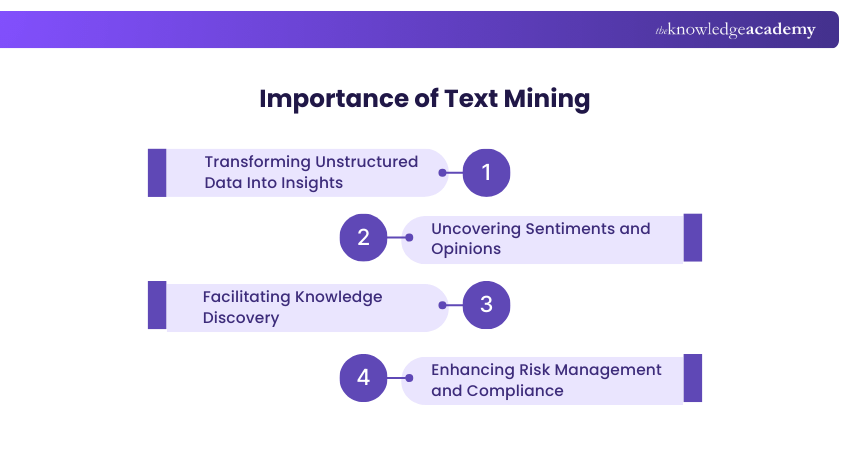
1) Transforming Unstructured Data Into Insights: Text Mining enhances business decision-making abilities by transforming unstructured data. Additionally, with the expansion of data from Social Media, emails, and reviews, organisations consistently need tools to identify external needs and trends.
2) Uncovering Sentiments and Opinions: Text Mining can easily discover sentiments and opinions in textual data using the NLP and Machine Learning (ML) applications. Moreover, by analysing customer feedback, Text Mining also helps businesses understand their preferences.
3) Facilitating Knowledge Discovery: Text Mining helps decode relationships and connections within larger datasets. This is beneficial in fields like healthcare, where analysing patient records can deliver relevant trends in treatment outcomes or disease prevalence, further promoting informed decision-making.
4) Enhancing Risk Management and Compliance: Text Mining also helps manage risk and compliance by monitoring communications for anomalies like fraud or regulatory violations.
Make your data speak through the power of Python with our Python Data Science Course — sign up now!
How Does Text Mining Work?
Text Mining works by discovering useful information sets of textual data. It involves:
1) Data Cleaning
Every text requires a cleaning before analysis. This includes removing any unnecessary information, such as extra spaces, special characters, or reduntant words. By performing data cleaning, texts become easier to work with for data analysts and data scientists.
2) Stemming
Stemming is a technique that converts words to their basic form, such as 'running from' 'ran,' and 'runner' to 'run.' This technique helps group similar words together, making it seamless for data professionals to analyse and interpret the meanings of these texts.
3) Tokenisation
Tokenisation is the process of splitting text into smaller units, such as words or phrases. For instance, the sentence 'I love apples' would be categorised into three tokens: 'I,' 'love,' and 'apples.' This helps Data Analysts to examine each section of the text separately.
4) Parts of Speech Tagging
In ‘Part of Speech Tagging’, the role of each word in a sentence is categorised into nouns, verbs, or adjectives. For example, in the sentence 'The cat sits,' 'cat' is a noun, and 'sits' is a verb. The aim of this technique is to understand the grammatical structure of texts.
5) Syntax Parsing
Syntax parsing is a technique that analyses the structure of sentences to understand their grammatical complexities. It helps us to see how different words and phrases fit together. For instance, it can show us in the phrase 'The quick brown fox,' 'quick' and 'brown' describe 'fox.' This technique is vital for data professionals to perform a thorough analysis of the text.
Key Techniques in Text Mining
There are primarily three techniques used in Text Mining. These include:

1) Information Retrieval
Information retrieval is identifying relevant data from a large collection of text, helping users to quickly locate specific documents or pieces of information. The goal of such technique is to deliver the most impactful results based on users’ preferences and intents.
2) Information Extraction
Information extraction is the process of extracting specific information from a large set of unstructured textual data. For example, it can quickly identify names, dates, and locations in a specific document. This technique also helps businesses to organise data for analysis and usage purposes, making it easier to understand complex information.
3) Text Classification
There are various approaches to text classification, the assignment of specific labels to a certain body of text. It is broadly used for spam filtering, sentiment score assignment, and document indexing. The Naive Bayes, SVM, and other deep neural network models have helped in automating the processes partially or fully.
4) Clustering
This is a technique for grouping several pieces of texts. These pieces of text have some similarities which is why they are put in the same category. It is helpful in making sense of unstructured pieces of text data through pattern detection. K-Means, DBSCAN, and Hierarchical Reverse Clustering are some of the well known ones.
Stay ahead in the digital age by registering for our Data Science Courses now!
5) Text Summarisation
Text summarisation aims to take large volumes of text and condense them into a few sentences that are meaningful and give you just the right amount of information needed. There are two forms extractive and abstractive. TextRank, BERTSUM, and T5 are some of the algorithms used for it.
6) Natural Language Processing
Natural Language Processing (NLP) uses Machine Learning and Deep Learning techniques to process, understand and analyse unstructured text data automatically. It enables systems to interpret human language and extract meaningful insights from written content. This includes Named Entity Recognition (NER), Sentiment Analysis and Text Summarisation.
7) Topic Modelling
Topic Modelling is a technique that identifies unrecognised topics in a particular set of texts. It assists in classifying and providing a summary for the data in textual form. There are several methods used for topic modelling, but Latent Dirichlet Allocation (LDA) and Non-negative Matrix Factorisation (NMF) are most frequently used for topic extraction.
Applications of Text Mining
Text Mining has transformed how organisations operate, enabling better decision-making and improved user experiences across industries. Common applications include the following:
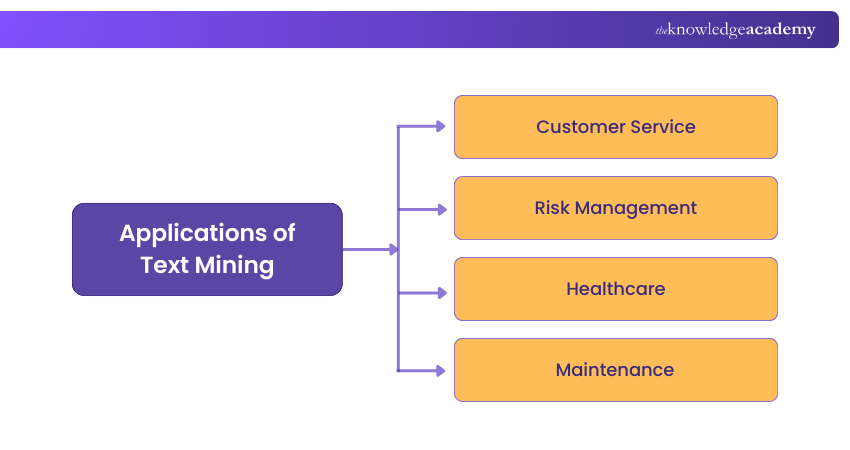
1) Customer Service
Organisations collect feedback through chatbots, surveys, NPS scores, online reviews, support tickets and Social Media. When combined with Text Mining and Sentiment Analysis, this data helps identify customer pain points quickly.
2) Risk Management
Text Mining supports Risk Analysis by tracking sentiment shifts and extracting insights from analyst reports, research papers and market commentary. This is particularly valuable in finance and banking.
3) Healthcare
In Biomedical Research, Text Mining automates the extraction and clustering of information from vast volumes of medical literature. This reduces the need for manual effort and accelerates research insights.
4) Maintenance
By analysing service logs, reports and technician notes, Text Mining reveals patterns linked to equipment issues. This allows for faster Root Cause Analysis.
Advantages and Disadvantages of Text Mining
Now let’s look into the numerous benefits Text Mining brings to the table as well as the drawbacks you must look out for:
1) Advantages of Text Mining
Handling Large Volumes of Data: Text Mining enables organisations to analyse and derive insights from vast amounts of unstructured textual information efficiently.
Wide Range of Use Cases: It supports diverse applications such as Sentiment Analysis, named entity recognition, topic modelling, and trend identification across industries.
Improved Decision-making: By uncovering patterns and relationships within text, Text Mining helps organisations make faster, more informed, and data-driven decisions.
Cost Efficiency: Automating text analysis reduces reliance on manual data entry and review, lowering operational costs and saving time.
2) Disadvantages of Text Mining
Technical Complexity: Text Mining involves advanced natural language processing and Machine Learning techniques, requiring specialised expertise and skills.
Data Quality Challenges: Inconsistent, incomplete or biased text data can impact the reliability and accuracy of extracted insights.
High Computational Requirements: Processing large text datasets demands significant computing power, which can be costly for smaller organisations.
Limited Data Scope: Text Mining focuses solely on unstructured textual data and cannot directly analyse numerical, visual, or structured data types.
Noise and Errors: Automated text analysis can produce inaccuracies, such as false associations or missed relationships. However, when error rates remain low, automation often outperforms manual analysis in efficiency and scalability.
Lack of Transparency: Text Mining may appear opaque, especially when users lack technical knowledge or access to underlying models and datasets. This makes it difficult to understand how conclusions are fully generated.
Text Mining vs Text Analytics: Key Differences
Although Text Mining and Text Analytics are often used interchangeably, there is a significant difference between them. Listed below are some of those differences:
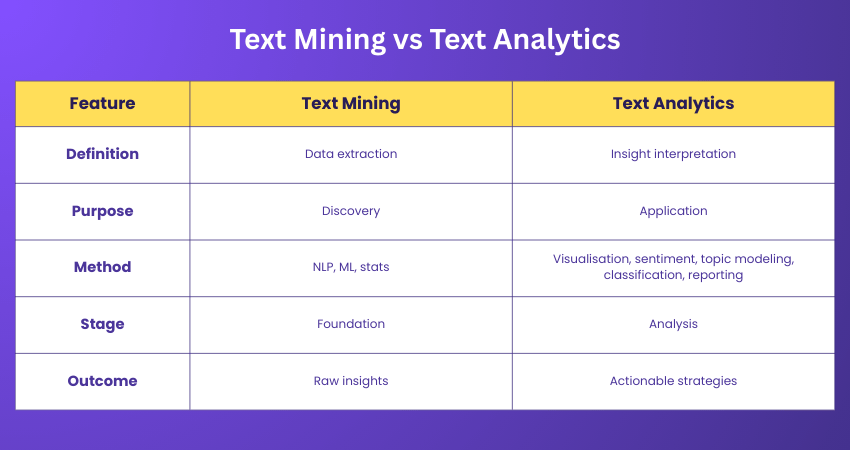
1) Definition
Text Mining: Text Mining involves obtaining useful information and patterns from unstructured text data by incorporating specific algorithms and techniques.
Text Analytics: In contrast, Text Analytics is the application of Data Science that interprets and derives actionable insights from the Text Mining result.
2) Purpose
Text Mining: It focuses primarily on uncovering hidden insights, trends, and relationships in textual information.
Text Analytics: While Text Analytics emphasises understanding and applying the insights derived from Text Mining to boost their decision-making capabilities.
3) Methods
Text Mining: It involves methods like Natural Language Processing (NLP), Machine Learning, and Statistical Analysis.
Text Analytics: While Text Analytics utilises data visualisation tools, Sentiment Analysis, and reporting methods as its primary methods.
4) Stage in Information Processing
Text Mining: Text Mining is the fundamental stage of the text Data Analytics process.
Text Analytics: While Text Analytics is the latter process of analysing and interpreting insights for achieving business goals.
5) Outcome
Text Mining: It generates raw insights and patterns from unstructured data.
Text Analytics: It transforms those insights into actionable strategies and decisions.
Dive into Data Analysis excellence with our Pandas For Data Analysis Training – join today!
Difference between Text Mining and Data Mining
1) Text Mining is the process of analysing unstructured textual data to extract meaningful information, such as patterns, topics, and sentiments.
2) Data Mining focuses on discovering patterns, trends, and relationships in structured datasets stored in databases or spreadsheets.

Difference Between Text Mining and NLP
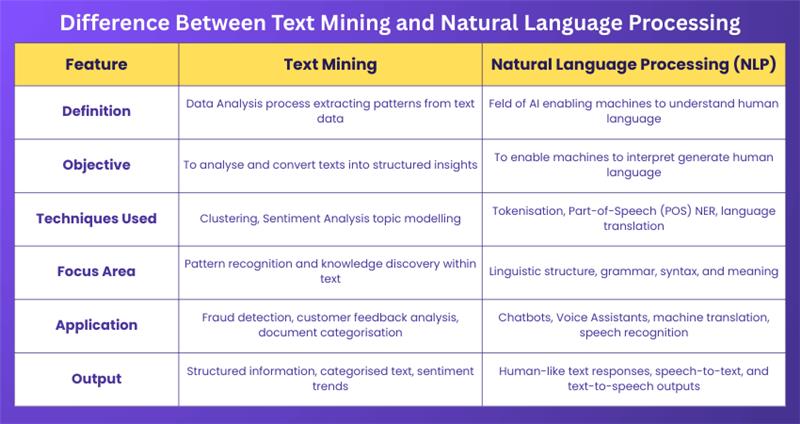
1) Text Mining is a broader field that focuses on extracting insights and knowledge from text data using Machine Learning and statistical methods.
2) Natural Language Processing (NLP) is a subset of AI that enables computers to understand, interpret, and generate human language.
Future of Text Mining
The future of Text Mining holds significant promise. As text data continues to expand and NLP and Machine Learning advance rapidly, Text Mining is becoming increasingly accessible. Its adoption is set to grow across industries such as healthcare, finance, and marketing, unlocking innovative applications and insights.
When combined with technologies like Artificial Intelligence and the Internet of Things, Text Mining will support more automated and scalable text analysis. Ultimately, it empowers organisations to capitalise on the vast data resources they already possess fully.
Conclusion
Text mining turns everyday words into valuable insight by revealing the patterns hidden within emails, reviews, conversations etc. By combining language with intelligent algorithms, you can gain clarity and foresight. As data volumes grow, understanding What is Text Mining becomes less optional and more essential. So, harness its power that's shaping future digital intelligence worldwide.
Learn how to analyse data like a pro with our Data Science With R Training – sign up now!
Frequently Asked Questions
What is NLP And Text Mining?

Natural Language Processing (NLP) is a field within Artificial Intelligence that helps computers interpret human language. NLP and Text Mining together can help transform raw text into actionable information, further enhancing industry decision-making.
What is Text Mining in Python?
Text Mining in Python refers to the process of extracting useful information from unstructured textual data using the applications of Python Programming. It involves techniques like Natural Language Processing (NLP) to analyse and interpret language patterns.
What are the Other Resources and Offers Provided by The Knowledge Academy?
The Knowledge Academy takes global learning to new heights, offering over 3,000+ online courses across 490+ locations in 190+ countries. This expansive reach ensures accessibility and convenience for learners worldwide.
Alongside our diverse Online Course Catalogue, encompassing 19 major categories, we go the extra mile by providing a plethora of free educational Online Resources like Blogs, eBooks, Interview Questions and Videos. Tailoring learning experiences further, professionals can unlock greater value through a wide range of special discounts, seasonal deals, and Exclusive Offers.
What is The Knowledge Pass, and How Does it Work?
The Knowledge Academy’s Knowledge Pass, a prepaid voucher, adds another layer of flexibility, allowing course bookings over a 12-month period. Join us on a journey where education knows no bounds.
What are the Related Courses and Blogs Provided by The Knowledge Academy?
The Knowledge Academy offers various Data Science Courses, including Text Mining Training, Python Data Science Course, and Data Science With R Training. These courses cater to different skill levels, providing comprehensive insights into Data Mining vs Data Analytics.
Our Data, Analytics & AI Blogs cover a range of topics related to Text Mining, offering valuable resources, best practices, and industry insights. Whether you are a beginner or looking to advance your Data Analysis knowledge, The Knowledge Academy's diverse courses and informative blogs have got you covered.

Lily Turner


Senior AI/ML Engineer and Data Science Author
Lily Turner is a data science professional with over 10 years of experience in artificial intelligence, machine learning, and big data analytics. Her work bridges academic research and industry innovation, with a focus on solving real-world problems using data-driven approaches. Lily’s content empowers aspiring data scientists to build practical, scalable models using the latest tools and techniques.
View Detail

 If you wish to make any changes to your course, please


