


 Top Rated Course


We may not have the course you’re looking for. If you enquire or give us a call on +1 6474932992 and speak to our training experts, we may still be able to help with your training requirements.
Volume of a Cone: Explained with Examples
The Knowledge Academy 28 April 2026Interested in learning how to find the Volume of a Cone? It's a straightforward process involving formulas that incorporate the radius and height of the cone. This blog will explain easy methods to calculate the Volume of a Cone through step-by-step examples, ensuring you grasp the concept effortlessly. Read on!

Training Outcomes Within Your Budget!
We ensure quality, budget-alignment, and timely delivery by our expert instructors.
Table of Contents

Ever wondered how much ice cream a cone can hold? Or why an ice cream cone holds less than a cup of the same height? Understanding the Volume of a Cone is a key concept in math and real-world scenarios! But there's no need to be overwhelmed by its mathematical underpinnings. Understanding it is easier than it looks. This blog breaks down the concept with real-world examples and shows you how the simple formula of a cone's volume shapes everything from architecture to everyday objects.
Table of Contents
1) Volume of Cone Formula
2) Derivation of Cone Volume
3) Examples of Cone Volume Calculations
4) Is a Cylinder Three Times the Volume of a Cone?
5) How to Make a Cone Mathematically?
6) Conclusion
Volume of Cone Formula
Understanding the Volume of a Cone is essential in various fields, from Geometry to Engineering. A cone is a three-dimensional shape that narrows smoothly from a flat base to a single point known as the apex.
The formula for determining the Volume of a Cone varies based on the provided dimensions such as its height, radius, and slanted height. Similarly, the Volume of Hemisphere can be calculated using specific formulas related to its radius. Below, you will explore the methods to find the cone's volume using its height and radius, height and diameter, and slant height.

Derivation of Cone Volume
You can consider a cone as a triangle being rotated about one of its vertices. For example, if there's a conical flask, its capacity will be equal to the volume of the cone. Essentially, a three-dimensional shape's volume of is equal to the space occupied by that shape. Consider this:
1) Take a conical flask and cylindrical container of the same height and base radius.
2) Fill the conical flask with water to the brim.
3) Pour the water into the cylindrical container; it will not fill the container completely.
4) Repeat the process a second time; the cylinder will still have vacant space.
5) Pour the water a third time; the cylindrical container will now be completely filled.
6) This demonstrates that the Volume of a Cone is one-third a cylinder's volume with the same base radius and height.
Cone Volume Using Height and Radius
The most common formula to calculate the Volume of a Cone involves using its height and the radius of its base. The formula is derived from the volume of a cylinder, as a cone can be thought of as a cylinder with a circular base that tapers to a point.
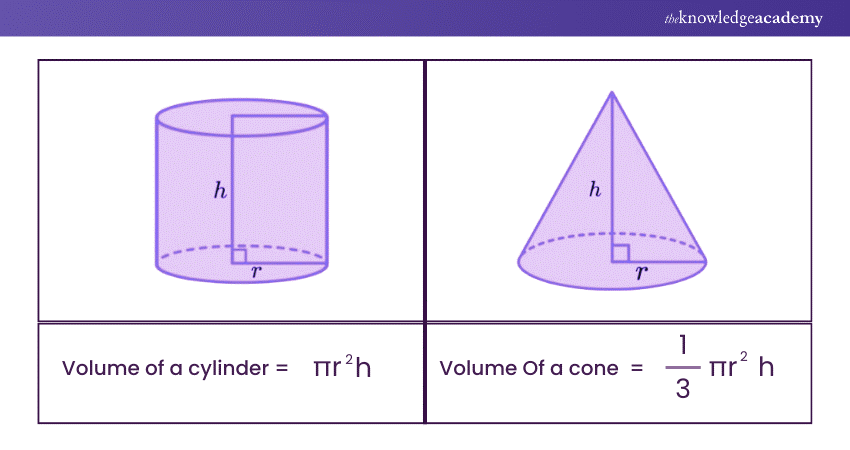
The formula to find the volume (V) of a cone using its height (h) and radius (r) is:

Here’s a step-by-step explanation of how this formula is applied:
1) Identify the Radius and Height: Measure the radius of the cone’s base and the perpendicular height from the base to the apex.
2) Square the Radius: In the next step, multiply the radius by itself to obtain ( r^2 ).
3) Calculate the Base Area: Multiply r2 by π (pi) to find the area of the base circle.
4) Find the Volume: Multiply the base area by the height of the cone, and then multiply by 1/3:
This formula indicates that the volume of a cone is one-third of the volume of a cylinder with an identical base area and height. This relationship arises because the cone can be viewed as a pyramid with a circular base.
Hone your ability to prioritise tasks and manage time effectively in our Motivation and Goal Setting Training - Sign up now!
Cone Volume Using Height and Diameter
Sometimes, the dimensions given might include the diameter of the base instead of the radius. Given that the diameter is twice the radius, we can adjust the formula to reflect this relationship. If d represents the diameter of the base, then

The volume formula using the diameter (d) becomes:

Simplifying this, we get:

Here’s the application of this formula:
a) Identify the Diameter and Height: Measure the diameter of the base and the height of the cone.
b) convert Diameter to Radius: Divide the diameter by 2 to get the radius.
c) Square the Radius: Alternatively, you can directly square the diameter and then divide by 4.
d) Calculate the Volume: Use the simplified formula to find the volume.
This method is particularly useful when the diameter is provided, saving an additional calculation step to find the radius first.
Unlock the secrets of geometry, refer to our blog on Volume of a Cuboid.
Cone Volume Using Slant Height
In some cases, you might have the slant height (l) of the cone instead of the perpendicular height. The slant height is the distance from the apex of the cone to any point on the circumference of the base. To find the volume using the slant height, you first need to determine the perpendicular height (h) using the Pythagorean theorem.

Here’s how to proceed:
a) Identify the Slant Height and Radius: Measure the slant height and the base's radius.
b) Calculate the Perpendicular Height: Use the Pythagorean theorem to find the height.
c) Find the Volume: Plug the radius and height into the cone volume formula.
Sharpen Your Skills. Train to Become a Top Engineer. Join our Engineering Skills Training now!
Examples of Cone Volume Calculations
1) Integer Dimensions
When the dimensions of the cone are integers, calculating the volume is straightforward. For example, a cone with a radius of three units and a height of five units uses the following formula:

Substitute the values of r and h to get the following:

Thus, the volume of the cone is 47.124 cubic units.
2) Decimal Dimensions
When the dimensions are decimals, the process remains the same, but the calculation involves decimal arithmetic. For a cone with a radius of 2.5 units and a height of 4.2 units:

Therefore, the volume of the cone is 27.489 cubic units.
3) Finding Length With Given Volume
To find the height when the volume is known, rearrange the volume formula. For a cone with a volume of 50 cubic units and a radius of three units:

The height is approximately 5.3 units.
4) Finding Radius With Given Volume
To find the radius when the volume is known, use the formula and solve for r. For a cone with a volume of 75 cubic units and a height of 6 units:

The radius is approximately 3.4 units.
5) Calculating Volume in Terms of Pi
Expressing volume in terms of π involves leaving π in the final answer. For a cone with a radius of four units and a height of nine units:
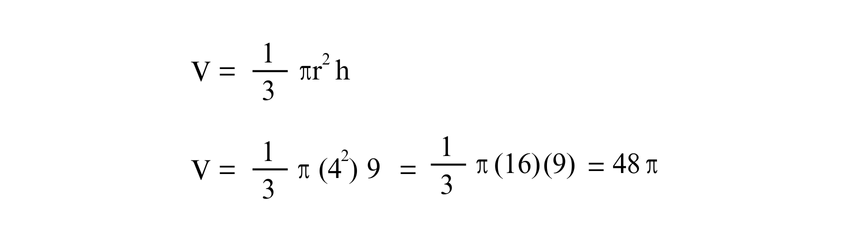
The volume is 48 π cubic units.
6) Calculating Volume Using Diameter
Using the diameter, first convert it to the radius. For a cone with a diameter of 8 units and a height of 7 units:

The volume is 37.33π cubic units.
Unlock your potential! Register for our Personal Development Courses today to enhance your skills, boost your confidence, and realise your goals.
Is a Cylinder Three Times the Volume of a Cone?
To be more precise, a cylinder's volume of is three times a cone's volume with the same base radius and height.
How to Make a Cone Mathematically?
A right circular cone is made by rotating a right-angle triangle around one of its axes by the right angle. You can make a paper cone by:
1) Making a Paper Circle.
2) Drawing Diagonal Lines from the circle's Centre.
3) Cutting Out the Triangle with scissors.
4) Bring the two edges together, slightly overlapping them.
Conclusion
Understanding the volume of a cone helps in various real-world applications, from understanding architecture to everyday objects. Its formula is key to solving geometric problems efficiently, and understanding the Base Area of Cylinder can further enhance your ability to tackle cylindrical shapes. The steps outlined in this blog will help you ace any problems pertaining to a cone's geometry.
Take charge of your future! Join our Career Development Course today and unlock the skills and strategies to advance your professional journey – Sign up now!
Frequently Asked Questions
Why is a Cone 1/3 of a Cylinder?

A cylinder's volume can be determined by multiplying the base area by its height. If the base radius is r and the height is h, the volume is πr²h. A cone with the same height and base radius shares the same base area, but its volume isn’t simply the base area times h. This makes sense, as a cone occupies less space than a cylinder of the same dimensions. Instead, its volume is exactly one-third of the cylinder’s volume.
What is The Maximum Possible Volume of a Cone?
By itself, a cone doesn't have a maximum volume. It can always be wider or taller for a larger capacity. However, if the cone is restricted by fitting inside another shape, like a sphere or a cylinder, then there might be a maximum volume it can reach within that constraint.
What are the Other Resources and Offers Provided by The Knowledge Academy?
The Knowledge Academy takes global learning to new heights, offering over 3,000+ online courses across 490+ locations in 190+ countries. This expansive reach ensures accessibility and convenience for learners worldwide.
Alongside our diverse Online Course Catalogue, encompassing 19 major categories, we go the extra mile by providing a plethora of free educational Online Resources like Blogs, eBooks, Interview Questions and Videos. Tailoring learning experiences further, professionals can unlock greater value through a wide range of special discounts, seasonal deals, and Exclusive Offers.
What is The Knowledge Pass, and How Does it Work?
The Knowledge Academy’s Knowledge Pass, a prepaid voucher, adds another layer of flexibility, allowing course bookings over a 12-month period. Join us on a journey where education knows no bounds.
What are the Related Courses and Blogs Provided by The Knowledge Academy?
The Knowledge Academy offers various Personal Development Courses, including the Engineering Skills Training, Time Management Training and the Supervisor training. These courses cater to different skill levels, providing comprehensive insights into Best Courses After 12th.
Our Business Skills Blogs cover a range of topics related to Personal Development, offering valuable resources, best practices, and industry insights. Whether you are a beginner or looking to advance your Engineering skills, The Knowledge Academy's diverse courses and informative blogs have got you covered.

The Knowledge Academy


Global Training Provider
The Knowledge Academy is a world-leading provider of professional training courses, offering globally recognised qualifications across a wide range of subjects. With expert trainers, up-to-date course material, and flexible learning options, we aim to empower professionals and organisations to achieve their goals through continuous learning.


 If you wish to make any changes to your course, please


