


 Top Rated Course


We may not have the course you’re looking for. If you enquire or give us a call on +1 6474932992 and speak to our training experts, we may still be able to help with your training requirements.
How to Calculate Percentile in JEE Mains 2026? Formula and Examples
The Knowledge Academy 23 December 2025The JEE Main exam is a national-level Engineering entrance exam in India for admission to undergraduate programs at IITs, NITs and other technical institutes. Knowing How to Calculate Percentile in JEE involves having insight into the key formula, examples and importance of normalisation in this prestigious exam.

Training Outcomes Within Your Budget!
We ensure quality, budget-alignment, and timely delivery by our expert instructors.
Table of Contents

Are you dreaming of kickstarting your Engineering aspirations from India’s top-tier institutions? Then, JEE Main is the first big step in turning it into reality. But here's one thing you need to consider: As you plan to crack the JEE Main, you must understand the process of calculating percentile scores because these scores will show exactly where you stand among thousands of fellow aspirants. With multiple exam sessions being conducted to test your mettle, normalisation is crucial in ensuring fairness. This blog will show you How to Calculate Percentile in JEE, by outlining the essential formula and easy-to-understand examples. So read on and decode your JEE rank effortlessly!
Table of Contents
1) What is JEE Main Exam?
2) How to Calculate JEE Main Percentile 2025?
3) JEE Main Percentile Calculation Formula
4) Essential Terms for JEE Main 2025 Percentile Calculation
5) Examples of Calculate JEE Main 2025 Percentile
6) Importance of JEE Main 2025 Normalisation of Scores
7) Key Highlights of JEE Main 2025 Percentile Score
8) JEE Main 2025 Tie-breaking Criteria
9) Conclusion
What is JEE Main Exam?
The JEE Main Exam is an entrance examination conducted in India regarding admissions to undergraduate engineering programs like BE, B.Tech, and B.Arch at the National Institutes of Technology (NITs), Indian Institutes of Information Technology (IIITs), and other Centrally Funded Technical Institutes (CFTIs). It's also an eligibility test for the JEE Advanced exam for admission to the IITs.

How to Calculate JEE Main Percentile 2025?
The JEE Main exam is conducted over multiple days and sessions, and the exam's difficulty level can vary across these days and sessions.
Here are the steps to calculate JEE Main percentile:
1) Count the number of candidates who appeared in your session.
2) Determine how many candidates scored equal to or less than you.
3) Apply the Percentile Formula.
4) Round off the percentile.
5) Use normalisation.
Let’s explore it in detail
JEE Main Percentile Calculation Formula
The NTA calculates JEE Main 2025 scores for the percentile for individual subjects (Physics, Chemistry, and Mathematics) separately and in the combined format through a normalisation formula. The following four percentiles is calculated for each candidate in the session:




Where:
1) T1, M1, P1 and C1 are raw scores in total, Mathematics, Physics and Chemistry respectively.
2) T1P, M1P, P1P and C1P are the percentile scores of Total, Mathematics, Physics and Chemistry.
Gain insight into career opportunities in the domain of software through Our Software Engineering Courses- Register now!
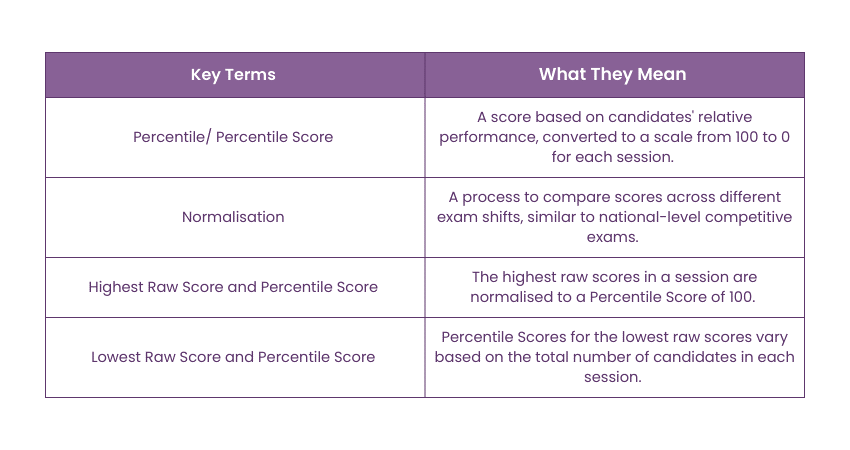
Essential Terms for JEE Main 2025 Percentile Calculation
Here are some important terms to remember regarding the JEE Main 2025 percentile calculation
Examples of Calculate JEE Main 2025 Percentile
These examples will illustrate the method of calculating the JEE Main percentile.
Example 1:
The highest raw score in JEE Main will be normalised to a percentile score of 100 for its respective session. Let's illustrate this with an example:
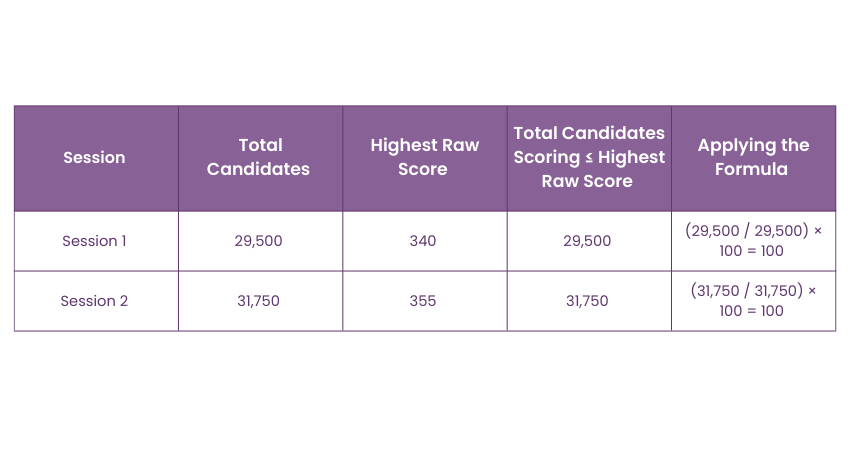
Example 2:
The lowest raw score and corresponding percentile score in JEE Main will be determined based on the lowest raw scores and the total number of candidates in each session. This example is a good demonstration:

Learn about the latest technology catalysing the field of Engineering in our comprehensive Engineering Skills Training - Sign up now!
Importance of JEE Main 2025 Normalisation of Scores
Here's why the JEE Main 2025 normalisation process is essential:
1) Normalisation accounts for varying difficulty levels across multiple sessions. This ensures that no candidate is unfairly advantaged or disadvantaged.
2) This conversion of raw scores into JEE Main percentile scores helps uniformly compare candidates' performance across different sessions.
3) The whole process ensures transparency in rankings. This is vital to create trust in the fairness of the evaluation system.
4) Thanks to this process, candidates can compete on an equal footing, regardless of the session or shift in which they appeared.
5) It highlights the actual performance of candidates, enabling accurate identification of deserving students for admissions.
6) Considering the intense competition, the normalised scores offer a fair ranking for admission to IITs, GFTIs, and other top institutions.
Key Highlights of JEE Main 2025 Percentile Score
These are some key points to keep in mind regarding the percentile score you need:
1) The overall percentile is not derived by averaging the percentiles of individual subjects.
2) The percentile score represents the normalised score for the exam, not the candidate’s raw marks.
3) The percentile score showcases the percentage of candidates who gained scores equal to or below a specific raw score in JEE Main. As a result, the highest scorer in each session will have a percentile of 100.
4) Percentile scores will also be calculated and assigned for marks between the highest and lowest scores.
5) The JEE Main merit list is prepared based on percentile scores.
6) Percentile scores are calculated up to seven decimal places to minimise tie-breaking situations and prevent clustering of scores.
Master the art of handling changes and challenges in your professional life through our Personal Development Courses - Sign up now!
JEE Main 2025 Tie-breaking Criteria
In case two or more candidates get equal percentile scores, their merit will be determined under the following order:
1) The candidates with higher percentile scores in Mathematics are the first option.
2) If there is a clash of scores again, candidates with higher percentile scores in Physics will be considered.
3) If there's a tie again, candidates with higher percentile scores in Chemistry will be preferred.
4) If the problem is still unresolved, older candidates will be preferred.
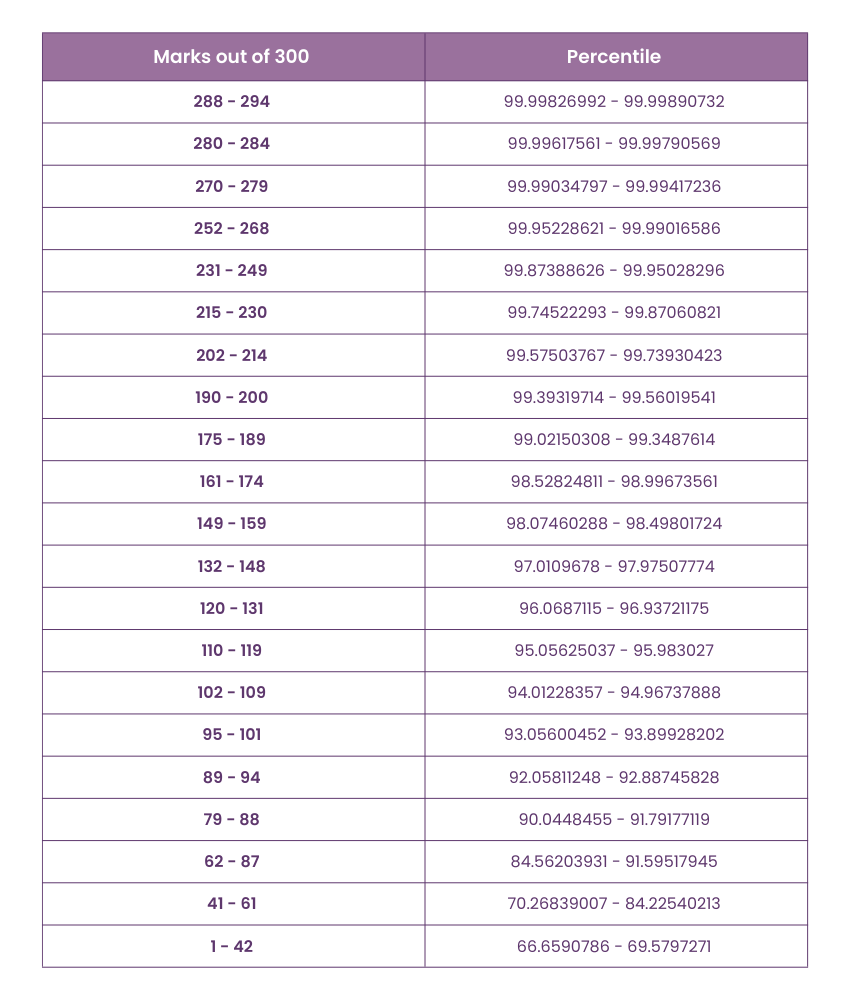
JEE Main 2025 Expected Marks Vs Percentile
Aspirants can refer to this table to know the expected marks range for which a specific percentile is assigned to the respective candidate:
Conclusion
Understanding How to Calculate Percentile in JEE is key to knowing where you stand among your competitors. You can accurately determine your scores with the right formula and a clear step-by-step approach. It's about staying focused, practising consistently, and using your percentile insights to strategise for your success in this highly competitive and prestigious Engineering exam. Understanding the Marks Are Required to Clear JEE Mains is essential, as it allows you to set realistic goals and tailor your preparation to meet the necessary criteria for success.
Want to gain deeper insight into the scope of career development? Our comprehensive Career Development Course will guide you - Sign up now!
Frequently Asked Questions
Can I get IIT With 93 Percentile?

Yes, achieving a 93 percentile in the JEE Main Exam 2025 is considered a good performance. Candidates with this percentile typically score between 95 and 101 marks.
How Many Marks to get 95 Percentile in JEE Main?
A candidate must score above 110 marks out of 300 to get 95 percentile in JEE Main. This indicates the Marks Required to Clear JEE Mains for achieving a competitive edge in the exam.
Which NIT has the Lowest Cutoff?
The cutoffs for NITs can vary depending on the branch. In general, NIT Manipur, NIT Mizoram, NIT Arunachal Pradesh, NIT Meghalaya, and NIT Nagaland tend to have lower cutoffs.
What are the Other Resources and Offers Provided by The Knowledge Academy?
The Knowledge Academy takes global learning to new heights, offering over 3,000 online courses across 490+ locations in 190+ countries. This expansive reach ensures accessibility and convenience for learners worldwide.
Alongside our diverse Online Course Catalogue, encompassing 19 major categories, we go the extra mile by providing a plethora of free educational Online Resources like Blogs, eBooks, Interview Questions and Videos. Tailoring learning experiences further, professionals can unlock greater value through a wide range of special discounts, seasonal deals, and Exclusive Offers.
What is The Knowledge Pass, and How Does it Work?
The Knowledge Academy’s Knowledge Pass, a prepaid voucher, adds another layer of flexibility, allowing course bookings over a 12-month period. Join us on a journey where education knows no bounds.
What are the Related Courses and Blogs Provided by The Knowledge Academy?
The Knowledge Academy offers various Personal Development Courses, including the Engineering Skills Training, Time Management Training and the Supervisor training. These courses cater to different skill levels, providing comprehensive insights into What is Electrical Engineering.
Our Business Skills Blogs cover a range of topics related to career, offering valuable resources, best practices, and industry insights. Whether you are a beginner or looking to advance your career, The Knowledge Academy's diverse courses and informative blogs have got you covered.

The Knowledge Academy


Global Training Provider
The Knowledge Academy is a world-leading provider of professional training courses, offering globally recognised qualifications across a wide range of subjects. With expert trainers, up-to-date course material, and flexible learning options, we aim to empower professionals and organisations to achieve their goals through continuous learning.


 If you wish to make any changes to your course, please


