




We may not have the course you’re looking for. If you enquire or give us a call on +1 6474932992 and speak to our training experts, we may still be able to help with your training requirements.
GDPR Compliance for AI: Key Rules, Strategies and Best Practices
John Davies 18 April 2026Explore how GDPR affects AI, covering compliance requirements, data protection principles, and best practices for lawful and ethical AI use in organisations. AI relies on large volumes of personal data, making strong privacy controls essential. These controls ensure data is used fairly, safely, and carefully.
Home
 Resources
IT Security & Data Protection
GDPR Compliance for AI: Key Rules, Strategies and Best Practices
Resources
IT Security & Data Protection
GDPR Compliance for AI: Key Rules, Strategies and Best Practices
Resources
IT Security & Data Protection
GDPR Compliance for AI: Key Rules, Strategies and Best Practices

Certified General Data Protection Regulation (GDPR) Foundation and Practitioner
 Top Rated Course
Top Rated Course
Exclusive 40% OFF
Training Outcomes Within Your Budget!
We ensure quality, budget-alignment, and timely delivery by our expert instructors.
Table of Contents
From personalised recommendations to automated decision-making, Artificial Intelligence (AI) is becoming an important part of everyday business. However, this growing reliance on data raises concerns about how personal information is collected and used. This is where AI and General Data Protection Regulation (GDPR) come together, ensuring organisations use data responsibly while still benefiting from intelligent technologies.
As businesses continue to adopt AI, maintaining privacy and trust has become critical. A strong data protection approach helps organisations stay compliant, reduce risks, and manage data in a clear and ethical way. In this blog, you will learn about AI and GDPR, their relationship, why GDPR matters, its principles, and more. Let's begin!
Table of Contents
1) Understanding the Impact of GDPR on AI
2) The Relationship Between GDPR and AI
3) Why GDPR Compliance is Crucial for AI Adoption?
4) Key GDPR Principles Relevant to AI
5) How to Use AI and Personal Data in a Compliant Way?
6) Challenges AI Creates for GDPR Compliance
7) Practical Tips for GDPR-compliant AI Systems
8) Conclusion
Understanding the Impact of GDPR on AI
The impact of the GDPR on AI is centred on strict control over personal data usage. AI systems must operate with transparency, fairness, and accountability. Also, organisations must comply with rules around automated decision-making. Failing to meet these requirements can lead to heavy fines and reputational damage, making compliance essential.
This impact is clearly seen across industries. In healthcare, AI tools must protect patient data through anonymisation and controlled use. In retail, businesses using AI for personalised marketing must obtain clear user consent and avoid using data beyond its original purpose. These requirements ensure that AI innovation continues while safeguarding individual privacy rights.

The Relationship Between GDPR and AI
The relationship between AI and GDPR focuses on how personal data is handled within intelligent systems. GDPR sets clear rules that guide AI development while protecting individual privacy and rights. Let’s look at it insightfully below:
1) Legal Basis for Data Processing
AI systems must process personal data based on a valid legal basis under GDPR, such as explicit consent or legitimate interest. Consent must be freely given, informed, specific, and unambiguous. When relying on legitimate interest, organisations must carefully balance their needs with the rights and freedoms of individuals.
2) Rights of Individuals
GDPR provides individuals with several rights over their data. These include the right to access and transfer their data, the right to understand how automated decisions are made, and the right to request data deletion. AI systems must be designed to support these rights and ensure transparency in decision-making processes.
3) Security and Accountability
Organisations must implement strong security measures to protect personal data from breaches or unauthorised access. Additionally, GDPR requires accountability, meaning organisations must document data processing activities, conduct Data Protection Impact Assessments (DPIAs), and apply privacy by design.
4) Data Minimisation and Purpose Limitation
GDPR requires AI systems to collect the minimum amount of data needed for a specific purpose. Data must not be used beyond its original intent without additional consent. This can be challenging for AI models that benefit from large datasets, making careful data selection and governance essential.
5) Anonymisation and Pseudonymisation Techniques
To reduce privacy risks, AI systems must apply anonymisation and pseudonymisation techniques. Anonymisation removes identifying details permanently, while pseudonymisation replaces them with coded identifiers. These methods allow AI systems to analyse data while protecting individual identities effectively.
Build your data privacy foundation fast with the Certified General Data Protection Regulation (GDPR) Foundation Training – Join now!
Why GDPR Compliance is Crucial for AI Adoption?
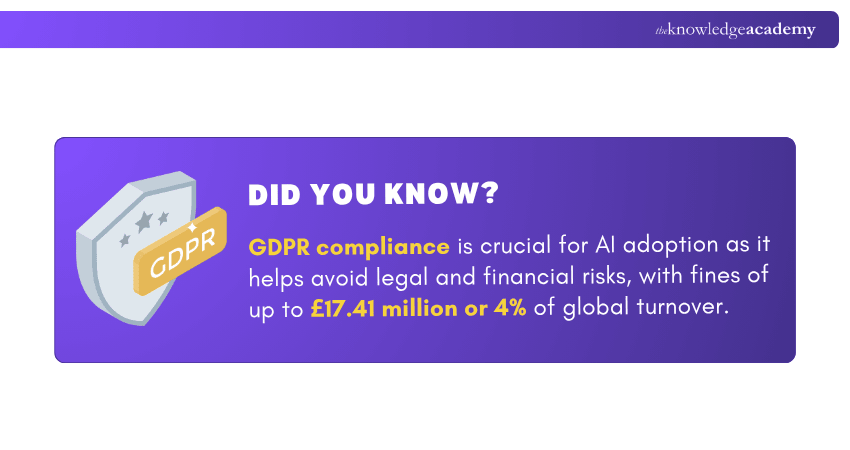
GDPR compliance is crucial for AI adoption because it helps organisations avoid serious legal and financial consequences, along with reputational damage and loss of customer trust. Since AI systems rely heavily on personal data, failing to meet GDPR requirements can create significant risks for businesses.
Also, compliance offers clear advantages when implemented correctly. Aligning AI and GDPR supports responsible innovation, allowing businesses to use AI effectively, meet legal requirements, and maintain transparency. It helps organisations build trust by showing a strong commitment to data protection and ethical practices.
Key GDPR Principles Relevant to AI
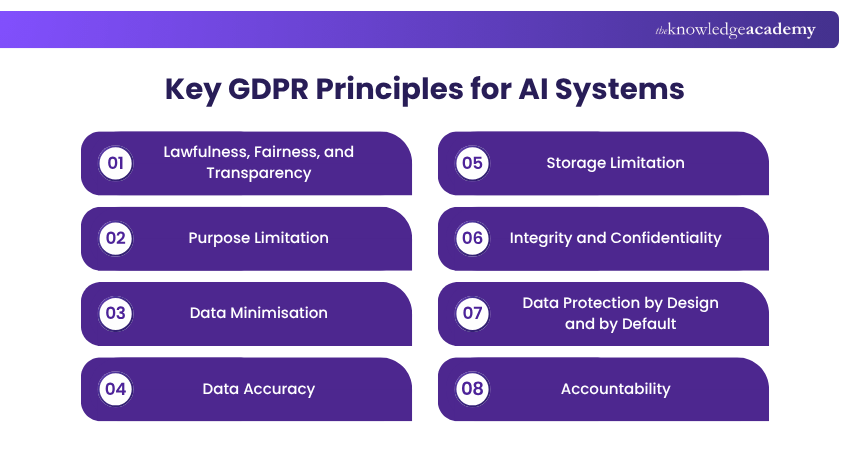
GDPR sets clear principles that guide how personal data should be handled in AI systems. These principles ensure that data is used responsibly, securely, and for specific purposes. Let’s look at them below:
1) Lawfulness, Fairness, and Transparency
AI systems must process personal data lawfully, based on valid legal grounds such as consent or legitimate interest. Fairness ensures that AI outcomes do not harm individuals, while transparency requires organisations to clearly explain how data is used, how decisions are made, and the risks involved.
2) Purpose Limitation
Personal data must be collected for specific, clear, and legitimate purposes. In AI, this means data used to train or run models should not be reused for unrelated purposes unless additional consent or legal justification is obtained.
3) Data Minimisation
AI systems should only use the minimum amount of personal data required for their purpose. Organisations must avoid excessive data collection and use techniques like anonymisation or pseudonymisation to reduce reliance on identifiable data.
4) Data Accuracy
Personal data used in AI must be accurate and kept up to date. Inaccurate or outdated data can lead to incorrect predictions or decisions. Therefore, organisations must regularly review and update datasets to maintain reliable AI outputs.
5) Storage Limitation
Personal data should not be stored longer than necessary. For AI, this means setting clear data retention policies and deleting or anonymising data once it is no longer required for training or analysis purposes.
6) Integrity and Confidentiality
AI systems must protect personal data from breaches, unauthorised access, or misuse. This includes implementing strong security measures such as encryption, access controls, and regular system monitoring.
7) Data Protection by Design and by Default
Privacy must be built into AI systems from the very beginning. Organisations should design AI processes that follow GDPR principles by default. This ensures only necessary data is processed and protection measures are applied automatically.
8) Accountability
Organisations are responsible for consistently demonstrating GDPR compliance. This includes maintaining records, conducting impact assessments, and clearly defining roles such as data controllers and processors in AI data handling.
Learn to drive compliance with practical expertise by joining the Certified General Data Protection Regulation (GDPR) Practitioner Training today!
How to Use AI and Personal Data in a Compliant Way?
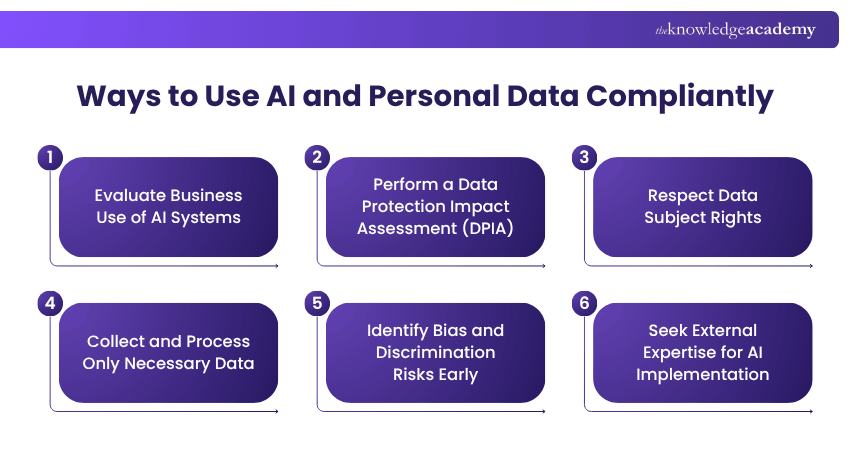
Using AI with personal data requires careful planning to meet GDPR requirements. Organisations must follow clear practices to ensure data is handled lawfully, securely, and fairly. Let's look at some essential ways below:
1) Evaluate Business Use of AI Systems
Organisations must understand how AI is used across their operations. Since AI processes personal data, a valid lawful basis, such as consent or legitimate interest, is required before any data is collected or used for training purposes.
2) Perform a Data Protection Impact Assessment (DPIA)
AI systems involve high-risk data processing, making DPIAs essential. This assessment helps identify privacy risks, evaluate data usage, and demonstrate accountability by clearly outlining how personal data is collected, stored, and processed.
3) Respect Data Subject Rights
Organisations must uphold individual rights such as access, rectification, and erasure of data. Additionally, they must inform users about automated decision-making, explain how decisions are made, and provide options for human intervention where required.
4) Collect and Process Only Necessary Data
AI systems should follow the data minimisation principle by using only relevant and necessary personal data. Techniques like anonymisation, synthetic data, or data masking can help reduce privacy risks while maintaining effective AI performance.
5) Identify Bias and Discrimination Risks Early
AI systems can inherit bias from training data, which can lead to unfair outcomes. Organisations must evaluate data quality, ensure it is representative and up to date, and assess the impact of AI decisions on different groups to reduce discrimination risks.
6) Seek External Expertise for AI Implementation
When using third-party AI tools, organisations should remain responsible for compliance as data controllers. They should ensure proper safeguards are in place and may involve Data Protection Officers (DPOs) to support compliance and risk management.
Think privacy first and always make GDPR awareness your daily habit with the GDPR Awareness Training – Sign up now!
Challenges AI Creates for GDPR Compliance
AI introduces several challenges when aligning with GDPR, mainly due to its reliance on large datasets and complex decision-making processes. Organisations must address these issues carefully to ensure data protection, transparency, and ethical use. Let’s look at the key challenges below:
1) Limited Transparency
Many AI models operate as “black boxes,” making it hard to explain how decisions are made. This creates challenges in meeting GDPR’s transparency requirements, requiring the use of explainable AI methods to improve clarity.
2) Ethical Concerns
AI systems can reflect biases present in training data, leading to unfair or discriminatory outcomes. Organisations must actively identify and reduce bias, ensuring AI decisions are fair, ethical, and aligned with GDPR principles.
3) Cross-border Data Transfers
AI systems involve transferring data across borders, which can conflict with GDPR rules. Organisations must implement safeguards such as Standard Contractual Clauses (SCCs) and encryption to ensure secure and compliant data transfers.
4) Data Quality and Consent Issues
AI depends on large volumes of data, making it difficult to obtain clear and informed consent, especially for third-party data. Organisations must ensure data is accurate, relevant, and collected with proper consent to meet GDPR requirements.
Learn UK data laws with confidence by joining the Data Protection Act Training (DPA 2018) now!
Practical Tips for GDPR-compliant AI Systems
Following practical tips can help organisations ensure their AI systems remain compliant with GDPR. These tips focus on strengthening data protection, transparency, and accountability in AI use. Let’s look at them below:
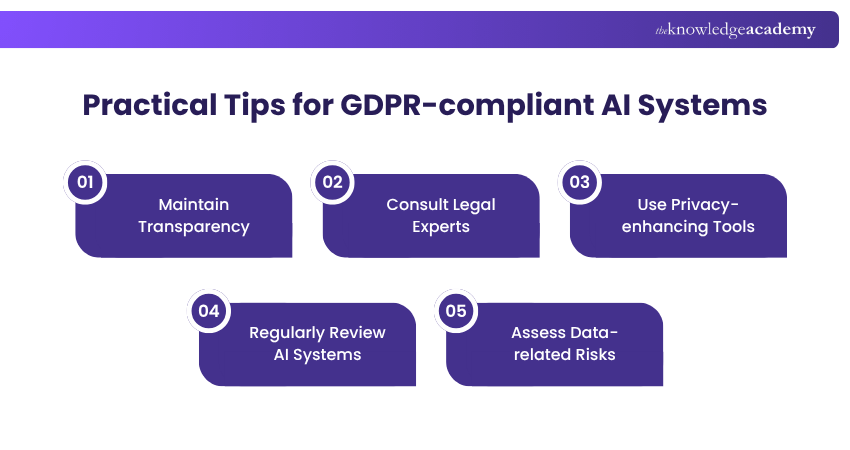
1) Maintain Transparency
Clearly explain how AI systems use personal data in simple language through privacy notices. This helps users understand data usage and supports GDPR transparency requirements. Also, transparent communication builds trust and improves user confidence.
2) Consult Legal Experts
Work with data protection experts or legal advisors to ensure compliance, especially when operating across regions with different data protection laws. Expert guidance helps organisations stay updated with evolving regulations and avoid costly mistakes.
3) Use Privacy-enhancing Tools
Apply techniques such as pseudonymisation or others to protect personal data and minimise the chances of identification while maintaining AI functionality. These tools reduce exposure of sensitive data while allowing meaningful analysis.
4) Regularly Review AI Systems
Continuously monitor and audit AI systems to ensure they comply with GDPR and produce fair, unbiased outcomes over time. Regular reviews also help detect issues early and maintain consistent performance.
5) Assess Data-related Risks
Regularly review how AI systems collect, use, and store personal data. Identifying potential risks and documenting the steps taken to reduce them ensures clear accountability. This helps organisations stay prepared for audits and demonstrate compliance when required.
Conclusion
AI continues to reshape how organisations operate, but its success depends on responsible data use and strong compliance practices. Understanding AI and GDPR is essential to ensure personal data is managed ethically, securely, and transparently. By following key principles, addressing challenges, and applying the best practices, organisations can build trustworthy AI systems and maintain long-term customer confidence.
Turn data privacy into your superpower and stay ahead with smarter GDPR skills by joining the GDPR Training today!
Frequently Asked Questions
Does the UK Have Any Laws on AI?

The UK follows a pro-innovation, sector-based approach to AI regulation. Instead of a single law, it applies principles like safety, transparency, fairness, accountability, and redress. This is supported by existing laws, such as UK GDPR and the Online Safety Act.
What has Replaced GDPR in the UK?
The Data (Use and Access) Act 2025 (DUAA) does not replace UK GDPR but updates it alongside the Data Protection Act 2018. It aims to simplify data use, support AI development, and reduce compliance burdens while maintaining strong data protection standards.
What are the Other Resources and Offers Provided by The Knowledge Academy?
The Knowledge Academy takes global learning to new heights, offering over 3,000+ online courses across 490+ locations in 190+ countries. This expansive reach ensures accessibility and convenience for learners worldwide.
Alongside our diverse Online Course Catalogue, encompassing 17 major categories, we go the extra mile by providing a plethora of free educational Online Resources like Blogs, eBooks, Interview Questions and Videos. Tailoring learning experiences further, professionals can unlock greater value through a wide range of special discounts, seasonal deals, and Exclusive Offers.
What is The Knowledge Pass, and How Does it Work?
The Knowledge Academy’s Knowledge Pass, a prepaid voucher, adds another layer of flexibility, allowing course bookings over a 12-month period. Join us on a journey where education knows no bounds.
What are the Related Courses and Blogs Provided by The Knowledge Academy?
The Knowledge Academy offers various GDPR Training, including the Certified General Data Protection Regulation (GDPR) Foundation and Practitioner Training, Certified General Data Protection Regulation (GDPR) Foundation Training, and GDPR Awareness Training. These courses cater to different skill levels, providing comprehensive insights into Data Breach.
Our IT Security & Data Protection Blogs cover a range of topics related to AI and GDPR, offering valuable resources, best practices, and industry insights. Whether you are a beginner or looking to advance your AI Compliance and Regulation skills, The Knowledge Academy's diverse courses and informative blogs have got you covered.

John Davies


Cyber Security Governance & Assurance Specialist
John Davies is a cybersecurity expert specialising in governance, risk management, and compliance. With over 15 years in the field, he has led enterprise-wide security programmes across finance, healthcare and public sector organisations. His content provides practical guidance on building secure environments, managing risk and aligning with regulatory frameworks.

Upcoming IT Security & Data Protection Resources Batches & Dates
Date
 Certified General Data Protection Regulation (GDPR) Foundation and Practitioner

 If you wish to make any changes to your course, please


