




We may not have the course you’re looking for. If you enquire or give us a call on 01344203999 and speak to our training experts, we may still be able to help with your training requirements.
CISSP vs Security+: Choosing the Right Path
ByVishnu SankarLast updated on: 03 October 2026
The CISSP and Security+ certifications target different career stages and skill levels in cybersecurity. In this blog, we will explain in a simple way what is the difference between CISSP and Security+ and which one will be right for you based on your skill level and career plan.
CISSP vs Security+ are two popular and trusted certifications in the domain of cybersecurity. Both are globally recognised and help professionals build a strong career in the security field. While CompTIA Security+ was introduced in 2002 to meet the growing need for skilled IT/IS experts, CISSP has been around since 1994 to provide deeper knowledge for experienced security professionals.
Recently, interest in both CISSP and Security+ certifications has grown as companies seek certified cybersecurity professionals. Choosing between them depends on factors such as your experience, career goals, and the type of cybersecurity role you want to pursue. Let's learn about it more!
What is CISSP Certification?
The Certified Information Systems Security Professional (CISSP) exam is one of the most respected certifications for cybersecurity professionals in the UK. It is intended for experienced cybersecurity experts and demonstrates their knowledge across a wide range of security domains. One of the key CISSP benefits is its recognition by global organisations, enhancing career prospects and credibility in the field.
CISSP is an advanced cybersecurity certification that validates technical and managerial knowledge across eight security domains. Candidates normally need five years of cumulative work experience in at least two CISSP domains to earn the certification. However, up to one year of the experience requirement may be satisfied through an eligible post-secondary degree or an approved credential. Candidates who pass the CISSP exam without meeting the experience requirement can become an Associate of ISC2 and have up to six years to gain the required experience.
The CISSP exam fees vary by region, so candidates should check the current ISC2 pricing before registering. CISSP holders must earn 120 Continuing Professional Education (CPE) credits during each three-year certification cycle and meet ISC2's other maintenance requirements.
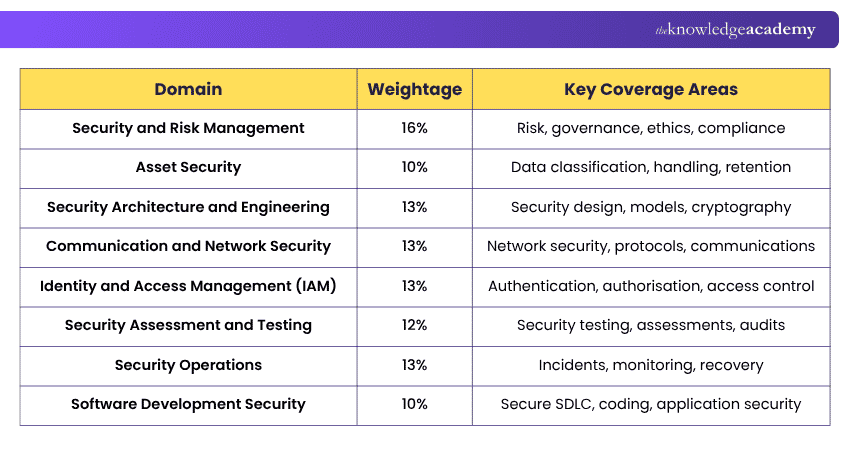
CISSP covers eight domains:
a) Security and Risk Management
b) Asset Security
c) Security Architecture and Engineering
d) Communication and Network Security
e) Identity and Access Management (IAM)
f) Security Assessment and Testing
g) Security Operations
h) Software Development Security

What is CompTIA Security+?
CompTIA Security+ is a foundational certification that tests your basic cybersecurity skills. Through this, you learn how to keep the network safe, identify threats and handle security problems. If you are new and want to start a cybersecurity career, then this certification is best.
Security+ teaches you simple topics like network security, following company security rules, understanding the weak points of the system and identifying threats. With this certification, you get the skills to work in the real world, which is useful for both private and government jobs. This also prepares you to take up higher certifications in the future, like CISSP.
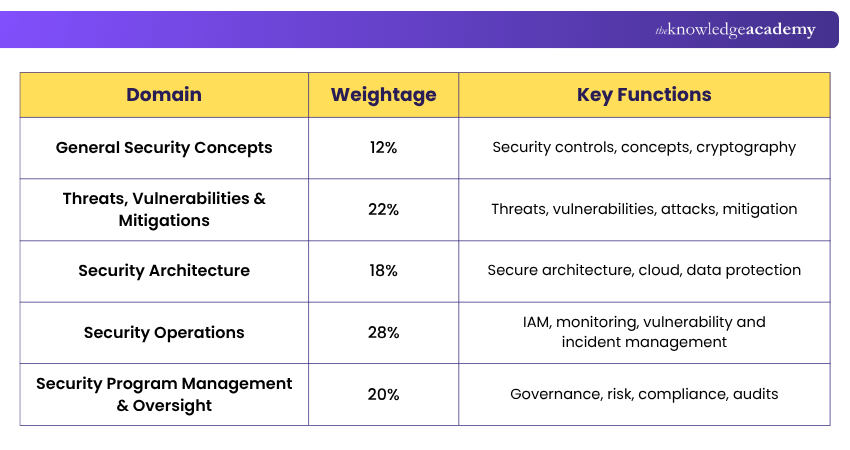
The current CompTIA Security+ SY0-701 exam is organised into five domains covering foundational security concepts, threats, architecture, operations, and security programme management.

Differences Between CISSP and CompTIA Security+
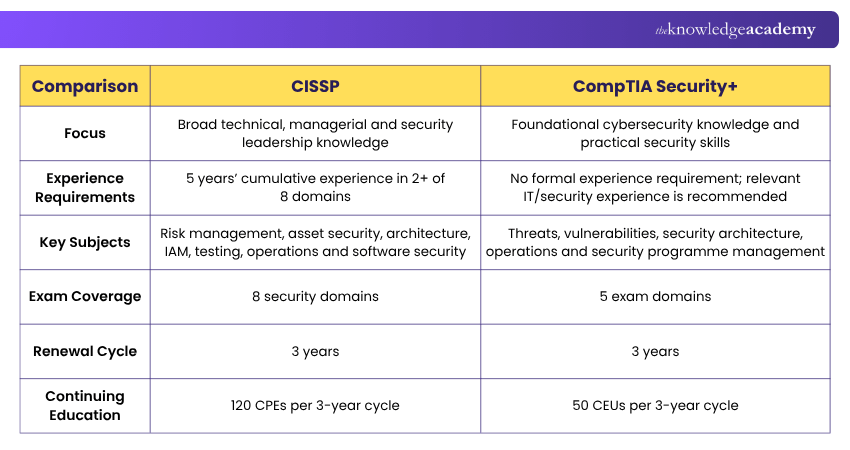
Before you decide whether to pursue CISSP or Security+, it is important to understand the basic differences between the two. The table below will help you quickly compare the two certifications, such as exam fees, experience level, number of topics covered, and what jobs can be obtained. Let's learn about it:
1) Focus
CISSP stands for Certified Information Systems Security Professional and mainly relates to more senior concepts in IT security. It covers the more technical areas, like cryptography, access control, and network security from a broader perspective of information security with eight domains that address most all aspects one could imagine.
Conversely, CompTIA Security+ certification covers a broad swath of cybersecurity topics, including network security, asset security, data protection, and numerous other fundamental areas needed to secure digital environments. It should be more of a big-picture overview covering some basic principles every network admin needs to know about managing and securing networks.
2) Key Subjects
CISSP covers some of the most advanced topics related to security, such as cryptography, access control, and network security. As an example, the CISSP exam is meant to heavily test one's ability in designing, implementing, and managing a resilient cybersecurity program across a broad spectrum of domains.
On the other hand, CompTIA Security+ focuses on network security networking, access control, asset management, and data protection. It is an entry-level certification, which means candidates should have knowledge of how to secure an IT environment.
3) Renewal Period
Either certification must be renewed every three years, verifying the ability of professionals to maintain their competence and sustain industry standards and best practices. Both CompTIA Security+ (a 3-year renewal cycle) and CISSP follow a three-year re-certification policy, as the cybersecurity industry is ever-changing with new threats and opportunities emerging regularly.
4) Continuing Credits
CISSP certification has a more demanding requirement, necessitating the accumulation of 120 Continuing Professional Education (CPE) credits every three years. This reflects the advanced nature of the certification and, following the recent CISSP exam changes, the expectation that CISSP professionals will continuously engage in learning to maintain their expertise.
In contrast, CompTIA Security+ certification requires holders to earn 50 Continuing Education Units (CEUs) over each three-year cycle to keep their certification valid. This emphasises the value of continuous learning and staying up to date with new cybersecurity trends and technologies.
5) Target Audience
The CISSP certification is intended for more seasoned security professionals. Candidates normally need at least five years of cumulative work experience across a minimum of two CISSP domains. Up to one year of this requirement may be satisfied through an eligible post-secondary degree or approved credential. Candidates who pass the exam without sufficient experience may become an Associate of ISC2 while completing the required experience.
In contrast, the CompTIA Security+ Certification is ideal for entry-level and intermediate IT professionals seeking to start or advance their careers in cybersecurity. It establishes a strong foundation and is beginner friendly.
These are only a few main distinctions between CISSP and CompTIA Security+. Both certifications can support cybersecurity professional development, but they are designed for different levels of experience and responsibility.
Quick Check: Which Certification Fits This Profile?
Question: A cybersecurity professional has five years of experience across multiple security domains and wants a certification covering technical, managerial, and security leadership knowledge. Which certification is more aligned with this profile?A. CompTIA Security+B. CISSPC. Both are identical in scopeD. NeitherCorrect Answer: B
CISSP and Security+ Exam Preparation Tips
Structured preparation can help candidates understand the exam objectives, strengthen weaker areas, and become familiar with the exam format.. Here are simple tips for both certifications which will help you:
Pro Tip
Use the official exam outline as a checklist throughout your preparation. Identify the domains where you are weakest and give them additional study and practice time instead of dividing your preparation time equally across every topic.
Tips for CISSP Exam:
1) First, understand all the eight domains of CISSP well. Every topic should be clear.
2) Use multiple resources (CBK, online courses, videos) instead of just one book.
3) If possible, join online training or coaching for better guidance.
4) Solve mock tests and practice papers so that you understand the exam pattern and CAT model.
5) Focus extra on your weak areas and revise them repeatedly.
Tips for Security+ Exam:
1) For your preparation, use whatever study material you find best (videos, books, PDFs).
2) After starting studying, maintain consistency and do not leave gaps in between.
3) Fix the exam date so that motivation remains.
4) Memorise the acronyms (short forms) properly as they are used in the exam.
5) Practice quizzes daily so that the concepts become clear.
6) First, solve performance-based questions, and later, multiple-choice ones (MCQs).
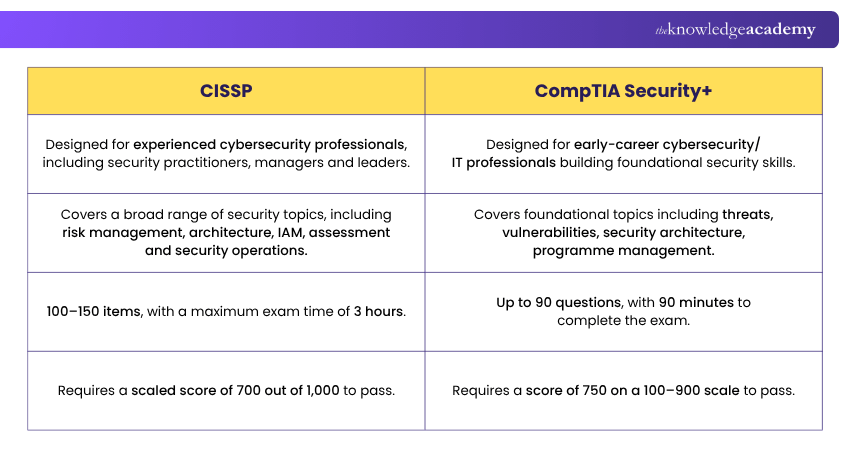
As you can see, these two tests have certain parallels as well as some variances. However, for people looking to begin a career in IT security, both tests are helpful.
Enhance your strategic leadership skills with the Chief Information Security Officer Training now!
CISSP and CompTIA Security+ Job Opportunities
The job opportunities associated with CISSP and CompTIA Security+ differ mainly because the certifications are designed for professionals at different stages of their cybersecurity careers. Let's look at them below:
1) CISSP Job Opportunities
CISSP is designed for experienced cybersecurity professionals and is commonly associated with senior technical, management and leadership positions. Common opportunities include:
a) Cybersecurity Architect: Designs secure enterprise systems and develops security architecture based on organisational requirements.
b) Information Security Manager: Oversees security programmes, policies, risk management and cybersecurity teams.
c) Senior Cybersecurity Consultant: Advises organisations on security strategy, risk management, compliance and security controls.
These positions typically involve enterprise security architecture, governance, risk management, policy development and strategic security oversight.
2) CompTIA Security+ Job Opportunities
CompTIA Security+ is suited to early-career IT and cybersecurity professionals looking to build practical security experience. Common job opportunities include:
a) Security Analyst: Monitors security systems, identifies potential threats and vulnerabilities, and supports incident response.
b) Systems Administrator: Manages and secures IT systems, user access, software updates and system configurations.
c) Network Administrator: Maintains and protects organisational networks, including network devices, access controls and connectivity.
These roles generally focus on hands-on security fundamentals, network defence, security administration and basic vulnerability management.
CISSP and Security+ serve different career stages. CISSP is designed for experienced professionals seeking broader technical and managerial expertise, while Security+ is better suited to building foundational cybersecurity skills. Choose based on your experience, career goals, and the roles you want to pursue, not simply which certification is more advanced.
Take your cybersecurity expertise to the next level by joining the CISSP Training today!

Vishnu Sankar is a Senior Content Writer with 5+ years of experience across content development, software development, web development and system administration. His technical background and professional training support his expertise in IT and Tech, while his extensive research and writing experience covers Project Management and Health and Safety.
View Detail

 If you wish to make any changes to your course, please


