


 Top Rated Course

We may not have the course you’re looking for. If you enquire or give us a call on +32 35001305 and speak to our training experts, we may still be able to help with your training requirements.
Types of Content Marketing: Explained
James Smith 03 March 2026Content marketing combines blogs, videos, podcasts, social posts, emails, and visuals to inform, engage, and influence audiences by goals and preferences. It supports brand trust, demand generation, and conversions across channels, aligning formats with audience intent, buyer journeys, and measurable business outcomes.

Training Outcomes Within Your Budget!
We ensure quality, budget-alignment, and timely delivery by our expert instructors.
Table of Contents

Content marketing is no longer about publishing more content; it is about choosing the right content formats to capture attention and drive action. From blogs and videos to podcasts and social media, each format serves a distinct purpose. Understanding these differences is critical to standing out in a crowded digital landscape.
In this blog, we break down the key Types of Content Marketing and explain how each one works. You will learn where each format fits within the buyer's journey and what business goals it supports.
Table of Contents
1) Types of Content Marketing
2) Why Use Different Types of Content Marketing?
3) Selecting the Best Types of Content Marketing
4) How to create a Content Marketing strategy?
5) Future Trends of Content Marketing
6) What are the 7 A of Content Marketing?
7) What are the 4 C's of Content Marketing?
8) Conclusion
Types of Content Marketing
Now that you know what Content Marketing is, let’s move on to the question - what are the Types of Content Marketing? Well they are as follows:
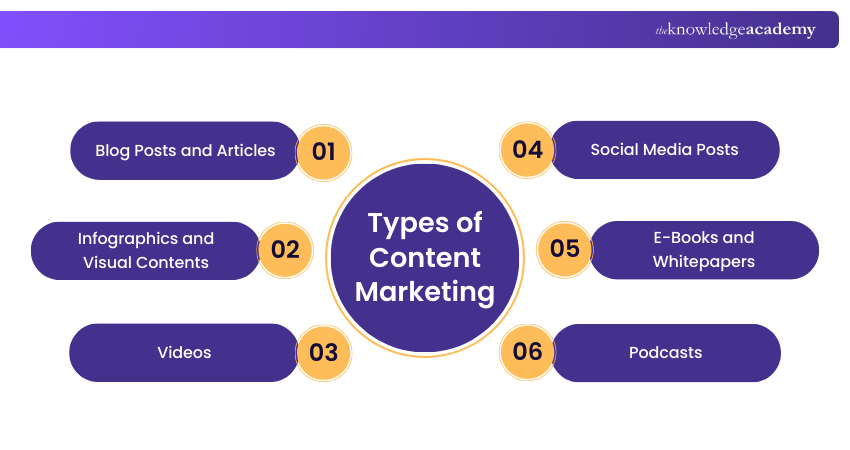
1) Blog Posts and Articles
Blog posts and articles are content marketing cornerstones that provide searchable information that is of value to the target audience. They assist in the establishment of authority, the enhancement of organic visibility, and a clear depiction of the pain points of the audience. Regular publication helps to maintain a steady rise in traffic.
2) Infographics and Visual Contents
Infographics and visual content convert even complicated ideas, figures, and statistics into easily digestible and impressive graphics. These visual resources create better involvement and understanding as they provide information in the form of appealing visuals. When implemented strategically, they have the potential to reach out further across platforms, enabling brands to communicate their insights better.
3) Videos
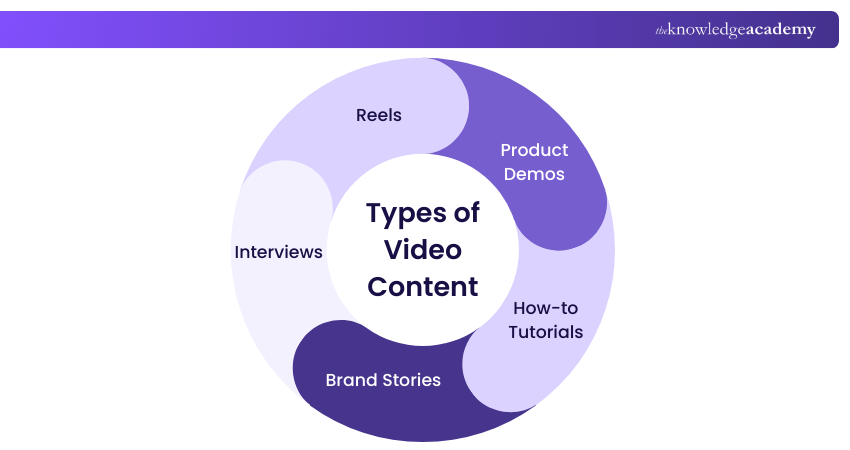
Videos have rapidly become a dominant form of content consumption. It holds the power to inspire and influences audience when written medium fails. This shows the powerful impact of video content in attracting and converting potential customers. Video Marketing provides a dynamic way to engage with your audience. Videos come in several forms:
4) Social Media Posts
Social media platforms are the go-to places for quick and engaging content. Short-form posts, images, and videos shared on platforms like Facebook, Instagram, Twitter, and LinkedIn help maintain brand visibility and keep your audience engaged in real time. Leveraging these platforms allows you to showcase your brand's personality, respond to trends, and connect with your audience on a more personal level.
5) E-Books and Whitepapers
When it comes to in-depth exploration of complex topics, eBooks and whitepapers are invaluable. These longer-form pieces offer comprehensive insights, research, and solutions to specific problems within your industry.
Often gated behind sign-up forms, eBooks and whitepapers also serve as lead-generation tools. By offering valuable content, you capture potential customers' information, enabling further targeted marketing efforts.
6) Podcasts
Podcasts have gained immense popularity due to their portability and convenience. Hosting a podcast allows you to engage your audience while they're commuting, working, exercising, or performing other activities. You can host discussions, interviews, storytelling sessions, and industry insights, creating a strong bond with your listeners through audio content.
7) Webinars and Live Streams
Webinars and live streams offer real-time interaction with your audience. These formats are excellent for hosting workshops, training sessions, Q&A segments, and product launches. Live interaction builds a sense of community. They allow your audience to participate directly, ask questions, and provide feedback. Conducting webinars and live streams also helps promote engagement and authenticity.
8) Case Studies
Showcasing real-world success stories through case studies provides real evidence of your brand's value. Case studies show how your product or service solved a specific problem for a customer. They offer social proof, building credibility and trust among potential customers who can relate to the challenges faced by the subjects of the case study.
9) User Generated Content (UGC)
User Generated Content (UGC) involves your audience creating content related to your brand. This can include reviews, testimonials, photos, videos, and more. UGC serves as authentic and unbiased social proof, showcasing the real impact your brand has on customers' lives. Sharing UGC also fosters a sense of community and involvement, as customers feel valued when their content is featured by the brand.
10) Emails
Email Marketing maintains a direct line of communication with your audience. By sending personalised content directly to subscribers' inboxes, this Email Marketing Statergies can nurture leads and engage existing customers. Email campaigns can include product updates, newsletters, educational content, and special offers. When crafted effectively, email marketing drives conversions and encourages recipients to take specific actions.
Learn advanced Email Marketing strategies with our expert-led Email Marketing Training. Register now!
11) Courses and Online Learning
Creating educational courses and online learning materials positions your brand as an authoritative source in your industry. Through written content, video lessons, or interactive modules, offering valuable educational resources can attract and retain a dedicated audience seeking to enhance their skills or knowledge.
12) Customer Reviews and Testimonials
Leveraging customer reviews and testimonials provides social proof of your product or service's effectiveness. Positive feedback from satisfied customers builds trust and credibility among potential buyers. Moreover, sharing authentic stories of how your offerings have positively impacted real customers can significantly influence purchasing decisions.
13) Interactive Content
Interactive content encourages active engagement from the audience. Examples include:
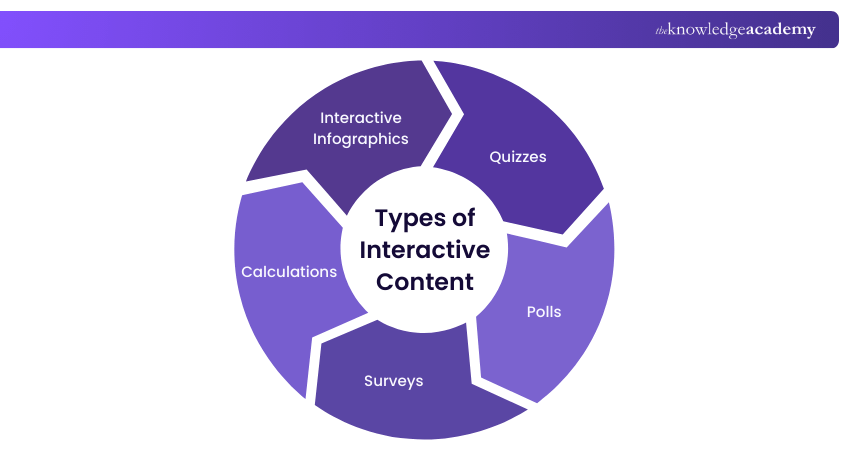
This type of content not only captures attention but also provides personalized experiences, enhancing user participation and satisfaction in Types of Social Media Content.
14) Microsites and Landing Page
Microsites refer to small groups of pages or mini websites containing immersive and rich content that is tailored and based upon a campaign, product, or audience distinct from a parent website. Landing pages are single and specialised pages that aim at eliciting a certain action, i.e., lead generation or conversions, and they have fewer diversions throughout so as to focus on the call to action.
15) Surveys
Surveys are interactive content assets that are used to gather insights, opinions, and feedback straight from the audience. They are also participatory, and they foster first-party data generation. Research findings can be recycled into reports or blogs. Surveys also boost personalisation and evidence-based marketing choices.
16) Memes
The marketing through memes is through the use of humour, trends, and cultural references to convey messages in a very shareable format. They are directed towards fast consumption and social engagement. Memes enhance exposure and connectivity when they are in line with the brand voice. This type of format is optimally used in social media, where people are active.
17) Newsletters
Newsletters provide high-end, filtered content straight to the inbox of subscribers on a routine basis. They assist in fostering relations and sustaining brand correspondence. Best newsletters include information, news, and actions. The format promotes retention, loyalty, and longevity.
18) Influencer Marketing Content
The influencer marketing content is developed with the help of credible voices in the industry to target brands in a genuine manner. It will utilise the credibility and reach of the influencer to create awareness and attraction towards the product or service. This content is usually presented in the form of reviews, which are posts on social media or even sponsored content.
19) Free Tools
Free tools are interactive tools aimed at giving instant value as well as demonstrating expertise. One of their appeals attracts users and solves a particular problem or makes a task easier. Such tools promote re-visiting and data capture. They are very useful in generating leads and building brand authority.
20) Research Reports
Research reports give original information, knowledge, and coverage on the trends or behaviour of the audience in the industry. They place brands as thought leaders as they provide evidence-based views. Reports are frequently walled so as to take leads. This type of content helps with credibility, backlinks, and strategic value in the long run.
Learn advanced Email Marketing strategies with our expert-led Email Marketing Training. Register now!
Why Use Different Types of Content Marketing?
Using different Types of Content Marketing is essential for creating a well-rounded and engaging marketing strategy. Variety in content not only captures the attention of a diverse audience but also caters to different learning preferences and platforms.
Different types of content cater to various segments of your audience. While some people prefer watching videos to understand a concept, others might find written articles more convenient. Hence, by offering a mix of content, you ensure that you're reaching and resonating with a wider range of potential customers.
Moreover, each content type has its own strengths. Videos can provide visual demonstrations, podcasts offer a way to absorb information on the go, and interactive content engages users actively. By utilising these strengths, you maximise the impact of your message.
Furthermore, various platforms thrive on specific types of content. Social media favours visual content like images and short videos, while in-depth content like whitepapers and eBooks can serve as valuable lead magnets on your website.
Adopting diverse content types also keeps your strategy fresh and exciting. It also prevents monotony and keeps your audience looking forward to what you'll share next.
Selecting the Best Types of Content Marketing
Choosing the most suitable types of content for your brand requires a strategic method that aligns with your audience's preferences, marketing goals, and the unique characteristics of your industry. Here's how to navigate this decision-making process:
1) Audience Analysis
Understanding your target audience is very important when it comes to Content Marketing. Perform thorough research to identify their demographics, preferences, behaviours, and content consumption habits.
Ask questions like - Are they more likely to engage with visual content, or do they prefer detailed written articles? Do they have time for podcasts, or are they more responsive to quick social media updates? This analysis forms the basis for personalising your content strategy to align with your audience.
2) Content Goals
Different content types serve different purposes. Are you aiming to educate, entertain, inspire, or drive sales? Your goals should align with your marketing objectives. For example, if your goal is to showcase your expertise, long-form articles or eBooks might be ideal. At the same time, if you want to show your product's functionality, videos and demos could be more effective.
3) Industry Relevance
Consider the nature of your industry. Certain content types may be better suited for conveying information within specific industries. For example, visually driven industries like fashion and design could greatly benefit from Instagram posts and visual content. On the other hand, a B2B company may find webinars and case studies more helpful in revealing their solutions.
4) Resource Allocation
Each content type requires different resources in terms of time, budget, and skills. Analyse your team's strengths and weaknesses. Do you have the expertise to create engaging videos, or would articles be more manageable, given your resources? Properly allocating resources ensures the quality and consistency of your selected content types.
5) Multi-channel Strategy
Consider where your audience spends their time. If they're active on social media, short-form content like infographics, videos, and social media posts might be effective. At the same time, if they're professionals seeking industry insights, webinars, case studies, and eBooks might better align with their preferences. A multi-channel approach can maximise your reach and engagement.
Elevate your brand with impactful Video Marketing – Register for our Video Marketing Training today!
6) Consistency and Adaptation
Consistency is key in Content Marketing. Regularly publishing content builds trust and keeps your audience engaged. However, you need to be open to adaptation. Trends change, and so do audience preferences. A successful Video Marketing Strategy requires you to stay agile and modify your content approach as needed to ensure that you're always delivering what your audience and customers want.
Amplify Brand Identity with Powerful Video Marketing with our Video Marketing Training- Register today!
How to create a Content Marketing strategy?
A well-executed content marketing approach forms the foundation of your efforts to captivate and convert your target audience. It requires meticulous planning, well-defined objectives, and a strategic approach. Here’s a comprehensive Content Marketing Strategy Guide to help you craft an effective and results-driven content marketing plan.
Future Trends of Content Marketing
The trends in Content Marketing are constantly evolving. Industry experts have highlighted key trends that will shape the future of Content Marketing Funnel. AI stands out as the game-changer in this space. However, it must be leveraged strategically. Here’s a list of ways to utilize AI effectively in the near future:
1) AI Usage for Human
This trend talks about the factor that AI should be used to benefit human creators and their audiences. Prioritising the audience's experience is important for various reasons. Content must be relatable in order to enhance their engagement.
AI should be seen as a tool that empowers writers and editors, rather than replacing them. It can assist in researching and improving its quality. However, the creative and strategic aspects should remain human-driven to ensure authenticity.
2) The Change in Search Engine Mechanisms
AI continues to transform search engine mechanisms. Therefore, adapting and aligning content strategy is important. To compete in search results list, the content must prioritise value above everything else, especially with the rise of tools like Google’s Generative AI Search.
Engaging readers by including interactive elements and making content posts to the point will help capture and keep audience attention. Additionally, producing research-heavy, unique content will remain a vital SEO strategy.
3) AI is Encouraging Creator Countermovement
Audiences are always drawn to authentic, behind-the-scenes (BTS) content. It showcases a brand's genuine working process. AI tools in creation are freeing up time for brands to prioritise human interactions. By incorporating real-life elements, such as unfiltered live videos BTS can build stronger relationships with their audiences.
What are the 7 A of Content Marketing?
The 7A framework provides seven key components of a successful content marketing strategy that assist brands in connecting with their audiences and meeting their business objectives. The 7 A's are:
1) Agility: Content strategies should be versatile and able to adjust to new trends, audience behaviour, and insights on performance, such that they can be constantly improved.
2) Authenticity: Real words and content that show a brand with pure voice earn loyalty and emotional attachment with audiences in the long run.
3) Attention: It is necessary to capture and maintain the attention of the audience with captivating headlines, topical issues, and captivating structures to be visible.
4) Audience: Knowing and breaking down the target audience will help focus on the correct needs and preferences.
5) Authority: Becoming a credible source with the help of professional knowledge, useful facts, and a stable supply system makes a brand a trusted one.
6) Action: Good content initiates quantifiable behaviours, like clicks, sign-ups, or purchases, with overt calls to action.
7) Acceleration: Amplifying reach and impact with distribution, promotion, and optimisation to assist content in gaining more traction through channels.
What are the 4 C's of Content Marketing?
The 4 C of content marketing are concepts that constitute the pillars of accomplishing a good strategy and performance in the digital context. They assist the marketer to create content that is resonable, community building, and results in quantifiable change by taking listeners through disillusionment to an action.
The 4 C's explained:
1) Creation: One should create original content of high quality that provides value and valid insight and narrates to the target audience.
2) Curation: Collecting and distributing appropriate content from other visitors to supplement what you provide and give your audience a wider context.
3) Connection: To create relationships and community with your audience and stakeholders by engaging and meaningfully interacting with them in a two-way manner.
4) Conversion: Conversion refers to the act of guiding and inspiring the audience to take a certain action, like signing up, purchasing, or subscribing, through clear calls to action and optimisation.
Conclusion
Content marketing is a powerful tool when you understand the types, strategies, and frameworks that guide effective creation and distribution. By leveraging blogs, videos, infographics, and interactive formats, brands can engage, inform, and convert audiences. Applying the right Types of Content Marketing helps every piece of content to become an opportunity to build trust, visibility, and lasting impact.
Boost your brand’s reach with strategic marketing with our Content Marketing Course – Join today!
Frequently Asked Questions
How Business Benefits From Content Marketing?

Businesses can benefit from Content Marketing. These benefits include:
1) Increased conversion rate
2) Builds strong customer relationship
3) Touch of Personalisation
4) Authenticity
5) Consistency
How many content types are there?
There are multiple types of content. This includes:
1) Blogs
2) Social media content
3) Emailers
4) White papers
5) Case studies
6) Webinars
7) Videos
8) E-books
What are the Other Resources and Offers Provided by The Knowledge Academy?
The Knowledge Academy takes global learning to new heights, offering over 3,000+ online courses across 490+ locations in 190+ countries. This expansive reach ensures accessibility and convenience for learners worldwide.
Alongside our diverse Online Course Catalogue, encompassing 17 major categories, we go the extra mile by providing a plethora of free educational Online Resources like Blogs, eBooks, Interview Questions and Videos. Tailoring learning experiences further, professionals can unlock greater value through a wide range of special discounts, seasonal deals, and Exclusive Offers.
What is The Knowledge Pass, and How Does it Work?
The Knowledge Academy’s Knowledge Pass, a prepaid voucher, adds another layer of flexibility, allowing course bookings over a 12-month period. Join us on a journey where education knows no bounds.
What are Related Courses and Blogs provided by The Knowledge Academy?
The Knowledge Academy offers various Marketing Courses, including Email Marketing Course, Web Analytics Course, and Conversion Rate Optimisation Training. These courses cater to different skill levels, providing comprehensive insights into What is Content Management.
Our Digital Marketing Blogs cover a range of topics related to Content Marketing offering valuable resources, best practices, and industry insights. Whether you are a beginner or looking to advance your Content Marketing skills, The Knowledge Academy's diverse courses and informative blogs have you covered.

James Smith


Digital Marketing Manager and Trainer
James Smith is a digital marketing professional with over a decade of experience in SEO, content strategy, paid media and analytics. He has supported both SMEs and global brands in transforming their digital presence. James’s writing and training are rooted in results-driven tactics and the latest marketing trends.
View Detail
Upcoming Digital Marketing Resources Batches & Dates
Date
 Digital Marketing Course
Digital Marketing Course
Fri 17th Jul 2026
Digital Marketing Course
Fri 13th Nov 2026

 If you wish to make any changes to your course, please


