


 Top Rated Course

We may not have the course you’re looking for. If you enquire or give us a call on +32 35001305 and speak to our training experts, we may still be able to help with your training requirements.
Spatial Computing and Its Key Concepts Explained
The Knowledge Academy 01 May 2026Spatial Computing blends physical and digital worlds, allowing interaction with spaces and objects in real-time through advanced technologies like AR and VR. It enables devices to understand real spaces and respond to movement, voice, and location. It's used in gaming, healthcare, and design to create immersive and real-time experiences.

Training Outcomes Within Your Budget!
We ensure quality, budget-alignment, and timely delivery by our expert instructors.
Table of Contents
Your walls, your desk, and even your coffee cup are now part of the digital experience. The characters from your favourite game can appear in your real surroundings. Wondering how? That’s Spatial Computing. It blends the real world with digital layers, enabling devices to understand and respond to their environment.
You don’t need to be a tech expert to explore this world. Just a little curiosity is enough to begin. So, what are you waiting for? Let’s dive in and see how Spatial Computing works, where it's used, and why it’s worth your attention!
Table of Contents
1) What is Spatial Computing?
2) How Does Spatial Computing Work?
3) Uses for Spatial Computing
4) Steps to Start a Career in Spatial Computing
5) Benefits of Spatial Computing
6) Challenges of Spatial Computing
7) Spatial Computing vs Edge Computing
8) Spatial Computing Examples
9) Future of Spatial Computing
10) Conclusion
What is Spatial Computing?
Spatial Computing is a smart technology where computers understand and work with the space around us. It combines tools like cameras, sensors, and software like Augmented Reality (AR), Virtual Reality (VR), and Artificial Intelligence (AI) to capture, process, and interact with Three-dimensional (3D) data. It enables digital systems to see the real world and respond in a way that feels natural to people.
It has three layers on how it works. Here are its layers:
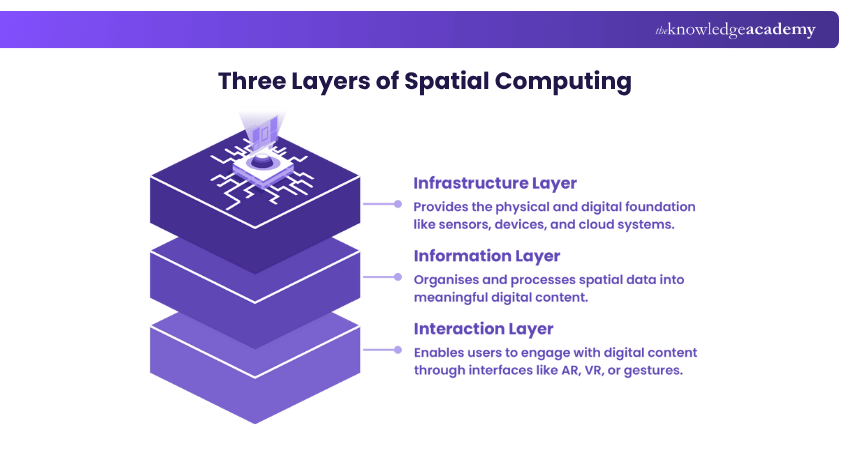
1) Infrastructure Layer: This is the foundation part that contains the hardware and systems that make everything possible. It includes cameras, AR, VR, 5G networks, etc.
2) Information Layer: This is the brain part, where the data is processed and understood. It involves AI, Machine Learning (ML), mapping, data analysis and other related technologies.
3) Interaction Layer: This is the experience part, which determines how the users interact with the system. It includes gestures, voice commands, tracking, etc.

How Does Spatial Computing Work?
Spatial Computing operates in three main steps: collecting data, understanding it, and using it to take action. Each step helps devices interact intelligently with the physical world.
1) Collect Data
The first step involves gathering information from the environment using devices such as smartphones, smart glasses, or VR headsets. These devices rely on:
1) Cameras to capture visuals of the surroundings
2) Sensors to detect movement and orientation
3) GPS to identify precise location
For example: If you wear AR glasses, they might scan your room to figure out where the furniture is.
2) Interpret Insights
Once the data is collected, the device processes and analyses it using technologies like AI, ML, and Computer Vision. This helps the system understand:
1) Where you are in the room
2) What direction you’re looking
3) If someone is speaking or moving
For example: If you're using a VR controller, the system can tell if you're waving, pointing, or picking something up. This helps it decide how to respond in real time.
3) Implement Actions
After understanding the situation, the device takes action. It shows or does something based on what it has learned. It might:
1) Display a 3D model in front of you
2) Play a sound when you get close to an object
3) Show a warning if a machine is about to fail in a factory
For example: While fixing a car, smart glasses highlight the exact part to repair and show alerts if something is wrong.
Learn how to combine multiple sensor information with our Sensor and Data Fusion Training – Register today!
Uses for Spatial Computing
Spatial Computing is transforming industries by combining the digital and physical worlds. Here are some of its most common and impactful uses:
1) Education and Training
Students and professionals can now learn through immersive, hands-on experiences. Instead of just reading about a topic, they can explore it in 3D environments. For example, doctors can practise surgeries in virtual settings, and pilots can train in realistic simulations.
1) Virtual field trips
2) AR flashcards for learning languages
3) Training firefighters in emergency situations
2) Architecture and Design
Architects, engineers, and designers use Spatial Computing to visualise spaces before construction begins. It allows them to walk through digital models, make design changes instantly, and spot potential issues early.
1) Viewing house designs in 3D
2) Checking furniture layout using a phone
3) Using AR to measure spaces on site
3) Gaming and Entertainment
Games feel more real when characters move around your actual space. In such instances, you don’t just play a game; you live in it. Your room becomes part of the game! Some examples include:
1) Playing AR games
2) Dancing games that track your moves
3) Interactive movies and storytelling
4) Healthcare
Hospitals and medical professionals use Spatial Computing for education, diagnosis, and treatment. It helps visualise complex data, simulate procedures, and assist in real-time surgeries.
1) AR for checking vital signs
2) 3D models to teach about the body
3) Remote surgeries using smart glasses
Steps to Start a Career in Spatial Computing
Let's check the steps involved in beginning your career in Spatial Computing:

1) Engage with Spatial Computing as a User
Begin by exploring Spatial Computing yourself. Try AR or VR apps on your phone or explore devices if available. This hands-on approach helps you understand how digital content blends with the real world, making it easier to learn how Spatial Computing works before diving into technical skills.
2) Register in Courses and Bootcamps
To learn Spatial Computing, take online courses or bootcamps that teach AR/VR development, or 3D design. These programs help you understand how to build immersive experiences and use tools that bring digital content into real space. It's a great way to build skills needed for jobs in this fast-growing field.
3) Explore Career Opportunities
While building your skills, start exploring career opportunities in Spatial Computing. Roles include AR/VR developer, 3D UX designer, Computer Vision Engineer, and Digital Twin Specialist. They offer exciting ways to apply your knowledge in real-world projects and emerging technologies.
4) Obtain Relevant Certifications
Boost your employability by earning recognised certifications in Spatial Computing or related fields. Certifications validate your technical abilities, keep your skills up to date, and show employers you’re serious about building a professional career in this fast-evolving domain.
Acquire the concepts of virtualisation and hypervisors with our Introduction to Virtualisation Technologies Course – Join now!
Benefits of Spatial Computing
Spatial Computing brings together the digital and physical worlds in ways that make our lives easier, safer, and more connected. Here are its key benefits:
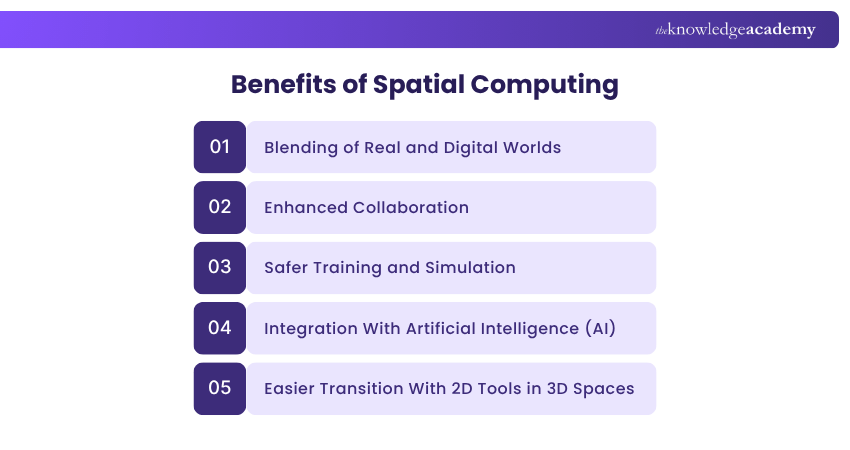
1) Blending of Real and Digital Worlds
Spatial Computing allows digital objects to appear and respond in the real world. Whether it's a 3D heart model floating in front of a medical student or directions displayed on your living room wall, this blending helps you understand and use information more easily and quickly.
2) Enhanced Collaboration
This technology makes teamwork better, even from far away. You can meet in virtual rooms, work on 3D designs together, and see the same digital content in real time. It’s very useful for projects in design, construction, and remote meetings.
3) Safer Training and Simulation
It is great for training in risky or complex environments. Medical students can practise surgeries, architects can walk through buildings before they’re built, and workers can train in factories without real danger. It offers a safe, cost-effective way to learn real-world skills.
4) Integration with Artificial Intelligence (AI)
AI helps Spatial Computing understand what’s happening in the environment. For example, it can recognise objects, people, or gestures and respond with helpful actions. This makes digital experiences smarter, more interactive, and more useful in different settings.
5) Easier Transition with 2D Tools in 3D Spaces
Even though Spatial Computing works in 3D, it still supports familiar 2D tools like web browsers or apps. This makes the experience more comfortable and less confusing for users, especially when starting out. You can work in 3D while still using the tools you already know.
Challenges of Spatial Computing
While Spatial Computing has many exciting benefits, it also has its own challenges. Let's check what they are:
1) Hard to Learn and Build
1) Developers need advanced skills in AR/VR and 3D design
2) Real-time testing needs expensive tools and environments
3) Not enough free or easy tools are available yet
4) This slows down innovation and app development
2) Expensive Devices
1) AR and VR headsets are still costly for most people
2) Schools and small businesses may not be able to afford them easily
3) Hardware upgrades are often needed
4) High price limits wider adoption of the technology
3) Privacy Issues
1) Devices track movement, voice, and even eye direction
2) Sensitive personal data may be collected without consent
3) The risk of data leaks or misuse is high
4) Strong privacy laws and controls are still lacking
4) Lack of Standard Rules and Compatibility
1) Devices from different brands don’t always work together
2) Apps made for one system may not run on another
3) Developers have to rebuild the same app multiple times
4) Users face inconsistent or broken experiences
Experience and apply theoretical knowledge to real-world scenarios with our Digital Twin Course – Sign up soon!
Spatial Computing vs Edge Computing
Spatial Computing combines the physical and digital worlds, allowing humans and machines to interact naturally through 3D environments. It uses technologies like sensors, Augmented Reality (AR) and Virtual Reality (VR) to create immersive experiences that respond to real-world movement and context.
Edge Computing, on the other hand, processes data closer to where it’s generated instead of relying on distant cloud servers. This reduces delays, improves speed, and enhances performance for real-time applications such as IoT devices, autonomous vehicles, and smart cities.
Let's explore their differences:
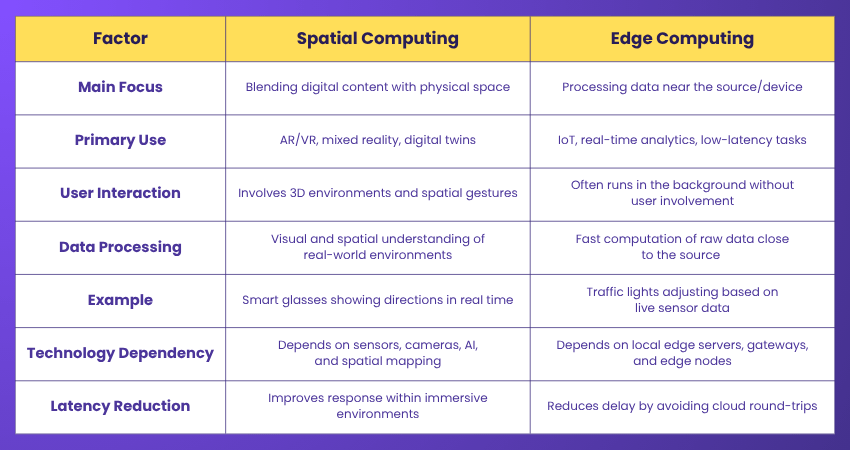
So, Spatial Computing is about where things are and how we use them. Edge computing is about how fast we use the data.
Spatial Computing Examples
Let’s look at how people and companies are using Spatial Computing today:
1) Virtual Reality (VR): VR creates a fully digital environment that replaces the real world. It’s widely used for gaming, immersive training, and virtual tours, allowing users to experience and interact with entirely digital spaces.
2) Augmented Reality (AR): AR overlays digital images, objects, or data onto the real world while keeping your surroundings visible. It enhances what you see rather than replacing it; for example, showing navigation directions on your phone camera view.
3) Mixed Reality (MR): MR combines both physical and digital elements, allowing them to interact in real time. The system understands your space and adjusts digital content accordingly.
4) Extended Reality (XR): XR is the collective term for VR, AR, and MR. It includes all technologies that create immersive experiences by blending the real and virtual worlds in different ways.
Future of Spatial Computing
Spatial Computing will keep growing in the coming years. As hardware becomes cheaper and more powerful, it is expected to expand across industries like education, healthcare, and entertainment, making immersive tech more practical and accessible.
1) Recent Advancements: Devices like the Apple Vision Pro are making Spatial Computing more practical. With multiple sensors and cameras, it enables smooth hand tracking, head movement, and real-world awareness, improving comfort and interaction.
2) The future: As devices get cheaper, lighter, and smarter, Spatial Computing may soon be used daily in work, education, healthcare, and entertainment.
Conclusion
Understanding what is Spatial Computing is now more important than ever. It changes how we use technology by letting us see and touch digital objects in real life. It’s already being used in games, schools, hospitals, and offices, and it’s only getting better. If you want to work with new and exciting technologies, Spatial Computing is a great place to start.
Adapt to diverse technological landscapes effectively with our Advanced Technologies Courses – Be a part of it today!
Frequently Asked Questions
What is Apple's Spatial Computing?

Apple’s Spatial Computing is used in the Vision Pro headset. It lets you control apps using your eyes, hands, and voice. You can watch movies, do work, or browse the web in 3D space, all while seeing the real world around you.
What are the Benefits of Spatial Computing?
Spatial Computing enhances productivity, collaboration, and creativity by merging digital and physical spaces. It enables immersive training, real-time data visualisation, hands-free interaction, and more natural user experiences.
What are the Other Resources and Offers Provided by The Knowledge Academy?
The Knowledge Academy takes global learning to new heights, offering over 3,000+ online courses across 490+ locations in 190+ countries. This expansive reach ensures accessibility and convenience for learners worldwide.
Alongside our diverse Online Course Catalogue, encompassing 17 major categories, we go the extra mile by providing a plethora of free educational Online Resources like Blogs, eBooks, Interview Questions and Videos. Tailoring learning experiences further, professionals can unlock greater value through a wide range of special discounts, seasonal deals, and Exclusive Offers.
What is The Knowledge Pass, and How Does it Work?
The Knowledge Academy’s Knowledge Pass, a prepaid voucher, adds another layer of flexibility, allowing course bookings over a 12-month period. Join us on a journey where education knows no bounds.
What are the Related Courses and Blogs Provided by The Knowledge Academy?
The Knowledge Academy offers various Advanced Technologies Courses, including Virtual Reality (VR) Training, Sensor and Data Fusion Training and Introduction to Virtualisation Technologies Training. These courses cater to different skill levels, providing comprehensive insights into Edge Computing.
Our Advanced Technology Blogs cover a range of topics related to Spatial Computing, offering valuable resources, best practices, and industry insights. Whether you are a beginner or looking to advance your Technological skills, The Knowledge Academy's diverse courses and informative blogs have got you covered.

The Knowledge Academy


Global Training Provider
The Knowledge Academy is a world-leading provider of professional training courses, offering globally recognised qualifications across a wide range of subjects. With expert trainers, up-to-date course material, and flexible learning options, we aim to empower professionals and organisations to achieve their goals through continuous learning.

Upcoming Advanced Technology Resources Batches & Dates
Date
 Virtual Reality (VR) Training
Virtual Reality (VR) Training
Fri 28th Aug 2026
Virtual Reality (VR) Training
Fri 27th Nov 2026

 If you wish to make any changes to your course, please


