


 Top Rated Course

We may not have the course you’re looking for. If you enquire or give us a call on +32 35001305 and speak to our training experts, we may still be able to help with your training requirements.
What Is a Session Token? Definition, Types, and Use cases
Richard Harris 22 April 2026A Session Token is a temporary digital key used to verify a user's identity after login, enabling secure and continuous access to Web Applications. These digital operations can be done without repeated authentication. These are usually stored in cookies, local or session storage and are sent with each request to verify identity.

Training Outcomes Within Your Budget!
We ensure quality, budget-alignment, and timely delivery by our expert instructors.
Table of Contents
Think of a Session Token like your VIP wristband at a concert. Once you’ve passed the entrance (logged in), that token says, “This person belongs here!”, and you’re free to move around without being stopped every five minutes. In the world of web security, tokens are the silent enablers of convenience and safety.
There is a digital glue holding your session together, you can think of them as your personal security badge. In this blog, we’ll decode everything about What is a Session Token, how they work, and how they keep your digital life secure, smooth, and interruption-free. Curious how they work? Read on to know more!
Table of Contents
1) What is a Session Token?
2) Purpose of Session Tokens
3) Session Token Types
4) How Does Session Token Work?
5) Common Use Cases for Session Tokens
6) How to Store Token in Session Storage and Protected?
7) Conclusion
What is a Session Token?
Session and Token Authentication play a crucial role in securing user access. A Session Token is a unique, temporary identifier generated by the server when a user logs into a website or application. It acts like a digital pass that confirms the user’s identity and authorises their actions during an active session. In modern applications, Session Tokens are also widely used in token-based authentication systems like Open Authorisation (OAuth) and JSON Web Token (JWTs).
Once issued, this token is stored on the client side in cookies, sessionStorage, or localStorage and sent back to the server with each request. After verification, if the token is valid and hasn’t expired, access is granted.

Purpose of Session Tokens
Here are the reasons why session Tokens are important:
User Authentication
1) Confirms the user has successfully logged in
2) Acts as digital proof of identity for the user
3) Generated by the server after valid credentials are provided
4) Stored in the user’s browser or app like cookies or local storage
5) Automatically sent with every request to the server
6) Verifies the user's identity without requiring repeated logins
Secure Sessions
1) Maintain secure communication between users and servers
2) Ensure only authenticated users can access protected content
3) Help prevent unauthorised access to sensitive data
4) Tokens are temporary and have a defined lifespan
5) Can be set to expire after inactivity or manual logout
6) Reduce risks like session hijacking and token misuse
Efficiency
1) Eliminates the need for users to log in repeatedly
2) Tokens handle authentication automatically in the background
3) Reduces friction across pages or API calls
4) Enhances page load speed and app responsiveness
5) Lowers server processing load by avoiding repeated authentication checks
6) Delivers a smoother, more seamless user experience
Scalability
1) Ideal for scalable web applications and APIs
2) Support stateless communication
3) Allow easier horizontal scaling across multiple servers
4) Simplify load balancing and server management
5) Enhance performance and reliability, even during high traffic
6) Make applications more flexible and cloud-friendly
Session Token Types
Let's discuss the two primary types of Session Tokens:
Traditional Session Tokens
These are stored on the server side. After logging in, a token is stored in memory or a database and linked to the user’s session. Each client request includes this token, which the server validates before granting access.
Here are the Pros:
1) Simple to implement
2) Server controls session lifecycle
Here are the Cons:
1) Not ideal for large-scale or stateless architectures
2) Higher server load reduces performance as user numbers grow
Design. Build. Launch. Learn Mobile App Development Course today!
Token-based Authentication
This modern approach uses tokens like JSON Web Tokens (JWT) that are stored client-side (in localStorage or sessionStorage). The server signs these tokens with user info and permissions, and clients send them with each request.
Here are the Pros:
1) Stateless and scalable
2) Easy to use across multiple services
Here are the Cons:
1) Requires secure client-side storage
2) Token invalidation can be tricky
How Does Session Token Work?
Let’s walk through their typical lifecycle and processes to get clarification:
Authentication Flow Using a Session Token
Here are some of the basic features:
1) Login Attempt: User submits their credentials like email and password
2) Validation: Server verifies the credentials
3) Token Creation: If valid, the server generates a Session Token
4) Token Delivery: Token is sent to the client and store browser memory or cookie
5) Session Start: Subsequent requests include the token for identity verification
Request Flow Using a Session Token
This is how request flow works and its key features:
1) Client Sends Request: User performs an action like View Orders
2) Token Included: Token is sent in the request header or cookie
3) Server Validates: Server checks the token’s integrity and data
4) Access Granted: If valid, the user action proceeds. If not, access is denied
Lifetime of a Session Token
Tokens aren’t meant to last forever. They typically have an expiry duration set during creation. Features are:
1) Short Lifespan: Improves security by minimising exposure
2) Refresh Tokens: Extend access without needing to re-authenticate
3) Revoke Tokens: Servers can blacklist tokens for additional security
Bring your tech dreams to life. Start Laravel Web Development Training with us!
OAuth and Session Tokens
It is often used for third-party authentication issues access tokens and refresh tokens. Features include:
1) Access Token: Short-lived, used for API requests
2) Refresh Token: Longer lifespan, used to get new access tokens
3) Token-based flows: Relies to offer secure and delegated access to user data
Common Use Cases for Session Tokens
Session Tokens are widely used across the digital landscape to provide secure, seamless user experiences. Here are the common uses of the same:
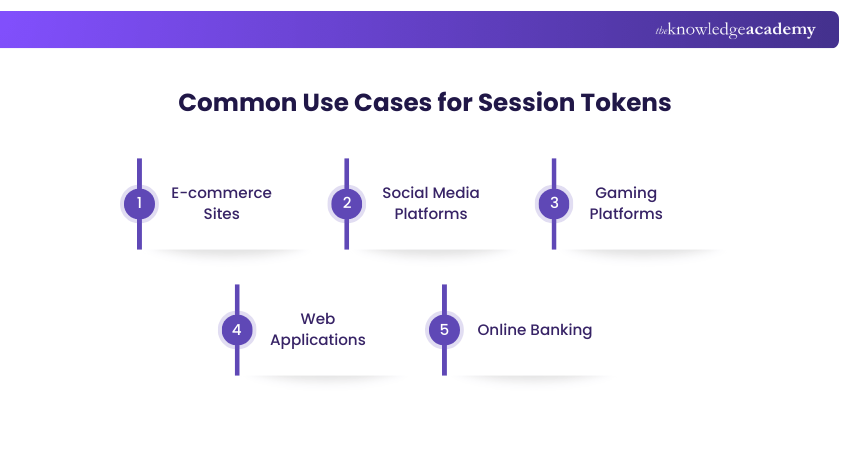
E-commerce Sites
Session Tokens allow users to stay logged in, manage shopping carts, process payments, and track orders securely. They ensure a smooth, uninterrupted shopping experience from browsing to checkout.
Social Media Platforms
On social platforms, Session Tokens are essential for keeping users authenticated while they scroll feeds, post updates, or send messages without repeated logins. They help maintain a seamless and responsive user journey.
Transform ideas into digital experiences. Start coding your future with Node.JS Course today!
Gaming Platforms
In gaming, tokens support secure login, preserve player sessions, track in-game progress, and sync data across devices, offering players a continuous and hassle-free experience.

Web Applications
Productivity tools like Trello or Google Docs use tokens to ensure user data is secure. These activities are done while keeping the UI responsive and uninterrupted.
Online Banking
Security is critical in online banking. Session Tokens enable secure, authenticated access to user accounts while protecting against data leaks and unauthorised transactions.
How to Store Token in Session Storage and Protected?
Using sessionStorage or localStorage comes with both ease and risk. Here are the correct ways on how to do it right:
1) Use sessionStorage that clears on tab close, ideal for short sessions

2) You have to Access the files securely to store token

3) Prevent XSS as it avoids injecting tokens into HTML, use CSP, validate input
4) Always Use HTTPS as it encrypts data in transit
5) Use HttpOnly Cookies to prevent JavaScript access to tokens
6) Token Expiry & Rotation to refresh tokens to reduce risk
Conclusion
This blog takes you through What is a Session Token with great details. It can be concluded that they are like your VIP pass to the internet, quiet, invisible, but essential. They keep you logged in, secure, and moving without a hitch. From shopping carts to banking apps, they’ve got your back. Just treat them right and they’ll make sure your online ride stays smooth and safe.
The world runs on code, learn to write it here with our WordPress Essentials Training now!
Frequently Asked Questions
Is JWT a Session Token?

Yes, a JSON Web Token (JWT) can act as a Session Token in token-based authentication systems. Instead of storing session data on the server, JWTs contain encoded user information and are stored on the client side. It allows stateless, scalable session management across web apps and APIs.
Are Session Tokens Safe?
Session Tokens are safe when properly implemented. Using HTTPS, setting expiration times, preventing XSS attacks, and storing tokens securely like HttpOnly cookies or sessionStorage all help protect them. However, poor practices can expose tokens to theft or misuse, risking hijacking.
What are the Other Resources and Offers Provided by The Knowledge Academy?
The Knowledge Academy takes global learning to new heights, offering over 3,000+ online courses across 490+ locations in 190+ countries. This expansive reach ensures accessibility and convenience for learners worldwide.
Alongside our diverse Online Course Catalogue, encompassing 17 major categories, we go the extra mile by providing a plethora of free educational Online Resources like Blogs, eBooks, Interview Questions and Videos. Tailoring learning experiences further, professionals can unlock greater value through a wide range of special discounts, seasonal deals, and Exclusive Offers.
What is The Knowledge Pass, and How Does it Work?
The Knowledge Academy’s Knowledge Pass, a prepaid voucher, adds another layer of flexibility, allowing course bookings over a 12-month period. Join us on a journey where education knows no bounds.
What are the Related Courses and Blogs Provided by The Knowledge Academy?
The Knowledge Academy offers various App & Web Development Training, including the Website Design Course, Node.JS Course and the MongoDB Course. These courses cater to different skill levels, providing comprehensive insights into Web Application.
Our Programming & DevOps Blogs cover a range of topics related to Web Development, offering valuable resources, best practices, and industry insights. Whether you are a beginner or looking to advance your Development skills, The Knowledge Academy's diverse courses and informative blogs have got you covered.

Richard Harris


Senior Full Stack Developer and Technology Educator
Richard Harris is a highly experienced full-stack developer with deep expertise in both frontend and backend technologies. Over his 12-year career, he has built scalable web applications for startups, enterprises and government organisations. Richard’s writing combines technical depth with clear explanations, ideal for developers looking to grow in modern frameworks and tools.

Upcoming Programming & DevOps Resources Batches & Dates
Date
 Front-End Web Development Course
Front-End Web Development Course
Thu 10th Sep 2026
Front-End Web Development Course
Thu 3rd Dec 2026

 If you wish to make any changes to your course, please


