


 Top Rated Course

We may not have the course you’re looking for. If you enquire or give us a call on +32 35001305 and speak to our training experts, we may still be able to help with your training requirements.
Design Thinking vs Agile: Detailed Comparison
Elizabeth Clark 28 February 2026Explore a detailed comparison between Design Thinking vs Agile. It will help you harness their strengths for successful project outcomes. Both approaches are used to solve problems and deliver value faster. While both focus on user needs, collaboration, and continuous improvement, they serve different purposes.

Training Outcomes Within Your Budget!
We ensure quality, budget-alignment, and timely delivery by our expert instructors.
Table of Contents
The modern-day organisation is constantly seeking ways to adapt, evolve, and stay ahead of the competition. In such a scenario, two popular methodologies, Design Thinking and Agile, have gained prominence for their ability to foster creativity and innovation and improve product development processes.
While both methodologies share common goals, they have distinct approaches and principles. Thus, before utilising any of the methodologies, it’s crucial to learn about their differences. In this blog, we will delve into a detailed comparison between Design Thinking vs Agile. So, read the blog to harness their strengths for successful outcomes.
Table of Contents
1) What is Design Thinking?
2) What is Agile?
3) Design Thinking vs Agile: Key differences
4) What do Design Thinking and Agile Have in Common?
5) Potential Challenges in Combining Agile and Design Thinking
6) How to Select the Right Approach?
7) Which Industries Use Design Thinking and Agile?
8) Conclusion
What is Design Thinking?
Design Thinking is a holistic problem-solving methodology that aims to address complex issues by deeply understanding the needs and experiences of the end-users. This approach recognises the significance of empathy in the creative process, urging teams to put themselves in the users' shoes to gain valuable insights. The Design Thinking process involves five distinct phases that are as follows:
1) Empathise: In this initial phase, teams seek to understand the users' perspectives, challenges, and aspirations. They conduct interviews and observations and engage in open conversations to empathise with users deeply.
2) Define: With insights gathered; teams define the core problem that needs to be solved. This phase requires framing the problem statement in a way that is actionable and relevant to the users' needs.
3) Ideate: Ideation is the creative phase where teams brainstorm and generate numerous potential solutions without judgment. It encourages thinking outside the box and nurtures diverse perspectives.
4) Prototype: Prototyping involves building tangible representations of potential solutions. These prototypes can be either physical or digital and serve as design thinking tools for testing and refining ideas.
5) Test: The final phase involves testing the prototypes with real users to gather feedback. The feedback loop guides further iterations, ensuring that the final solution aligns closely with user needs and expectations.
What is Agile?
Agile is an incremental and iterative approach to Project Management and Product Development. It was initially formulated as a response to the shortcomings of traditional, linear Project Management approaches. Agile methodologies, like Scrum, Kanban, and Lean, focus on delivering value to users in small, manageable increments. Here are some of the key aspects of Agile:
1) Iterative progress: Agile projects are divided into small iterations or increments, often called "sprints" in Scrum. Each iteration results in a shippable product increment, enabling for continuous feedback and improvement.
2) Customer collaboration: Agile places a strong emphasis on customer collaboration throughout the development process. Regular feedback from users or stakeholders helps shape the product's direction.
3) Cross-functional teams: Agile teams are typically cross-functional, consisting of members with diverse skills necessary to complete the work. This promotes collaboration and shared ownership of the project.
Design Thinking vs Agile: Key differences
After understanding about each approach, now, let’s have a detailed look at the key differences between Design Thinking and Agile:
Key Principles
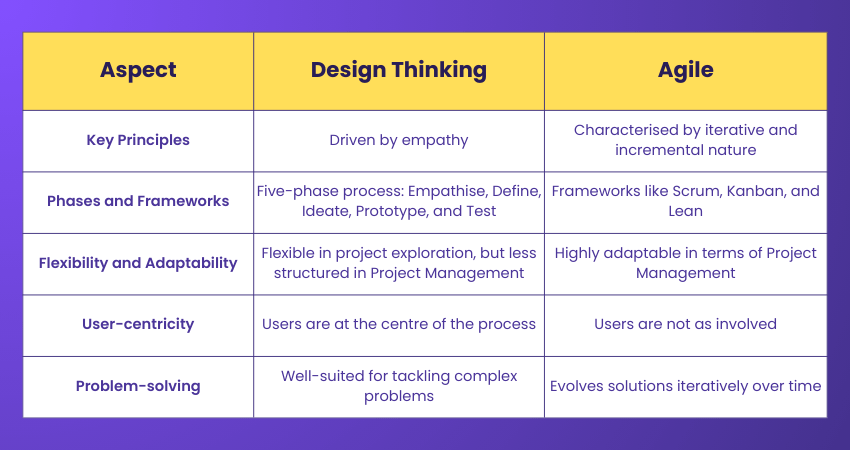
Design Thinking is driven by empathy. It emphasises deeply understanding the users, their experiences, and the context of the problem at hand. It encourages open-ended exploration and creative thinking to uncover novel solutions. The core principle is that by putting oneself in the shoes of the user, teams can identify unmet needs and develop solutions that resonate with users on a profound level.
Agile, in contrast, is characterised by its iterative and incremental nature. It prioritises adaptability, collaboration, and delivering incremental value. Agile teams focus on breaking down complex projects into manageable parts and frequently reassessing and adjusting their approach based on feedback. This iterative approach allows for flexibility and continuous improvement throughout the project's lifecycle.
Phases and Frameworks
Design Thinking follows a structured five-phase process: Empathise, Define, Ideate, Prototype, and Test. Each phase has a specific purpose, starting with empathising with the users to define the problem, generate ideas, create prototypes, and finally, test these prototypes with real users. This process is highly linear and is designed to foster creativity while maintaining a clear progression from understanding the problem to proposing solutions.
Agile, on the other hand, offers a variety of frameworks like Scrum, Kanban, and Lean. These frameworks provide flexibility in structuring the work. For example, Scrum divides work into time-boxed iterations called Sprints, while Kanban uses visual boards to manage and track tasks. The Agile approach is characterised by the continuous flow of work and adaptability, allowing teams to adjust priorities and requirements as they go.
Flexibility and adaptability
Design Thinking is inherently flexible in its problem-exploration phase. It encourages teams to explore diverse ideas and perspectives without the constraints of a predefined process. However, it can appear less structured in terms of Project Management compared to Agile. This flexibility is ideal for situations where the problem space is ambiguous and requires extensive exploration.
Agile, on the other hand, is highly adaptable in terms of Project Management. It provides well-defined processes and frameworks that facilitate efficient task management and progress tracking. Agile teams can easily adjust their course to respond to changing requirements and priorities. This adaptability is particularly valuable in situations where there's a need for rapid adjustments and regular delivery of incremental value.
User-centricity
Design Thinking places users at the heart of the process from start to finish. The entire methodology is centred around gaining a deep understanding of users' needs, motivations, and pain points. This extensive empathy helps in designing solutions that truly resonate with users.
Agile also incorporates user feedback, but it may not immerse as deeply into the user's world as Design Thinking. Agile teams often engage with customers or stakeholders primarily at the beginning and during regular review points, This ensures that the product aligns with user needs but without the same depth of exploration seen in Design Thinking.
Problem-solving
Design Thinking is particularly well-suited for tackling complex problems where understanding the problem space is critical. It encourages teams to spend a significant amount of time exploring and defining the problem thoroughly before proposing solutions. This ensures that the solutions developed are addressing the right issues and resonate with users.
Agile, on the other hand, begins with a problem or a set of requirements and evolves solutions iteratively over time. While it doesn't delve as deeply into problem exploration as Design Thinking, it excels at responding to changing market conditions or user feedback by allowing for flexible adjustments during the project's course.
Lead change and empower teams to build resilient futures with Agile Leadership Training – Join now!
What do Design Thinking and Agile Have in Common?
Design thinking and Agile share similarities despite different scope and execution. Let’s have a look at some similarities between Design Thinking and Agile:
1) Both Design Thinking and Agile prioritise understanding and addressing the needs and preferences of end-users or customers. They involve continuous feedback loops and iterations to ensure that the final product or solution aligns with user expectations.
2) Both methodologies encourage interdisciplinary teams to work together. In Agile, cross-functional teams typically include Developers, Testers, Designers, and other stakeholders. In Design Thinking, teams may consist of Designers, Researchers, Marketers, and individuals from various backgrounds to bring different perspectives to problem-solving.
3) Design Thinking and Agile rely on the concept of prototyping and testing. In Design Thinking, prototypes are used to explore and validate design ideas with users. At the same time in Agile, working software or product increments are tested and refined. Both methodologies prioritise learning through experimentation.
4) Both approaches acknowledge that, especially in complex projects, the full scope and requirements are not always known upfront. They both accept and adapt to changes and uncertainties as the project progresses.
5) Design Thinking places a strong emphasis on empathising with end-users and gaining a deep understanding of their needs through observation and interviews.
Although 'Agile' and 'Design Thinking' share some common ground, they are not interchangeable concepts, as you've learned. Therefore, it's important to consider which method would be the best match for your project and choose accordingly.
Potential Challenges in Combining Agile and Design Thinking
Combining the Agile and Design Thinking methodologies into a single cohesive way of working is no easy feat, and teams may encounter some obstacles during the process. However, the good news is that there are specific steps they can take to combine these approaches effectively. Here's how they can achieve optimum results by combining the two approaches:
Using the right solution at the right time
Choosing the right methodology for product development can feel confusing. Start by applying Agile and Design Thinking to small, low-risk projects. This helps teams gain hands-on experience, understand how each approach works in practice, and build confidence for complex initiatives.
When shaping and exploring an idea, Design Thinking works best because it focuses on understanding users and defining the problem. Agile is more effective once the problem is clear and the solutions need to be delivered quickly. Product design is not linear, so teams must question assumptions, test ideas, and adapt to offer the best possible product.
Balancing design and development
Mixing Design Thinking vs Agile can create tension. To avoid this, it is important that the entire team understands the value of the empathy, definition, and ideation stages in the Design Thinking process. These stages help to clarify the real problem before development begins, reducing work and preventing confusion.
It is also essential to communicate that Design Thinking skills are not limited to the early project phases. The whole team must stay engaged in understanding the problem throughout the lifecycle and collaborate to build a practical design framework. This helps teams to align their efforts and achieve desired outcomes.
Rediscovering the product
As Agile team members become more experienced in Design Thinking, they may realise that their Agile stories have not been validated from a user-centric perspective. To tackle this problem, adopt a dual-track approach and create a unified team of Designers and Developers who allocate their time equally between exploration and delivery.
Cross-functional teams have a better understanding of business requirements and user needs, which enables them to make more informed decisions for the overall customer experience.
Simplifying the design handoff
When Designers pass fixed design assets to Product Developers, misinterpretations may cause Developers to code differently than intended. It's recommended to create interactive prototypes to confirm the design works and simplify handoff rather than sending static design assets.
One more effective approach is to use design patterns as fundamental building blocks. By gaining the acceptance of the whole team, these patterns become simpler to implement and encourage team members to avoid making low-level design decisions.
Increasingly complex requirements
The more complex a product or project is, the more time it takes and the more issues arise. The Scrum Master should collaborate with the development team to break down complex requirements into smaller stories and iterate over time to plan and design the best solution possible. It's recommended to break down the process into small sprints, such as two weeks instead of eight. Ask, what can we accomplish in this 2-week sprint?
To avoid overwhelming your team with too much planning and backlog grooming, it's a good idea to start small by conducting hybrid Sprints that combine Design Thinking activities with agile Sprint Planning. This approach allows for incremental progress while giving your team the flexibility to explore new methods and tackle ambiguous questions.
Sharpen your skills and shape your success with practical skills for powerful leadership with Leadership Skills Training – Join today!
How to select the right approach?
Choosing the right approach between Design Thinking and Agile depends on several critical factors. These factors are as follows:
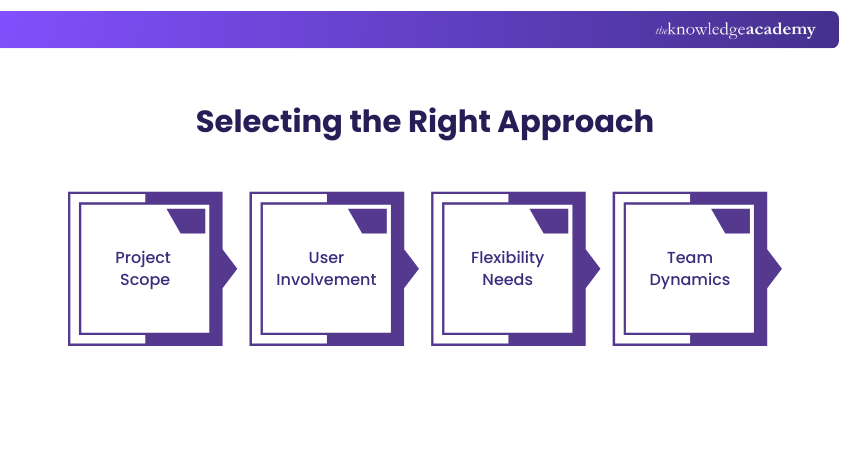
1) Project scope: For projects dealing with complex, user-centric problems, Design Thinking is often more suitable. Agile, with its flexibility, can be applied to a broader range of projects.
2) User involvement: If achieving deep user empathy and understanding is critical, leaning towards Design Thinking is a wise choice. Agile, while incorporating user feedback, may not emphasise it as intensely as Design Thinking.
3) Flexibility needs: If your project requires rapid adaptation to changing requirements, Agile offers greater adaptability due to its iterative nature.
4) Team dynamics: Consider your team's strengths, preferences, and familiarity with each approach. Some teams excel in a more structured Agile environment, while others may prefer the creative freedom afforded by Design Thinking.
Turn complex challenges into creative solutions and drive innovation with human-centred designs with Design Thinking For R&D Engineers Training now!
Which Industries Use Design Thinking and Agile?
Many industries use Design Thinking and Agile to innovate and deliver business value faster. In technology companies, like Apple and IBM apply for Agile iteratives for creating user-friendly products.
Finance use Agile to roll out digital services, healthcare combines both to improve patient experience and systems, while Automotive relies on them for smart and adaptive production.
Conclusion
Understanding the difference between Design Thinking vs Agile enables you to assess both their strengths. Grasping how each works helps organisations to harness their powers. This drives innovation and brings success to your projects. It is essential to choose the method that best aligns with your goals and organisational culture.
Lead with vision, inspire with action with Leadership Courses – Register now!
Frequently Asked Questions
Can Design Thinking and Agile be Used Together?

Yes, Design Thinking and Agile can be used together for a holistic approach to product development. Design Thinking defines the building process in accordance with customer needs, while Agile drives the building process through iterative delivery.
Is Design Thinking Part of Agile?
No, Design thinking and Agile are distinct. Design Thinking explores the problem space, empathising with users and defining needs. Agile tackles the solution space through sprints and iterations.
What are the Other Resources and Offers Provided by The Knowledge Academy?
The Knowledge Academy takes global learning to new heights, offering over 3,000+ online courses across 490+ locations in 190+ countries. This expansive reach ensures accessibility and convenience for learners worldwide.
Alongside our diverse Online Course Catalogue, encompassing 17 major categories, we go the extra mile by providing a plethora of free educational Online Resources like Blogs, eBooks, Interview Questions and Videos. Tailoring learning experiences further, professionals can unlock greater value through a wide range of special discounts, seasonal deals, and Exclusive Offers.
What is The Knowledge Pass, and How Does it Work?
The Knowledge Academy’s Knowledge Pass, a prepaid voucher, adds another layer of flexibility, allowing course bookings over a 12-month period. Join us on a journey where education knows no bounds.
What are the Related Courses and Blogs Provided by The Knowledge Academy?
The Knowledge Academy offers various Leadership Courses, including the Design Thinking Course, Agile Leadership Training, and Design Thinking for R&D Engineers Training. These courses cater to different skill levels, providing comprehensive insights into Design Thinking in Business Strategy.
Our Business Skills Blogs cover a range of topics related to Design Thinking vs Agile, offering valuable resources, best practices, and industry insights. Whether you are a beginner or looking to advance your Design and Agile skills, The Knowledge Academy's diverse courses and informative blogs have got you covered.

Elizabeth Clark


Senior Leadership Trainer and Business Strategist
Elizabeth Clark is a senior trainer and strategist with a strong background in leadership, business management, and operational improvement. With more than 15 years of experience, she has worked with leaders across industries to enhance their influence, communication, and strategic planning skills. Her writing is known for being insightful and focused on real-world leadership challenges.
View Detail
Upcoming Business Skills Resources Batches & Dates
Date
 Successful People Management and Team Leadership
Successful People Management and Team Leadership
Fri 3rd Jul 2026
Successful People Management and Team Leadership
Fri 2nd Oct 2026

 If you wish to make any changes to your course, please


