
Who should attend this ISO 50001 Lead Auditor Training Course?
The ISO 50001 Lead Auditor Course in the United States is specifically designed for managers and individuals who aspire to become Lead Auditors for Energy Management Systems based on the ISO 50001 standard. This course is beneficial for various professionals including:
- Energy Consultants
- Internal Auditors
- Sustainability Managers
- Supply Chain Managers
- Corporate Social Responsibility (CSR) Leaders
- Renewable Energy Project Managers
- Operations Directors
Prerequisites for the ISO 50001 Lead Auditor Training Course
There are no formal prerequisites for attending this ISO 50001 Lead Auditor Course.
ISO 50001 Lead Auditor Training Course Overview
ISO 50001 is an international standard for Energy Management Systems that specifies the requirements for creating, putting into practice, sustaining, and enhancing an EMS. It provides a framework of requirements for organizations in the United States to create a policy for more energy-efficient use, set goals and aims to comply with the policy and make energy consumption-related decisions more clearly.
Professionals aspiring to become Lead Auditors or enhance their auditing skills should aim to master this course in the United States. Lead Auditors play a critical role in assessing compliance and ensuring the effectiveness of management systems such as ISO 9001 (Quality Management), ISO 14001 (Environmental Management), and ISO 45001 (Occupational Health and Safety). This training is essential for Quality Managers, Compliance Officers, and anyone involved in auditing processes.
The Knowledge Academy's 5-day Lead Auditor Training Course in the United States provides a comprehensive understanding of auditing principles, techniques, and the specific requirements of various management system standards. Delegates will gain the expertise to plan, conduct, report, and follow up on audits effectively. Completing this course empowers professionals to lead and manage audits with confidence, ensuring compliance and continual improvement within their organizations.
Course Objectives
- To impart in-depth knowledge of auditing principles and standards
- To provide practical training in audit planning, conducting, and reporting
- To familiarize delegates with the specific requirements of management system standards
- To equip delegates with the skills to lead and manage audit teams effectively
- To prepare professionals for the Lead Auditor Certification in their chosen management system standard
- To enhance delegates' ability to drive compliance and continual improvement through audits
Upon completion of the Lead Auditor Training Course in the United States, delegates will benefit by gaining the expertise needed to lead audits effectively and with confidence. This proficiency not only enhances their professional credentials but also enables them to contribute significantly to the quality, safety, and environmental performance of their organizations.
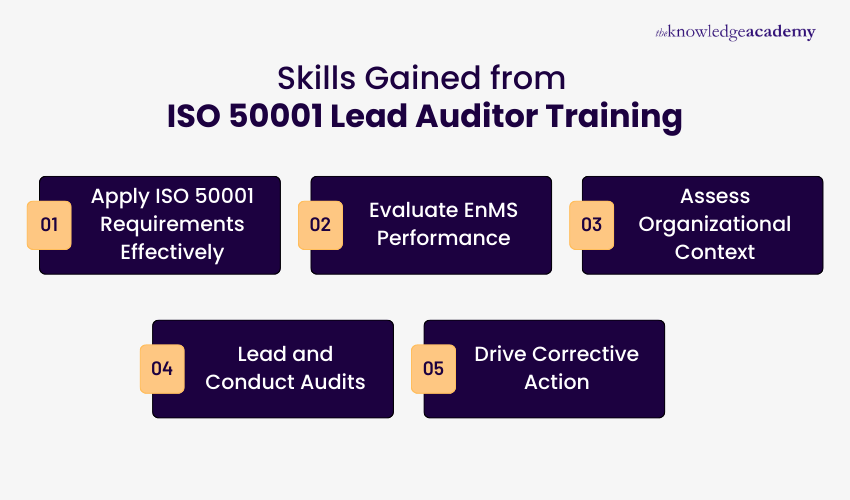
Skills Gained from ISO 50001 Lead Auditor Training
ISO 50001 Lead Auditor Training develops practical auditing, energy management, and performance evaluation capabilities aligned with ISO 50001 requirements. Learners gain end-to-end competence to audit, evaluate, and continually improve Energy Management Systems (EnMS) across organizations.

Here are the core skills professionals will gain from this training:
- Apply ISO 50001 Requirements Effectively: Interpret and apply ISO 50001 terminology, and the Plan-Do-Check-Act (PDCA) cycle when auditing Energy Management Systems.
- Evaluate EnMS Performance: Conduct management reviews and Energy Performance Indicators (EnPIs) and evaluate energy performance using reliable data.
- Assess Organizational Context: Develop the ability to evaluate the organizational context, the needs of interested parties, leadership commitment, and defined roles during audits.
- Lead and Conduct Audits: Gain the capability to conduct internal audits, interview personnel, collect evidence, and evaluate findings against ISO 50001 criteria.
- Drive Corrective Action: Learners will gain the skills to identify nonconformities, verify corrective actions, and support continual improvement through management reviews.