
ArchiMate® Training

accredited by

The ArchiMate® course is accredited by The Open Group®

Online Instructor-led (2 days)

Classroom (2 days)

Official The Open Group ArchiMate® Level 1 Exam

ArchiMate® 3 Training Course Outline

Unit 1: Basic Concepts and Definitions

  • Introduction to ArchiMate® Language
  • ArchiMate® Language for Enterprise Architecture Modelling
  • What is Enterprise Architecture?
  • Key Enterprise Architecture Concepts
  • Stakeholders and Concerns
  • Describing Enterprise Architectures
  • ArchiMate® Language Supports the Development of Enterprise Architectures
  • Definitions
  • Examples

Unit 2: Language Structure

  • Top-Level Hierarchy of ArchiMate® Concepts
  • Definitions: Model, Concept, Element
  • Layering of ArchiMate® Language
  • Definition: ArchiMate® Core Language
  • ArchiMate® Core Language: Three Main Layers
  • Cross-Layer Relationship: Serving
  • Cross-Layer Relationship: Realization
  • Example: Multilayer Model
  • Example: Multilayer Model – Business Layer
  • Example: Multilayer Model – Application Layer
  • Example: Multilayer Model – Technology Layer
  • Example: Multilayer Model – Cross Layer Interaction
  • ArchiMate® Core Framework
  • The ArchiMate® Full Framework
  • Abstract in ArchiMate® Language 
  • External Vs Internal
  • Types Vs Instances
  • Behavior Vs Active Structure
  • Conceptual Vs Logical Vs Physical
  • Types Vs Instances
  • Concepts and their Notation
  • Use of Nesting
  • Use of Colors and Notational Cues
  • Example: Use of Colors and Notational Cues

Unit 3: Generic Metamodel

  • Design Approach
  • Metamodels at Different Levels of Specificity
  • Design and Core Concepts
  • Hierarchy of Behavior and Structure Elements
  • Behavior and Structure Elements Metamodel
  • Behavior Elements Notation
  • Aspects
  • Behavior and Structure Elements Metamodel
  • Active Structure Element Notation
  • Behavior Elements
  • Additional Behavior Element Type: Event
  • Passive Structure Elements
  • Specialisations of Structure and Behavior Elements
  • Summary of Specialisation of Core Elements
  • Motivation and Composite Elements
  • Grouping
  • Location

Unit 4: Modelling Relationships

  • Relationships
  • Structural Relationships
  • Structural Relationships Realization
  • Structural Relationships Assignment
  • Structural Relationships Aggregation
  • Structural Relationships Composition
  • Semantics of Structural Relationships
  • Dependency, Dynamic, and Other Relationship 
  • Relationship Connectors
  • Relationship Review 

Unit 5: Modelling Motivation 

  • Motivation Elements
  • Motivation Elements Metamodel
  • Stakeholder, Driver, and Assessment
  • Goals and Outcomes 
  • Principles, Requirements, and Constraints
  • Meaning and Value
  • Using Motivation Elements with Core Elements

Unit 6: The Strategy Layer

  • Strategy Elements Metamodel
  • Resource (Structure Element)
  • Capability (Behavior Element)
  • Value Stream
  • Course of Action (Behavior Element)
  • Using Strategy Elements with Motivation and Core Elements
  • Strategy Layer Elements Review

Unit 7: Business Layer 

  • Business Layer Metamodel
  • Active Structure, Behavior, and Passive Structure
  • Business Internal Active Structure Elements
  • Active Structure Elements
  • Business Actor
  • Business Role
  • Business Collaboration
  • Business Interface
  • Behavior Elements
  • Business Internal Behavior Elements
  • Business Process
  • Business Event
  • Business Service
  • Business Interaction
  • Passive Structure Elements
  • Business
  • Object
  • Representation
  • Contract
  • Composite Element 

Unit 8: Application Layer 

  • Application Layer Metamodel
  • Active Structure, Behavior and Passive Structure
  • Active Structure Elements
  • Application Component
  • Application Collaboration
  • Passive Structure Elements

Unit 9: Technology Layer 

  • Technology Layer Metamodel
  • Active Structure, Behavior and Passive Structure
  • Active Structure Elements 

Unit 10: Modelling Physical Elements

  • Physical Elements Metamodel
  • Physical Behavior Elements
  • Passive Structure Elements

Unit 11: Relationships Between Core Layers

  • Alignment of the Business Layer and Lower Layers
  • Alignment of the Application and Technology Layers
  • Serving Relationships between Layers
  • Derived Relationships Applied in Relationships Between Core Layers

Unit 12: The Implementation and Migration Layer

  • Implementation and Migration of Metamodel
  • Implementing and Migrating Elements
  • Relationships with Other Aspects and Layers

Unit 13: Addressing Stakeholder Concerns with Architecture Views and Viewpoints

  • Introduction to Architecture Views and Viewpoints
  • Stakeholders and Concerns 
  • Viewpoint Purpose and Content

Unit 14: Language Customization Mechanisms

  • Adding Attributes to ArchiMate® Concepts and Relationships
  • Creating New Element Types Using Specialization
  • Specialization of Elements and Relationships
  • Creating a Profile for Risk Analysis
  • Using Specializations to Model Risk Analysis

ArchiMate® is a registered trademark of The Open Group®.

Show moredown

Who Should Attend this ArchiMate® 3 Training Course?

This ArchiMate® 3 Course in in the United States is intended for individuals involved in Enterprise Architecture projects or those planning to initiate one, and who need to understand the Enterprise Architecture artefacts crafted using the ArchiMate® modeling language. Professionals who can greatly benefit from this course are as follows:

  • Enterprise Architects
  • Solution Architects
  • Technology Architects
  • Business Architects
  • Information Architects
  • IT Architects
  • Application Architects
  • Data Architects

Prerequisites of the ArchiMate® 3 Training Course

There are no formal prerequisites for attending this ArchiMate® 3 Course.

ArchiMate® 3 Training Course Overview

The ArchiMate® 3 Training Course in the United States offers a specialized program designed to equip individuals with the knowledge and skills needed to comprehend and utilize the ArchiMate® 3 modeling language for Enterprise Architecture. The ArchiMate® 3 modeling language is an industry-standard language utilized for visualizing, analyzing, and communicating complex architectural concepts and relationships within organizations.

Targeting Enterprise Architects, IT Professionals, Business Analysts, and anyone involved in Enterprise Architecture planning and design, this course in in the United States emphasizes the significance of the ArchiMate® 3 modeling language proficiency. Particularly beneficial for individuals seeking to enhance their ability to utilize the ArchiMate® 3 modeling language effectively in modeling and analyzing enterprise architectures.

This 2-day ArchiMate® 3 training in the United States covers a range of topics related to the ArchiMate® 3 modeling language, including its key concepts, viewpoints, layers, and relationships. Participants gain practical experience in creating models using the ArchiMate® modeling language to represent different architectural domains, such as business processes, applications, data, and technology infrastructure, through hands-on exercises, case studies, and practical examples.

ArchiMate® 3 Training Course Objectives

  • To learn the fundamentals of the ArchiMate 3.0 modeling language and its core concepts
  • To understand how to model and analyze Enterprise Architectures using the ArchiMate® modeling language
  • To apply the ArchiMate® modeling language principles to enhance collaboration among diverse stakeholders
  • To gain proficiency in expressing architectural views and viewpoints
  • To create visual representations for effective communication in strategic decision-making
  • To prepare for and pass the ArchiMate® 3 Foundation exam

Upon course completion in the United States, delegates will benefit by gaining practical skills in Enterprise Architecture, fostering collaboration, and earning a certification that validates their expertise, positioning them for career advancement in organizational transformation initiatives.

Show moredown

What's Included in this ArchiMate® 3 Training Course?

  • ArchiMate® 3 Training Course: Level 1 Examination
  • ArchiMate® 3 Training Course: Level 2 Examination
  • World-Class Training Sessions from Experienced Instructors
  • ArchiMate® 3 Training Course: Level 1 and Level 2 Certificate
  • Digital Delegate Pack 

Show moredown

ArchiMate® 3 Training Course: Level 1 Exam Information

Passing the ArchiMate® 3 Training Course: Level 1 exam will prove your knowledge of the basic concepts and terminology of the ArchiMate® 3 modelling language, as well as the three layers on which ArchiMate® focuses. The format of the exam is as follows: 

  • Type of Questions: Multiple Choice 
  • Total Questions: 40 (each question is worth 1 mark) 
  • Total Marks: 40 Marks  
  • Pass Marks: 60%, or 24/40 Marks 
  • Duration: 60 Minutes 
  • Open Book/Closed Book: Closed book

ArchiMate® 3 Training Course: Level 2 Exam Information

Passing the ArchiMate® 3 Training Course: Level 2 exam will demonstrate a delegate’s ability to apply the concepts and language of ArchiMate® in practical situations, as well as rewarding those who pass with full ArchiMate® 3 certification. The format of the exam is as follows: 

  • Type of Questions: Scenario-based and Multiple Choice 
  • Total Questions: 8 (each question is worth 5 marks) 
  • Total Marks: 40 Marks 
  • Pass Marks: 65%, or 26/40 Marks 
  • Duration: 90 Minutes 
  • Open Book/Closed Book: Open book

Please note that the ArchiMate® 3 Exams are only available online and not in the classroom. 

Show moredown

accredited by

The ArchiMate® course is accredited by The Open Group®

Online Instructor-led (1 days)

Classroom (1 days)

Official The Open Group ArchiMate® Level 1 Exam

ArchiMate® 3 Training Course: Level 1 Outline

Unit 1: Basic Concepts and Definitions

  • Introduction to ArchiMate® Language
  • ArchiMate® Language for Enterprise Architecture Modeling
  • What is Enterprise Architecture?
  • Key Enterprise Architecture Concepts
  • Stakeholders and Concerns
  • Describing Enterprise Architectures
  • ArchiMate® Language Supports the Development of Enterprise Architectures
  • Definitions
  • Examples

Unit 2: Language Structure

  • Top-Level Hierarchy of ArchiMate® Concepts
  • Definitions: Model, Concept, Element
  • Layering of ArchiMate® Language
  • Definition: ArchiMate® Core Language
  • ArchiMate® Core Language: Three Main Layers
  • Cross-Layer Relationship: Serving
  • Cross-Layer Relationship: Realization
  • Example: Multilayer Model
  • Example: Multilayer Model – Business Layer
  • Example: Multilayer Model – Application Layer
  • Example: Multilayer Model – Technology Layer
  • Example: Multilayer Model – Cross Layer Interaction
  • ArchiMate® Core Framework
  • The ArchiMate® Full Framework
  • Abstract in ArchiMate® Language 
  • External Vs Internal
  • Types Vs Instances
  • Behavior Vs Active Structure
  • Conceptual Vs Logical Vs Physical
  • Types Vs Instances
  • Concepts and their Notation
  • Use of Nesting
  • Use of Colors and Notational Cues
  • Example: Use of Colors and Notational Cues

Unit 3: Generic Metamodel

  • Design Approach
  • Metamodels at Different Levels of Specificity
  • Design and Core Concepts
  • Hierarchy of Behavior and Structure Elements
  • Behavior and Structure Elements Metamodel
  • Behavior Elements Notation
  • Aspects
  • Behavior and Structure Elements Metamodel
  • Active Structure Element Notation
  • Behavior Elements
  • Additional Behavior Element Type: Event
  • Passive Structure Elements
  • Specializations of Structure and Behavior Elements
  • Summary of Specialization of Core Elements
  • Motivation and Composite Elements
  • Grouping
  • Location

Unit 4: Modeling Relationships

  • Relationships
  • Structural Relationships
  • Structural Relationships Realization
  • Structural Relationships Assignment
  • Structural Relationships Aggregation
  • Structural Relationships Composition
  • Semantics of Structural Relationships
  • Dependency, Dynamic, and Other Relationship 
  • Relationship Connectors
  • Relationship Review 

Unit 5: Modeling Motivation 

  • Motivation Elements
  • Motivation Elements Metamodel
  • Stakeholder, Driver, and Assessment
  • Goals and Outcomes 
  • Principles, Requirements, and Constraints
  • Meaning and Value
  • Using Motivation Elements with Core Elements

Unit 6: The Strategy Layer

  • Strategy Elements Metamodel
  • Resource (Structure Element)
  • Capability (Behavior Element)
  • Value Stream
  • Course of Action (Behavior Element)
  • Using Strategy Elements with Motivation and Core Elements
  • Strategy Layer Elements Review

Unit 7: Business Layer 

  • Business Layer Metamodel
  • Active Structure, Behavior, and Passive Structure
  • Business Internal Active Structure Elements
  • Active Structure Elements
  • Business Actor
  • Business Role
  • Business Collaboration
  • Business Interface
  • Behavior Elements
  • Business Internal Behavior Elements
  • Business Process
  • Business Event
  • Business Service
  • Business Interaction
  • Passive Structure Elements
  • Business
  • Object
  • Representation
  • Contract
  • Composite Element 

ArchiMate® is a registered trademark of The Open Group®.

Show moredown

Who should attend this ArchiMate® 3 Training Course: Level 1?

This ArchiMate® 3 Training Course: Level 1 in the United States is designed for individuals involved in Enterprise Architecture projects or those planning to start one. It's especially beneficial for those who need to understand the Enterprise Architecture artefacts created using the ArchiMate® 3 modeling language. Certain professionals who can greatly benefit from it are:

  • Enterprise Architects
  • Solution Architects
  • Technology Architects
  • Business Architects
  • Information Architects
  • IT Architects
  • Application Architects

Prerequisites of the ArchiMate® 3 Training Course: Level 1

There are no formal prerequisites for taking this ArchiMate® 3 Training Course: Level 1.

ArchiMate® 3 Training Course: Level 1 Overview

The ArchiMate® 3 Training Course: Level 1 in the United States provides a comprehensive introduction to the ArchiMate® 3 modeling language, a standardized language for Enterprise Architecture Modeling and communication. As businesses increasingly rely on complex systems, understanding and applying the ArchiMate® modeling language principles becomes crucial for effective strategic planning and decision-making.

To stay competitive in the dynamic field of Enterprise Architecture, professionals across IT, business analysis, and strategic planning should aim at mastering the ArchiMate® modeling language. This training in the United States equips them with the skills needed to create visual representations and align IT solutions with organizational goals, fostering collaboration among diverse stakeholders.

This 1-day training by the Knowledge Academy covers key principles, notation, and techniques. Delegates will learn to model and analyze Enterprise Architectures, enhancing their ability to optimize business processes and contribute to organizational success.

ArchiMate® 3 Training Course: Level 1 Objectives

  • To understand the fundamental concepts and principles of the ArchiMate® modeling language
  • To grasp the notation and language elements used in the ArchiMate® modeling language
  • To comprehend the relationships between different ArchiMate® modeling languages
  • To learn how to create models using the ArchiMate® modeling language for effective communication
  • To apply the ArchiMate® modeling language principles in aligning IT solutions with business objectives
  • To gain practical skills in using the ArchiMate® modeling language for strategic business planning

Upon completion, delegates in the United States will benefit from enhanced proficiency in Enterprise Architecture, validated by a certification, positioning them for career advancement and enabling them to contribute strategically to organizational transformations.

Show moredown

What's included in this ArchiMate® 3 Training Course: Level 1?

  • ArchiMate® 3 Training Course: Level 1 Examination
  • World-Class Training Sessions from Experienced Instructors
  • Digital Delegate Pack

Show moredown

ArchiMate® 3 Training Course: Level 1 Exam Information

Passing the ArchiMate® 3 Training Course: Level 1 exam will prove your knowledge of the basic concepts and terminology of the ArchiMate® 3 modelling language, as well as the three layers on which ArchiMate® focuses. The format of the exam is as follows: 

  • Type of Questions: Multiple Choice 
  • Total Questions: 40 (each question is worth 1 mark) 
  • Total Marks: 40 Marks  
  • Pass Marks: 60%, or 24/40 Marks 
  • Duration: 60 Minutes 
  • Open Book/Closed Book: Closed book

Show moredown

accredited by

The ArchiMate® course is accredited by The Open Group®

Online Instructor-led (1 days)

Classroom (1 days)

Official The Open Group ArchiMate® Level 2 Exam

ArchiMate® 3 Training Course: Level 2 Course Outline

This ArchiMate® 3 Training Course: Level 2 Course is designed to prepare delegates for taking the ArchiMate® 3 Training Course: Level 2 examination and will explain the more advanced aspects of the ArchiMate® modeling language, in addition to revisiting the basic concepts involved in the ArchiMate® 3 modeling language. The course includes:

Module 1: Derivation of Relationship 

  • Derivation Rules
  • Two Types of Derivation
  • Notation of Derivation Rules
  • Derivation Rules for Potential Relationships
  • Restrictions on Applying Derivation Rules

Module 2: Motivation Viewpoint 

  • Stakeholder Viewpoint
  • Goal Realization Viewpoint and Contribution Viewpoint
  • Principles Viewpoint
  • Requirements Realization Viewpoint
  • Motivation Viewpoint

Module 3: Strategy Viewpoints 

  • Strategy Viewpoint
  • Capability Map Viewpoint and Value Stream Viewpoint
  • Outcome Realization Viewpoint
  • Resource Map Viewpoint

Module 4: Basic Viewpoints – Business Layer and Application Layer

  • Organization Viewpoint
  • Business Process Cooperation Viewpoint
  • Product Viewpoint
  • Application Cooperation Viewpoint
  • Application Usage Viewpoint

Module 5: Basic Viewpoints – Technology Layer

  • Implementation and Deployment Viewpoint
  • Technology Viewpoint
  • Technology Usage Viewpoint

Module 6: Implementation and Migration Viewpoints

  • Project Viewpoint
  • Migration Viewpoint
  • Implementation and Migration Viewpoint

Module 7: Applying the Viewpoint Mechanism

  • Defining and Classifying Viewpoints: Purpose Dimension
  • Creating the View
  • Application of the Viewpoint Mechanism in Real-Case Modelling Situations

Module 8: Language Customization Mechanisms

  • Why Should We Customize the Language?
  • Adding Attributes to ArchiMate® Elements and Relationships
  • Profile and Profile Types
  • Creating New Element Types Using Specialization
  • Specialization of Elements and Relationships
  • Using Specializations to Model Risk Analysis
  • Creating a Profile for Risk Analysis
     

ArchiMate® is a registered trademark of The Open Group® .

Show moredown

Who Should Attend this ArchiMate® 3 Training Course: Level 2?

The ArchiMate® 3 Training Course: Level 2 in the United States is designed for professionals who want to learn and apply the ArchiMate® modeling language for Enterprise Architecture. This course is particularly beneficial for:

  • Enterprise Architects
  • Solution Architects
  • Technology Architects
  • Business Architects
  • Information Architects
  • Application Architects
  • Data Architects

Prerequisites of the ArchiMate® 3 Training Course: Level 2

Before registering for the ArchiMate® 3 Training Course: Level 2, delegates must have successfully completed and passed the ArchiMate® 3 Training Course: Level 1 Examination.

ArchiMate® 3 Training Course: Level 2 Course Overview

The ArchiMate® 3 Training Course: Level 2 in the United States is an advanced training tailored to provide individuals with in-depth knowledge and advanced skills in utilizing the ArchiMate® 3 modeling language for Enterprise Architecture. The ArchiMate® 3 modeling language serves as an industry-standard language for visualizing, analyzing, and communicating complex architectural concepts and relationships within organizations.

Designed for experienced enterprise architects, IT professionals, business analysts, and individuals deeply involved in Enterprise Architecture planning and design, this course aims to elevate participants' proficiency in the ArchiMate® 3 modeling language. It's especially beneficial for those striving to enhance their ability to utilize the ArchiMate® 3 modeling language effectively in modeling and analyzing intricate enterprise architectures in the United States.

The Knowledge Academy's 1-day ArchiMate® Training in in the United States empowers delegates by honing their expertise in advanced concepts of the ArchiMate® modeling language. This includes a focus on intricate aspects such as advanced layering, cross-layer dependencies, and the application of the ArchiMate® modeling language in motivation extension.

ArchiMate® 3 Training Course: Level 2 Objectives

  • To master advanced concepts and principles of the ArchiMate® 3 modeling language, delve into its comprehensive framework and explore its depth
  • To enhance proficiency in creating complex models for diverse architectural domains, practice applying the knowledge in varied scenarios
  • To apply advanced viewpoints, layers, and relationships effectively, understand their interconnections for a holistic enterprise architecture view
  • To utilize modeling techniques to analyze and optimize intricate enterprise architectures, focus on strategic alignment with business goals
  • To foster enhanced communication and collaboration among stakeholders through advanced models, create clear, understandable, and relevant models addressing stakeholders' concerns

Upon completion of the ArchiMate® 3 Training Course: Level 2 in in the United States, participants emerge equipped with advanced knowledge, skills, and certification in employing the ArchiMate® 3 modeling language for sophisticated enterprise architecture planning and design. They are poised to leverage models to align intricate business and IT strategies, elevate decision-making processes, and drive transformative organizational change.

Show moredown

What's Included in this ArchiMate® 3 Training Course: Level 2?

  • ArchiMate® 3 Training Course: Level 2 Examination
  • World-Class Training Sessions from Experienced Instructors
  • Digital Delegate Pack

Show moredown

ArchiMate® 3 Training Course: Level 2 Exam Information

Passing the ArchiMate® 3 Training Course: Level 2 exam will demonstrate a delegate’s ability to apply the concepts and language of ArchiMate® in practical situations, as well as rewarding those who pass with full ArchiMate® 3 certification. The format of the exam is as follows: 

  • Type of Questions: Scenario-based and Multiple Choice 
  • Total Questions: 8 (each question is worth 5 marks) 
  • Total Marks: 40 Marks 
  • Pass Marks: 65%, or 26/40 Marks 
  • Duration: 90 Minutes 
  • Open Book/Closed Book: Open book

Please note that the ArchiMate® 3 Exams are only available online and not in the classroom. 

Show moredown

Not sure which course to choose?

Speak to a training expert for advice if you are unsure of what course is right for you. Give us a call on +1 7204454674 or Inquire.

Introduction to ArchiMate® Courses

ArchiMate® Courses offer professionals an industry-recognised route to mastering Enterprise Architecture using the ArchiMate® modelling language. These courses cover the full framework, from foundational concepts to advanced modelling techniques, and are accredited by The Open Group®.

Core concepts covered in ArchiMate® Courses are:

  • Language Structure and Metamodel: Learners understand the fundamental structure of the ArchiMate® modeling language, including core concepts, key elements, and the generic metamodel used to represent Enterprise Architectures.
  • Business, Application, and Technology Layers: Professionals understand the three main layers of the ArchiMate® modeling language and learn how to model business processes, application interactions, technology services, and supporting infrastructure.
  • Cross-Layer Relationships: Delegates gain knowledge of how relationships flow across different layers, enabling them to model dependencies, interactions, and alignment between business needs, application behavior, and technology components.
  • Implementation and Migration Layer: Participants learn how to model implementation stages, work packages, deliverables, and migration plans that support transformation initiatives and enterprise change programs.
  • Architecture Views and Viewpoints: Learners understand how to use viewpoints to communicate specific architectural concerns and create visual representations that support analysis, stakeholder engagement, and strategic decision-making.
     

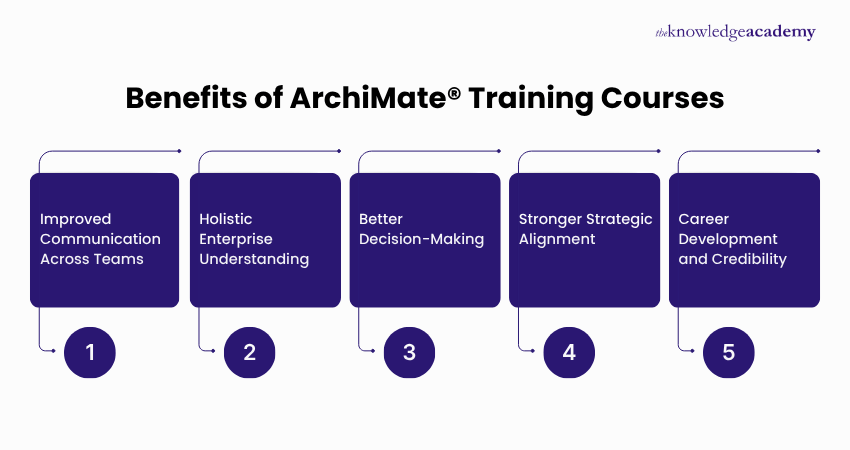
Benefits of ArchiMate® Training Courses

The Knowledge Academy’s ArchiMate® Training Courses help organizations model complex Enterprise Architectures in a clear, structured way. This training strengthens communication, supports better strategic decisions, and enhances the professional profile of delegates. The key benefits of these courses include:

Benefits of ArchiMate Training Courses

  • Improved Communication Across Teams: This training helps professionals use a standardized visual language, enabling clearer communication between business, application, and technology teams during architecture discussions.
  • Holistic Enterprise Understanding: Learners gain the ability to view the entire organization across business, application, and technology layers, improving awareness of how processes, systems, and capabilities are connected.
  • Better Decision-Making: the ArchiMate® modeling language supports impact analysis, scenario exploration, and options comparison, helping organizations make informed decisions about change, investment, and transformation.
  • Stronger Strategic Alignment: Delegates learn to design architectures that clearly demonstrate how IT capabilities support business goals, improving alignment between enterprise strategy and technology roadmaps.
  • Career Development and Credibility: Completing ArchiMate® Training and certification showcases specialist skills in Enterprise Architecture modelling, supporting career progression into roles such as Enterprise Architect, Business Architect, or IT Strategy Professional while strengthening professional credibility.
Show more blue-arrow

Package deals for ArchiMate® Training

Our training experts have compiled a range of course packages on a variety of categories in ArchiMate® Training, to boost your career. The packages consist of the best possible qualifications with ArchiMate® Training, and allows you to purchase multiple courses at a discounted rate.

Swipe for more. Don’t miss out!

ArchiMate® Training FAQs

ArchiMate® Training is a program designed to teach participants about the ArchiMate® modeling language, which is used for enterprise architecture modeling.
Whether ArchiMate® Training is worth it depends on individual career goals and industry requirements. However, for professionals in the field of Enterprise Architecture, the knowledge of the ArchiMate® modeling language can be a valuable skill to possess.
The ArchiMate® modeling language is used for modeling Enterprise Architectures, describing, analyzing, and visualizing architecture structures, processes, and relationships within organizations.
The requirements for ArchiMate® Training typically include knowledge of enterprise architecture principles, familiarity with modeling concepts, and proficiency in using ArchiMate modeling tools.
The renewal requirements for ArchiMate® Certification may vary depending on the certifying body. Some certifications may require periodic renewal through continuing education or re-examination.
ArchiMate® Certification includes different levels such as Foundation, Practitioner, and Master, each representing a progressively advanced understanding and proficiency in using the ArchiMate® modeling language.
The ArchiMate® Training Courses include examinations, world-class training sessions led by experienced instructors, an ArchiMate® Certificate, and a digital delegate pack.
The durations of the ArchiMate® Training Courses vary, and it's necessary to check each specific course to know about its respective duration.
ArchiMate® Training Certification can help develop skills in Enterprise Architecture modeling, understanding and analyzing architecture structures, processes, and relationships, and proficiency in using the ArchiMate® modeling language and tools.
After completing the ArchiMate® Courses, individuals may pursue various job opportunities such as Enterprise Architect, Solution Architect, Business Analyst, IT Consultant, or roles related to Enterprise Architecture and business process modeling in organizations across different industries.

The Knowledge Academy is one of the Leading global training provider for ArchiMate® Training.

The training fees for ArchiMate® Training in the United States starts from $3695

Show more down

Why we're the go to training provider for you

icon

Best price in the industry

You won't find better value in the marketplace. If you do find a lower price, we will beat it.

icon

Trusted & Approved

Recognised by leading certification bodies, we deliver training you can trust.

icon

Many delivery methods

Flexible delivery methods are available depending on your learning style.

icon

High quality resources

Resources are included for a comprehensive learning experience.

barclays Logo
deloitte Logo
Thames Water Logo

"Really good course and well organised. Trainer was great with a sense of humour - his experience allowed a free flowing course, structured to help you gain as much information & relevant experience whilst helping prepare you for the exam"

Joshua Davies, Thames Water

santander logo
bmw Logo
Google Logo
cross

Upgrade Your Skills. Save More Today.

superSale Unlock up to 40% off today!

WHO WILL BE FUNDING THE COURSE?

close

close

Thank you for your enquiry!

One of our training experts will be in touch shortly to go over your training requirements.

close

close

Press esc to close

close close

Back to course information

Thank you for your enquiry!

One of our training experts will be in touch shortly to go overy your training requirements.

close close

Thank you for your enquiry!

One of our training experts will be in touch shortly to go over your training requirements.