
APM Training

accredited by

Our APM PMQ course is accredited by APM

Online Instructor-led (5 days)

Classroom (5 days)

Online Self-paced (40 hours)

APM PMQ Exam

APM Project Management Qualification (PMQ) Course Outline

The APM Project Management Qualification (PMQ) syllabus is based upon the APM Body of Knowledge 7th edition. Through this 5-day training course, you will gain a broad understanding of Project Management, which help you participate in projects of different capacities, ranging from small-scale individual projects to large organizational projects.

Module 1: How Organizations and Projects Are Structured

  • Differentiate between Permanent and Temporary Organization Structures
  • Way in Which an Organizational Breakdown Structure is Used to Create a Responsibility Assignment Matrix
  • Role and Key Responsibilities of the Project Manager
  • Responsibilities of the Project Manager and the Project Sponsor Throughout the Project
  • Describe Other Roles Within Project Management
  • Describe the Functions and Benefits of Different Types of Project Office
  • Why Aspects of Project Management Governance are Required?

Module 2: Project Life Cycles

  • Differentiate Between Linear, Iterative and Hybrid Life Cycles
  • Why Projects are Structured as Phases in a Linear Life Cycle?
  • Differentiate Between a Project Life Cycle and an Extended Life Cycle
  • Role of Knowledge and Information Management to Inform Decision Making
  • Benefits of Conducting Reviews Throughout the Life Cycle
  • Why Projects May Close Early?

Module 3: Situational Context of Projects

  • Differentiate Between Projects and Business as Usual
  • Differentiate Between Project Management, Portfolio Management and Programme Management
  • Relationship Between Programs, Projects and Strategic Change
  • Where the Use of Program Management May be Appropriate?
  • Where the Use of Portfolio Management May be Appropriate?
  • Tools and Techniques Used to Determine Factors Which Influence and Impact Projects
  • Impact of the Legal and Regulatory Environment on Projects

Module 4: Communication within Project Management

  • Benefits to a Project of a Communication Plan
  • Relationship Between Stakeholder Analysis and an Effective Communication Management Plan
  • State Factors Which Can Positively or Negatively Affect Communication
  • State Sources of Conflict Within a Project
  • Ways in Which Conflict Can be Addressed
  • How to Plan and Conduct Negotiations?

Module 5: Principles of Leadership and Teamwork

  • How Leadership Impacts Team Performance and Motivation
  • Change Leadership Styles to Effectively Support the Management of a Project
  • Characteristics and Benefits of Effective Teams and Teamwork
  • Factors Which Impact the Leadership of Virtual Teams
  • Which Influences the Creation, Development and Leadership of Teams?

Module 6: Understand Planning for Success

  • Importance of a Business Case Throughout the Project Life Cycle
  • What’s Meant by Benefits Management
  • Investment Appraisal Techniques Used by a Project Manager
  • Information Management Process
  • Factors Which Would Typically be Reported on to Help Ensure Successful Project Outcomes
  • Relationship Between the Deployment Baseline and the Development of a Project Management Plan in Linear and Iterative Life Cycles
  • Importance of Producing a Project Management Plan
  • Typical Contents of a Project Management Plan
  • Approaches to Producing Estimates
  • Reasons for and Benefits of Re-estimating with Project Life Cycle
  • Relationship Between Stakeholder Analysis, Influence and Engagement
  • Importance of Managing Stakeholder Expectations to the Success
  • Why a Project Manager Would Use Earned Value Management?
  • Interpret Earned Value Data
  • Benefits of Using the Interpretation of Earned Value Data
  • Role of Contingency Planning in Projects

Module 7: Understand Project Scope Management

  • Scope in Terms of Outputs, Outcomes and Benefits
  • How to Establish Scope Through Requirements Management Processes?
  • How to Manage Scope Through Configuration Management Processes?
  • Different Stages of a Typical Change Control Process

Module 8: Schedule and Resource Optimization

  • Ways to Create and Maintain a Schedule
  • Differentiate Between Critical Path and Critical Chain as Scheduling Techniques
  • How Resources are Categorized and Allocated to a Linear Life Cycle Schedule?
  • How Resources are Categorized and Allocated to an Iterative Life Cycle Schedule?
  • Differentiate Between Resource Smoothing and Resource Levelling.
  • Differentiate Between Cost Planning for Iterative Life Cycles and Cost Planning for Linear Life Cycles

Module 9: Understand Project Procurement

  • Purpose, Typical Content and Importance of a Procurement Strategy.
  • Differentiate Between Different Methods of Supplier Reimbursement
  • Differentiate Between Different Contractual Relationships.
  • Supplier Selection Process

Module 10: Risk and Issue Management of Project Management

  • Explain Each Stage in a Risk Management Process
  • Proactive and Reactive Responses to Risk
  • Benefits of Risk Management
  • Key Aspects of Issue Management

Module 11: Quality in the Context of a Project

  • What’s Meant by Quality Planning?
  • Differentiate Between Quality Control and Quality Assurance

Show moredown

Who Should Attend this APM PMQ Course?

This APM Project Management Qualification (PMQ) is suitable for project professionals who want to broaden their project management knowledge and take on greater responsibility within project environments. It is particularly beneficial for:

  • Project Managers
  • Assistant Project Managers
  • Project Coordinators
  • Project Officers
  • Program Team Members
  • PMO Professionals
  • Project Engineers
  • Business Analysts

Prerequisites for the APM PMQ Course

There are no specific academic prerequisites for attending this course. However, previous experience working within a project environment and a basic understanding of project management practices would be beneficial for delegates.

APM Project Management Qualification (PMQ) Course Overview

The APM PMQ Course develops broad knowledge across the key areas involved in managing and delivering projects. It explores how projects are established, governed, planned, led, controlled, and aligned with organizational and commercial objectives.

Delegates will strengthen their understanding of decision-making, stakeholder engagement, leadership, project controls, and approaches for managing uncertainty and change. They will also develop a broader perspective of how different project management areas interact.

This 5-Day course offered by The Knowledge Academy helps delegates apply structured project management knowledge across varied project environments. They will be better equipped to contribute to project decisions, manage competing priorities, and support successful project outcomes.

APM Project Management Qualification (PMQ) Course Objectives 

  • To understand how project life cycles influence project delivery and governance
  • To examine business cases, benefits, sustainability, procurement, and assurance
  • To strengthen stakeholder engagement, communication, leadership, and teamwork
  • To understand requirements, solutions, quality, planning, and resource management
  • To apply approaches for budgeting, scheduling, risk, and issue management
  • To understand how change can be assessed, controlled, and communicated effectively

Learning Outcomes of this APM PMQ Course

Upon completing this course, delegates will have a broader understanding of how projects are structured, governed, planned, and controlled across different environments. They will also be better equipped to make informed project decisions, collaborate with stakeholders, manage uncertainty, and support effective delivery throughout the project life cycle.

Show moredown

What’s Included in this APM PMQ Course?

  • APM Project Management Qualification (PMQ) Examination
  • World-Class Training Sessions from Experienced Instructors
  • Interactive Learning with 24*7 Support
  • Digital Delegate Pack

Show moredown

APM Project Management Qualification (PMQ) Exam Information

The exam is completed online in the Surpass platform. It has a time limit of 2.5 hours and is split into two parts. You can take a break of up to 30 minutes between parts, if you want to. The break time will be in addition to the 2.5 hour exam time.

The exam is in the following format:

Introduction and instruction pages.

  • Section 1: GPDR, employer and county selection.
  • Section 2: Live examination – Part A.
  • Section 3: Live examination – Part B.
  • Section 4: Survey questions (if applicable).

There are 40 questions in the exam, worth a total of 90 marks.

You should attempt every question in the exam.

Examination scores

The pass mark for the APM Project Management Qualification will vary between exam versions to take account of slight differences in question difficulty between different exam versions. The exam has a maximum score of 90 marks.

Show moredown

accredited by

Our APM PFQ course is accredited by APM

Online Instructor-led (2 days)

Classroom (2 days)

Online Self-paced (16 hours)

Official APM PFQ Exam

APM Introductory Certificate (PFQ) Course Outline

During this 2-day course, delegates will produce various documents required to plan, monitor, and control any project. There will be many opportunities to discuss their findings, their understanding of the processes and their approach to Project Management. Throughout the course, additional information will be given to ensure that delegatesobjectives of each session. Individual exercises will also be used to consolidate the subjects taught.

Module 1: Understand Project Management and the Operating Environment

  • Define the Term Project
  • Projects Vs Business as Usual
  • Define the Term Project Management
  • Purpose of Project Management
  • Define the Term Program Management
  • Define the Term Portfolio Management
  • PESTLE Analysis

Module 2: Understand Project Life Cycles

  • Project Life Cycle
  • Linear Project Life Cycle
  • Iterative Project Life Cycle
  • Hybrid Life Cycle
  • Extended Project Life Cycle

Module 3: Understand the Roles and Responsibilities within Projects

  • What is Project Sponsorship?
  • Role of the Project Sponsor
  • What is an Organization?
  • Project Team Structure Example
  • Project Sponsor and Project Manager
  • Project Governance
  • Project Team Members
  • End Users
  • Product Owner
  • Project Management Office

Module 4: Understand Project Management Planning

  • Define the Term Deployment Baseline
  • Linear Vs Iterative Life Cycles
  • Stakeholders of a Project Management Plan
  • Purpose of a Business Case
  • Typical Contents
  • Role of a Project Sponsor and Project Manager in a Business Case
  • What is Stakeholder Management?
  • Stakeholder Analysis Process
  • How a Stakeholder Analysis Supports Effective Stakeholder Engagement
  • Define the Term Benefits Management
  • What is Estimating?
  • Typical Estimating Methods
  • Purpose of the Estimating Funnel
  • What is Project Success?
  • What is Success?
  • When to Define Success?
  • Success Criteria
  • Reporting
  • Purpose of Project Progress Reporting
  • Benefits of Project Progress Reporting

Module 5: Understand Project Scope Management

  • Scope Management
  • Scope Management within Linear and Iterative lifecycles
  • Breakdown Structures
  • Product Breakdown Structure
  • Work Breakdown Structure
  • Cost Breakdown Structure
  • Organizational Breakdown Structures
  • Responsibility Assignment Matrix
  • Configuration Management
  • Change Control
  • Why Change Control
  • Change Control Process
  • Configuration Management Process

Module 6: Understand Resource, Scheduling and Optimization in a Project

  • What is Scheduling?
  • Purpose of Scheduling
  • Purpose of Critical Path Analysis
  • Purpose of Milestones
  • Time Boxing
  • What is Resource Optimization?
  • Resource Levelling
  • Resource Smoothing
  • Procurement Strategy

Module 7: Understand Project Risk and Issue Management in the Context of a Project

  • What is Risk?
  • What is Project Risk Management?
  • Purpose of Risk Management
  • Risk Management Process
  • Use of Risk Registers
  • What is an ‘Issue’?
  • Terminology
  • Purpose of ‘Issue Management
  • Differentiate Between an Issue and a Risk
  • Issue Resolution Process

Module 8: Understand Quality in the Context of a Project

  • Definition of Quality
  • Quality Management
  • Quality Components
  • Quality Planning
  • Quality Control
  • Quality Assurance
  • Decision Gates
  • Post Project Reviews
  • Benefit Reviews
  • Project Audits

Module 9: Understand Communication in the Context of a Project

  • What is Communication?
  • Communications in Projects
  • Face-to-Face Communication
  • Physical Communication
  • Virtual Communication
  • Contents of a Communication Plan
  • Benefits to a PM of a Communication Plan

Module 10: Understand Leadership and Teamwork within a Project

  • Leadership
  • Impact on Team Performance
  • Challenges to a Project Manager
  • Tuckman Team Development Model
  • Belbin Roles

Show moredown

Who should attend this APM Introductory Certificate PFQ Course?

The APM Project Fundamentals Qualification (PFQ) Course is suitable for professionals seeking a broad understanding of fundamental Project Management principles. It is particularly beneficial for:

  • Project Managers
  • Junior Project Managers
  • Project Coordinators
  • Project Team Members
  • Operations Professionals
  • Professionals Working in Project Environments
  • Individuals New to Project Management

Prerequisites for the APM Introductory Certificate PFQ Course

There are no formal prerequisites for attending this APM Project Fundamentals Qualification (PFQ) Course. However, an interest in Project Management can support the learning experience.

APM Introductory Certificate PFQ Course Overview

The APM Project Fundamentals Qualification (PFQ) Course introduces the core concepts and principles of Project Management. It covers project life cycles, governance, planning, stakeholder engagement, scope, scheduling, resources, risk, quality, communication, leadership, and teamwork.

Delegates will develop knowledge of key Project Management terminology, roles, responsibilities, planning approaches, risk and issue management, quality practices, and communication methods. The training also develops an understanding of how these areas contribute to effective project delivery.

This 2-Day course by The Knowledge Academy enables delegates to apply foundational Project Management knowledge within different project environments. They will be able to support planning, understand project responsibilities, manage basic project activities, and contribute more effectively to project delivery.

APM Introductory Certificate PFQ Course Objectives

  • To understand the fundamental principles and terminology of Project Management
  • To understand project life cycles, governance, planning, and stakeholder engagement
  • To gain knowledge of scope, scheduling, resources, risk, and quality management
  • To understand communication, leadership, and teamwork within project environments
  • To develop the knowledge required to contribute effectively to project delivery

Learning Outcomes of this APM Introductory Certificate PFQ Course

Upon completion of this training course, delegates will understand the fundamental concepts, terminology, roles, and practices of Project Management. They will be able to support project planning, contribute to risk and quality activities, communicate effectively with stakeholders, and work more confidently within project environments.

Show moredown

What’s Included in this APM Introductory Certificate PFQ Course?

  • APM PFQ Examination
  • World-Class Training Sessions from Experienced Instructors
  • Digital Delegate Pack
     

Show moredown

APM Project Fundamentals Qualification (PFQ) Exam Information

The APM Introductory Certificate in Project Management (PFQ) Exam assesses participants' understanding of the fundamental concepts and principles of project management. This certification focuses on providing individuals with a foundation in project management knowledge and terminology. 

  • Type of Questions: Multiple Choice 
  • Total Questions: 60 
  • Total Marks: 60 Marks 
  • Pass Marks: 60%, or 36/60 Marks 
  • Duration: 60 Minutes 
  • Open Book/Closed Book: Closed book

The assessment will cover the following core principles of Project Management:

  • Planning and Scheduling
  • Communications
  • Quality Management
  • Teamwork
  • Resource Management
  • Risk Management
  • Issue Management
  • Handover
  • Reviews

Show moredown

accredited by

Our APM Project Assurance Practitioner course is accredited by APM

Online Instructor-led (2 days)

Classroom (2 days)

Online Self-paced (16 hours)

APM Project Assurance Practitioner Training Course Outline

Module 1: Governance of Enterprise IT

  • What Is Project Assurance?
  • Assurance and Confidence in Delivery
  • Course Structure and Case Study
  • Who Provides Assurance

Module 2: Integrated Assurance Principles

  • Core Assurance Principles
  • Independence and Objectivity
  • Assurance as Critical Friend
  • Aligning to Business Case and Benefits

Module 3: Organisational Landscape of Integrated Assurance

  • Assurance in Governance Structures
  • Key Assurance Stakeholders
  • Project, Programme and Portfolio Levels
  • Organisational Maturity Factors

Module 4: Dimensions of Integrated Assurance

  • Three Lines Model
  • Delegated Assurance Levels
  • Ad Hoc, One-Off and Continuous Assurance
  • Independence vs Collaboration

Module 5: Review Types

  • Gateway Reviews
  • Health Checks and Diagnostics
  • Peer Reviews
  • Choosing the Right Review Type

Module 6: Integrated Assurance Tools and Techniques

  • Risk-Based Assurance Planning
  • Evidence Gathering and Analysis
  • Reporting Findings Clearly
  • Case Study Application

Module 7: Developing an Integrated Assurance Model

  • Designing an Assurance Strategy
  • Selecting an Operating Model
  • Scope, Mandate and Sponsorship
  • Building the Assurance Plan

Module 8: Implementing the Integrated Assurance Plan

  • Scheduling and Coordination
  • Building an Assurance Team
  • Managing Budget and Expectations
  • Follow-Up and Lessons Learned

Module 9: Integrated Assurance Competencies

  • Technical and Analytical Skills
  • Communication and Influencing
  • Ethics and Managing Bias
  • Giving and Receiving Feedback

Show moredown

Who Should Attend this APM Project Assurance Practitioner Training?

This training is suitable for professionals involved in project governance, assurance, reviews, risk, and delivery oversight. It is particularly relevant to delegates who want to strengthen their ability to plan and support integrated assurance activities, including:

  • Project Assurance Professionals
  • Project Managers
  • Program Managers
  • PMO Professionals
  • Risk Managers
  • Governance Professionals
  • Project Reviewers
  • Project Controls Professionals

Prerequisites for the APM Project Assurance Practitioner Training

There are no formal prerequisites to attend this training. However, a basic understanding of project management, governance, or project delivery would be beneficial for delegates.

APM Project Assurance Practitioner Training Overview

APM Project Assurance Practitioner Training develops knowledge of how assurance supports governance and effective project delivery. It covers integrated assurance principles, organizational structures, review approaches, implementation, and professional competencies.

Delegates will develop skills in assurance planning, evidence gathering, review selection, reporting, stakeholder engagement, and coordinating assurance activities. They will also understand how independence, objectivity, ethics, and effective communication contribute to credible assurance.

This 2-Day course offered by The Knowledge Academy and endorsed by APM helps delegates apply integrated assurance approaches within project environments. They will be better equipped to plan assurance activities, evaluate evidence, coordinate reviews, and support effective project governance.

APM Project Assurance Practitioner Training Course Objectives

  • To understand the purpose and principles of project assurance
  • To explain how assurance operates across governance structures
  • To distinguish between different assurance and review approaches
  • To apply risk-based assurance planning and evidence analysis techniques
  • To develop structured assurance strategies, models, and plans
  • To strengthen communication, influencing, ethics, and feedback capabilities

Learning Outcomes of this APM Project Assurance Practitioner Training

Upon completing this APM Endorsed training, delegates will understand how integrated assurance contributes to project governance and confidence in delivery. They will also be better equipped to plan and coordinate assurance activities, assess evidence, communicate findings, and support effective review and follow-up processes.

Show moredown

What's Included in this APM Project Assurance Practitioner Training?

  • World-Class Training from Experienced Instructors
  • Interactive Learning with 24*7 Support
  • Digital Delegate Pack
  • APM Project Assurance Practitioner Certificate

Show moredown

accredited by

Our APM Project Risk Management Level 1 course is accredited by APM

Online Instructor-led (2 days)

Classroom (2 days)

Online Self-paced (16 hours)

APM Project Risk Management Level 1 Exam

APM Project Risk Management Level 1 Certification Outline

Module 1: General

  • Definitions
  • Background to Project Risk Management

Module 2: Benefits

  • Hard Benefits of Project Risk Management
  • Soft Benefits of Project Risk Management
  • Threats to Effective Risk Management

Module 3: Principles

  • Risk as Threat and Opportunity

Module 4: Process

  • Different Phases of the Pram Process
  • Initiate
  • Identification of Risks
  • Assess
  • Assess Risks Qualitatively and Quantitatively
  • Plan Responses
  • Selection of Appropriate Risk Response Strategies Dependent on Importance of the Risk Event and Cost Benefit of The Response

Module 5: Organisation And Control

  • The Risk Management Plan
  • Responsibilities of Different Roles in The Risk Management Process:
  • Sponsor
  • Project Manager
  • Risk Process Manager
  • Risk Manager
  • Risk Owner
  • Action Owner
  • Control of The Process – Risk Management Plan, Risk Register, Risk Analysis, Risk Status Reports, Risk Reviews, Lessons Learnt
  • Project Contingency or Management Reserve

Module 6: Behaviour

  • Risk Attitude of Individuals
  • The Risk Attitude Spectrum
  • Risk-Averse
  • Risk-Tolerant
  • Risk-Neutral
  • Risk-Seeking
  • Biasing Influences on Individual Risk Attitude – The Triple Strand:
  • Situational Factors
  • Subconscious Factors
  • Affective Factors – Feelings and Emotions
  • Biasing Influences on Group Risk Attitude Including:
  • Groupthink
  • The “Moses Factor” (Or “Follow the Leader”)
  • Risky and Cautious Shift
  • Cultural Conformity Including the Influence of National Cultural Differences

Module 7: Application

  • Introducing Risk Management into an Organisation
  • Getting Buy-In to Risk Management

Module 8: Risk Identification Technique

  • Uses of Different Risk Identification Techniques Such As:
  • Assumptions Analysis
  • Constraints Analysis
  • Checklists
  • Prompt Lists
  • Brainstorming
  • Interviews
  • Swot Analysis
  • Delphi Technique
  • Qualitative Risk Assessment
  • Uses of Different Qualitative Risk Assessment Techniques
  • Prioritisation Of Risks Based on Probability, Impact and Proximity
  • Quantitative Risk Assessment
  • Uses of Different Quantitative Risk Assessment Techniques
  • Risk Response
  • Uses of Different Techniques for Responding to Risks

Show moredown

Who Should Attend this APM Project Risk Management Level 1 Course?

This training is suitable for professionals involved in projects who want to strengthen their understanding of Project Risk Management. It is also beneficial for those looking to develop their skills or take on greater responsibilities in managing project risks, including:

  • Project Manager
  • Risk Manager
  • Project Coordinator
  • Business Analyst
  • PMO Analyst
  • Project Team Member
  • Risk Analyst
  • Project Support Officer

Prerequisites for the APM Project Risk Management Level 1 Course

There are no formal prerequisites to attend this APM Project Risk Management Level 1 Training Course. However, a basic understanding of project management concepts can help delegates engage more effectively with the course content.

APM Project Risk Management Level 1 Course Overview

APM Project Risk Management Level 1 provides a structured understanding of Project Risk Management and its importance in supporting successful projects. It covers risk principles, threats and opportunities, the risk management process, and approaches to identifying and assessing project risks.

Delegates will develop skills in qualitative and quantitative risk assessment, selecting suitable risk responses, and understanding risk management roles and controls. They will also gain insight into how individual and group attitudes can influence risk-related decisions.

This 2-Day course by The Knowledge Academy enables delegates to apply structured risk management practices within project environments. They will be better equipped to prioritise risks, select appropriate responses, maintain effective risk controls, and contribute to more informed project decisions.

APM Project Risk Management Level 1 Course Objectives

  • To understand the core principles and processes of Project Risk Management
  • To identify project risks using appropriate risk identification techniques
  • To conduct qualitative and quantitative risk assessments
  • To explore suitable strategies for responding to project risks
  • To examine key roles, responsibilities, and controls in the risk management process
  • To recognise how individual and group attitudes can influence risk management decisions

Learning Outcomes of this APM Project Risk Management Level 1 Course

Upon completing this course, delegates will be equipped with the knowledge and skills to identify, assess, and respond to project risks effectively. They will also be better prepared to apply structured risk management practices and contribute to successful project outcomes.

Show moredown

What's Included in this APM Project Risk Management Level 1 Course?

  • APM Project Risk Management Level 1 Examination
  • World-Class Training from Experienced Instructors
  • Interactive Learning with 24*7 Support
  • Digital Delegate Pack

Show moredown

APM Project Risk Management Level 1 Exam Information

The APM Project Risk Management Level 1 Certification Exam assesses participants on their understanding of the key concepts, principles, and processes of project risk management. This certification helps individuals gain a solid foundation in risk terminology, risk identification, risk analysis, and effective response planning within a project environment.

  • Type of Questions: Multiple Choice Questions
  • Total Questions: 60 Questions
  • Total Marks: 60 Marks 
  • Pass Marks: 60%
  • Duration: 1 Hour
  • Open Book/Closed Book: Closed Book

Show moredown

Not sure which course to choose?

Speak to a training expert for advice if you are unsure of what course is right for you. Give us a call on +1 7204454674 or Inquire.

Essential Topics Covered in APM Training

The Knowledge Academy's APM Courses are designed to provide learners with fundamental skills for project management. Key knowledge areas covered in our courses consist of:

  • Comprehensive Project Management: Gain an end-to-end understanding of project management, covering everything from initiation to delivery.
  • Project Life Cycle: Gain foundational knowledge of linear, iterative, and hybrid models to manage each stage of a project effectively.
  • Project Governance and Stakeholder Management: Understand how to monitor stakeholder expectations and establish structures and processes that ensure project success.
  • Project Planning and Scheduling: Learn to create detailed plans and schedules to guide project execution and monitor progress.
  • Risk and Issue Management: Identify, assess, and mitigate risks and issues that could impact project outcomes.
  • Quality Management: Develop an understanding of how to implement procedures that guarantee project deliverables meet required standards.
  • Resource and Cost Management: Learn effective techniques for allocating resources and managing budgets to prevent overspending.
  • Communication and Teamwork: Enhance collaboration and communication among stakeholders and project teams.
  • Project Closure and Handover: Ensure projects are completed successfully with deliverables transferred seamlessly.
     

Benefits of APM Qualifications

Benefits of APM Qualifications

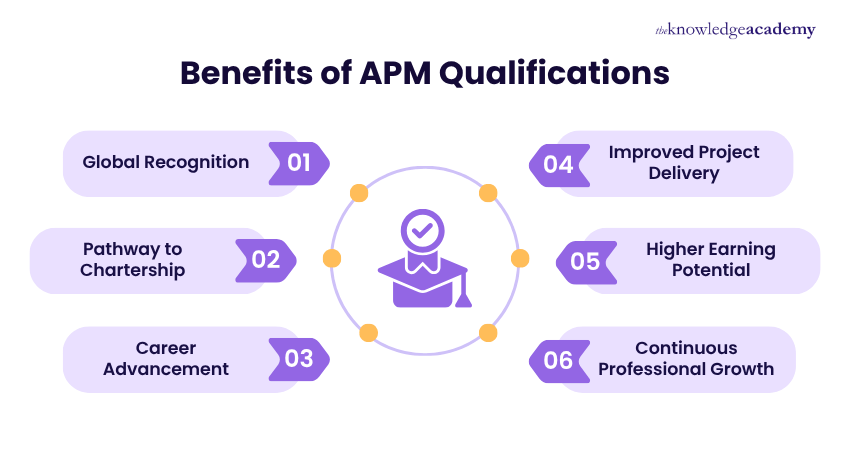
There are many benefits for project management professionals who earn an APM Qualification. Listed below are some of the prominent advantages of being certified:

  • Global Recognition: Earn an internationally respected qualification that highlights your project management expertise.
  • Pathway to Chartership: APM qualifications provide a clear route to Chartered Project Professional (ChPP) status, the highest benchmark in project management.
  • Career Advancement: Access to wider career opportunities and progress into senior leadership roles.
  • Improved Project Delivery: Apply structured methodologies that enhance efficiency, reduce risks, and ensure successful outcomes.
  • Higher Earning Potential: Certified professionals are valued for their expertise and command better compensation.
  • Continuous Professional Growth: Join a professional network that encourages lifelong learning and skill enhancement through ongoing development opportunities.
Show more blue-arrow

Package deals for APM Training

Our training experts have compiled a range of course packages on a variety of categories in APM Training, to boost your career. The packages consist of the best possible qualifications with APM Training, and allows you to purchase multiple courses at a discounted rate.

Swipe for more. Don’t miss out!

APM Training FAQs

APMP Training refers to structured courses to prepare individuals for the Association for Project Management Professional Qualification, enhancing Project Management and delivery skills.
Pursuing APMP Courses enhances your skills in bid and proposal management, boosts your career prospects, increases your earning potential, and recognizes your expertise on a global scale.
Yes, all our APM Courses are accredited by APM, the Association for Project Management.
The duration of these APM Courses varies from 2-5 days.
After achieving your APM Qualification, consider pursuing advanced Project Management Certifications like PMP or PRINCE2 for global recognition or specialize in Agile methodologies with Scrum or SAFe Certifications.
To achieve your APM PMQ Certification, join your desired training course from The Knowledge Academy’s extensive range of APM Courses, study the APM Body of Knowledge, complete the requisite learning hours, and pass the PMQ examination.
For studying for the APM Project Management Qualification, books such as "APM Body of Knowledge," "APM Project Management Qualification Study Guide," and "Project Management for the Unofficial Project Manager" are helpful resources.
APM Training is designed for individuals aiming to pursue a career in Project Management, including novices and professionals seeking to enhance their skills and knowledge in managing projects efficiently.
The prerequisite of this course varies. However, a prior knowledge of Project Management can be beneficial for a wide range of professionals.
If you face any issues in accessing the course materials, then you can reach out to our customer support team who will provide you with quick assistance to resolve the issue.
The Knowledge Academy stands out as a prestigious training provider known for its extensive course offerings, expert instructors, adaptable learning formats, and industry recognition. It's a dependable option for those seeking this APMP Certification.
The Knowledge Academy in the United States offers learning and professional development resources, including course materials, expert-led training sessions, and more. We provide insightful Blogs and News updates, keeping learners well-informed about trends and valuable tips. Explore The Knowledge Academy’s Resources to learn more.
Apart from APMP Courses, The Knowledge Academy provides a variety of courses in multiple categories. etc. Explore our Course Catalogue to learn more about the courses we offer.
The Knowledge Pass is a prepaid training voucher offered by The Knowledge Academy that gives you the flexibility to choose from a range of training courses over 12 months. You can use it to attend courses online or in person at a location of your choice.

Please see our APM Training available in the United States

The Knowledge Academy is one of the Leading global training provider for APM Training.

The training fees for APM Training in the United States starts from $5995

Show more down

Why we're the go to training provider for you

icon

Best price in the industry

You won't find better value in the marketplace. If you do find a lower price, we will beat it.

icon

Trusted & Approved

Recognised by leading certification bodies, we deliver training you can trust.

icon

Many delivery methods

Flexible delivery methods are available depending on your learning style.

icon

High quality resources

Resources are included for a comprehensive learning experience.

barclays Logo
deloitte Logo
Thames Water Logo

"Really good course and well organised. Trainer was great with a sense of humour - his experience allowed a free flowing course, structured to help you gain as much information & relevant experience whilst helping prepare you for the exam"

Joshua Davies, Thames Water

santander logo
bmw Logo
Google Logo
cross

Upgrade Your Skills. Save More Today.

superSale Unlock up to 40% off today!

* WHO WILL BE FUNDING THE COURSE?

close

close

Thank you for your enquiry!

One of our training experts will be in touch shortly to go over your training requirements.

close

close

Press esc to close

close close

Back to course information

Thank you for your enquiry!

One of our training experts will be in touch shortly to go overy your training requirements.

close close

Thank you for your enquiry!

One of our training experts will be in touch shortly to go over your training requirements.