


 Top Rated Course


We may not have the course you’re looking for. If you enquire or give us a call on +1 7204454674 and speak to our training experts, we may still be able to help with your training requirements.
What is Semantic SEO? The Ultimate Guide to Authority
James Smith 18 April 2026Semantic SEO enhances search rankings by focusing on user intent, context, and related keywords, improving content relevance and visibility in search results. From focusing on keywords to understanding human language, SEO has been upgraded to Semantic SEO. It aims to offer reliable and relevant content based on a search query.

Training Outcomes Within Your Budget!
We ensure quality, budget-alignment, and timely delivery by our expert instructors.
Table of Contents
Gone are the days when search engines focused only on relevant keywords while providing search results. When human emotions are replicated with robotics, why is it not possible for search engines to understand the user's mindset and intentions? The possibilities are made into actions!
The opposite person, your friends or your colleagues, might not always understand what you are stating or looking for. But it is not the situation with SEOs. Semantic SEO strives to predict what you want even before you provide additional details. Let's explore how it is functional with Semantic SEO in this blog.
Table of Contents
1) What is Semantic SEO?
2) How Does Semantic Search Work?
3) Why is Semantic SEO Important for Your Business?
4) Benefits of Semantic Search for Users
5) Semantic SEO Best Practices
6) Examples of Semantic Search
7) Conclusion
What is Semantic SEO?
You might be thinking that you know what SEO is but are unsure of the topic “What is Semantic SEO?” Semantic SEO is one of the approaches to Search Engine Optimisation (SEO), which primarily focuses on understanding the user’s intention with their search. It analyses the meaning behind the words and phrases used in the search while focusing on the relevant keywords.
In general, in the past, SEO worked solely depending on the keywords in the searches. That is, the search results are produced based on relevant keywords. In the current world, this practice has been changed and upgraded. Now, SEOs understand the meaning and human language before providing any search results.

How Does Semantic Search Work?
Semantic SEO works deliberately to provide search results that are most relevant to the user’s intent, context, and in-depth meaning. To understand human intentions and inner thought processes, SEO takes help from certain functionalities and combined technologies. These include Natural Language Processing (NLP) and Machine Learning (ML).
1) Natural Language Processing (NLP): It is a form of Artificial Intelligence (AI); that helps in decoding human language to understand, interpret and think how a human would do. It enables machines to process and respond to text or speech in a way that mimics natural human interaction.
2) Machine Learning (ML): Enhances semantic searches by precise comprehension of the user’s intent, breaking down complex patterns, and analysing historical searches. It enables systems to learn from data over time, improving their ability to predict relevant results even when queries are vague or phrased differently than before.
Why is Semantic SEO Important for Your Business?
Semantic SEO is important to achieve search engines’ attention. For instance, Google’s search engine works on the principle of E-E-A-T (Experience, Expertise, Authoritativeness, and Trustworthiness). These four principles basically aim for the quality of knowledge and content delivered. Likely, here are the importance of Semantic SEO for your business:

1) Higher Ranking
When you are rich in your content, search engines will definitely make your content rank higher or appear at the top of the search results with relevant keywords in it. A higher ranking will boost your website visibility along with organic trafficking.
2) Keyword Expansion
The older usage of SEO worked well with relevant keywords. It is not the same now. The keywords added are organic, and with that, other related keywords are also included in your content. With this strategy, your content will appear for related query searches also.
3) Quality Signals
You can build your website authority and trust when you are providing high-quality content. That makes Semantic SEO give a positive signal to the search engines for your website. These signals ensure that all the contents of your website are ranked on the relevant results page.
4) People Also Ask (PAA) Visibility
When you include several aspects of a specific topic, Semantic SEO will show relevant points from your website in the People Also Ask (PAA) section. It creates more website visibility by making your content appear in several search queries.
5) Visitor Retention
Users will continue exploring your website if you provide all the possible relevant information about the main content. Sometimes, it will act as additional information for your users. It keeps them glued to your website from visiting others.
Would you like to learn about the factors influencing your content quality? Join our Search Engine Marketing (SEM) Training immediately!
Benefits of Semantic Search for Users
You can easily appear in SEO search results, but when you’re featured in Semantic SEO search results, it is different. You are noticed for your content quality and information. Let’s look at the benefits that you will gain from empowering Semantic SEO techniques to your website.
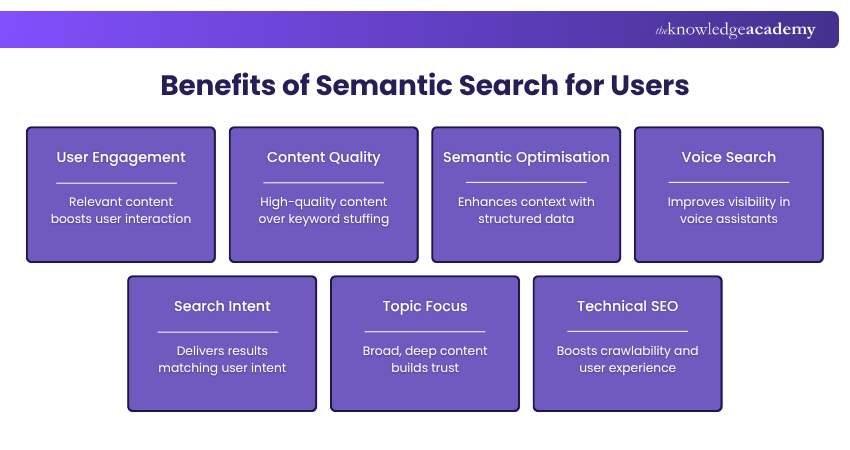
1) User Engagement
1) The more relevant your content is, the more engaged the users are
2) Provides users with satisfying search results and a smoother search process
3) Chances of preferring your website for quality content and comfortable reading
2) Content Quality
1) Semantic search fosters high-quality content over keyword stuffing
2) Leads to relevant results even when users come with incorrect or abrupt queries
3) Achieve content quality and personalisation by focusing on users’ thought process
3) Semantic Optimisation
1) Semantic optimisation works with the content rather than keywords
2) Structured data markup aids context and easy navigation to search engines
3) Helps search engine to grasp the idea of content with ease
4) Voice Search
1) Boost your visibility in voice assistants like Google Assistant, Alexa, Siri, and Cortana
2) High chance to appear in snippets of a search result
3) Ambiguity in query is handled with relevant search results
5) Search Intent
1) Makes search engines understand the exact query
2) Search results are always relevant to the content and often extra informative
3) Enriches user’s satisfaction with relevant results of search intent
6) Topic Focus
1) Helps users to explore broader content with their search than the required details only
2) Being extensive with information builds trust and credibility
3) Enhances content discovery and search accuracy
7) Technical SEO
1) Improves website crawlability and ranking with optimised content
2) With a better website structure, your content is easily understood and accessible
3) Increases seamless webpage loads, thereby providing an exceptional user experience
Upgrade your technical SEO techniques effectively with Google Search Console Training - Register soon!
Semantic SEO Best Practices
Here are the best practices that you can employ to have your website Semantic SEO friendly:
1) Keyword Research
Doing keyword research before planning your content will be the primary step in Semantic SEO practices. Prepare a list of possible, semantically related and relevant keywords and check their relevance with the tools that are available. You can also include keyword clustering by adding keywords that are related to similar queries.
2) Content Creation
As much as you prepare the keywords, the efforts are ten times bigger when you want to create semantic content. You need to prepare a list of the headings and subheadings you might want to include, along with other specifications like images and tables. Semantic search results will make some parts of your content appear in snippets if they find it most relevant.
3) Internal Linking
Internal linking is one of the best practices to promote your website. It is done by linking related URLs from your website to the main search intent. These internal links are placed in the body of the content or website for easy navigation for users. At the same time, it helps search engines in seamless crawling for information on your website.
4) Structured Data
While creating content for your website, if it is structured, it enables the search engines to clearly understand your website and the context of your content. Imagine if a content is unstructured; users might be confused about where to start or might struggle to follow the coherence. Therefore, structured content gains more attention from search engines and users.
Craft impactful content that drives audience engagement by signing up for our Content Marketing Course now!
Examples of Semantic Search
Semantic search is utilised in all contexts of search. It is not defined for any particular search intent. Here are some examples of how semantic search works with search engines:
1) Information Search
Semantic SEO helps you find all the related information regarding your primary search query. It will provide you with details from organic website trafficking through a holistic understanding of your actual intent.
Tip: For instance, when you search for “Tree” in any search engine, it will show the basic definition of the term along with some relevant images and other related information in snippets or various features.
2) Product Inquiry
When you are searching for any information regarding a product, you will not only get the basic information about the product. You will also get additional details like its review, ratings, stores that have the product or online availability, usage methods, similar brands, and so on.
Tip: Imagine you are searching for a watch in general; you will see details like watches for men, women, and kids or watches for office wear, and casuals. Occasionally, you will be taken into other brands that have similar features for comparison too.
3) Site Navigation
Site navigation refers to the practice of navigating to various menus of a particular website. Each website will be structured for navigation purposes. From broader categories, it will be narrowed down to specific subtopics. Search results feature those subtopic links, too.
Tip: When you search for interior design ideas, you will be given options like kitchen, living room, bedroom, office, garden and outdoors as subcategory links on the search results page. These are optimised results by search engines to help you directly find what you need.
Conclusion
People are busier than usual. It makes it difficult to grab their attention quicker for something. Even if they do, it is challenging to sustain their attention. But make it achievable with the help of Semantic SEO to pull the users to your website and stay with you. When you provide what they exactly need, you succeed not only in receiving their attention, but in receiving their trust and credibility, too.
Expertise in personalising and optimising your content by registering for our Performance Marketing Training today!
Frequently Asked Questions
What is a Semantic Markup?

Semantic markup or Semantic HTML refers to the usage of Hypertext Markup Language (HTML) to convey the meaning of the content that they enclose. This creates easy, understandable codes for your content.
Why Use Semantic Tags?
Semantic tags are used for easy understanding and reading of the context of a content. It also enhances the website structure, accessibility, and readability of content.
What are the Other Resources and Offers Provided by The Knowledge Academy?
The Knowledge Academy takes global learning to new heights, offering over 3,000 online courses across 490+ locations in 190+ countries. This expansive reach ensures accessibility and convenience for learners worldwide.
Alongside our diverse Online Course Catalogue, encompassing 19 major categories, we go the extra mile by providing a plethora of free educational Online Resources like News updates, Blogs, videos, webinars, and interview questions. Tailoring learning experiences further, professionals can maximise value with customisable Course Bundles of TKA.
What is The Knowledge Pass, and How Does it Work?
The Knowledge Academy’s Knowledge Pass, a prepaid voucher, adds another layer of flexibility, allowing course bookings over a 12-month period. Join us on a journey where education knows no bounds.
What are the Related Courses and Blogs Provided by The Knowledge Academy?
The Knowledge Academy offers various Digital Marketing Courses, including SEO Course, Search Engine Marketing (SEM) Training and Google Search Console Training. These courses cater to different skill levels, providing comprehensive insights into What is a Search Engine.
Our Digital Marketing Blogs cover a range of topics related to Semantic SEO, offering valuable resources, best practices, and industry insights. Whether you are a beginner or looking to advance your Digital Marketing skills, The Knowledge Academy's diverse courses and informative blogs have got you covered.

James Smith


Digital Marketing Manager and Trainer
James Smith is a digital marketing professional with over a decade of experience in SEO, content strategy, paid media and analytics. He has supported both SMEs and global brands in transforming their digital presence. James’s writing and training are rooted in results-driven tactics and the latest marketing trends.
View Detail

 If you wish to make any changes to your course, please


