


 Top Rated Course

We may not have the course you’re looking for. If you enquire or give us a call on +65 6929 8747 and speak to our training experts, we may still be able to help with your training requirements.
What is Data Analysis? A Complete Guide for Beginners
Lily Turner 26 December 2025Curious to know What is Data Analysis? It is the process of collecting, organising, and interpreting data to extract meaningful insights. By uncovering patterns and trends, it enables businesses and policymakers to make data-driven decisions. It also optimises operations and predicts outcomes, shaping strategies across various industries.

Training Outcomes Within Your Budget!
We ensure quality, budget-alignment, and timely delivery by our expert instructors.
Table of Contents
Data is everywhere flowing through businesses, shaping industries, and influencing decisions at every level. However, without proper analysis, it remains just a sea of numbers with no real meaning. This is where Data Analysis comes in. But What is Data Analysis? It is the key to unlocking valuable insights, enabling organisations to make smarter decisions, predict trends, and solve complex problems.
To fully grasp its significance, it’s important to understand how Data Analysis works. Why techniques and tools like PowerBI, Tableau and CRM Analytics make it so effective? And why is it becoming one of the most sought-after skills in today’s digital age? This blog will answer these questions and more. Let’s explore What is Data Analysis and why it matters.
Table of Contents
1) Understanding Data Analysis
2) Importance of Data Analysis
3) Types of Data Analysis
4) Data Analysis Process
5) Key Techniques in Data Analysis
6) Popular Tools for Data Analysis
7) Conclusion
Understanding Data Analysis
Data Analysis is the systematic process of inspecting, organising, and interpreting Data to extract meaningful insights. It helps identify patterns, trends, and relationships within data, enabling informed decision-making. Used across various industries, Data Analysis supports businesses, researchers, and policymakers in making data-driven choices that enhance efficiency, accuracy, and strategic planning.
In practice, Data Analysis starts with data collection from sources like databases, surveys, or sensors. Since Raw Data often contains errors, data cleaning is essential for ensuring accuracy. Analysts then apply statistical methods, Machine Learning, or computational techniques to uncover insights, summarising vast datasets and identifying key trends.
Once insights are derived, they are interpreted and visualised through charts, dashboards, and reports, enhancing stakeholder understanding. Ultimately, Data Analysis supports decision-making, risk assessment, and optimisation, driving progress in industries like healthcare, finance, marketing, and technology. If you're preparing for a career in this field, reviewing Data Analytics Interview Questions can help you gain a deeper understanding of the key concepts and tools used in these processes, and what employers look for in potential candidates.
Importance of Data Analysis
Data is everywhere, but without proper analysis, it’s just a collection of numbers and facts. Let’s look at why Data Analysis matters and how it impacts different industries.
a) Improved Decision-making: Helps organisations make informed, strategic decisions by analysing past trends and predicting future outcomes.
b) Identifying Market Trends: Enables businesses to understand Customer Behaviour and market trends, allowing them to tailor products and services effectively.
c) Optimising Operations: Streamlines processes, reduces costs, and improves efficiency.
d) Risk Management: Detects potential risks and fraud, allowing organisations to take preventive measures.
e) Enhanced Customer Experience: Personalises services and improves customer satisfaction by understanding and analysing customer data.
Types of Data Analysis
Not all Data Analysis serves the same purpose. Some analyses describe past events, while others predict future trends. Here’s a breakdown of the four main types of Data Analysis and how they are used.
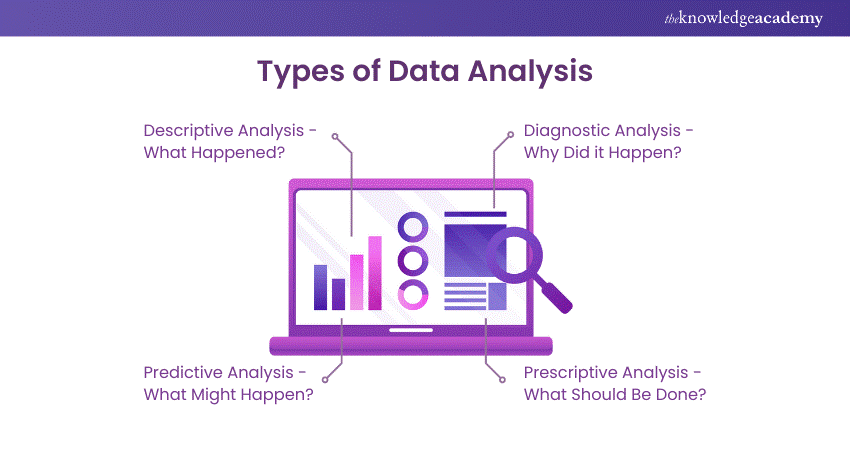
Descriptive Analysis (What Happened?)
Descriptive analysis is like a summary report—it helps us understand what has already happened. This type of analysis is used to identify patterns, trends, and key takeaways from historical data.
Methods Used:
a) Mean, Median, Mode (measures of central tendency).
b) Standard Deviation, Variance (measures of dispersion).
c) Graphs and Charts to visualise trends.
Example: A retail store analysing last year’s sales to find peak shopping months.
Diagnostic Analysis (Why Did it Happen?)
If something unusual happens in the data, diagnostic analysis helps us find the reason behind it. It’s like an investigation—digging deeper into the numbers to discover cause-and-effect relationships.
Methods Used:
a) Drill-down analysis (breaking data into smaller categories).
b) Correlation analysis (identifying relationships between variables).
Example: A company notices a sudden drop in sales and investigates whether it’s due to pricing changes, competitor activity, or seasonal demand.
Predictive Analysis (What Might Happen?)
Predictive analysis is about forecasting the future using historical data. Businesses and researchers use this type of analysis to anticipate customer behaviour, market trends, and business outcomes.
Methods Used:
a) Regression analysis (identifying trends and patterns).
b) Time series analysis (tracking data over time).
c) Machine Learning models to make accurate predictions.
Example: A bank predicting which customers are likely to default on loans based on their credit history.
Join our Predictive Analytics Course today and start making smarter, data-driven business decisions!
Prescriptive Analysis (What Should Be Done?)
Prescriptive analysis goes a step further - it doesn’t just predict the future but suggests the best course of action. This type of analysis is often used in automation, AI, and decision-making systems.
Methods Used:
a) Optimisation algorithms (finding the most efficient solution).
b) Decision trees (evaluating possible outcomes).
Example: An e-commerce website recommending personalised products based on user browsing history.
Data Analysis Process
Analysing data isn’t just about plugging numbers into a spreadsheet. It’s a structured, step-by-step process that ensures accurate and meaningful insights. Here’s how it’s done:
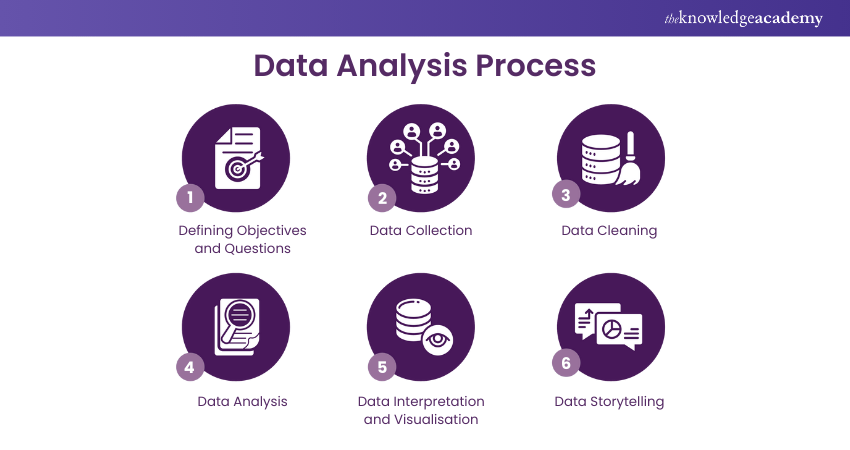
Step 1: Defining Objectives and Questions
Before starting, ask yourself:
a) What problem are we trying to solve?
b) What insights do we need?
c) What kind of data is required?
Setting a clear goal ensures that the analysis stays focused and relevant.
Step 2: Data Collection
Data can come from various sources, including:
a) Surveys and Questionnaires: Direct input from users
b) Databases and Spreadsheets: Existing company records
c) Web Scraping and APIs: Collecting online data
d) Sensor Data (IoT Devices): Tracking real-time information
Step 3: Data Cleaning
Raw data is often messy - incomplete, inconsistent, or duplicated. Cleaning involves:
a) Handling missing values (removing or filling gaps)
b) Removing duplicates (avoiding bias)
c) Standardising formats (dates, currencies, etc.)
Step 4: Data Analysis
Now, it’s time to apply statistical and Machine Learning techniques to extract insights. The choice of method depends on the type of data and objective.
Step 5: Data Interpretation and Visualisation
The results need to be understandable and actionable. This is where visualisation tools like Power BI and Tableau help create:
a) Charts and Graphs: Bar charts, pie charts, histograms
b) Dashboards: Interactive reports for real-time tracking
Step 6: Data Storytelling
Numbers alone don’t tell a story – the key is how you present your findings. Good data storytelling includes the effective use of Data Storytelling Tools to transform raw data into a compelling narrative that resonates with your audience.
1) Contextualising Insights: Explaining why the data matters.
2) Making Complex Data Simple: Using visuals and summaries.
3) Providing Recommendations: What actions should be taken next?
Enhance your skills with Data Science Courses and boost your career today!
Key Techniques in Data Analysis
When working with data, choosing the right analytical technique is crucial for uncovering insights. Let’s break down the most important techniques in a simple, engaging way.
Descriptive Statistics
Think of descriptive statistics as the summary section of a report—it tells you what’s going on in your dataset without making predictions. This technique helps you understand trends and patterns at a glance.
Key Methods:
1) Measures of Central Tendency: Where does the data cluster?
a) Mean (average), Median (middle value), and Mode (most frequent value).
2) Measures of Variability: How spread out is the data?
a) Variance (how far numbers are from the mean).
b) Standard Deviation (how much the data varies from the average).
Example: If a school analyses student test scores, descriptive statistics will show the average score, highest and lowest scores, and how much variation exists among students.
Inferential Statistics
Descriptive statistics describe data, but what if you want to draw conclusions beyond what’s in your dataset? That’s where inferential statistics come in. It helps make predictions about a larger group (population) based on a smaller sample.
Key Methods:
1) Confidence Intervals: Gives a range in which we expect the actual population value to fall.
2) Hypothesis Testing: Helps determine whether a pattern or trend is real or just due to chance.
Example: If a restaurant surveys 100 customers about their satisfaction, inferential statistics can help predict how all customers feel based on that sample.
Regression Analysis
Regression analysis helps you understand relationships between variables and even predict future outcomes. It’s one of the most commonly used techniques in finance, marketing, and economics.
Types of Regression:
1) Linear Regression: Predicts a continuous outcome (e.g., how temperature affects ice cream sales).
2) Logistic Regression: Predicts a binary outcome (e.g., will a customer buy a product or not?).
Example: An e-commerce company can use regression analysis to predict future sales based on advertising spend.
Clustering Analysis
Clustering is a technique used to group similar data points together, making it easier to identify patterns and structure in large datasets.
Common Clustering Methods:
1) K-Means Clustering: Assigns data points into K number of clusters based on similarity.
2) Hierarchical Clustering: Creates a tree-like structure of clusters that can be split into smaller groups.
Example: Streaming platforms like Netflix use clustering to group users based on their viewing habits, recommending movies that match their interests.
Classification Analysis: Sorting Data into Categories
While clustering groups unknown data, classification assigns data into predefined categories based on patterns. It’s widely used in Machine Learning and Artificial Intelligence.
Common Classification Techniques:
1) Decision Trees: Sort data into branches based on characteristics.
2) Random Forests: Combines multiple decision trees for more accuracy.
3) Support Vector Machines (SVMs): Used in image and text recognition.
Example: Email providers use classification analysis to sort emails into “Spam” or “Inbox” based on patterns.
Time Series Analysis
Time series analysis helps track patterns and trends over time, making it essential for forecasting future values.
Common Methods:
1) Moving Averages: Smooths out fluctuations in data to reveal trends.
2) ARIMA Models: Predicts future values based on past observations.
3) Seasonal Decomposition: Identifies seasonal patterns in data.
Example: Stock market analysts use time series analysis to predict future stock prices based on historical trends.
Enhance your analytical skills with Data Mining Training and transform raw data into insights!
Popular Tools for Data Analysis
The right tools make Data Analysis more efficient and insightful. Here are six powerful tools for analysing data:
1) Excel
Microsoft Excel might be the oldest player in the game, but it remains one of the most widely used tools for Data Analysis. It’s simple, accessible, and powerful enough for basic to intermediate-level analytics.
What Makes Excel Great?
a) Easily summarise and analyse large datasets.
b) Automate calculations and statistical analysis.
c) Visualise data with bar charts, pie charts, and scatter plots.
Who Should Use It?
a) Beginners learning Data Analysis.
b) Businesses handling financial reports, inventory, and project data.
c) Professionals who need a quick and simple way to analyse small datasets.
2) Python
Python is like the superpower of Data Analysis—it’s used for everything from data manipulation to AI-powered predictions. Unlike Excel, Python can handle massive datasets, automate analysis, and apply Machine Learning.
What Makes Python Great?
a) Used for cleaning and transforming data.
b) Handles large-scale numerical computations.
c) Create stunning visualisations.
Who Should Use It?
a) Data scientists and analysts working with large datasets.
b) Developers integrating Data Analysis into apps and software.
c) Anyone looking to automate repetitive tasks.
3) R
If Python is a Swiss Army Knife, R is the master toolkit for statisticians. It’s specifically designed for statistical computing and data visualisation, making it ideal for complex statistical models and academic research.
What Makes R Great?
a) Advanced tests, regression, and What is Probability models.
b) One of the best tools for creating visualisations.
c) A collection of R packages that simplify Data Analysis.
Who Should Use It?
a) Researchers and statisticians performing advanced statistical analysis.
b) Data analysts working in healthcare, finance, and academia.
c) Professionals who need specialised statistical tools beyond Excel or Python.
4) SQL
Structured Query Language (SQL) is like a data detective—it helps you find, filter, and manipulate vast amounts of data stored in databases. If your data is stored in large databases like MySQL, PostgreSQL, or Microsoft SQL Server, you’ll need SQL to extract useful insights.
What Makes SQL Great?
a) No need to load entire files, just extract what you need.
b) Perform operations like SUM(), AVG(), and GROUP BY.
c) Works seamlessly with other tools like Python, Power BI, and Tableau.
Who Should Use It?
a) Data analysts and engineers working with big data.
b) Businesses managing customer databases, inventory, or transactions.
c) Anyone working with structured data stored in relational databases.
5) Power BI
Microsoft Power BI is a powerful tool for data visualisation and business intelligence. It takes raw data and transforms it into interactive reports and dashboards, making it ideal for professionals who need to present data in a clear, engaging way.
What Makes Power BI Great?
a) No coding needed!
b) Connect to live databases for up-to-date insights.
c) Uses Machine Learning to detect trends and anomalies.
Who Should Use It?
a) Business analysts creating real-time dashboards for leadership teams.
b) Companies looking to track KPIs and performance metrics.
c) Professionals who need interactive, shareable reports.
6) Tableau
Tableau is one of the most powerful tools for visualising complex datasets. It allows users to create stunning, interactive dashboards with ease, making it a favourite among business analysts, marketers, and data scientists.
What Makes Tableau Great?
a) No coding required!
b) Works with Excel, SQL, cloud databases, and more.
c) Creates charts, heat maps, and geospatial analysis.
Who Should Use It?
a) Businesses wanting interactive reports to share with stakeholders.
b) Data analysts looking to turn raw data into compelling visual stories.
c) Organisations that need real-time data updates.
How Hard is Data Analysis?
Data analysis can vary in difficulty depending on the complexity of the data and tools used. Basic analysis may be straightforward, but advanced techniques require knowledge of statistical methods, programming, and domain expertise for accurate insights. For those looking to deepen their understanding, a Regression Analysis Guide can be an excellent resource to explore more advanced techniques and improve the accuracy of your analysis.
Is Data Analyst an IT Job?
A Data Analyst is not strictly an IT job, but it overlaps with IT roles. Data Analysts focus on interpreting data to support business decisions, while IT professionals primarily manage systems, infrastructure, and technology.
Conclusion
As data becomes increasingly central to decision-making, understanding What is Data Analysis is more important than ever. It enables organisations to turn raw data into valuable insights, helping drive smarter decisions, optimise operations, and stay competitive in a data-driven world. Mastering Data Analysis empowers businesses to unlock new opportunities and ensure sustained growth.
Learn Pandas for Data Analysis and gain the skills to transform your career with our Pandas For Data Analysis Training – join now!
Frequently Asked Questions
What is an Example of Data Analysis?

An example of Data Analysis is a healthcare provider analysing patient data to identify trends in disease outbreaks. This analysis helps predict future health risks and optimise treatment plans, ultimately improving patient care and resource allocation.
Does Data Analysis Require Coding?
While some basic Data Analysis tasks can be performed with tools like Excel, more advanced analysis - such as statistical modelling or Machine Learning - typically requires coding, often using languages like Python or R for greater flexibility and scalability.
What are the Other Resources and Offers Provided by The Knowledge Academy?
The Knowledge Academy takes global learning to new heights, offering over 3,000 online courses across 490+ locations in 190+ countries. This expansive reach ensures accessibility and convenience for learners worldwide.
Alongside our diverse Online Course Catalogue, encompassing 19 major categories, we go the extra mile by providing a plethora of free educational Online Resources like Blogs, eBooks, Interview Questions and Videos. Tailoring learning experiences further, professionals can unlock greater value through a wide range of special discounts, seasonal deals, and Exclusive Offers.
What is The Knowledge Pass, and How Does it Work?
The Knowledge Academy’s Knowledge Pass, a prepaid voucher, adds another layer of flexibility, allowing course bookings over a 12-month period. Join us on a journey where education knows no bounds.
What are the Related Courses and Blogs Provided by The Knowledge Academy?
The Knowledge Academy offers various Data Science Courses, including Pandas for Data Analysis Training, Data Science with R Training, Python Data Science Course and many more. These courses cater to different skill levels, providing comprehensive insights into Raw Data.
Our Data, Analytics and AI Blogs cover a range of topics related to Data Analysis, offering valuable resources, best practices, and industry insights. Whether you are a beginner or looking to advance your Data Analysis skills, The Knowledge Academy's diverse courses and informative blogs have got you covered.

Lily Turner


Senior AI/ML Engineer and Data Science Author
Lily Turner is a data science professional with over 10 years of experience in artificial intelligence, machine learning, and big data analytics. Her work bridges academic research and industry innovation, with a focus on solving real-world problems using data-driven approaches. Lily’s content empowers aspiring data scientists to build practical, scalable models using the latest tools and techniques.
View Detail
Upcoming Data, Analytics & AI Resources Batches & Dates
Date
 Pandas for Data Analysis Training
Pandas for Data Analysis Training
Thu 23rd Jul 2026
Pandas for Data Analysis Training
Thu 17th Dec 2026

 If you wish to make any changes to your course, please


