


 Top Rated Course

We may not have the course you’re looking for. If you enquire or give us a call on +44 20 4538 6376 and speak to our training experts, we may still be able to help with your training requirements.
Agile Methodology in Software Testing: A Complete Guide
Richard Harris 15 July 2026In Software Testing, Agile Methodology is a flexible, collaborative approach where testing happens in the development cycle. This allows for quick feedback and faster bug fixes. Discover Agile Methodology in Software Testing, its benefits, principles, and strategies to enhance product quality through continuous feedback and teamwork.

Training Outcomes Within Your Budget!
We ensure quality, budget-alignment, and timely delivery by our expert instructors.
Table of Contents

In traditional models, testing came last, often rushed and under-resourced. But Agile Methodology in Software Testing rewrites the rules. Here, testing is a continuous journey, starting on day one and evolving with the product. It turns testers into collaborators, using automation, exploratory testing, and frequent feedback to ensure rapid, reliable delivery.
Think Agile Software Testing rapid feedback, test automation, and iterative progress. This isn’t just a process; it’s a cultural shift that brings quality to the forefront. In this blog, we dive deep into this approach that’s helping teams innovate confidently and deliver software users love.
Table of Contents
1) What is Agile Testing Methodology?
2) Agile Testing Principles
3) Agile Testing Strategies
4) Agile Testing Benefits
5) What does an Agile Tester do?
6) Agile Testers Skills
7) Types of Agile Testing
8) The Agile Testing Life Cycle
9) Waterfall vs Agile Testing
10) Agile Testing Challenges
11) What is the Agile Methodology of Software Testing?
12) What is Agile Methodology in QA?
13) Conclusion
What is Agile Testing Methodology?
Agile Testing Methodology is a flexible approach to Software Testing that follows the principles of Agile Software Development. Unlike traditional methods, Agile Testing is not a separate phase; instead, it is integrated continuously throughout the development lifecycle. This means testing starts early and is performed regularly, allowing for quick identification of issues and faster resolution.
The Agile Testing Quadrants break down large testing efforts into smaller, manageable tests that target specific user stories, tasks, or technical requirements. This structured approach ensures that each component of the software is thoroughly tested, enhancing overall quality. It also emphasises collaboration among developers, test engineers, and stakeholders, fostering a culture of teamwork and continuous feedback

Agile Testing Principles
The core ideas of Agile Testing are vital for producing top-notch software in a constantly changing development setting. By integrating Shift Left Testing in Agile, teams can ensure early engagement, cooperation, and ongoing enhancement during the development cycle. Here are some of its principles:
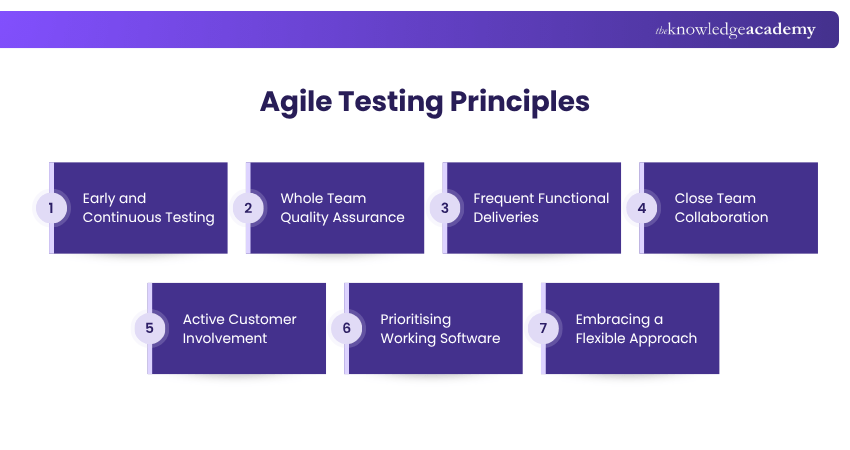
a) Early and Continuous Testing: Testing begins at an early stage and continues consistently throughout the development cycle. Testers begin testing the software early in the development process and maintain testing throughout the development cycle.
b) Whole Team Approach: In Agile Development, every team member, such as Developers, Testers, Business Analysts, and Product Owners, is responsible for ensuring the product's quality.
c) Frequent Deliveries: Agile Teams consistently deliver functional software every two weeks to maintain ongoing progress and receive feedback.
d) Close Collaboration: All team members in an Agile project work closely together to stay aligned and prevent surprises.
e) Customer Involvement: Customers play an active role in the Agile Development, offering feedback in every iteration to assist the team in making ongoing enhancements.
f) Working Software: Agile Teams prioritise quality Software Management in each iteration, emphasising functional software rather than extensive documentation or other deliverables.
g) Flexible Approach: Agile development promotes flexibility by allowing teams to modify requirements at any point in the development process.
Elevate your expertise with Agile Software Testing Training. Start today and excel in Agile testing practices!
Agile Testing Strategies
Agile testing is a continuous and collaborative process that aligns closely with Agile Development principles. Unlike traditional testing, which occurs late in the development cycle, Agile testing happens throughout the project, ensuring faster feedback and higher adaptability to change.
1) Iteration 0
Iteration 0 is also called the Inception Phase, lays the groundwork for the project. Testing during this stage involves:
a) Setting up test environments
b) Defining the test strategy
c) Identifying key risks and mitigation plans
d) Initial requirements gathering and early test case writing
e) It ensures alignment and readiness before development begins
2) Construction Iteration
This is the core development phase where features are built in small increments. Testing is:
a) Integrated with development (Test-Driven Development, Unit Tests, etc.)
b) Testers, developers, and stakeholders work together
c) Regression and functional tests run with each iteration
d) Focus is on validating working software frequently
3) Release End Game
Also called the Stabilisation Phase, this is when final validations occur. Activities include:
a) Final system testing
b) Performance and load testing
c) Defect resolution and regression testing
d) Preparing documentation and deployment plans
e) The goal is to ensure the product is ready for production use
4) Production
Post-deployment, testing doesn’t stop. This phase includes:
a) Monitoring the system for issues (real-time feedback)
b) Performing hotfix validations and patch testing
c) Supporting users and gathering enhancement request
d) It ensures continuous quality and addresses any real-world issues quickly
Agile Testing Benefits
In current Software Development, these key benefits guarantee an efficient and top-notch process:
a) Immediate and Continuous Testing: Swiftly detects and addresses issues, leading to improved software quality.
b) Ongoing Feedback from Clients and Stakeholders: Guarantees the product aligns with user needs and can adjust to changing demands.
c) Regular Delivery of Software: Regular delivery of functional software ensures that users are consistently receiving updates, which helps to keep the product competitive.
d) Fosters Teamwork: Encourages developers, testers, and business analysts to work closely together to minimise errors and misunderstandings.
e) Utilises Automated Testing Tools: Improves testing efficiency and reliability, enabling concentration on intricate assignments.
f) Reduces Risks: Identifying problems early on helps avoid major issues further along in the development process.
g) Enhancing Software Quality: Enhances software quality by promoting adaptability, teamwork, and risk minimisation.
What Does an Agile Tester do?
In Agile, it is everyone's responsibility to test and ensure quality. Testers and developers work together in an Agile setting, emphasising communication and teamwork.
Tests often drive Agile Development. Developers employ test-driven development (TDD) techniques to create tests before writing the code that these tests will test. The partnership between developers and Agile Testers starts very early in establishing user stories, such as requirements.
Throughout the development and testing stages, it is essential to maintain Close Communication and collaboration. Agile Testers test in an ongoing manner as developers code. Developers frequently engage in testing, while Agile Testers might also be involved in coding to some extent. This comprehensive method guarantees that testing and development are synced, boosting software quality and effectiveness.
Agile Testers Skills
Agile Testers have a unique skill set that allows them to thrive in a fast-paced development environment. Their abilities offer a seamless integration of testing within the process. Let’s explore some essential skills of Agile Testers:

1) Strong Communication Skills: Effective Communication Skills are vital for Agile Testers to interact with team members and grasp customer needs and requirements.
2) Strong Technical Skills: Agile Testers need strong technical skills, such as knowledge of the code and technology stack.
3) Strong Problem-solving Skills: Agile Testers need strong problem-solving abilities s to rapidly identify and resolve issues, think innovatively, and create new solutions when required.
4) Team Player: Agile Testers must excel in a team setting, demonstrate flexibility and adaptability, and thrive in high-pressure situations.
Achieve excellence in Testing with our Software Testing Black Belt Training today!
Types of Agile Testing
Numerous approaches have been created for Agile testing procedures. Here, we spotlight four of the most utilised Agile testing approaches. Although not one method is ideal for all products, these models are helpful initial references for developing a tailored strategy.

1) Test-driven Development
ATDD involves creating tests to define the requirements before development. Acceptance Test-Driven Development (ATDD) is a form of Test-Driven Development (TDD). It highlights the importance of teamwork in Agile testing by engaging customers, developers, and Testers in creating acceptance tests from the customer's viewpoint.
The tests must be created before the corresponding functionality is developed. Following the Agile Testing Pyramid approach, this process streamlines test case creation, giving developers clear visibility into customer expectations and product usage. By removing uncertainty, If we compare Traditional Testing and Agile Testing, it is evident that Agile has surpassed traditional testing methods, thanks to the continuous updates and improvements brought by the Scrum methodology.
2) Behaviour-driven Development
BDD, also known as Behaviour-driven Development, focuses on producing software based on the desired behaviour of the system.
BDD is built upon and improves upon TDD and ATDD. It recognises the appropriate business results and conducts tests according to those desired results. There are five steps to follow in BDD.
a) Explain the conduct
b) Compose the definition of the step.
c) Sprint and not succeed
d) Create a code that will ensure the successful completion of the step.
e) Sprint and throw
BDD guarantees that Software Development is in accordance with the business objectives and users' requirements.
Become an expert in Adaptable Testing with Agile Tester Training – Sign up now!
3) Exploratory Testing
Exploratory testing involves a repeated sequence of test design, test execution, analysis, learning, and returning to the beginning. In contrast to scripted tests, Agile Testers create tests on the fly while exploring the product.
This method gives Testers an experience that closely mirrors how the product will look when used in real-life situations. It is an efficient method for promptly evaluating functional software and detecting errors that may go unnoticed by other testing techniques.
4) Session-based Testing
Session-based testing improves upon and enhances exploratory testing. Exploratory testing demands the Tester to be creative, whereas session-based testing introduces organisation. A charter is established before the commencement of a test session. Continuous testing sessions concentrate solely on this one charter.
After the test, a complete report on the session is given, and the manager is briefed. This extra framework guarantees comprehensive testing across all product areas and avoids any bottlenecks in specific areas.
The Agile Testing Life Cycle
Agile testing is not a linear process; it's adaptive and ongoing, evolving with each sprint. However, it follows a structured life cycle to ensure continuous quality and collaboration across development stages.
Impact Assessment
The aim is to assess how changes or new features will impact the system. Testers also identify gaps, edge cases, and define a high-level test scope. This is the initial phase where the testing team analyses:
1) Requirements and user stories
2) Dependencies, risks, and acceptance criteria
Test Planning
It sets the strategy for how testing will align with development goals. Here, testers collaborate with the team to plan test efforts. This includes:
1) Estimating testing timelines for each sprint
2) Identifying required test environments and tools
3) Assigning responsibilities
1) Test Design
In this sub-phase:
a) Test scenarios and cases are outlined
b) Each test is linked to a specific user story or acceptance criterion
c) This ensures full coverage and aligns tests with business objectives
2) Test Development
Here, actual test cases are written and automated where possible. Activities include:
a) Creating reusable test scripts
b) Preparing test data
c) Setting up continuous integration pipelines
d) Automation plays a key role in maintaining test efficiency across iterations
Daily Scrum
Testers actively participate in daily stand-ups to:
1) Share progress and blockers
2) Align testing efforts with ongoing development
3) Reprioritise tests as requirements evolve
4) This ensures tight collaboration and quick feedback loops
Release Readiness
Before a sprint ends, the team evaluates whether the software is ready for release. Testing focuses on:
1) Final regression runs
2) Integration checks
3) Ensuring all user stories are validated and defects resolved
4) It’s a checkpoint for quality assurance before deployment
Deployment and Monitoring
Once the release is deployed:
1) Testers monitor the system in the production environment
2) Logs, alerts, and user feedback are assessed for anomalies
3) Hotfixes or rollbacks are tested if needed
4) This stage ensures stability and captures learnings for future sprints
Waterfall vs Agile Testing
Agile testing differs from Waterfall testing. In Waterfall testing, project requirements are established at the beginning and remain unchanged. Once the project starts, these requirements act as the specifications and cannot be changed. Testers can create test cases beforehand and run them after the development is finished.
On the other hand, Agile projects often experience changing requirements, showcasing a Key Difference Between Traditional Testing and Agile Testing. Testers in Agile need to be flexible, generating test cases on the fly and adjusting to modifications as they occur.
Agile Testing Challenges
Agile testing presents several challenges. Firstly, Agile Teams operate quickly and frequently make changes, requiring Testers to be highly adaptable and able to adjust their approach quickly.
Secondly, Agile Teams typically involve many stakeholders. Testers must communicate effectively with all team members and the customer. Additionally, Agile environments often have tight deadlines, requiring Testers to work well under pressure and deliver quality results promptly.
What is the Agile Methodology of Software Testing?
Agile Software Testing is an iterative and continuous testing approach where testing begins early and happens alongside development. It focuses on collaboration, quick feedback, and adaptability, ensuring high-quality releases through frequent testing of small, functional parts.
What is Agile Methodology in QA?
Agile Quality Assurance (QA) integrates throughout the Software Development lifecycle. Instead of testing after development, QA teams collaborate from day one, conduct ongoing testing, ensure quick bug fixes, and align testing goals with user stories in every sprint.
Conclusion
Agile Testing makes Software Development faster, smoother, and more reliable. Instead of waiting until the end, testing happens throughout the project, helping teams find and fix issues early. Agile Methodology in Software Testing is all about working together, staying flexible, and making sure the final product truly works for users. With Agile, quality isn’t an afterthought, it’s built in from the start.
Enhance Flexibility and Efficiency with our Agile Software Testing Course – Register now!
Frequently Asked Questions
How do you Handle Testing in Agile?

In Agile, testing is ongoing and done together. Testers collaborate with developers and stakeholders to develop and apply test plans during the entire development process.
What is the Best Agile Methodology?
The best Agile Methodology depends on your project needs, but Scrum is widely adopted for its structured sprints, roles, and regular feedback. It promotes iterative progress, transparency, and continuous improvement. It is ideal for most development teams seeking agility and focus.

Richard Harris


Senior Full Stack Developer and Technology Educator
Richard Harris is a highly experienced full-stack developer with deep expertise in both frontend and backend technologies. Over his 12-year career, he has built scalable web applications for startups, enterprises and government organisations. Richard’s writing combines technical depth with clear explanations, ideal for developers looking to grow in modern frameworks and tools.


 If you wish to make any changes to your course, please


