


 Top Rated Course

We may not have the course you’re looking for. If you enquire or give us a call on + 1-866 272 8822 and speak to our training experts, we may still be able to help with your training requirements.
Different Types of Machine Learning: A Complete Guide
The Knowledge Academy 07 March 2026Explore the diverse landscape of Different Types of Machine Learning. Uncover the essence of supervised, unsupervised, semi-supervised, reinforcement, and deep learning. This comprehensive blog breaks down the intricacies of each type, offering a clear understanding of their unique applications and advantages. Read more to learn!

Training Outcomes Within Your Budget!
We ensure quality, budget-alignment, and timely delivery by our expert instructors.
Table of Contents
Are you a seasoned Data Scientist, curious tech enthusiast, or business professional looking to leverage AI's potential? If yes, then understanding the different Types of Machine Learning (ML) is essential.
According to Fortune Business Insights, in 2022, the Machine Learning market had a global size of $19.20 billion. The market is expected to reach $26.03 billion in 2022 and reach $225.91 billion by 2030. These statistics are a true testament that understanding the Types of Machine Learning is crucial.
Different Types of Machine Learning have specific uses and are important in developing intelligent systems in various industries. In this Blog, we will look at Different Types of Machine Learning, their applications and their advantages across industries.
Table of Contents
1) What are the different Types of Machine Learning?
a) Supervised Learning
b) Unsupervised Learning
c) Semi-supervised Learning
d) Reinforcement Learning
e) Deep Learning
2) Conclusion
What are the different Types of Machine Learning?
Machine Learning, an integral component of Artificial Intelligence (AI), empowers computers to learn from data and improve performance without explicit programming. Machine Learning algorithms enable accurate predictions and informed decision-making by analysing vast datasets and identifying patterns.
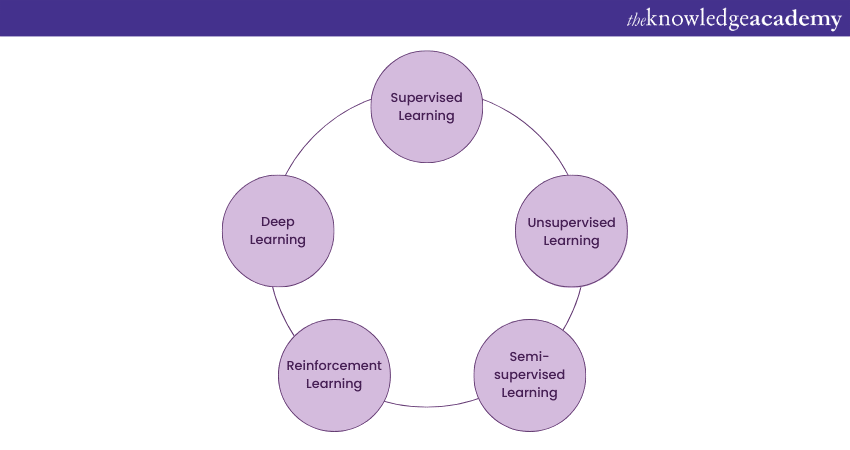
With applications spanning diverse industries, Machine Learning continues to revolutionise technology, driving innovation and shaping a future where intelligent systems enhance productivity and enrich our daily lives. If you’re curious about How to Become a Machine Learning Engineer, understanding these applications is essential, as they play a critical role in the industry. The following are the Types of Machine Learning:
Supervised Learning
Supervised Learning is a fundamental category of Machine Learning where algorithms are trained on labelled data, with each input paired with its corresponding output. The objective is to train the algorithm to understand the connection between inputs and outputs and apply this knowledge to make precise predictions on fresh, unexplored data.
During training, the model iteratively adjusts its internal parameters using optimisation techniques like Gradient Descent in Machine Learning to minimise the difference between predicted outputs and actual labels.
The Supervised Learning paradigm finds extensive applications in various real-world scenarios. In classification tasks, the algorithm learns to assign data points to specific categories or classes, such as identifying whether an email is spam. In regression tasks, the model predicts continuous numerical values, such as estimating the price of a house based on its features.
Machine Learning offers significant advantages in Supervised Learning. This enables precise predictions and classifications that facilitate decision-making across diverse applications. By leveraging labelled data, algorithms learn from past examples.
This can lead to improved generalisation and performance on new, unseen data. This empowers businesses to gain valuable insights, optimise processes, and make informed decisions for enhanced efficiency and effectiveness.
Unsupervised Learning
Unsupervised Learning, another essential type of Machine Learning, is characterised by its ability to analyse unlabelled data and discover patterns, structures, or relationships within it. Unlike Supervised Learning, Unsupervised Learning does not require explicit output labels for training.
Instead, unsupervised algorithms use clustering and dimensionality reduction techniques to organise data into groups based on similarities or to simplify its representation without losing essential information. This category of Machine Learning is instrumental when dealing with large, unstructured datasets, where labelling data may be impractical or expensive. Machine Learning finds diverse applications in Unsupervised Learning, including the following:
a) Customer segmentation for targeted marketing
b) Anomaly detection in cybersecurity
c) Topic modelling in Natural Language Processing (NLP)
Additionally, it supports exploratory data analysis, enabling researchers and businesses to gain valuable insights and unveil hidden patterns that may result in novel discoveries or enhanced decision-making.
Semi-supervised Learning
Semi-supervised Learning is a unique category of Machine Learning that combines supervised and Unsupervised Learning elements. It operates on datasets containing a mix of labelled and unlabelled data. This makes it highly valuable when acquiring labelled data is costly or time-consuming.
The algorithm learns from a limited set of labeled data to make predictions while utilising unlabeled data to identify underlying patterns and enhance performance. The Differenc Between Data Analytics and Machine Learning lies in their approach—while data analytics focuses on interpreting existing data, machine learning enables systems to improve automatically through experience. Semi-supervised learning is widely applied in real-world scenarios, including sentiment analysis, speech recognition, and image classification.
Reinforcement Learning
Reinforcement Learning is an efficient way of Machine Learning which enables agents to acquire knowledge by interacting with their surroundings. The agent performs actions within the environment and gets feedback in the form of either rewards or punishments, which guides its learning process.
The goal is for the agent to learn an optimal strategy to maximise cumulative rewards over time. This learning approach finds its applications in various dynamic and complex scenarios, such as game playing, robotics, and autonomous vehicles.
In gaming, Reinforcement Learning has demonstrated impressive feats, beating human champions in games like Go and Chess. In robotics, it enables robots to navigate real-world environments and learn from trial and error. For autonomous vehicles, it aids in decision-making and navigating through changing traffic conditions.
Deep Learning
Deep Learning is a significant type of Machine Learning that utilises deep neural networks to address intricate problems. These networks imitate the structure and operation of the human brain, consisting of numerous interconnected layers of neurons.
The popularity of Deep Learning has skyrocketed due to its remarkable capability to learn complex patterns automatically. It also includes representations from data without explicit feature engineering.
The depth of these networks allows them to capture hierarchical and abstract features. This makes them exceptionally well-suited for tasks like image and speech recognition, NLP, and autonomous systems. As the demand for advanced speech recognition systems increases, professionals in the field, such as Speech Recognition Engineers, are in high demand. Consequently, the Speech Recognition Engineer Salary is competitive, reflecting the specialised knowledge required for this cutting-edge technology.
Their power lies in their capacity to handle vast amounts of data and generalise to new, unseen examples. This leads to superior performance compared to traditional Machine Learning approaches.
Get Ahead of the Competition with Key Machine Learning Interview Questions!
Transfer Learning
Transfer Learning is a methodology used in Machine Learning, which involves applying knowledge gained from one task or domain to enhance learning in another related task or domain. Rather than starting from scratch, Transfer Learning makes use of pre-trained models and their learned representations.
The model's knowledge is transferred and fine-tuned on the new task with less data, saving computational resources and time. This technique is particularly beneficial when labelled data is limited and expensive to obtain for the target task.
Transfer Learning has proven successful in various applications, such as computer vision, NLP, and speech recognition. This helps unlock the potential for more efficient and effective Machine Learning solutions.
Online Learning
Online Learning is also known as Incremental or Streaming Learning. It is a Machine Learning approach that enables models to learn continuously from new data as it arrives sequentially. Unlike traditional Batch Learning, where the model is trained on a fixed dataset, Online Learning adapts to changing environments and dynamic data streams.
Online Learning has the significant advantage of efficiently handling massive amounts of data in real time. This makes it suitable for applications like fraud detection, recommendation systems, and online advertising.
Models can be updated and refined on the fly, staying updated with the latest information and providing timely predictions. Additionally, Online Learning is computationally efficient, requiring minimal memory and processing resources for continuous learning.
Ensemble Learning
Ensemble Learning is one of the most powerful Types of Machine Learning techniques. It involves combining multiple models, called "base learners," to make more accurate and robust predictions. The idea behind Ensemble Learning is that by leveraging the collective wisdom of diverse models, the overall performance can be significantly improved compared to individual models. Ensemble methods can be broadly categorised into two types:
a) Bagging methods: Methods like Random Forest create multiple base learners by training on different subsets of the data and averaging their predictions to reduce variance and improve generalisation.
b) Boosting methods: Methods like AdaBoost and Gradient Boosting sequentially train base learners, giving more weight to misclassified instances to focus on difficult-to-learn examples.
Moreover, Ensemble Learning finds extensive applications in various domains. It includes image and speech recognition, anomaly detection, and recommendation systems.
Instance-based Learning
Instance-based Learning, or Lazy Learning, is a Machine Learning approach that stores training instances rather than creating explicit models during the training phase. Instead of generalising from the training data, Instance-based Learning makes predictions based on the similarity of new instances to the stored examples.
When a prediction is needed, the algorithm searches for the most similar instances in the training set and uses their labels to determine the outcome. This method is particularly useful when the data distribution is complex or changes frequently. It allows the model to adapt quickly to new patterns and maintain flexibility in handling dynamic datasets.
Decision Tree Learning
A popular and simple-to-grasp Machine Learning approach is Decision Tree Learning, which can be employed for both classification and regression duties. To create a Decision Tree, a hierarchical structure is built where internal nodes represent decisions based on specific features, and the leaf nodes represent the final prediction.
The algorithm recursively partitions the data based on the best feature that maximises information gain or reduces impurity at each node. Decision trees are a user-friendly and intuitive method of data analysis that can effectively handle both numerical and categorical data. However, they may suffer from overfitting when the tree becomes too deep or complex, requiring pruning techniques to improve generalisation. For a clearer understanding, reviewing Decision Tree vs Random Forest can provide a useful comparison of how these two models handle data and overfitting.
Discover the usage of deep learning libraries like Keras and TensorFlow; sign up for our Deep Learning Training now!
Clustering
In Machine Learning, Clustering is a well-known unsupervised technique that categorises similar data points according to their intrinsic features. The primary objective of Clustering is to detect patterns and structures within the data. This forms coherent clusters that exhibit shared traits.
The algorithm assigns data points to clusters based on their similarity, where points within the same cluster are more similar than those in other clusters.
Clustering finds extensive applications in various domains, including customer segmentation for targeted marketing and anomaly detection in cybersecurity. It is also applicable in image segmentation in computer vision. It aids in exploratory data analysis and facilitates data understanding, paving the way for insightful discoveries and informed decision-making.

Dimensionality Reduction
Dimensionality Reduction is a crucial technique in Machine Learning used to reduce the number of features in a dataset while preserving essential information. High-dimensional data can be complex and computationally expensive to process, leading to the "curse of dimensionality," where models may suffer from overfitting and increased computational requirements. Dimensionality Reduction addresses these issues by transforming the data into a lower-dimensional space. The two common approaches to Dimensionality Reduction are as follows:
a) Principal Component Analysis (PCA): PCA is a technique that identifies the main components in the data that explain the majority of the variation, making it possible to compress the information without losing too much valuable data.
b) Distributed Stochastic Neighbor Embedding (t-SNE): t-SNE focuses on preserving the pairwise similarities between data points, making it useful for visualising high-dimensional data in a lower-dimensional space.
By reducing dimensionality, models become more efficient, training times decrease, and data visualisation becomes more manageable, facilitating better data understanding and improved model performance.
Upgrade your knowledge of AI applications and related fields within AI sign up for our Artificial Intelligence & Machine Learning Training now!
Association Rule Learning
Machine Learning involves a data mining technique known as association Rule Learning. It seeks to unearth intriguing relationships or associations between items within extensive transactional datasets. It finds utility in market basket analysis, where the objective revolves around identifying customers' frequent co-purchasing of items.
The primary concept behind association Rule Learning is to find item sets with strong correlations, expressed in the form of rules like "if X, then Y." These rules indicate that if a customer purchases item X, they are likely to buy item Y as well. The measure of an Association Rule's strength is determined by two metrics outlined below:
a) Support: Refers to the frequency of occurrence of an itemset in the dataset
b) Confidence: Quantifies the probability of the consequent item Y being purchased when the antecedent item X is present.
Apriori and FP-Growth are common algorithms used for association Rule Learning. Apriori generates frequent item sets level-wise, while FP-Growth employs a more efficient approach using a frequent pattern tree structure.
In Machine Learning, association Rule Learning finds numerous applications in retail, marketing, and recommendation systems. It enables retailers to optimise product placements, create targeted marketing campaigns, and offer personalised product recommendations.
Natural Language Processing (NLP) and Text Analytics
Machine Learning is closely linked to Natural Language Processing (NLP) and Text Analytics. It is because these fields handle the interaction between computers and human language. NLP's primary focus lies in comprehending and processing natural language, empowering computers to interpret, generate, and respond to human language in a meaningful and contextually relevant manner. However, one of the primary challenges in NLP is human language's inherent ambiguity and complexity, which arises from the diverse vocabulary, grammar rules, and nuances of meaning.
Moreover, NLP techniques encompass various tasks, such as sentiment analysis, named entity recognition, part-of-speech tagging, and machine translation. These applications have far-reaching implications, from chatbots and virtual assistants to language translation and sentiment monitoring on social media.
Text Analytics relies heavily on Machine Learning to extract valuable insights and patterns from unstructured text data. Techniques such as text classification, clustering, and information extraction are employed to organise and process extensive amounts of textual information efficiently.
Conclusion
Understanding the Different Types of Machine Learning can allow you to witness the sheer power and versatility of Artificial Intelligence. Comprehending the difference between Deep Learning and Machine Learning helps highlight how these technologies complement one another. Understanding the intricacies of these Machine Learning types can open up a world of possibilities for businesses, researchers, and technology enthusiasts alike. So, staying informed about the latest developments can become a key to harnessing ML’s full potential.
Gain theoretical knowledge regarding the different machine learning algorithms; sign up for our Machine learning Training now!
Frequently Asked Questions

The Knowledge Academy


Global Training Provider
The Knowledge Academy is a world-leading provider of professional training courses, offering globally recognised qualifications across a wide range of subjects. With expert trainers, up-to-date course material, and flexible learning options, we aim to empower professionals and organisations to achieve their goals through continuous learning.

Upcoming Data, Analytics & AI Resources Batches & Dates
Date
 Machine Learning Course
Machine Learning Course
Fri 14th Aug 2026
Machine Learning Course
Fri 23rd Oct 2026
Machine Learning Course
Fri 11th Dec 2026

 If you wish to make any changes to your course, please


