


 Top Rated Course

We may not have the course you’re looking for. If you enquire or give us a call on +44 1344 203999 and speak to our training experts, we may still be able to help with your training requirements.
Information Security Analyst Job Description: A Complete Guide
The Knowledge Academy 13 February 2026The Information Security Analyst Job Description includes responsibilities like monitoring systems for security breaches and implementing security measures. Strong problem-solving skills, analytical mind and communication proficiency are essential in this role, alongside a strong understanding of security technologies and best practices.
Home
 Resources
IT Security & Data Protection
Information Security Analyst Job Description: A Complete Guide
Resources
IT Security & Data Protection
Information Security Analyst Job Description: A Complete Guide
Resources
IT Security & Data Protection
Information Security Analyst Job Description: A Complete Guide

Training Outcomes Within Your Budget!
We ensure quality, budget-alignment, and timely delivery by our expert instructors.
Table of Contents

With cyber threats growing every day, Information Security Analysts have become the frontline defenders of our digital world. They spot risks, stop breaches, and help keep sensitive data safe. If you’re curious about what this role really involves, this blog breaks down the Information Security Analyst Job Description; from the skills you’ll need to the responsibilities you’ll take on and the path to get started. Let’s read ahead!
Table of Contents
1) Who is an Information Security Analyst?
2) What Does an Information Security Analyst Do?
3) Information Security Analyst Roles and Responsibilities
4) Essential Skills of Information Security Analyst
5) Qualification & Certification Requirements for Information Security Analyst
6) Average Salary for Information Security Analyst
7) Information Security Analyst Job Description Template
8) Is an Information Security Analyst a Good Career Choice?
9) How Can You Become an Information Security Analyst
10) Conclusion
Who is an Information Security Analyst?
Information Security Analysts implement and manage security systems to protect an organisation's networks and data while upholding security standards. They must thoroughly understand the organisation and collaborate across departments to identify and address vulnerabilities. Their role involves assessing and enhancing the overall security posture by analysing the effectiveness of existing measures.
As technology continuously evolves affecting data transmission, analysis, storage, and encryption. Therefore, Security Analysts must stay current with the latest trends and cyber-attack strategies. They install firewalls and encryption programs to safeguard data from unauthorised access, identify network vulnerabilities, update software, and work with IT staff to bolster security and manage potential threats.
What Does an Information Security Analyst Do?
Information Security Analysts are important to safeguard your business’s digital assets. Here are their key roles:
1) They design and implement security measures to protect computer networks and systems from threats.
2) They ensure proper online security to prevent data breaches that could harm the company’s operations.
3) They are tasked with formulating disaster recovery plans to safeguard business information during incidents.
4) They stay updated with evolving IT security practices and new hacking techniques.
Step up as your organisation’s security hero – join our ISO 27002 Training now!
Information Security Analyst Roles and Responsibilities
Information Security Analysts are essential for maintaining robust Cyber Security. Their role involves a variety of critical tasks to protect and enhance IT systems. Their key responsibilities include:
1) Monitor computer networks for vulnerabilities and security threats.
2) Investigate Cyber Security Incidents.
3) Install and configure security measures and software.
4) Protect systems and information infrastructure with firewalls and Data Encryption.
5) Upgrade systems to ensure compatibility with the latest security software.
6) Install and update antivirus software.
7) Test and evaluate new technologies for security effectiveness.
8) Conduct penetration testing to identify system weaknesses.
9) Assess IT requirements and offer impartial recommendations on security measures.
10) Collect feedback from end-users to continuously enhance security systems.
Essential Skills of Information Security Analyst
To advance in the field of Cyber Security, Security Analysts should possess expertise in several key areas:

1) Incident Response: Manage and mitigate the impact of security breaches and cyber-attacks, ensuring timely resolution and future prevention.
2) Ethical Hacking: Identify and address security threats through penetration testing and vulnerability evaluation to protect against unauthorised access.
3) Risk Management: Develop and enforce Information Security policies to manage and mitigate risks effectively.
4) Computer Forensics: Conduct data collection, analysis, and reporting to investigate and prevent organisational crimes related to data breaches.
5) Intrusion Prevention: Monitor and analyse network traffic to detect and respond to potential threats.
In addition to these core skills, proficiency in firewalls, network security, Linux, Unix, Security Engineering, architecture, and assurance is essential. Successful professionals in this field are detail-oriented, possess strong interpersonal skills, and have a keen analytical mindset.
Supercharge your cyber skills; our ISO 27002 Foundation Training can be your launchpad – sign up now!
Qualification & Certification Requirements for Information Security Analyst
Typically, a Security Analyst role requires a bachelor’s degree in Information Science, Computer Science or any related field. Most employers seek candidates with 1-5 years of relevant experience.
Even if you lack extensive experience, pursuing security certifications can be a valuable step. Many widely recognised IT Security and governance certifications will validate your knowledge and skills, making you a more desirable candidate.
Here is a list of certifications to become an Information Security Analyst:
1) Certified Information Systems Security Professional (CISSP)
2) Certified Ethical Hacker (CEH)
3) Certified Information Security Manager (CISM)
5) Certified in Risk and Information Systems Control (CRISC)
6) Certified in the Governance of Enterprise IT (CGEIT)
Average Salary for Information Security Analyst
In the field of Information Security, compensation can vary based on experience, industry and location. Here’s a breakdown of the average Information Security Analyst salary across three major regions:
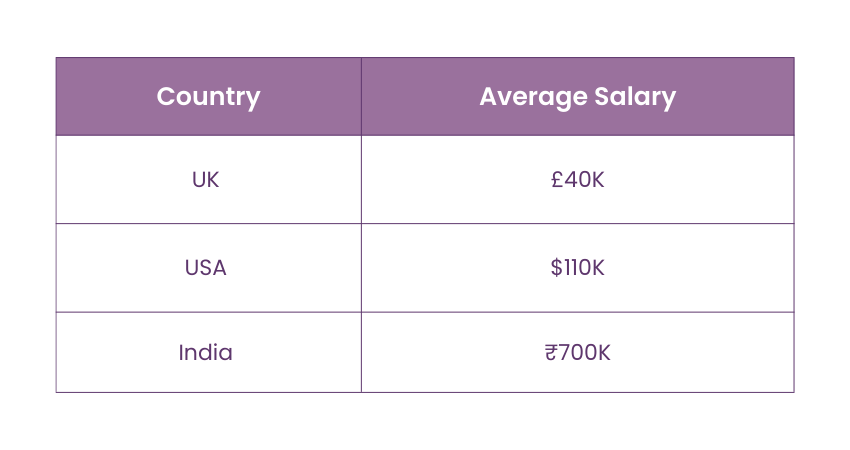
Source: Glassdoor
Information Security Analyst Job Description Template
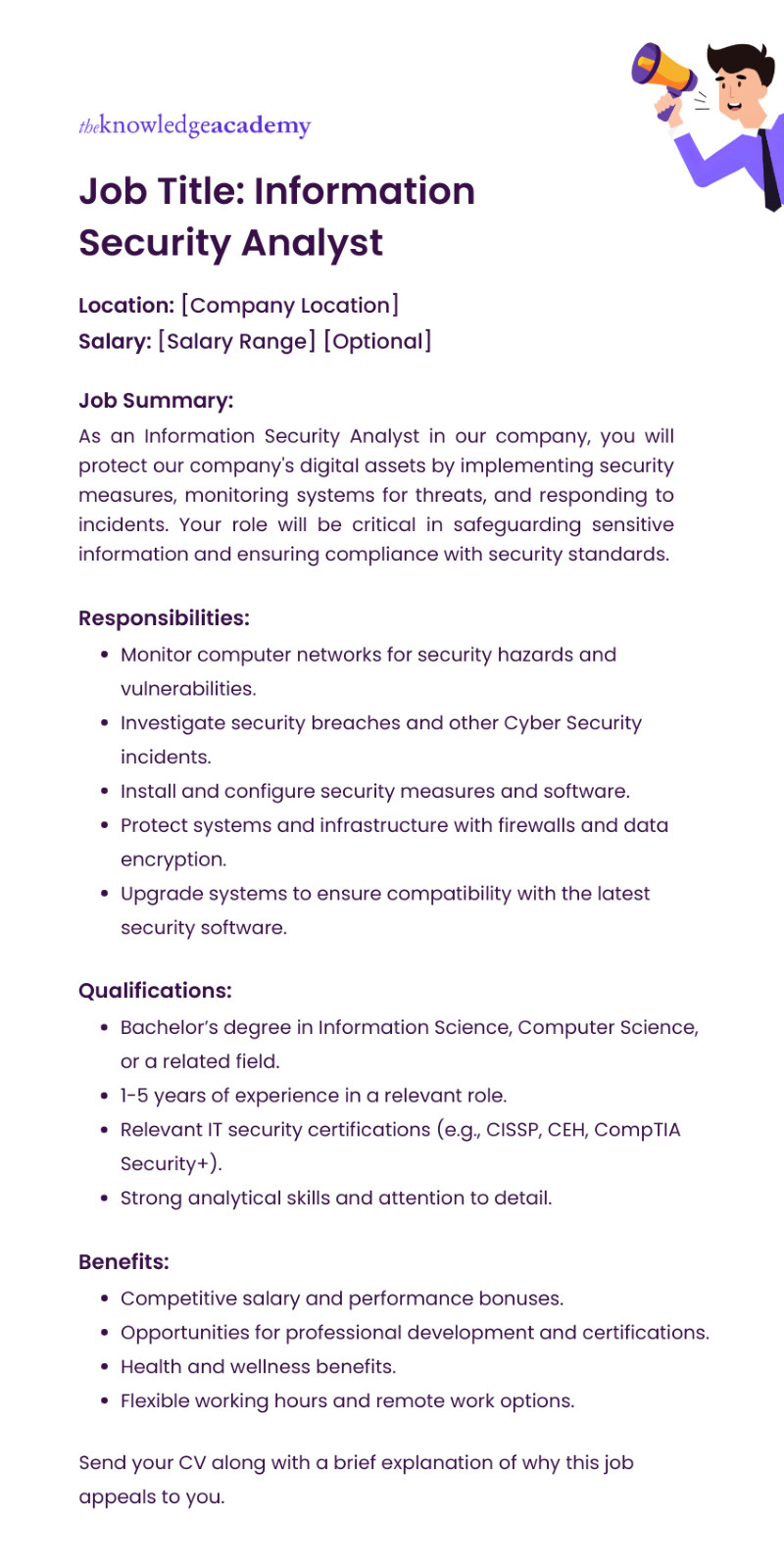
We have given a template for your reference. It will help you better understand the responsibilities and requirements of an Information Security Analyst. Let’s dive in!
Is an Information Security Analyst a Good Career Choice?
For those interested in technology and cybersecurity, Being an Information Security Analyst is a great career choice. The demand for expert professionals continues to grow fast due to rising and more complex cyber threats. This means strong job security, good salary prospects and plenty of opportunities.
Success in this role depends on having strong problem-solving skills, a good understanding of technology, a strong sense of ethics and a willingness to keep learning.
How can You Become an Information Security Analyst?
To embark on a career as an Information Security Analyst, consider the following steps:
1) Educational Background: Obtain a bachelor's degree in Computer Science, Programming, or a related field.
2) Work Experience: Gain 1–5 years of experience in roles like systems administration to build a foundation in IT.
3) Skill Development: Develop expertise in ethical hacking, intrusion prevention, incident response, Computer Forensics and reverse engineering. Familiarity with tools and concepts such as Security Information and Event Management (SIEM), firewalls, Linux/UNIX systems and application security is also beneficial.
4) Certifications: Pursue relevant certifications to enhance your qualifications.
5) Continuous Learning: Stay informed about the latest cybersecurity trends and threats to remain effective in the role.
Conclusion
The Information Security Analyst Job Description focuses on safeguarding digital assets and strengthening cybersecurity. This role includes monitoring networks, setting up security tools, and acting quickly when a threat arises. Getting ready for common Information Security Analyst Interview Questions can amplify your chances of landing the job, which is key in shaping an organisation’s overall security plan.
Own the audit room—get certified with our ISO 27002 Lead Auditor Training today!
Frequently Asked Questions
Why are Information Security Analysts Important?

Information Security Analysts are important because they design and execute network security. They are responsible for developing standards, maintaining computer networks and defending the firm from cyberattacks.
How Does an Information Security Analyst Respond to Security Breaches?
An Information Security Analyst checks how well an organisation protects its computer systems and fix any issues they find. They create plans to handle security attacks, reduce downtime and get systems running again quickly. They also study trends to guess what future threats might look like.
What are the Other Resources and Offers Provided by The Knowledge Academy?
The Knowledge Academy takes global learning to new heights, offering over 3,000+ online courses across 490+ locations in 190+ countries. This expansive reach ensures accessibility and convenience for learners worldwide.
Alongside our diverse Online Course Catalogue, encompassing 19 major categories, we go the extra mile by providing a plethora of free educational Online Resources like Blogs, eBooks, Interview Questions and Videos. Tailoring learning experiences further, professionals can unlock greater value through a wide range of special discounts, seasonal deals, and Exclusive Offers.
What is The Knowledge Pass, and How Does it Work?
The Knowledge Academy’s Knowledge Pass, a prepaid voucher, adds another layer of flexibility, allowing course bookings over a 12-month period. Join us on a journey where education knows no bounds.
What are the Related Courses and Blogs Provided by The Knowledge Academy?
The Knowledge Academy offers various ISO 27002 Training, including the ISO 27002 Foundation Training, ISO 27002 Lead Auditor Training and ISO 27002 Internal Auditor Training. These courses cater to different skill levels and provide comprehensive insights into What is ISO.
Our IT Security & Data Protection Blogs cover a range of topics related to ISO 27002, offering valuable resources, best practices, and industry insights. Whether you are a beginner or looking to advance your IT Security & Data Protection. The Knowledge Academy's diverse courses and informative blogs have got you covered.

The Knowledge Academy


Global Training Provider
The Knowledge Academy is a world-leading provider of professional training courses, offering globally recognised qualifications across a wide range of subjects. With expert trainers, up-to-date course material, and flexible learning options, we aim to empower professionals and organisations to achieve their goals through continuous learning.

Upcoming IT Security & Data Protection Resources Batches & Dates
Date
 ISO 27002 Foundation Training
ISO 27002 Foundation Training
Mon 13th Jul 2026
ISO 27002 Foundation Training
Mon 12th Oct 2026

 If you wish to make any changes to your course, please


