


 Top Rated Course

We may not have the course you’re looking for. If you enquire or give us a call on +60 1800812339 and speak to our training experts, we may still be able to help with your training requirements.
How to Improve Social Skills: 14 Proven Tips
The Knowledge Academy 23 March 2026Improve social skills by listening actively, engaging in conversations, using open body language, and practising regularly in low-pressure settings. Build confidence by observing social cues and responding thoughtfully during interactions. Over time, consistent practice strengthens communication, relationships, and overall social comfort.

Training Outcomes Within Your Budget!
We ensure quality, budget-alignment, and timely delivery by our expert instructors.
Table of Contents
Ever feel awkward at social gatherings? Struggling to start conversations or make meaningful connections? If so, you’re not alone, but Social Skills can be learned and improved. It’s not about being the life of the party; it’s about creating real connections that open up both personal and professional opportunities. In this blog, we’ll share 15 practical tips on How to Improve Social Skills.
From conversation starters and Active Listening to mastering body language and overcoming shyness, you’ll gain strategies on How to Improve Social Skills. By the end, you’ll be ready to feel more at ease in any interaction, ditch awkward silences, make lasting impressions, and build stronger relationships. Let’s get started!
Table of Contents
1) What are Social Skills?
2) Importance of Social Skills in Everyday Life
3) 14 Ways to Improve Your Social Skills
4) What are the Benefits of Social Skills?
5) How Do I Handle Awkward Silences in Conversations?
6) Conclusion
What are Social Skills?
Social skills refer to skills that enable you to communicate and interact well with others. They consist of speaking with clarity, listening to others, understanding their emotions, listening, cooperating, and responding to others in social contexts. Good social skills can assist in creating good relationships with people, collaborating with them, and adjusting to new conditions.
Positive social competence is a source of success in personal and professional life. It simplifies conflict resolution, teamwork, and positive impressions. Social skills can be developed by training in body language, empathy, and verbal and non-verbal communication.
Importance of Social Skills in Everyday Life
Social skills play a crucial role in our everyday life as they enable us to effectively interact with other people, establish positive relationships with them, and how to conduct ourselves in a social situation with confidence. Good social skills enhance communication, cooperation, and understanding the perspective of others, which makes it easier to solve conflicts and work within a team.
These competencies also enhance self-esteem and misunderstanding, contributing to an improved personal and professional experience. Good social skills allow you to relate well to others and make long-term relationships and react well to others in any social environment.
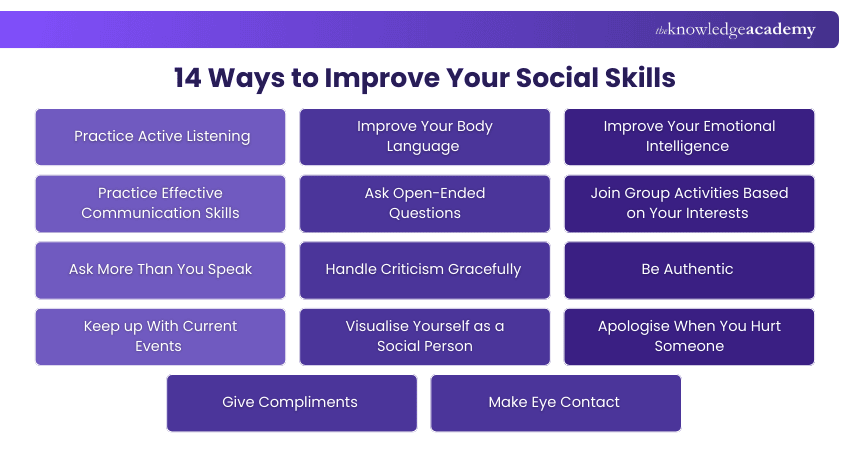
14 Ways to Improve Your Social Skills
The advantages of strong social skills are undeniable, opening doors to personal and professional success. Now that we've explored these benefits, let's delve into the practical side. Let us now investigate 15 powerful strategies to improve your Social Skills and confidently navigate any social situation!
1) Practice Active Listening
Active listening is to give complete attention to the one speaking without having to think about your reply or to interrupt. It is listening intently, nodding, maintaining eye contact, and demonstrating that you are listening, summarising or posing pertinent questions. Active listening will assist you in creating stronger relationships, lessen confusion, and ensure that other people feel acknowledged and respected, which will enhance your social life in the long term.
2) Improve Your Body Language
Improving body language helps convey confidence and openness in social interactions. Positive body language includes maintaining good posture, using appropriate gestures, and facing the person you are speaking with. Avoid closed-off gestures like crossing your arms. Practise in front of a mirror or with a friend to become more aware of your body language and its impact on your communication.
3) Improve Your Emotional Intelligence
By enhancing your emotional intelligence, you get to know and control your own feelings and feel the feelings of other people, and this makes socialising a lot easier and more effective. These involve getting to know yourself better, controlling your responses, empathy, and considering your responses during conversations. Emotional intelligence is enhanced and helps you to communicate better with people and solve conflicts and establish better relations.
Join our Personal Development Courses today and unlock your full potential!
4) Practice Effective Communication Skills
Effective communication means clearly sharing your thoughts and understanding what others are saying. It includes both spoken and unspoken signals, like word choice, tone, clarity, and body language. Mastering these skills helps you get your message across and avoid misunderstandings. Focus on speaking clearly, listening carefully, and responding appropriately. Improving your communication skills helps you interact confidently in any situation.
5) Ask Open-Ended Questions
Asking open-ended questions can help spark engaging conversations. This allows the person you're talking to share their thoughts or recount their experiences in-depth. There's more to say than just a quick "yes" or "no." By doing this, you're showing that you genuinely value their opinion. Include questions like "What's your take on...?" or "What were your feelings when...?" to promote meaningful conversations.
6) Join Group Activities Based on Your Interests
By participating in group activities that you find enjoyment in, you have the inherent chances of exercising social skills and interacting with others in a natural environment. You can find people with similar interests by joining clubs, classes or hobby groups, you can more easily initiate conversations and gain confidence in social situations. It also assists you in building positive relationships and enhancing communication and teamwork.
7) Ask More Than You Speak
It's about showing your interest in people through the questions you ask and the things you encourage them to share with you. This approach helps you learn more about them and keeps the conversation flowing. Ensure balanced participation by practising active listening and asking thoughtful questions. This not only makes others feel valued but also enriches your social experiences.
8) Handle Criticism Gracefully
Taking criticism gracefully means accepting input without becoming defensive or upset. Listen to what others have to say, thank them for their feedback, and reflect on how it can help you improve. Respond maturely with constructive calmness to show your willingness to grow. View every criticism as an opportunity to learn and grow positively rather than as a personal attack.
9) Be Authentic
Authenticity is the ability to present yourself as you are in your social life and not attempting to impress others or play a role. By telling the truth and sharing your true thoughts and emotions, it becomes much easier to be trusted and get close to people. Being authentic will enable you to connect with others in a better, more substantial way, and feel more relaxed in a social environment.
10) Keep up With Current Events
Keeping up with current affairs provides you with interesting topics to discuss and helps you engage in conversations about what's happening in the world. Read news articles, watch the news, or listen to podcasts regularly. Being informed lets you contribute meaningfully to discussions and shows that you are knowledgeable and aware, enhancing your social interactions.
Boost your interpersonal skills with our Emotional Intelligence Training. Sign up now to thrive in any environment!
11) Visualise Yourself as a Social Person
Visualising yourself as a social person implies imagining yourself interacting positively with others: confidently engaging in conversations, making friends, and handling social situations with ease. This mental rehearsal can boost your self-confidence and reduce anxiety. Regular visualisation helps create a positive mindset, making it easier to act confidently and naturally in real social encounters.
12) Apologise When You Hurt Someone
Apologising when you hurt someone demonstrates responsibility and respect for their feelings. An honest apology involves acknowledging the mistake, showing remorse, and resolving not to repeat the behaviour. Practise being honest and direct, for example, saying, "I'm sorry for what I said earlier; it was inconsiderate." Apologising helps repair relationships and build trust.
13) Give Compliments
Giving genuine compliments boosts others' confidence and strengthens your social bonds. Focus on specific, sincere observations rather than vague praise. Your compliments should be honest and reflect something you genuinely appreciate about the other person. Practise giving compliments regularly to make it a natural part of your interactions, helping to create a positive and encouraging social environment.
14) Make Eye Contact
Eye contact is very powerful when engaging with people and increases confidence in conversation. It shows that you are paying attention and are interested in the interaction. Practise by maintaining natural and comfortable eye contact and looking away occasionally to avoid staring. Good eye contact builds trust and rapport, making your interactions more meaningful and effective.
Gain practical tools for conflict resolution, communication, and decision-making with our Supervisor Training – Join today!
What are the Benefits of Social Skills?
Improving your social skills is important for your well-being. Good social skills can help in many ways:
1) Mental Health Benefits
a) Reduce anxiety and depression
b) Boost self-confidence and empathy
c) Improve teamwork and build stronger relationships
2) Physical Health Benefits
a) Lack of social connections can be worse than obesity, smoking, or high blood pressure
b) Feeling isolated can increase the risk of dementia as you get older
3) Social and Career Benefits
a) Better Work Relationships: People enjoy working with you, which can help in career growth.
b) Give and Take: Being kind to others makes them more likely to help you in return.
c) Setting Boundaries: Good communication helps others respect your space and feelings.
d) Stronger Client Connections: Freelancers, salespeople, and customer service reps build better trust and loyalty.
e) Job Interviews: Using open body language, eye contact, and a friendly smile can leave a great first impression.
Improving social skills makes life easier, helps you connect with others, and opens up new opportunities!
Enhance your communication with our Active Listening Training. Register now to connect better!
How Do I Handle Awkward Silences in Conversations?
Awkward silences are a normal part of communication and do not always mean the conversation is failing. Instead of panicking, stay calm and take a moment to observe the other person’s behaviour. You can ground yourself by taking a few slow breaths and giving the conversation space to continue naturally. If the silence lasts longer, gently restart the conversation by asking a simple question or making an observation. Learning to stay comfortable during short pauses helps conversations feel more relaxed and authentic.
Conclusion
Empowered with these 15 tips, you're well aware of how to Get Better at Drawing and how to Improve Social Skills! Step out of your comfort zone, embrace new connections, and watch your social confidence flourish. Remember, practice makes perfect; so go forth and conquer those social situations!
Strengthen your network with our Building Business Relationships Course. Join today to drive success!
PFrequently Asked Questions
How do I maintain Engaging Conversations?

To keep conversations engaging, focus on showing genuine curiosity and actively listening to the other person. Ask thoughtful questions, respond to their ideas, and be willing to share your own experiences or opinions. When both people listen and open up, the conversation naturally becomes deeper and more meaningful.
What Exercises Can Improve Social Skills?
Role-playing is an effective exercise for improving social skills. In this activity, people act out real-life situations such as resolving conflicts or having conversations, which allows them to practise communication in a safe environment. After the exercise, discussing what went well and what could improve helps build confidence and develop better social interaction skills.
What are the Other Resources and Offers Provided by The Knowledge Academy?
The Knowledge Academy takes global learning to new heights, offering over 3,000+ online courses across 490+ locations in 190+ countries. This expansive reach ensures accessibility and convenience for learners worldwide.
Alongside our diverse Online Course Catalogue, encompassing 17 major categories, we go the extra mile by providing a plethora of free educational Online Resources like Blogs, eBooks, Interview Questions and Videos. Tailoring learning experiences further, professionals can unlock greater value through a wide range of special discounts, seasonal deals, and Exclusive Offers.
What are the Other Resources and Offers Provided by The Knowledge Academy?
The Knowledge Academy’s Knowledge Pass, a prepaid voucher, adds another layer of flexibility, allowing course bookings over a 12-month period. Join us on a journey where education knows no bounds.
What are the Related Courses and Blogs Provided by The Knowledge Academy?
The Knowledge Academy offers various Personal Development Courses, including the Active Listening Skills Course, Building Business Relationships Course and Emotional Intelligence Training. These courses cater to different skill levels, providing comprehensive insights into Communication Barriers.
Our Business Skills Blogs cover a range of topics related to Social Skills, offering valuable resources, best practices, and industry insights. Whether you are a beginner or looking to advance your Social Skills, The Knowledge Academy's diverse courses and informative blogs have got you covered.

The Knowledge Academy


Global Training Provider
The Knowledge Academy is a world-leading provider of professional training courses, offering globally recognised qualifications across a wide range of subjects. With expert trainers, up-to-date course material, and flexible learning options, we aim to empower professionals and organisations to achieve their goals through continuous learning.

Upcoming Business Skills Resources Batches & Dates
Date
 Social Skills Training
Social Skills Training
Fri 17th Jul 2026
Social Skills Training
Fri 25th Sep 2026

 If you wish to make any changes to your course, please


