


 Top Rated Course

We may not have the course you’re looking for. If you enquire or give us a call on + 800 908601 and speak to our training experts, we may still be able to help with your training requirements.
Executive Assistant vs Administrative Assistant: What's the Difference
Charlotte Wilson 24 February 2026This blog will explore the similarities and differences between two common administrative roles: Executive Assistant vs Administrative Assistant. We will compare their skills, education, work experience, key responsibilities, and salary. We will also provide some tips on choosing the right career path for you.
Home
 Resources
Business Skills
Executive Assistant vs Administrative Assistant: What's the Difference
Resources
Business Skills
Executive Assistant vs Administrative Assistant: What's the Difference
Resources
Business Skills
Executive Assistant vs Administrative Assistant: What's the Difference

Training Outcomes Within Your Budget!
We ensure quality, budget-alignment, and timely delivery by our expert instructors.
Table of Contents
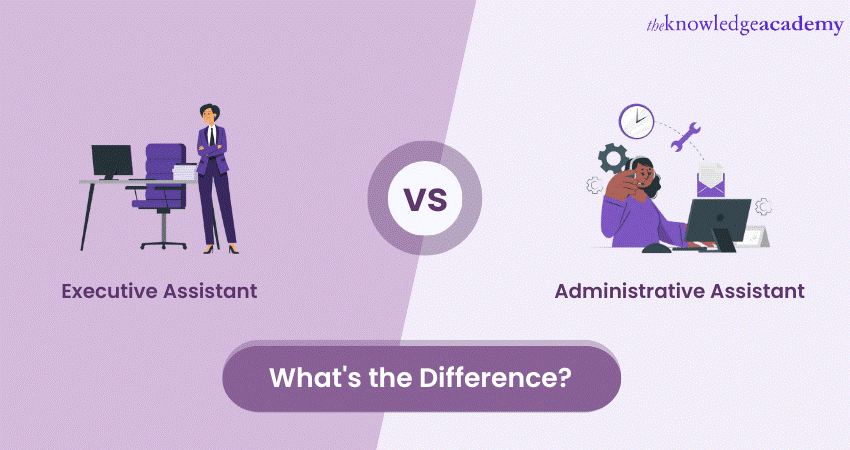
If you are interested in a career in administration and business, you may have wondered what the difference is between Executive Assistant vs Administrative Assistant. These two positions may sound similar, but they have distinct roles and responsibilities in an organisation.
Both roles require strong organisational and communication skills, but they differ in the degree of complexity and autonomy they have. In this blog, we will help you understand the difference between Executive Assistant vs Administrative Assistant and how to decide which one is best suited for your goals and interests. Let’s take a closer look at each role and how they compare.
Table of Contents
1) What is an Executive Assistant?
2) What is an Administrative Assistant?
3) Difference between Executive Assistant and Administrative Assistant
a) Skills
b) Education
c) Work experience
d) Key responsibilities
e) Salary
4) Conclusion
What is an Executive Assistant?
An Executive Assistant is a trusted partner of a senior executive, such as a CEO, CFO, or VP. An EA is responsible for managing the executive’s schedule, travel, correspondence, projects, and meetings. An EA may also handle sensitive and confidential information, supervise other staff, and act as a liaison between the executive and other stakeholders. An EA may also have a strategic role in the organisation, providing insights, ideas, and solutions to the executive.
Some of the common tasks that an EA performs are:
a) Managing the executive’s calendar and appointments
b) Booking and arranging travel, accommodation, and transportation
c) Preparing and editing documents, reports, presentations, and invoices
d) Conducting research and analysis
e) Organising and facilitating meetings and events
f) Handling phone calls, emails, and messages
g) Maintaining records and databases
h) Creating and updating workflows and procedures
i) Coordinating with other departments and external parties
What is an Administrative Assistant?
An Administrative Assistant is a generalist who supports the daily operations of an office or a department. An AA is responsible for performing various clerical and organisational tasks, such as filing, data entry, typing, copying, and mailing. An AA may also assist with customer service, reception, inventory, and bookkeeping. An AA may work with multiple managers or staff members, depending on the size and structure of the organisation.
Some of the common tasks that an AA performs are:
a) Answering and directing phone calls, emails, and messages
b) Greeting and assisting visitors and clients
c) Scheduling and confirming appointments and meetings
d) Preparing and distributing documents, memos, letters, and forms
e) Maintaining and updating records and files
f) Ordering and managing office supplies and equipment
g) Processing and recording payments and expenses
h) Entering and verifying data and information
i) Supporting other staff members with administrative tasks
Unlock success with our expert PA and Secretarial Course!
Difference between Executive Assistant and Administrative Assistant
Executive Assistants and Administrative Assistants are both professionals who perform various administrative tasks in an organisation. However, they differ in the level of skills, education, work experience, responsibilities, and salary they have. Here are some of the key differences:
Skills
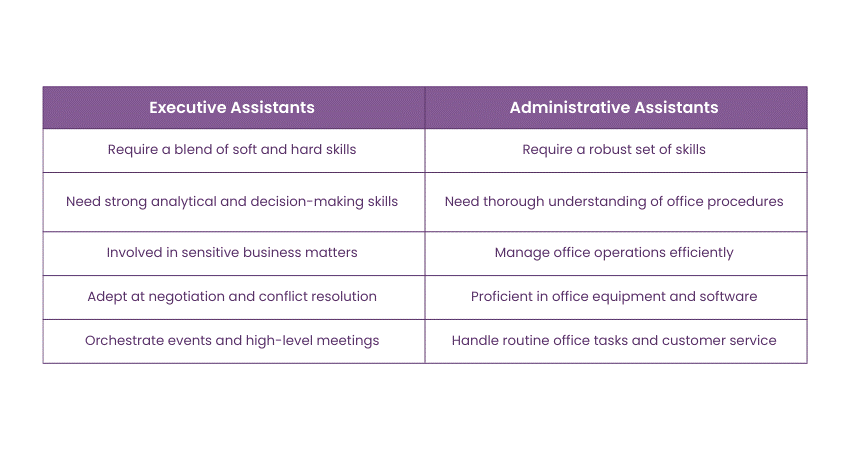
Executive Assistants are often seen as extensions of the executives they support, requiring a blend of soft and hard skills. Apart from advanced proficiency in office software, they need to exhibit strong analytical skills, enabling them to interpret complex data and prepare executive summaries. Their role often demands excellent judgment and decision-making abilities, as they might be involved in sensitive business matters. EAs must also possess exceptional organisational skills, not just for managing schedules but also for orchestrating events and high-level meetings. They should be adept at negotiation, as they often liaise with various stakeholders, and need to be skilled in conflict resolution.
Administrative Assistants, while not typically involved in decision-making at the executive level, require a robust set of skills to efficiently manage office operations. They should have a thorough understanding of office procedures, from filing systems to meeting coordination. Proficiency in standard office equipment and software is essential, as is the ability to handle routine office tasks with speed and accuracy. AAs need strong written and verbal communication skills for drafting correspondence and interacting with staff and clients. Customer service skills are also important, as AAs often serve as the first point of contact for an organisation. Organisational skills are crucial, as they frequently manage multiple tasks and deadlines.
Education
For EAs, higher education is often a significant advantage. A bachelor's degree in business administration, communication, or a related field is commonly preferred. EAs with degrees often have a better understanding of business operations and management principles, which can be crucial in supporting high-level executives. Furthermore, EAs may benefit from specialised training in executive support, project management, or legal and financial aspects, depending on the industry they are in. Professional development courses in leadership, strategic planning, and corporate communications are also seen as valuable, as they help EAs align more closely with the executive's goals and style of management.
AAs might find that specific educational backgrounds are less critical, but having coursework in office administration, computer applications, or business writing can be advantageous. Community colleges and vocational schools often offer programs that equip AAs with the necessary skills for the role. In today's tech-driven workplace, being proficient in the latest office technologies and software can set an AA apart. Ongoing training in new office technologies, time management, and customer service can also be beneficial for career growth and efficiency in the role.
Work experience
Executive Assistants usually climb the career ladder through progressive roles in administration. Their experience often includes roles where discretion, confidentiality, and high-level support were key components. Long-term tenure in a previous administrative role, especially in a complex, dynamic environment, is seen as valuable. This experience provides EAs with insights into organisational dynamics, stakeholder management, and strategic planning. Working closely with senior executives, EAs gain a nuanced understanding of business challenges and leadership styles, equipping them to preemptively manage the needs of the executives they support.
In contrast, Administrative Assistants often enter the field with diverse backgrounds. While some may progress from receptionist or clerical positions, others may transition from customer service or other administrative roles. The variety in their background can be an asset, bringing a range of perspectives and approaches to the role. AAs develop expertise in general office administration, learning to juggle various tasks efficiently. Over time, they may specialise in certain areas like database management, event planning, or technical writing, depending on the needs of their organisation.
Key responsibilities
EAs often manage complex calendars, coordinate travel arrangements, and prepare and review important documents before they reach the executive. They might also be involved in strategic planning and project management and represent the executive in meetings or communications. The EA role requires a high degree of professionalism and the ability to work under pressure, often managing sensitive or critical business matters.
AAs handle a broader range of general administrative tasks. They are responsible for maintaining office systems, handling correspondence, organising files, and supporting staff with various administrative needs. AAs may also be involved in managing office supplies, overseeing the maintenance of office equipment, and assisting in preparing and organising company events or meetings.
Salary
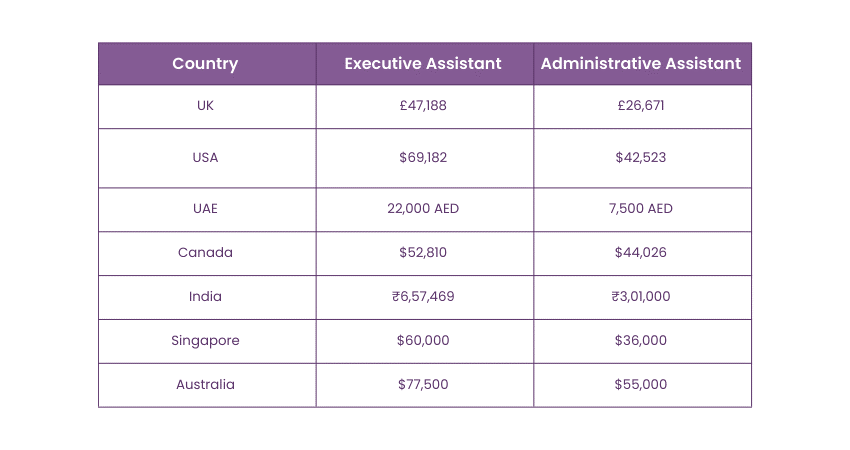
Salaries for both EAs and AAs vary widely based on industry, location, and the organisation's size. EAs, given their higher level of responsibility and closer work with executives, typically command higher salaries. In metropolitan areas or within high-profile industries like finance or tech, EA salaries can be particularly competitive. While generally earning less, AAs can see significant salary increases with experience, specialised skills, or by working in high-demand industries. Both roles may offer additional benefits like bonuses, health insurance, and retirement plans, contributing to the overall compensation package.
Source: Glassdoor
Transform your professional skills with our comprehensive Administrative Assistant Masterclass!
Conclusion
Executive Assistant vs Administrative Assistant are both valuable and essential roles in any organisation. They both perform administrative and organisational tasks, but they differ in the level of complexity and autonomy they have. Executive Assistants support top executives and may have more advanced and specialised skills, education, work experience, key responsibilities, and salary than Administrative Assistants. Administrative Assistants support the daily operations of an office or a department and may have more general and routine tasks than Executive Assistants.
Elevate your professional game with the ultimate Office Skills Masterclass!
Frequently Asked Questions
What are the benefits of becoming an Executive Assistant or an Administrative Assistant?

Both roles offer job stability, career advancement, networking opportunities, and personal satisfaction. Executive Assistants may enjoy more benefits, such as higher salaries, greater autonomy, and more influence. Administrative Assistants may enjoy more benefits, such as flexibility, diversity, and less stress.
How can I improve my qualifications and skills as an executive or Administrative Assistant?
You can improve your qualifications and skills by taking courses, workshops, or certifications in relevant topics such as business administration, communication, project management, or technology. You can also seek mentorship, feedback, or coaching from experienced professionals.
What are the other resources and offers provided by The Knowledge Academy?
The Knowledge Academy takes global learning to new heights, offering over 3,000+ online courses across 490+ locations in 190+ countries. This expansive reach ensures accessibility and convenience for learners worldwide.
Alongside our diverse Online Course Catalogue, encompassing 17 major categories, we go the extra mile by providing a plethora of free educational Online Resources like Blogs, eBooks, Interview Questions and Videos. Tailoring learning experiences further, professionals can unlock greater value through a wide range of special discounts, seasonal deals, and Exclusive Offers.
What is Knowledge Pass, and how does it work?
The Knowledge Academy’s Knowledge Pass, a prepaid voucher, adds another layer of flexibility, allowing course bookings over a 12-month period. Join us on a journey where education knows no bounds.
What are related PA and Secretarial courses and blogs provided by The Knowledge Academy?
The Knowledge Academy offers various PA and Secretarial Course, including Administrative Assistant Masterclass, Secretarial Masterclass, etc. These courses cater to different skill levels, providing comprehensive insights into Competitive Intelligence Process.
Our Business Skills blogs cover a range of topics related to the Administrative Assistant Masterclass, offering valuable resources, best practices, and industry insights. Whether you are a beginner or looking to advance your Business skills, The Knowledge Academy's diverse courses and informative blogs have you covered.

Charlotte Wilson


Soft Skills and Business Training Manager
Charlotte Wilson is an expert in soft skills development, with over 14 years of experience helping individuals and teams improve communication, productivity and emotional intelligence in the workplace. Her training content is focused on enhancing interpersonal effectiveness and fostering positive, collaborative environments across all levels of an organisation.
View Detail
Upcoming Business Skills Resources Batches & Dates
Date
 Office Management Course
Office Management Course
Fri 10th Jul 2026
Office Management Course
Fri 6th Nov 2026

 If you wish to make any changes to your course, please


