


 Top Rated Course


We may not have the course you’re looking for. If you enquire or give us a call on +44 20 4538 6376 and speak to our training experts, we may still be able to help with your training requirements.
Different Types of Accounting: A Quick Overview
Olivia Taylor 02 April 2026Different Types of Accounting includes financial, managerial, cost, tax, and forensic types, each designed to support internal management, reporting, and compliance. These Accounting Types help organisations track performance, manage costs, and comply with regulations. They provide insights for informed decisions and accurate reporting.

Training Outcomes Within Your Budget!
We ensure quality, budget-alignment, and timely delivery by our expert instructors.
Table of Contents

Have you ever wondered how businesses keep track of every penny they earn and spend? Or how massive corporations manage to stay financially healthy year after year? The answer lies in the Different Types of Accounting, each one designed to handle specific financial tasks with precision. In this blog, we’ll break down each type and explore why mastering them is essential in today’s financial world.
Table of Contents
1) Different Types of Accounting and Their Uses
a) Financial Accounting
b) Management Accounting
c) Cost Accounting
d) Tax Accounting
e) Auditing
f) Forensic Accounting
g) Public accounting
h) Nonprofit Accounting
i) International accounting
j) Accounting information systems
2) What are Three Golden Rules of Accounting?
3) What are the Two Main Accounting Methods?
4) Conclusion
Different Types of Accounting and Their Uses
Different Types of Accounting serve unique purposes, from managing day-to-day expenses to ensuring legal compliance. By understanding each type and its uses, businesses can improve efficiency, maintain transparency, and achieve long-term growth. These are the Types of Accounting:
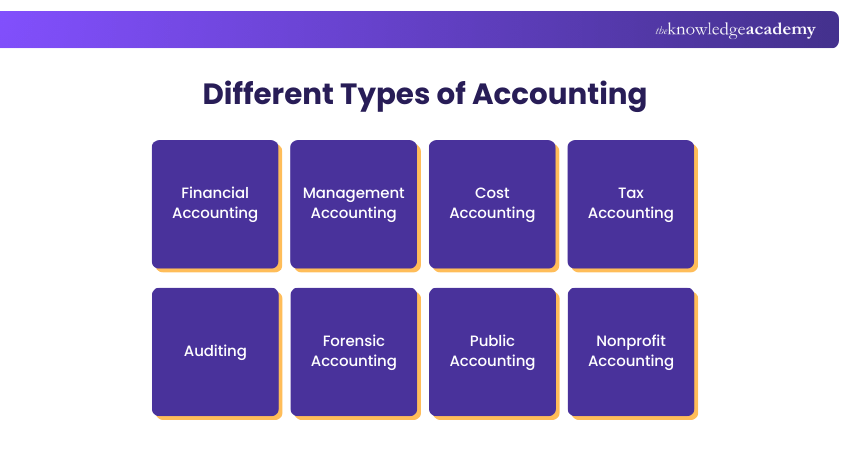
In this section, we'll explore the Different Types of Accounting and go deep into how they are used to provide accurate financial information.
1) Financial Accounting
Financial Accounting is one of the most widely used Types of Accounting in businesses. It records transactions and prepares financial statements such as the balance sheet, income statement, and cash flow statement to show a company’s financial position.
Given below are its uses:
a) Financial Reporting:
Financial accounting produces reports like balance sheets, income statements, and cash flow statements. These reports summarise a company’s financial position, performance, and liquidity for effective decision-making.
b) Creditor Analysis:
Banks, lenders, and suppliers review financial accounting reports to assess a company’s creditworthiness and ability to meet financial obligations before extending credit or loans.
c) Regulatory Compliance:
Financial accounting ensures organisations follow recognised standards such as IFRS or GAAP. This supports transparency, reduces financial risks, and maintains compliance with regulations.
d) Communication with Stakeholders:
Clear financial reporting helps organisations communicate their financial performance to stakeholders, including shareholders, employees, customers, and the public, strengthening trust and credibility.

2) Management Accounting
Management Accounting, or Managerial Accounting, is one of the key Types of Accounting that provides financial and non-financial information for internal decision-making. It helps managers plan, analyse performance, and make strategic business decisions.
Mentioned below are its applications in the industry:
a) Budgeting:
Management Accountants prepare budgets that outline expected income and expenses over a specific period. These plans help organisations allocate resources effectively and control spending.
b) Forecasting:
Forecasting involves analysing past data and market trends to predict future financial outcomes. This helps businesses plan ahead and respond to potential opportunities or challenges.
c) Cost Analysis:
Management Accounting examines both direct costs, such as materials and labour, and indirect costs, like overheads. Understanding these costs helps organisations improve pricing strategies and identify cost-saving opportunities.
d) Performance Evaluation:
Management Accountants analyse financial and operational data to assess the performance of departments, projects, or products. This helps identify strengths and areas for improvement.
e) Resource Allocation:
Management Accounting information supports decisions about where to invest resources, such as marketing, research, or business expansion, to achieve organisational goals.
f) Risk Management:
By analysing financial data and potential outcomes, management Accountants help organisations identify risks and make informed decisions to reduce their impact.
3) Cost Accounting
Cost Accounting is one of the important Types of Accounting that focuses on analysing and controlling the costs of producing goods or services. It examines variable costs such as materials and labour and fixed costs like rent to determine total production costs and improve profitability.
Some of its uses are:
a) Cost Classification and Allocation:
Cost accounting assigns costs to specific products, projects, or departments. Direct costs, such as materials and labour, are linked directly to production, while indirect costs or overheads are allocated across operations using suitable methods.
b) Pricing Strategy:
By identifying the true cost of production, cost accounting helps businesses set appropriate prices that cover expenses and maintain desired profit margins.
c) Cost Efficiency and Optimisation:
Cost accounting highlights areas where spending can be reduced without affecting quality. It helps organisations identify waste, improve processes, and use resources more efficiently.
d) Profitability Analysis:
Understanding cost structures allows businesses to evaluate the profitability of products, services, or departments, helping management focus on the most profitable areas.
e) Budgeting and Forecasting:
Cost accounting supports budgeting by analysing past cost patterns and estimating future expenses. This helps organisations plan finances more accurately.
f) Performance Measurement:
By comparing actual costs with planned or standard costs, businesses can measure performance and identify areas where improvements are needed.
g) Process Improvement:
Cost accounting helps identify inefficiencies in operations and production processes, enabling organisations to refine workflows and improve overall efficiency.
Join our Financial Modelling and Forecasting Training to make strategic financial decisions with confidence!
4) Tax Accounting
Tax Accounting is one of the key Types of Accounting that manages tax obligations and ensures compliance with tax laws. It involves calculating tax liabilities, preparing returns, and reviewing financial records.
Some of its key roles include:
a) Tax Planning:
Tax Accountants analyse financial activities and tax regulations to identify deductions, credits, or allowances that help reduce overall tax liabilities.
b) Tax Compliance:
They ensure that businesses follow all applicable tax laws and submit accurate tax returns within the required deadlines.
c) Tax Reporting:
Tax Accountants prepare the necessary financial information and documentation needed for tax filings and audits.
d) Risk Management:
By keeping up to date with changes in tax legislation, Tax Accountants help organisations avoid penalties and manage tax-related risks.
e) Financial Analysis:
They examine financial records and transactions to calculate the correct tax payable and ensure transparency in financial reporting.
f) Problem Solving and Advisory:
Tax Accountants interpret complex financial data and provide guidance on managing tax obligations effectively while remaining compliant with regulations.
5) Auditing
Auditing is one of the important Types of Accounting that reviews financial records to ensure accuracy and compliance with accounting standards. Audits may be performed internally or by independent external auditors.
Take a look at the uses of auditing in a company:
a) Independent Verification:
External auditors review financial statements to confirm that they accurately reflect the company’s financial performance and position.
b) Enhanced Credibility:
Audited financial reports increase trust among investors, lenders, regulators, and other stakeholders.
c) Compliance with Standards:
Auditors ensure that financial records follow recognised accounting standards and legal requirements.
d) Internal Controls Evaluation:
Auditing helps assess the effectiveness of internal controls and identify weaknesses that could lead to errors or fraud.
e) Fraud Detection and Prevention:
Auditors review transactions and records to detect irregularities and reduce the risk of fraudulent activities.
f) Operational Efficiency:
Audits can highlight inefficient processes and suggest improvements to strengthen organisational performance.
g) Transparency and Accountability:
Audited financial statements offer stakeholders a clear and reliable view of a company’s financial health.
h) Legal and Regulatory Compliance:
Auditing helps organisations meet legal obligations and avoid penalties by ensuring financial practices follow relevant regulations.
Elevate your financial expertise with our focused Financial Management Course for a successful and impactful career – Join now!
6) Forensic Accounting
Forensic Accounting is one of the specialised Types of Accounting that investigates financial records to detect fraud or illegal activities. It involves analysing transactions and providing financial evidence for legal proceedings.
Some of its key uses include:
a) Fraud Detection and Prevention:
Forensic Accountants inspect financial records and transactions to identify signs of fraud, embezzlement, or other unethical activities.
b) Litigation Support:
They assist in legal cases by analysing financial data and providing expert reports or testimony to support investigations and court proceedings.
c) Quantification of Damages:
Forensic Accountants assess financial losses in cases such as contract disputes, fraud, or business interruption claims.
d) Investigation of Financial Irregularities:
They trace financial transactions to uncover activities such as money laundering, bribery, or other financial misconduct.
e) Risk Assessment and Prevention:
By reviewing internal controls and financial processes, Forensic Accountants help organisations identify weaknesses and prevent future financial crimes.
f) Bankruptcy and Insolvency Analysis:
Forensic Accountants analyse financial records during bankruptcy or insolvency cases to determine the causes of financial failure and assess asset distribution.
g) Digital Forensics:
They also examine electronic financial records and digital trails to uncover hidden evidence related to financial wrongdoing.
7) Public Accounting
Public Accounting is one of the important Types of Accounting that provides auditing, tax, and financial advisory services to individuals, businesses, and government organisations.
Some of its key services include:
a) Financial Statement Preparation:
Public Accountants prepare and review financial statements to ensure they are accurate and follow the accounting standards. These reports help clients understand their financial position and meet reporting requirements.
b) Auditing and Assurance Services:
They conduct audits to examine financial records and confirm that financial statements are reliable and compliant with regulations.
c) Tax Preparation and Advisory:
Public Accountants assist with tax return preparation, tax planning, and compliance with tax laws, helping clients manage their tax responsibilities effectively.
d) Financial Consulting Services:
They provide advice on financial planning, budgeting, and business strategies to support better Financial Management and growth.
e) Accounting and Bookkeeping Services:
Public Accountants handle routine accounting tasks such as bookkeeping, Payroll Management, and financial reporting.
f) Difference from Private Accounting:
Unlike Private Accountants who work for a single organisation, Public Accountants serve multiple clients across different industries, providing independent financial expertise.
Learn fundamental Bookkeeping principles to manage financial records efficiently with our Bookkeeping Course – Join now!
8) Nonprofit Accounting
Nonprofit organisations have unique accounting needs due to their tax-exempt status and focus on fulfilling a mission rather than generating profits. Nonprofit Accountants handle fund accounting, ensuring funds are allocated appropriately for specific purposes and adhering to donor restrictions.
Some important uses of Nonprofit Accounting are:
a) Fund Accounting: Nonprofit accounting often employs fund accounting, which involves segregating financial resources into distinct funds based on their designated purposes. This allows nonprofits to track and report on funds separately, ensuring that resources are allocated in accordance with donor restrictions and the organisation's mission.
b) Financial Accountability: Nonprofits are accountable to various stakeholders, including donors, grant-making organisations, regulatory bodies, and the public. Nonprofit accounting plays a pivotal role in maintaining financial accountability by providing accurate, clear, and understandable financial statements that demonstrate prudent use of resources.
c) Budgeting and Resource Allocation: Nonprofit accounting helps in creating budgets that align with the organisation's mission and goals. Efficient resource allocation is critical for nonprofits to fulfil their objectives effectively, and accurate accounting data is essential for making informed budgetary decisions.
d) Grant and Project Accounting: Many nonprofits rely on grants and project-based funding to carry out their work. Nonprofit Accountants manage grant funds separately, tracking income and expenses for specific projects to ensure compliance with grant terms and proper allocation of resources.
e) Internal Controls for Good Governance: Nonprofit Accountants establish and monitor internal controls to prevent mismanagement of funds or potential fraud. These controls promote good governance and safeguard the financial integrity of the organisation.
f) Mission Impact Reporting: Nonprofit accounting goes beyond numbers; it helps quantify the impact of the organisation's work. Nonprofits use financial data to show how their efforts are translating into positive change, making them more attractive to donors and supporters.
9) International Accounting
International accounting supports businesses operating across multiple countries or planning global expansion. It focuses on managing financial activities across borders while ensuring compliance with International Financial Reporting Standards (IFRS) and country-specific accounting, tax, and regulatory requirements.
a) Compliance with International Standards: International Accountants ensure financial records align with IFRS and local accounting standards. This consistency allows businesses to report financial performance accurately across different regions.
b) Cross-border Tax Management: International Accountants track varying tax laws, treaties, and regulations across countries. They help organisations remain compliant while optimising tax obligations in multiple jurisdictions.
c) Preparation of Global Financial Reports: International Accountants prepare consolidated financial statements that reflect the performance of multinational operations. These reports support transparency and informed decision-making for global stakeholders.
d) Review of International Transactions: International Accountants analyse cross-border transactions to ensure accuracy, proper valuation, and regulatory compliance. This helps reduce financial risk and reporting errors.
e) Regulatory and Legal Compliance: By staying updated on international financial regulations, International Accountants help businesses meet legal requirements in foreign markets, reducing the risk of penalties and compliance issues.
f) Support for Global Expansion: International accounting enables businesses to identify overseas opportunities with confidence. Expert guidance helps organisations navigate complex financial environments and manage growth across international markets effectively.
10) Accounting Information Systems
Accounting Information Systems (AIS) use technology to collect, process, and store financial data efficiently. These systems help businesses automate accounting tasks, improve data accuracy, and generate reliable financial reports to support informed decision-making.
a) Automation of Financial Processes: AIS automates routine accounting activities such as data entry, transaction recording, and reporting. This reduces manual errors and improves the speed and accuracy of financial operations.
b) Integration with Business Systems: AIS can integrate with payroll, inventory, and other operational systems. This seamless integration minimises duplicate data entry and ensures consistency across departments.
c) Improved data Accuracy and Security: By centralising financial information, AIS enhances data accuracy and provides secure access controls. This ensures sensitive financial data is protected and easily retrievable when needed.
d) Use of Artificial Intelligence: Modern AIS platforms use AI to categorise transactions, reconcile accounts, and identify unusual patterns. These intelligent features help detect potential fraud and maintain financial integrity.
e) Support for Strategic Decision-making: By handling repetitive tasks, AIS allows Accountants and business owners to focus on Financial Analysis, forecasting, and strategic planning, improving overall business performance.
Gain expertise in project Financial Analysis and techniques with our Project Accounting Course – Register now!
What are the Three Golden Rules of Accounting?
The three Golden Rules of Accounting form the foundation of accurate financial recording and ensure consistency in the double-entry bookkeeping system. By applying these rules, businesses can correctly classify transactions and maintain reliable financial records.
a) Personal Accounts: Debit the receiver and credit the giver to reflect transactions involving individuals or organisations.
b) Real Accounts: Debit what comes in and credit what goes out to track assets accurately.
c) Nominal Accounts: Debit all expenses and losses and credit all incomes and gains to determine profit or loss.
What are the Two Main Accounting Methods?
The two main Accounting methods are Cash Basis Accounting and Accrual Basis Accounting. In Cash Basis Accounting, transactions are recorded when money is received or paid. In Accrual Basis Accounting, transactions are recorded when income is earned or expenses are incurred, regardless of cash flow.
Conclusion
Understanding the Different Types of Accounting is vital for effective Financial Management and decision-making. From financial reporting to fraud detection, each type serves a unique role in supporting business growth. Mastering these accounting types ensures accuracy, transparency, and long-term success in any organisation. Start exploring the right type today to drive smarter financial outcomes.
Explore our comprehensive Accounting Courses to enhance your financial skills and boost your career!
Frequently Asked Questions
What is the Highest Paid Type of Accounting?

Specialised fields such as Forensic Accounting, Management Accounting, and Auditing at top firms are among the highest-paid Types of Accounting. Roles in tax advisory for large corporations or senior positions like CFO also offer high salaries due to their expertise and leadership responsibilities.
What are the Three Models of Accounting?
The three models of Accounting are Cash Basis, where transactions are recorded when money changes hands, Accrual Basis, where transactions are recorded when earned or incurred, and Hybrid Basis, which combines aspects of both for flexible financial tracking and reporting.
What are the Other Resources and Offers Provided by The Knowledge Academy?
The Knowledge Academy takes global learning to new heights, offering over 3,000+ online courses across 490+ locations in 190+ countries. This expansive reach ensures accessibility and convenience for learners worldwide.
Alongside our diverse Online Course Catalogue, encompassing 17 major categories, we go the extra mile by providing a plethora of free educational Online Resources like Blogs, eBooks, Interview Questions and Videos. Tailoring learning experiences further, professionals can unlock greater value through a wide range of special discounts, seasonal deals, and Exclusive Offers.
What is The Knowledge Pass, and How Does it Work?
The Knowledge Academy’s Knowledge Pass, a prepaid voucher, adds another layer of flexibility, allowing course bookings over a 12-month period. Join us on a journey where education knows no bounds.
What are the Related Courses and Blogs Provided by The Knowledge Academy?
The Knowledge Academy offers various Accounting Courses, including the Accounting Course, Project Accounting Course, and the Cash Management Course. These courses cater to different skill levels, providing comprehensive insights into What is Remittance.
Our Accounting and Finance Blogs cover a range of topics related to Types of Accounting, offering valuable resources, best practices, and industry insights. Whether you are a beginner or looking to advance your Accounting and Finance skills, The Knowledge Academy's diverse courses and informative blogs have got you covered.

Olivia Taylor


Chartered Accountant and Financial Training Specialist
Olivia Taylor is a qualified chartered accountant with over a decade of experience in financial management, auditing and corporate reporting. Having worked with leading firms in both the public and private sectors, Olivia brings clarity to complex financial topics. Her writing focuses on helping professionals build confidence in key areas of accounting, compliance and financial planning.
View Detail

 If you wish to make any changes to your course, please


