


 Top Rated Course

We may not have the course you’re looking for. If you enquire or give us a call on +39 800580270 and speak to our training experts, we may still be able to help with your training requirements.
What is Logical Thinking? A Beginner's Guide
Charlotte Wilson 25 February 2026Logical Thinking is the process of analysing facts and situations objectively to solve problems and make decisions without emotions. It helps improve problem-solving and creativity in both personal and professional life. Developing certain skills enhances your productivity and strengthens critical reasoning abilities.

Training Outcomes Within Your Budget!
We ensure quality, budget-alignment, and timely delivery by our expert instructors.
Table of Contents
Let’s say that you are choosing between two career paths; one feels exciting but uncertain, the other safe but unfulfilling. Do you follow your gut, or do you step back, analyse the facts, and weigh the risks before deciding? That ability to think critically and systematically is what sets Logical Thinking apart. But What is Logical Thinking, and why is it so important?
At its core, Logical Thinking is about breaking down problems, spotting patterns, and making well-reasoned decisions. In this blog, we’ll uncover What is Logical Thinking, how it influences decision-making, and simple ways to strengthen this skill. Read more to refrain from impulsive decision-making.
Table of Contents
1) Understanding Logical Thinking
2) Components of Logical Thinking
3) Why is Logical Thinking Important?
4) What are Logical Thinking Skills?
5) Developing Logical Thinking Skills
6) Exercises to Improve Logical Thinking
7) Conclusion
Understanding Logical Thinking
Logical Thinking is the capacity to employ reason and systematic processes to analyse information, establish connections, and reach well-founded conclusions. It entails a structured and rational approach to problem-solving and Decision-making.
For example, consider a scenario where you're presented with a puzzle. To logically think through it, you would assess the provided clues, break down the problem into smaller elements, and systematically find potential solutions. You'd avoid hasty or emotion-driven judgments and rely on evidence and sound reasoning to arrive at the correct answer, showcasing the essence of Logical Thinking in Problem-solving.

Components of Logical Thinking
After knowing What is Logical Thinking, let’s move on to its key components. Logical Thinking comprises several key components that work together to facilitate reasoned analysis and problem-solving. Here are the following key components of Logical Thinking.
1) Deductive Reasoning: Deductive reasoning involves drawing specific conclusions from general premises or facts. It's like moving from a broad idea to a more specific conclusion. For example, if all humans are mortal, and Socrates is a human, then you can logically conclude that Socrates is mortal.
2) Inductive Reasoning: Inductive reasoning is the procedure of forming general conclusions based on specific observations or evidence. It's the opposite of deductive reasoning. For instance, if you observe that the sun has risen every day, you might inductively reason that the sun will rise again tomorrow.
3) Causal Inference: Causal inference is the ability to identify cause-and-effect relationships between events, actions, or variables. It involves understanding that one event or action can lead to another event consequently. In essence, it's the recognition that a specific cause produces a particular effect.
4) Analogy: Analogical Reasoning or analogy involves drawing similarities and making comparisons between two or more situations, objects, or concepts. It's a way of applying knowledge or understanding from one context to another by recognising shared features or characteristics.
Analogical Reasoning is powerful because it allows you to transfer what you know in one domain to another, making it easier to comprehend and solve new problems, much like how Analogous Estimation in project management applies historical data from similar projects to estimate costs or timelines for new ones.
Become the leader you aspire to be – sign up for our Leadership Courses now!
Why is Logical Thinking Important?
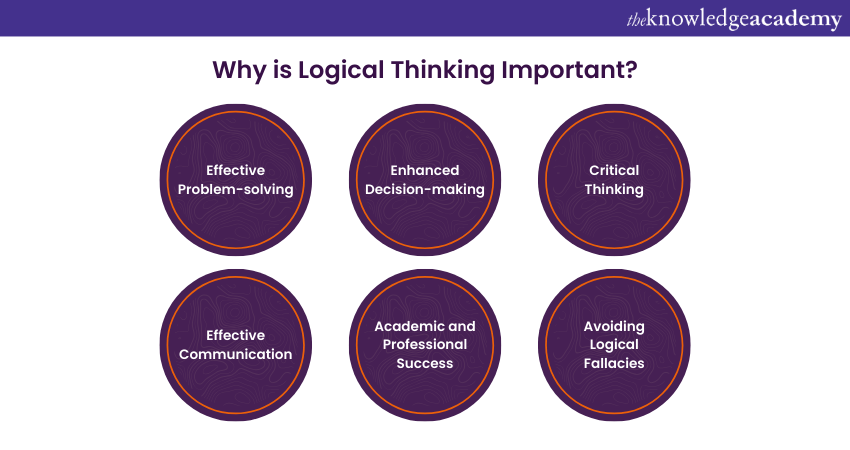
Logical Thinking is a vital cognitive skill that holds huge significance in several aspects of life. It enables individuals to navigate complex challenges, make informed decisions, and engage in thoughtful analysis. Here are key reasons highlighting the importance of Logical Thinking.
Logical Thinking is a vital cognitive skill that holds huge significance in several aspects of life. It enables individuals to navigate complex challenges, make informed decisions, and engage in thoughtful analysis. Here are key reasons highlighting the importance of Logical Thinking.
1) Effective Problem-solving: Logical Thinking equips individuals with the ability to dissect complex problems, identify patterns, and devise systematic solutions. Whether it's troubleshooting a technical issue or resolving personal dilemmas, Logical Thinking ensures that problems are approached with a structured and efficient methodology.
2) Enhanced Decision-making: Making sound decisions is a cornerstone of success in both personal and professional life. Logical Thinking allows individuals to evaluate options, consider consequences, and choose the most rational course of action. This is particularly critical in high-stakes situations.
3) Critical Thinking: Logical Thinking is at the core of critical thinking, encouraging individuals to question assumptions, seek evidence, and challenge existing beliefs. This capacity for critical analysis fosters a deeper understanding of complex issues and prevents the acceptance of unfounded or biased information, highlighting the Importance of Critical Thinking in making well-reasoned judgments.
4) Effective Communication: In discussions and debates, Logical Thinking helps individuals express their ideas and viewpoints clearly and persuasively. It enables individuals to construct well-structured arguments, provide evidence, and counter opposing views, fostering productive and respectful communication.
5) Academic and Professional Success: Logical Thinking is highly valued in educational settings and the workplace. It allows students to excel academically by tackling challenging coursework and assignments. In the professional world, it's a key attribute for problem-solving, innovation, and ways to advance your career development.
6) Avoiding Logical Fallacies: Logical Thinking equips individuals with the ability to recognise and avoid common logical fallacies such as circular reasoning, straw man arguments, and ad hominem attacks. This safeguards them from being deceived or manipulated by flawed or deceptive arguments.
Learn to manage innovation with our Innovative Thinking Training – Join today!
What are Logical Thinking Skills?
Logical Thinking skills are cognitive abilities that allow individuals to process information, analyse it systematically, and draw reasonable conclusions. These skills enable people to approach problems, decisions, and challenges with a structured and rational mindset.
Developing Logical Thinking Skills
Developing strong Logical Thinking skills is essential for improved problem-solving, decision-making, and critical analysis. Here are some key strategies to help you enhance your Logical Thinking abilities.

1) Practice Critical Thinking: Engage in activities that require critical thinking, such as analysing articles, solving puzzles, or evaluating arguments. Regular practice sharpens your analytical skills.
2) Learn Formal Logic: Study the principles of formal logic, which provide a structured approach to reasoning. This can include topics like syllogisms, propositional logic, and predicate logic.
3) Identify Assumptions: When faced with a problem or argument, be aware of underlying assumptions. Question these assumptions and consider how they impact the overall reasoning.
4) Break Down Problems: When tackling complex problems, break them down into smaller, more manageable components. Analyse each component individually before looking at the problem as a whole.
5) Seek Diverse Perspectives: Engage in discussions and debates with people who hold different viewpoints. This helps you consider a range of perspectives and strengthens your ability to construct and counter-arguments.
6) Read Widely: Reading a variety of materials, from academic articles to literature, exposes you to different modes of reasoning and argumentation. This broadens your thinking and enhances your ability to connect ideas.
7) Solve Puzzles and Brain Teasers: Engaging in puzzles, riddles, and brain teasers challenges your mind and encourages creative problem-solving. It's an enjoyable way to exercise your Logical Thinking.
8) Develop Mathematical Skills: Mathematics is a discipline that heavily relies on Logical Thinking. Learning and practising mathematical concepts and problem-solving techniques can significantly boost your logical reasoning skills.
Learn to manage time management skills with our Practical Thinking Course – Join today!
Exercises to Improve Logical Thinking
Enhancing your Logical Thinking skills is achievable through various exercises and activities. Here are some practical exercises to help you strengthen your Logical Thinking abilities:
1) Sudoku Puzzles: Solve Sudoku puzzles, as they require logical deduction to fill in the missing numbers.
2) Crossword Puzzles: Crosswords challenge your vocabulary and logical word placement.
3) Brain Teasers: Engage in brain teasers and riddles that encourage creative problem-solving.
4) Chess and Board Games: Play strategic board games like chess, checkers, or strategic video games that require forward thinking and planning.
5) Logical argumentation: Engage in debates or discussions where you must construct reasoned arguments and counter opposing viewpoints.
6) Coding and Programming: Learn coding and programming languages which promote structured and Logical Thinking in problem-solving.
7) Mathematical Challenges: Solve mathematical problems and equations, as mathematics is inherently logical.
8) Mensa Puzzles: Work on Mensa puzzles, which are designed to test and strengthen Logical Thinking skills.
9) Logic Games: Play logic-based games like Minesweeper or Mastermind.
10) Logical Analogy Exercises: Practice solving analogy exercises that test your ability to find relationships between words or concepts.
11) Visual Logic Puzzles: Tackle visual logic puzzles like nonograms or logic grid puzzles.
12) Critical Reading: Practising Critical Reading through books, articles, and research papers helps sharpen your ability to identify strong arguments and weak logic.
13) Coding Challenges: Participate in online coding challenges and competitions that require logical problem-solving in coding.
14) Scientific Method: Conduct simple science experiments or projects, applying the scientific method to develop hypotheses and draw logical conclusions.
15) Poker or Card Games: Play card games like poker, where you must strategise and make logical decisions based on probabilities and information.
16) Analyse Real-world Situations: Analyse real-world situations or news stories, evaluating the information, causes, and potential consequences.
These exercises will help you practice and enhance your Logical Thinking skills in a fun and engaging way, making them an integral part of your problem-solving and decision-making toolkit.
Want to excel in your next interview? Practice answering the toughest Critical Thinking Interview Questions to demonstrate your problem-solving and analytical abilities with ease.
Conclusion
Mastering What is Logical Thinking isn’t just about solving problems; it is about seeing the bigger picture, making smarter decisions, and approaching life with clarity. The more you refine this skill, the better equipped you’ll be to handle challenges. So, think critically and turn uncertainty into opportunity.
Learn to lead impactful discussions with our Meeting Skills Training – Join today!
Frequently Asked Questions
How can Logical Thinking Boost my Career?

Logical Thinking helps you solve problems, make better decisions, and work more efficiently. It allows you to analyse situations clearly, which improves job performance and career growth.
Can Creative Hobbies Improve my Logical Thinking?
Yes, creative hobbies like drawing, music, or puzzles help the brain think in new ways. They improve problem-solving skills, making it easier to think logically and find smart solutions.
What are the Other Resources and Offers Provided by The Knowledge Academy?
The Knowledge Academy takes global learning to new heights, offering over 3,000 online courses across 490+ locations in 190+ countries. This expansive reach ensures accessibility and convenience for learners worldwide.
Alongside our diverse Online Course Catalogue, encompassing 17 major categories, we go the extra mile by providing a plethora of free educational Online Resources like Blogs, eBooks, Interview Questions and Videos. Tailoring learning experiences further, professionals can unlock greater value through a wide range of special discounts, seasonal deals, and Exclusive Offers.
What is The Knowledge Pass, and How Does it Work?
The Knowledge Academy’s Knowledge Pass, a prepaid voucher, adds another layer of flexibility, allowing course bookings over a 12-month period. Join us on a journey where education knows no bounds.
What are Related Courses and Blogs Provided by The Knowledge Academy?
The Knowledge Academy offers various Sales Training, including Creative and Analytical Thinking Training, Practical Thinking Course, and Design Thinking Course. These courses cater to different skill levels, providing comprehensive insights into How to Create a Sales Funnel
Our Business Skills Blogs cover a range of topics related to Logical Thinking, offering valuable resources, best practices, and industry insights. Whether you are a beginner or looking to advance your Business Management skills, The Knowledge Academy's diverse courses and informative blogs have got you covered.

Charlotte Wilson


Soft Skills and Business Training Manager
Charlotte Wilson is an expert in soft skills development, with over 14 years of experience helping individuals and teams improve communication, productivity and emotional intelligence in the workplace. Her training content is focused on enhancing interpersonal effectiveness and fostering positive, collaborative environments across all levels of an organisation.
View Detail
Upcoming Business Skills Resources Batches & Dates
Date
 Online Sales Training
Online Sales Training
Fri 10th Jul 2026
Online Sales Training
Fri 2nd Oct 2026

 If you wish to make any changes to your course, please


