
Journalism Course Outline

Module 1: Overview

  • What is Journalism?
  • Media Functions
  • Journalism History

Module 2: Matter of Facts

  • Fact Vs Opinion
  • News Values and Analysing
  • News Elements and Recognising
  • Hard News and Soft News
  • Writing with Style
  • News Story Structure
  • News Writing

Module 3: News Gathering and Interviewing

  • Compiling a Beat Sheets
  • Events Calendar
  • Background Research
  • Investigative Reporting
  • Conducting and Preparing the Interview
  • Writing the Interview

Module 4: Feature and Sports Writing

  • Introduction to Feature Writing
  • Feature Leads, Bodies, and Conclusions
  • Planning a Feature Story

Module 5: Sports Writing

  • Analysing Sports Stories
    • What is Sports Journalism?
    • What is Sports Writing in Journalism?
    • Types of Sports Stories

Module 6: Matter of Opinion

  • What is an Editorial?
  • Types of Editorials
  • Analysing and Writing an Editorial

Module 7: Headlines Writing and Typography, and Graphics

  • Counting Headlines
  • Writing Headlines
  • Designing a Logo
  • Writing Captions

Module 8: Layout, Design, and Writing for Broadcast

  • Designing a Font Page
  • Analysing Television and Radio News
Show more blue-arrow

Who Should Attend this Journalism Course?

This Journalism Course is suitable for professionals and aspiring media practitioners who want to develop skills in reporting, interviewing, news writing, and journalistic content creation. It can particularly benefit:

  • Aspiring Journalists
  • News Reporters
  • Content Writers
  • Feature Writers
  • Editorial Assistants
  • Media Professionals
  • Communications Executives
  • Sports Writers

Prerequisites for the Journalism Course

There are no formal prerequisites to attend this Journalism Course. It is suitable for beginners and aspiring journalists, as well as professionals looking to strengthen writing, research, reporting, and ethical journalism skills across print, digital, and broadcast media.

Journalism Course Overview

Our Journalism Course introduces delegates to the principles of journalism and how news is researched, structured, and presented across different media formats. It covers news values, facts and opinions, interviewing, feature writing, editorials, headlines, and broadcast content.

Delegates develop skills in gathering information, conducting interviews, structuring news stories, and writing for different journalistic purposes. They also strengthen their ability to analyse news content, plan features, create headlines, and present information clearly.

This 1-Day course offered by The Knowledge Academy enables delegates to apply journalism techniques when researching, writing, and presenting news content. They will be better equipped to produce clear, structured, and relevant journalistic material across print and broadcast contexts.

Journalism Course Objectives

  • To understand core journalism principles, news values, and story structure
  • To develop research and news-gathering skills for journalistic reporting
  • To improve news, feature, and sports writing techniques
  • To distinguish between fact, opinion, hard news, and soft news
  • To conduct effective interviews and present gathered information clearly
  • To develop skills in headline writing, captions, layout, and broadcast content

Learning Outcomes of this Journalism Course

Upon completing this Journalism Course, delegates will be able to research information, conduct interviews, structure news stories, and write clear journalistic content for different formats. They will also strengthen their ability to analyse news values, distinguish fact from opinion, and develop feature, editorial, headline, and broadcast content.

Essential Skills You'll Learn from this Journalism Course

This Journalism Course helps learners develop the core skills required to research, create, analyse, and present news content effectively across modern media platforms.

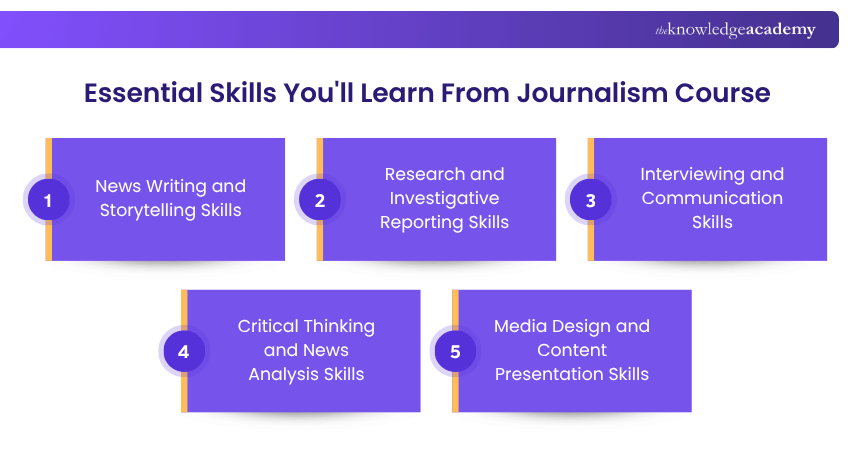
Essential Skills You'll Learn From Journalism Course

  • News Writing and Storytelling Skills: Learn to create clear, engaging, and accurate news stories for different audiences.
  • Research and Investigative Reporting Skills: Develop techniques for gathering information, conducting background research, and supporting investigative reporting.
  • Interviewing and Communication Skills: Build confidence in conducting interviews and communicating professionally with stakeholders.
  • Critical Thinking and News Analysis Skills: Strengthen the ability to evaluate information, recognise news values, and distinguish fact from opinion.
  • Media Design and Content Presentation Skills: Learn how to structure and present content effectively for print, digital, and multimedia platforms.

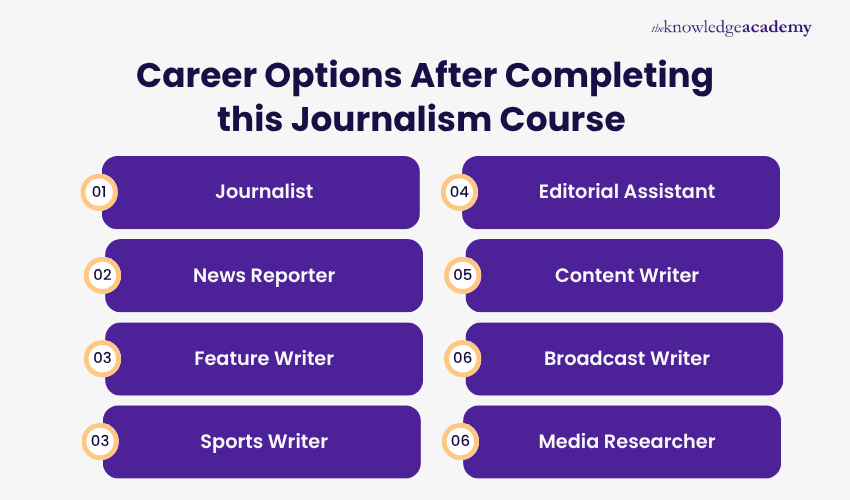
Career Options After Completing this Journalism Course

Completing this Journalism Course can support progression into a range of journalism and media-related roles. Depending on experience, existing skills, and employer requirements, delegates may explore opportunities such as:

Career Opportunities After Completing this Journalism Course

Career progression will also depend on practical experience, portfolio development, and the specific requirements of the role or organisation.

Show more blue-arrow

What’s Included in this Journalism Course?

  • World-Class Training Sessions from Experienced Instructors
  • Journalism Certificate
  • Digital Delegate Pack
Show more blue-arrow

Train Your Workforce

Looking for Journalism Course in-house or onsite training Mumbai. We specialise in corporate group training and bulk bookings for organisations of all sizes. Our trainers deliver tailored sessions at your premises, online, or hybrid, with best price guarantee, group discounts and flexible scheduling.

Approved supplier to 54,040 organisations

The Knowledge Academy is an approved training supplier to 54,040 organisations across the UK, Europe, North America and Australia, so most buyers can book through their existing purchasing process with no new supplier setup.

Our Mumbai venue

Includes..

Free Wi-Fi

To make sure you’re always connected we offer completely free and easy to access wi-fi.

Air conditioned

To keep you comfortable during your course we offer a fully air conditioned environment.

Full IT support

IT support is on hand to sort out any unforseen issues that may arise.

Video equipment

This location has full video conferencing equipment.

Mumbai is situated within the West Coast of India, as well as it being the capital of Maharashtra, it plays an important part within the global economics system. Bombay as the city was previously known as, up until 1995 is also known as an alpha world city and has the largest number of millionaires and billionaires across India, with it therefor being noted as the wealthiest city in India. Mumbai is home to around 18.4 million people and is regarded as the second largest metropolitan population within India as of the record in 2011 with 20.7 million people. Schools and Colleges within Mumbai can be found within the city as well as the suburbs and are either run privately, by the government or the Brihanmumbai Municipal Corporation. Secondary schools are operated by the MCGM primary education system to which it is schooling around 485,531 students in 1,188 primary schools and around 55,576 students in 49 secondary schools within eight different languages these being English, Hindi, Urdu, Kannada, Marathi, Tamil, Gujarati and Telugu. Colleges offer students opportunities to participate within Junior college level, undergraduate level, BCom, BSc and BA courses. As stated by the 10+2+3/4 plan students complete ten years at school to then go on to a junior college and study either science, commerce or arts and they complete that over a two year period. University courses at a degree level are offered in a wide range of different subjects such as engineering, law, media, applied arts and architecture, management, dental, pharmacy as well as Commerce and Science. There are a few universities and colleges within Mumbai and these are the University Institute of Chemical Technology, Indian Institute of Technology (Bombay), SNDT Women’s University, Government Law college, Veermata Jijabai Technological Institute, Narsee Monejee Institute of Management Studies, Sir J. J. School of Art which is the oldest art institution within Mumbai along the Thadomal Shahani Engineering College which is also the oldest private engineering college and the first of its kind to join up with the University of Mumbai to be able to give students the chance to learn about the biomedical engineering, computer engineering, biotechnology and information technology. The University of Mumbai is regarded to be one of the premier universities within India with achievements such as being placed within the top 50 engineering schools of the world ranking at 41 by the American Business Insider within 2013 as well as excelling as the 3rd best multi-disciplinary university within the QS university rankings within India.   

Show moredown

Ways to take Journalism Course in Mumbai

Live Online

The same live course from home, with a live instructor and other delegates. Mirrors the classroom schedule.

Best for: starting soon, without travel.

1 day · next Fri 15 Jan 2027

See live online dates

Online Self-Paced

Study 24/7 on your own schedule through our learning platform, with progress tracking.

Best for: fitting study around work.

90 days of access

See self-paced options

Onsite

We bring the course to your team, at your premises, online or hybrid, on dates that suit you.

Best for: groups and bulk bookings.

Tailored to your team

Get a team quote

Loading ....

Package deals for Journalism Course in Mumbai

Our training experts have compiled a range of course packages on a variety of categories in Journalism Course, to boost your career. The packages consist of the best possible qualifications with Journalism Course, and allows you to purchase multiple courses at a discounted rate.

Journalism Course in Mumbai FAQs

What is Journalism and what does a Journalist do?

Journalism involves researching, gathering, evaluating, and presenting information for public audiences. Journalists investigate stories, conduct interviews, verify information, and produce news, features, editorials, or broadcast content in a clear and structured manner.

What is the Journalism Course about?

This Journalism Course develops foundational knowledge of reporting, news gathering, interviewing, writing, and content presentation. Delegates learn how to structure stories, analyse news, conduct interviews, and communicate information effectively across journalistic formats.

Are there any prerequisites for taking up this Journalism Training?

There are no formal prerequisites to attend this Journalism Training. An interest in news, writing, communication, or media can help delegates engage more effectively with the course content.

What is the duration of this Journalism Course?

This Journalism Course takes 1 Day to complete. During the training, delegates develop essential knowledge and skills related to reporting, interviewing, news writing, and journalistic content creation.

What are the benefits of taking this Journalism Course?

This Journalism Course helps delegates strengthen reporting, interviewing, research, writing, and news-analysis skills. It also builds their ability to organise information, structure journalistic content, and communicate stories clearly across different media formats.

Does The Knowledge Academy provide corporate training?

Yes, The Knowledge Academy provides corporate Journalism Training tailored to organisational requirements. Training can be aligned with team roles, learning needs, organisational priorities, and suitable delivery arrangements.

Does The Knowledge Academy offer support to candidates pursuing this Journalism Course?

Yes, The Knowledge Academy provides support to delegates throughout the Journalism Course. The support team will assist with course access, training-related queries, and general learning support before, during, and after the training.

Does this Journalism Course include interview and investigative reporting techniques?

Yes, this Journalism Course covers interview preparation and conducting interviews alongside background research and investigative reporting. Delegates develop a structured approach to gathering information and presenting interview-based content.

How can Journalism skills benefit content creators, bloggers, and communication professionals?

Journalism skills can help content creators, bloggers, and communication professionals research information more effectively, structure stories clearly, and communicate with greater accuracy. This Journalism Course helps delegates strengthen interviewing, news analysis, and headline-writing skills that can improve the quality and organisation of their content.

What interview techniques are taught in this Journalism Course?

This Journalism Course covers preparing for interviews, conducting them effectively, gathering relevant information, and turning interview material into structured written content. These techniques help delegates approach interviews with clearer objectives and stronger communication.

What role does multimedia storytelling play in Journalism?

Multimedia storytelling allows journalists to present news through written, visual, and broadcast formats, making information more accessible to different audiences. Our course covers content presentation, layout, captions, and television and radio news analysis. Delegates choosing the Journalism Online Course option can develop an understanding of these techniques through a flexible learning format.

What topics are covered in this Journalism Course?

This Journalism Course covers the essential principles of reporting, news gathering, interviewing, journalistic writing, and content presentation. Delegates also explore different approaches to news, feature, editorial, sports, headline, and broadcast content without limiting their learning to a single journalistic format.

What does feature writing mean in Journalism?

Feature writing involves creating detailed and engaging stories that explore a subject beyond straightforward news reporting. Our course covers planning feature stories and structuring effective leads, bodies, and conclusions. These skills are covered across our training options, including the Online Journalism Course format, helping delegates develop clear and engaging journalistic content.

Is Journalism still a good career choice in 2026?

Yes, journalism remains a valuable career choice for delegates interested in researching information, reporting stories, interviewing people, and communicating with audiences. This Online Journalism Training helps delegates strengthen writing, reporting, analytical, and communication skills that can support progression across journalism and related media roles.

What does Journalism ethics mean?

Journalism ethics refers to professional principles that guide responsible reporting, such as accuracy, fairness, accountability, and careful handling of information. These principles help journalists maintain credibility, respect audiences, and make responsible decisions when gathering and presenting news.

How is this Journalism Training Course kept up to date with current industry trends?

This Journalism Training Course is regularly reviewed and updated to maintain relevance to current journalism practices and media developments. Updates are incorporated where appropriate to reflect evolving approaches to reporting, writing, content presentation, and professional communication.

What should be my next step after completing the Journalism Course?

After completing the Journalism Training Course, delegates can continue developing their reporting and writing skills through practical experience and portfolio building. They can also explore journalism and media-related opportunities or undertake further training in areas aligned with their career goals.

Why choose The Knowledge Academy in Mumbai over others?

The Knowledge Academy is a trusted training provider offering experienced instructors, flexible learning formats, comprehensive course options, and structured learning resources. Our courses are perfect choice for delegates seeking professional Journalism Training in Mumbai.

What is the cost/training fees for Journalism Course in Mumbai?

The training fees for Journalism Course in Mumbai starts from INR154995

Which is the best training institute/provider of Journalism Course in Mumbai?

The Knowledge Academy is one of the Leading global training provider for Journalism Course.

What are the best Personal Development Courses courses in Mumbai?

Please see our Personal Development Courses courses available in Mumbai

Show more blue-arrow

Customers Reviews

Request For Pricing

WHO WILL FUNDING THE COURSE?
+44

Corporate Training

Unlock tailored pricing and customised training solutions for your team’s needs.

Request your quote today!

Why choose The Knowledge Academy

price

Best price in the industry

You won't find better value in the marketplace. If you do find a lower price, we will beat it.

learning

Many delivery methods

Flexible delivery methods are available depending on your learning style.

resources

High quality resources

Resources are included for a comprehensive learning experience.

Our Clients

"Really good course and well organised. Trainer was great with a sense of humour - his experience allowed a free flowing course, structured to help you gain as much information & relevant experience whilst helping prepare you for the exam"

Joshua Davies, Thames Water
santander barclays bmw google thames-water deloitte bupa tesla
cross

Exclusive Deals For Future Leaders!

cyber-monday-sale UP TO 60% OFF!

* WHO WILL BE FUNDING THE COURSE?

close

close

Thank you for your enquiry!

One of our training experts will be in touch shortly to go over your training requirements.

close

close

Press esc to close

close close

Back to course information

Thank you for your enquiry!

One of our training experts will be in touch shortly to go overy your training requirements.

close close

Thank you for your enquiry!

One of our training experts will be in touch shortly to go over your training requirements.