


 Top Rated Course

We may not have the course you’re looking for. If you enquire or give us a call on +918037244591 and speak to our training experts, we may still be able to help with your training requirements.
What is Supply Chain Management and Why It Matters Today?
The Knowledge Academy 15 July 2026Supply Chain Management (SCM) is the process of planning, managing, and coordinating goods, services and information from raw materials to the customers. It includes sourcing, production, logistics, inventory, and aims to improve efficiency. This reduces costs and ensures timely product availability by streamlining each step.

Training Outcomes Within Your Budget!
We ensure quality, budget-alignment, and timely delivery by our expert instructors.
Table of Contents
What is Supply Chain Management?
Supply Chain Management (SCM) is the strategic coordination and oversight of all activities involved in the production and delivery of goods and services. This process starts from raw material sourcing to final product delivery. It encompasses the entire lifecycle of a product, including procurement, manufacturing, inventory management, warehousing, transportation, and customer service.

Modern Supply Chain Management also involves using data analytics, automation, and technology platforms to track performance. It also forecasts demand, manages risks, and improves decision-making. This can be done by enhancing customer satisfaction, minimising delays, and responding quickly to market changes.
Why is Supply Chain Management Important?
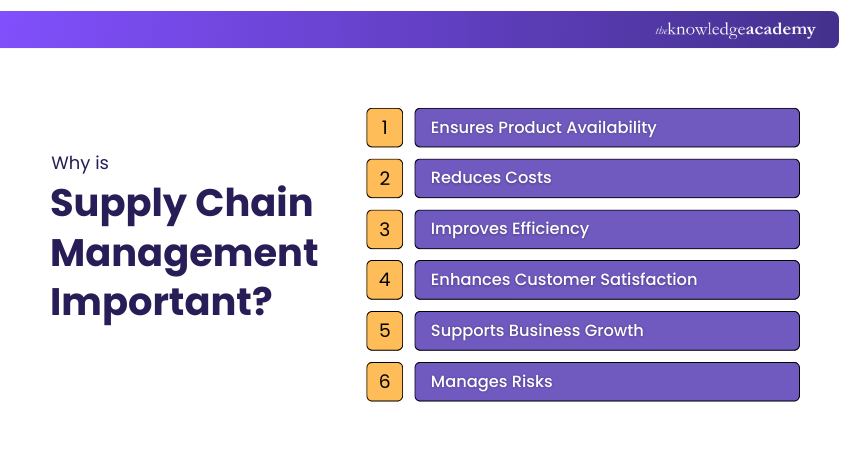
Here's a detailed explanation of each point on why Supply Chain Management (SCM) is important:
1) Ensures Product Availability
SCM helps deliver the right products to the right place at the right time, reducing stockouts and delays. This prevents stockouts, avoids excess inventory, and keeps shelves and warehouses optimally stocked.
2) Reduces Costs
SCM improves sourcing strategies, negotiates better supplier contracts, and enhances distribution methods. By optimising sourcing, production, and logistics, SCM cuts unnecessary expenses and improves profit margins.
3) Improves Efficiency
Streamlining processes from suppliers to customers boosts speed, minimizes waste, and increases overall productivity. It eliminates redundancies, reduces delays, and shortens production cycles.
4) Enhances Customer Satisfaction
Timely deliveries, better product quality, and accurate order fulfillment lead to happier customers and repeat business. A smooth supply chain directly improves the customer experience and brand reputation.
Enhance your knowledge of current industry trends with our Industry training - join now!
5) Supports Business Growth
A strong supply chain enables companies to scale operations, enter new markets, and respond to demand changes quickly. A strong supply chain is essential for sustainable growth.
6) Manages Risks
SCM helps identify and mitigate risks such as supplier disruptions, transportation delays, or inventory shortages. With risk mitigation strategies and contingency plans in place, companies can respond quickly and minimise impact.
6 Phases of Supply Chain Management
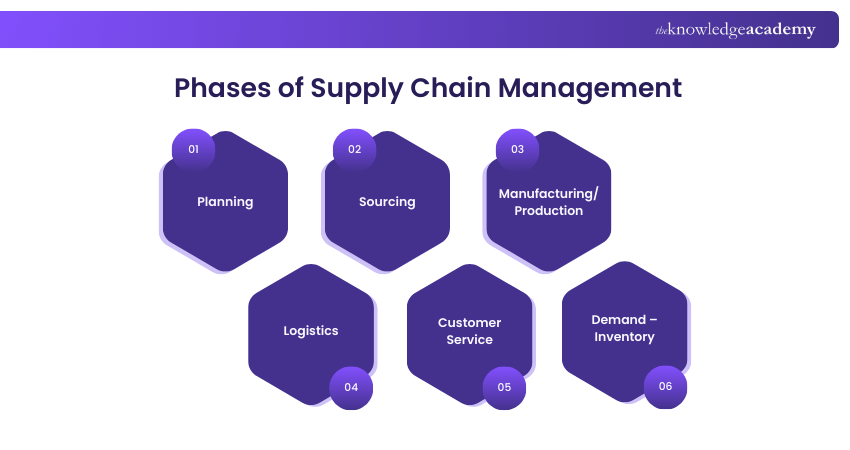
Supply Chain Management is made up of several interconnected components, each playing a crucial role in ensuring the smooth flow of goods, information, and services from suppliers to customers. Below are the key components and their functions:
Planning
1) Involves forecasting demand and supply
2) Sets production schedules and resource plans
3) Aligns operations with customer needs and business goals
4) Helps avoid overproduction or shortages
Sourcing
1) Focuses on supplier selection and management
2) Involves procurement of raw materials and components
3) Includes negotiating contracts and ensuring supplier quality
4) Aims to maintain cost-effectiveness and timely deliveries
Manufacturing/Production
1) Converts raw materials into finished goods
2) Covers production planning, quality control, and packaging
3) Ensures timely production to meet demand
4) Focuses on efficiency, consistency, and cost reduction
Logistics
1) Manages transportation and warehousing
2) Oversees inventory storage and product distribution
3) Ensures timely and accurate delivery to customers
4) Includes order tracking and fulfillment
Customer Service
1) Handles post-purchase communication and support
2) Manages returns, refunds, and customer complaints
3) Provides real-time assistance and product info
4) Builds trust and long-term customer loyalty
Demand – Inventory
1) Balances product availability with customer demand
2) Uses forecasting tools to predict future needs
3) Monitors stock levels and reorder points
4) Minimises stockouts and excess inventory costs
From classroom to boardroom - Get industry certified with Logistics Management Training now!
Types of Supply Chain Models
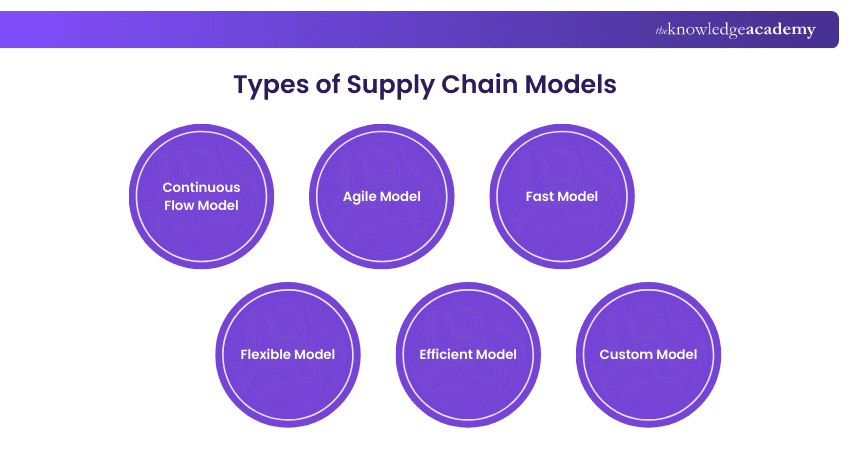
Different industries and businesses require different supply chain approaches based on their product type, customer expectations, and market demand. Here are the six most common supply chain models and what they offer:
Continuous Flow Model
The Continuous Flow Model is designed for manufacturers producing the same goods consistently over time. It works best for stable, high-volume production environments where demand is predictable.
1) Ideal for industries like food, pharmaceuticals, or chemicals
2) Focuses on efficiency, low variability, and steady output
3) Requires tight coordination with suppliers and minimal disruption
Agile Model
The Agile Model is built for flexibility and speed, especially when dealing with changing customer demands or customised products.
1) Suited for businesses with unpredictable demand or frequent product changes
2) Allows quick adjustments to market shifts or customer feedback
3) Works best in fashion, tech gadgets, or seasonal industries
Fast Model
The Fast Model focuses on getting products to market quickly, often for trend-driven items that have short life cycles.
1) Perfect for companies that rely on the first-mover advantage
2) Prioritises speed and quick turnover over long-term forecasting
3) Common in fashion, electronics, or viral consumer products
Flexible Model
The Flexible Model is designed for companies with fluctuating production volumes or varied product types. It allows operations to scale up or down easily.
1) Useful in industries with both high and low demand cycles
2) Offers adaptability across multiple product lines
3) Ideal for manufacturers that handle custom and standard orders
Efficient Model
This model is centered on maximising productivity while minimising costs. It aims to eliminate waste, reduce inventory, and streamline processes.
1) Best for price-sensitive markets with intense competition
2) Relies on accurate demand forecasting and lean inventory practices
3) Common in commodity-based industries like paper, cement, or steel
Custom Model
The Custom Model is tailored to businesses that offer highly specialised or made-to-order products. It emphasises unique supply chain designs for unique customer needs.
1) Built for customisation and customer-centric operations
2) Involves close collaboration with customers and suppliers
3) Common in aerospace, luxury goods, or specialised machinery
Challenges in Supply Chain Management
Although the latest technologies and tactics can overcome several problems in the Supply Chain, they are still facing specific difficulties that can affect smooth operations. Discussed below are some common challenges faced by Supply Chains:
Although the latest technologies and tactics can address various issues in the Supply Chain, certain difficulties persist, impacting seamless operations. One critical aspect is Supply Chain Risk Management, which plays a vital role in mitigating potential disruptions. Discussed below are some common challenges faced by Supply Chains:
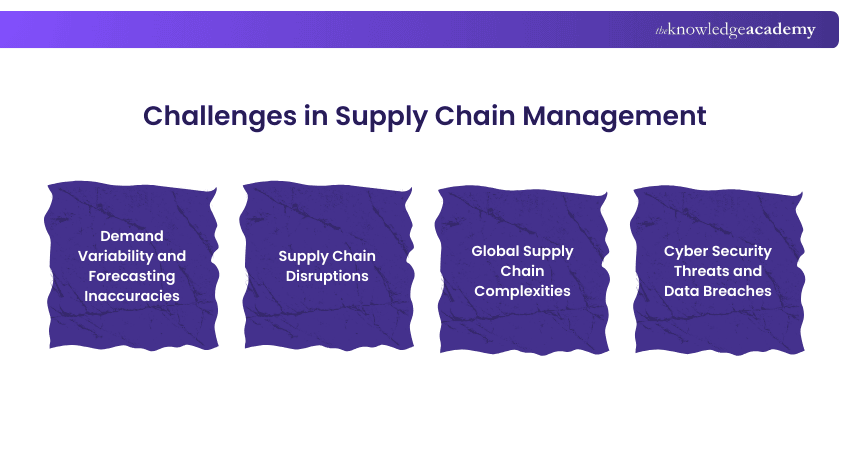
Demand variability and forecasting inaccuracies
Predicting customer demand ideally will always be strenuous for Supply Chain managers. The changing consumer behaviour, marketplace trends and external factors mainly fuel demand variability. As a result, forecast errors can result in unnecessary inventory costs or missed sales.
For this reason, companies should keep developing their forecast models. It should be done in close collaboration with sales and marketing teams on customer demand patterns.
Supply Chain disruptions
Supply Chain breakdowns stem from natural disasters, geopolitical turmoil, or unexpected events that may have an extensive impact on business operations. Such fluctuations may provoke the postponement of the production, transportation, and delivery processes.
Companies should have contingency plans in place to minimise risks. Risk management strategies, such as diversifying suppliers' bases and budgeting for interruptions, will help tackle the issues effectively.
Global Supply Chain complexities
With such a globalised Supply Chain, complex globalised international trade, custom regulations, and cross-border logistics become very important to deal with. Languages, currencies, and legal systems are just a few of the many communication barriers that lead to delays in the decision-making process.
Additionally, geopolitical tensions and trade policy changes may impede the flow of goods forward and backwards in global Supply Chains. Thus, applying the latest technologies, forming strong partnerships with local stakeholders, and being attentive to the geopolitical environment are the keys to continuing control over complexities in the global Supply Chain.
Unlock your facilitation potential – Sign up for our Facilitation Skills Training now!
Cyber Security threats and data breaches
Supply Chains are data-intensive, so cyber threats and data breaches are common in such an environment. The impact of such a cyber-attack is that it cripples the organisation's operations, completely confidential information and results in a vast inflow of money.
Therefore, companies must reinforce their Cyber Security approach to strengthen Supply Chain Security and fight technological threats. The program must include data encryption, regular vulnerability tests, and the provision of Cyber Security courses to staff members.
What is the Difference Between Supply Chain Management and Logistics?
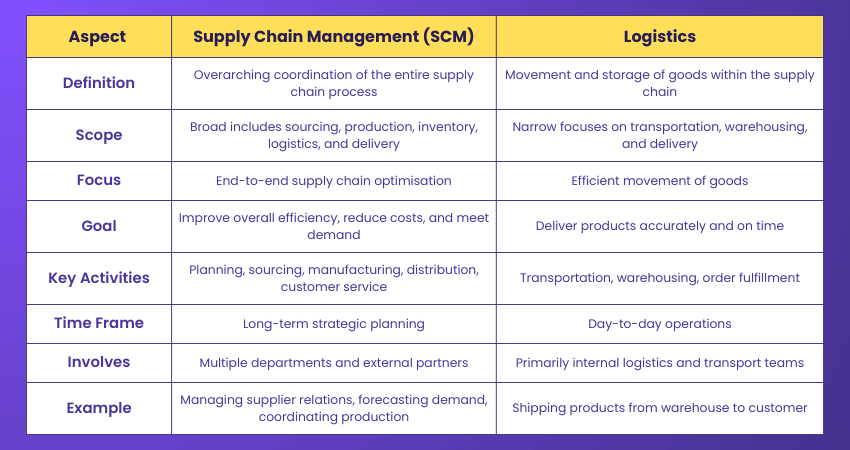
Supply Chain Management (SCM) is the broader concept. It includes the planning, coordination, and management of all activities involved in sourcing raw materials, manufacturing, distribution, and delivering products to the end customer.
Logistics, on the other hand, is a component of SCM. It focuses specifically on the movement, storage, and transportation of goods. This includes shipping, warehousing, order fulfillment, and inventory control. Here is a concise table regarding this:
What is the Role of a Supply Chain Manager?
A Supply Chain Manager oversees and coordinates every stage of the supply chain to ensure goods are produced and delivered efficiently, cost-effectively, and on time.
Key Responsibilities:
1) Planning supply chain strategies based on demand forecasts
2) Sourcing reliable suppliers and managing vendor relationships
3) Coordinating production, inventory, and logistics activities
4) Monitoring performance metrics to improve speed and reduce costs
5) Managing risks such as delays, shortages, or disruptions
6) Ensuring compliance with regulations and quality standards
7) Collaborating across departments like procurement, manufacturing, logistics, and sales
Conclusion
In essence, ranging from sourcing raw materials to delivering finished products, Supply Chain Management is the backbone of every successful business. It’s more than logistics; it’s the engine that keeps products flowing and customers satisfied. Understanding What is Supply Chain Management means appreciating the intricate process behind every purchase you make.
Bridge skill gaps fast - Explore our Facilities Management Training today!
Frequently Asked Questions
What is Reverse Logistics in Supply Chain Management?

Reverse logistics in Supply Chain Management refers to the process of moving goods from customers back to the seller or manufacturer. It includes returns, repairs, recycling, refurbishing, and disposal. It helps recover value, reduce waste, and improve customer satisfaction while efficiently managing post-sale product flow.
What are the benefits of SCM?
The Benefits of SCM are:
a) Efficiency
b) Reduces costs
c) Improves product quality

The Knowledge Academy


Global Training Provider
The Knowledge Academy is a world-leading provider of professional training courses, offering globally recognised qualifications across a wide range of subjects. With expert trainers, up-to-date course material, and flexible learning options, we aim to empower professionals and organisations to achieve their goals through continuous learning.


 If you wish to make any changes to your course, please


