


 Top Rated Course

We may not have the course you’re looking for. If you enquire or give us a call on +918037244591 and speak to our training experts, we may still be able to help with your training requirements.
SOA vs Microservices: Key Differences Explained
Lily Turner 16 April 2026Service-oriented Architecture and Microservices break apps into services. SOA is broader, while Microservices are smaller, independently deployable units. Each offers a unique structure and approach. Their scalability fits various environments, workflows, modern application needs, and growing business demands.

Training Outcomes Within Your Budget!
We ensure quality, budget-alignment, and timely delivery by our expert instructors.
Table of Contents
When it comes to building powerful software, the real question is, do you want a tightly connected system or a network of fast, independent parts? That’s where the SOA vs Microservices debate comes in. Think of it like designing a city. SOA is like a grand central station, structured and efficient, but it can slow down when things get busy. Microservices? They're like having lots of smaller stations, quick, flexible, but a bit trickier to manage.
So, which one moves your software better? That’s what we’re here to explore. In this blog, we’ll break down their architecture, communication styles, key differences, benefits, and real-world examples to help you find the perfect fit for your business.
Table of Contents
1) What is a Microservice?
2) What is SOA?
3) Key Differences Between SOA and Microservices
4) Benefits of SOA
5) Benefits of Microservices
6) When to use: SOA vs Microservices
7) Conclusion
What is a Microservice?
Microservices are a modern approach to software design. They break down applications into small, independent services. Each Microservice focuses on a single task and runs on its own.
Unlike SOA, Microservices don’t need to share the same technology stack or database. They talk to each other using lightweight protocols like REST or messaging queues and are easy to scale, update, and deploy independently.
Example:
Netflix uses Microservices for features like streaming, billing, and recommendations; each runs independently and can be updated or scaled separately.

What is SOA?
SOA stands for Service-oriented Architecture. It is a way of designing software systems by dividing them into reusable services. Each service in SOA performs a specific function and can be used by different parts of the system.
These services communicate over a network using standard protocols such as HTTP or SOAP. They are usually larger and more complex than Microservices and often share a common platform and database.
Example:
Amazon's early architecture used SOA, with shared services like payments and user authentication reused across teams via standard protocols.
Gain expertise in cloud platforms with our Cloud Computing Training - Join now!
Key Differences Between SOA and Microservices
Let’s look at how SOA and Microservices make a difference across different aspects:
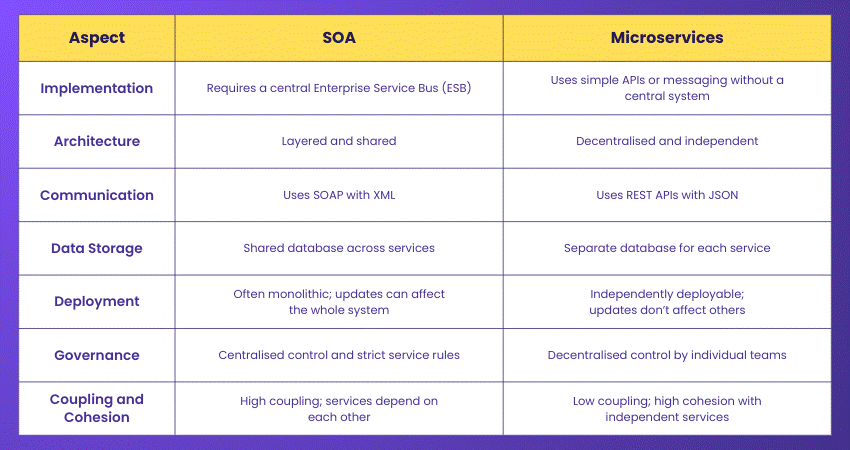
SOA vs Microservices: Implementation
1) SOA depends on a central Enterprise Service Bus (ESB) to connect and coordinate services, making it efficient but heavier.
2) Microservices skip the ESB and use simple APIs or lightweight messaging, making the system more flexible and easier to scale.
SOA vs Microservice: Architecture
1) In SOA, services are part of a layered structure with business logic, service layers, and integration modules working together.
2) Microservices, on the other hand, follow a flat, decentralised design, where each service is self-contained and operates on its own.
SOA vs Microservice: Communication
1) SOA typically uses SOAP and XML, which are reliable but more complex and slower.
2) Microservices prefer REST and JSON, which are quicker, simpler, and better suited for web and mobile apps.
SOA vs Microservice: Component Sharing
1) SOA is built for reusability; different parts of a system can tap into the same logic or data services.
2) Microservices avoid sharing components to maintain independence, so one service doesn’t rely on another’s code or database.
SOA vs Microservice: Data Storage
1) SOA often works with a shared database, which can slow things down if too many services access it at once.
2) Microservices use separate databases per service, boosting performance and making data handling more flexible.
SOA vs Microservice: Remote Services
1) SOA uses Remote Procedure Calls (RPCs), which tend to be heavier and more complex.
2) Microservices use lightweight HTTP requests or messaging queues, keeping communication fast and efficient.
SOA vs Microservice: Granularity
1) SOA services are coarse-grained, handling broader tasks within a single service.
2) Microservices are fine-grained, meaning each service does one specific thing and does it well.
SOA vs Microservice: Deployment
1) SOA often requires full or semi-full redeployment when changes are made, since services are closely tied.
2) Microservices allow independent deployment; you can update one part without touching the rest.
SOA vs Microservice: Governance
1) SOA leans toward centralised governance, with strict rules and standards across services.
2) Microservices embrace decentralised governance, giving teams the freedom to manage their own services independently.
SOA vs Microservice: Size and Scope
1) SOA is ideal for enterprise-level systems with complex, large-scale integrations.
2) Microservices are better suited for agile projects where fast development, frequent updates, and scalability are key.
SOA vs Microservice: Coupling and Cohesion
1) SOA often ends up with tightly coupled services, where a change in one can impact others.
2) Microservices are loosely coupled and cohesive, so services work independently, and changes are easier to manage.
SOA vs Microservice: Deployment
1) In SOA, services are often tightly connected and share the same database. So, updating one service can ripple across the system, requiring full redeployment.
2) With Microservices, each service is independent. Teams can deploy updates to one service without disturbing the rest, making changes faster and less risky.
Learn the fundamentals of Terraform for efficient cloud infrastructure development. Join our Terraform Training now!
Benefits of SOA
Here are the benefits of SOA:

1) Service Reusability:
SOA promotes shared services across applications, for example, invoicing and order tracking using the same customer info service.
2) Consistent Governance:
Shared data repositories allow for standardised data governance across all services, supporting compliance and control.
3) Centralised Management:
SOA’s centralised architecture makes it easier to enforce uniform standards in large enterprise environments.
4) Enterprise Integration:
Ideal for connecting legacy systems and enabling communication between diverse business applications.
Benefits of Microservices
Here are the advantages of Microservices:
1) Independent Scalability:
Each Microservice can scale individually, ensuring better speed and responsiveness under growing loads.
2) Faster Updates:
Microservices can be built and deployed independently, allowing for quick changes without system-wide impact.
3) Flexible Governance:
Teams can set governance rules per service, encouraging autonomy and streamlined development.
4) Better Performance:
With no shared resources, Microservices reduce latency and avoid bottlenecks, ensurig smooth performance.
When to use: SOA vs Microservices
Choosing between Microservices and SOA depends on your project goals, team structure, and the complexity of your system.
When we use SOA:
1) You are part of a large enterprise that needs to integrate multiple systems and services.
2) Uniform governance, data control, and shared resources are essential across teams.
3) You already use an Enterprise Service Bus (ESB) and want to optimise it further.
When we use Microservices:
1) You're developing a modern, cloud-native or web-based application from the ground up.
2) Your teams prefer working independently with different tech stacks or programming languages.
3) You aim to move quickly with agile development, continuous deployment, and DevOps practices.
Both architectures can solve complex problems, but your choice depends on your team size, business needs, legacy systems, and long-term goals.
Conclusion
SOA vs Microservices both aim to improve how we build and manage applications, but they approach it in different ways. SOA suits complex enterprise environments with structured integration, while Microservices are ideal for fast-moving, scalable apps. The choice depends on your project’s structure, speed requirements and long-term goals.
Attain knowledge about OpenStack and Identity Management. Join our Linux OpenStack Administration Training today!
Frequently Asked Questions
Is SOA the Same as Microservices?

No, they are not the same. SOA is a broader architecture that organises software as reusable services, often connected by a central system. Microservices are smaller, independent services built to be self-contained and lightweight. While both use services, their design, communication, and goals differ.
Why did SOA Fail?
SOA failed because it was too complex to manage and required a lot of coordination between services. It often became slow and hard to scale as everything was connected through a central system. Many teams found it difficult to make quick updates without affecting the whole system.
What are the Other Resources and Offers Provided by The Knowledge Academy?
The Knowledge Academy takes global learning to new heights, offering over 3,000 online courses across 490+ locations in 190+ countries. This expansive reach ensures accessibility and convenience for learners worldwide.
Alongside our diverse online course catalogue, encompassing 19 major categories, we go the extra mile by providing a plethora of free educational Online Resources like News updates, Blogs, videos, webinars, and interview questions. Tailoring learning experiences further, professionals can maximise value with our customisable Course Bundles.
What is The Knowledge Pass, and How Does it Work?
The Knowledge Academy’s Knowledge Pass, a prepaid voucher, adds another layer of flexibility, allowing course bookings over a 12-month period. Join us on a journey where education knows no bounds.
What are the Related Courses and Blogs Provided by The Knowledge Academy?
The Knowledge Academy offers various Cloud Computing Courses, including the Microservices Architecture Training, Cloud Computing Training, and the Linux OpenStack Administration Training. These courses cater to different skill levels, providing comprehensive insights into What are Microservices.
Our Cloud Computing Blogs cover a range of topics related to Microservices, offering valuable resources, best practices, and industry insights. Whether you are a beginner or looking to advance your Cloud Computing skills, The Knowledge Academy's diverse courses and informative blogs have got you covered.

Lily Turner


Senior AI/ML Engineer and Data Science Author
Lily Turner is a data science professional with over 10 years of experience in artificial intelligence, machine learning, and big data analytics. Her work bridges academic research and industry innovation, with a focus on solving real-world problems using data-driven approaches. Lily’s content empowers aspiring data scientists to build practical, scalable models using the latest tools and techniques.
View Detail
Upcoming Cloud Computing Resources Batches & Dates
Date
 Microservices Architecture Training
Microservices Architecture Training
Fri 7th Aug 2026
Microservices Architecture Training
Fri 27th Nov 2026

 If you wish to make any changes to your course, please


