


 Top Rated Course


We may not have the course you’re looking for. If you enquire or give us a call on +918037244591 and speak to our training experts, we may still be able to help with your training requirements.
What is Lean Methodology: A Complete Guide
The Knowledge Academy 02 April 2026Lean Methodology is a customer-focused approach that enhances efficiency by reducing waste and improving processes through continuous improvement. It streamlines workflows and improves value delivery across teams. It helps organisations boost productivity, reduce costs, and respond faster to customer needs.

Training Outcomes Within Your Budget!
We ensure quality, budget-alignment, and timely delivery by our expert instructors.
Table of Contents
Rework, delays, and unclear workflows can pile up quickly when they are not properly managed. These issues are common in many organisations, yet their root causes are rarely addressed. Instead of fixing the process, teams often work around the problem, which leads to frustration, higher costs, and inconsistent results.
That's where Lean Methodology offers a practical way to identify waste, simplify processes, and focus on what truly adds value to the customer. In this blog, you will learn what Lean Methodology is, why it matters, and how it can be applied to create sustainable improvement for your business. Let's delve in!
Table of Contents
1) What is Lean Methodology?
2) Foundational Concepts of Lean
3) The 5 Principles of Lean Methodology
4) Lean Terminology and Tools
5) Benefits of Lean Methodology
6) Drawbacks of Lean Methodology
7) Lean vs Six Sigma
8) When Would Lean Methodology Be Used?
9) Conclusion
What is Lean Methodology?
Lean Methodology is a structured approach that focuses on delivering maximum customer value by removing unnecessary activities and improving process efficiency. In this context, waste refers to any task or step that does not add value to the end product. The goal is to streamline workflows, optimise resources, and ensure faster and more efficient delivery.
It also promotes a culture of continuous improvement, where teams regularly evaluate their processes, identify inefficiencies, and make small, consistent changes. By encouraging collaboration and valuing employee input, Lean helps organisations achieve better quality outcomes and improved overall performance.
History of Lean Methodology
Although Lean Methodology originated in manufacturing, it is now widely applied across industries such as IT, healthcare, services, and project management. Below is a brief overview of how Lean evolved over time:
a) Early 20th Century: Henry Ford introduced mass production through the assembly line, enabling faster production of standardised products like the Model T.
b) 1926: Sakichi Toyoda founded Toyoda Automatic Loom Works, which later evolved into Toyota. The company initially focused on textile machinery before expanding into automobiles.
c) 1950: Eiji Toyoda visited Ford’s Rouge plant in Michigan and recognised that mass production needed adaptation to suit Japan’s smaller and more varied market demands.
d) Development of the Toyota Production System (TPS): Working with Taiichi Ohno, Toyota developed TPS, focusing on:
i) Jidoka: Automation with built-in quality, where machines stop automatically when problems occur to prevent defects.
ii) Just-in-Time: Producing only what is needed, when it is needed, to minimise waste and inventory.
e) Kaizen (Continuous Improvement): TPS introduced Kaizen, a principle that encourages ongoing, small improvements by involving employees at all levels in problem-solving and process enhancement.
f) 1991: The term “Lean” was popularised by James P. Womack, Daniel T. Jones, and Daniel Roos in the book The Machine That Changed the World, which highlighted Toyota’s approach and introduced Lean principles to a global audience.
Foundational Concepts of Lean?
Lean Methodology is built on a few core ideas that guide how organisations improve processes and create value. Here are the two most important concepts among those:
1) Respect for People
Respect for people means valuing employees as the key contributors to organisational success. Lean encourages listening to team members, involving them in decision-making, and trusting their experience to identify problems and suggest improvements.
When people feel respected and supported, they are more engaged, motivated, and willing to take responsibility for improving their work. One practical way to apply this is through the Gemba Walk technique. During this, leaders go to the actual place where work happens to observe processes, ask questions, and understand challenges directly from employees.
2) Continuous Improvement
Continuous improvement focuses on making small, ongoing improvements rather than waiting for major changes. Lean promotes regularly reviewing processes to find inefficiencies and improve performance step by step.
This mindset helps organisations adapt to change, prevent repeated problems, and steadily improve quality, efficiency, and customer satisfaction over time. For this, methods like PDSA (Plan, Do, Study, Act) and DMAIC (Define, Measure, Analyse, Improve, and Control) are used. They help teams identify problems, test solutions, measure results, and maintain improvements, ensuring changes are sustainable and aligned with business goals.
The 5 Principles of Lean Methodology
Lean Methodology focuses on maximising value while minimising waste. Let’s explore the core Lean Methodology principles.
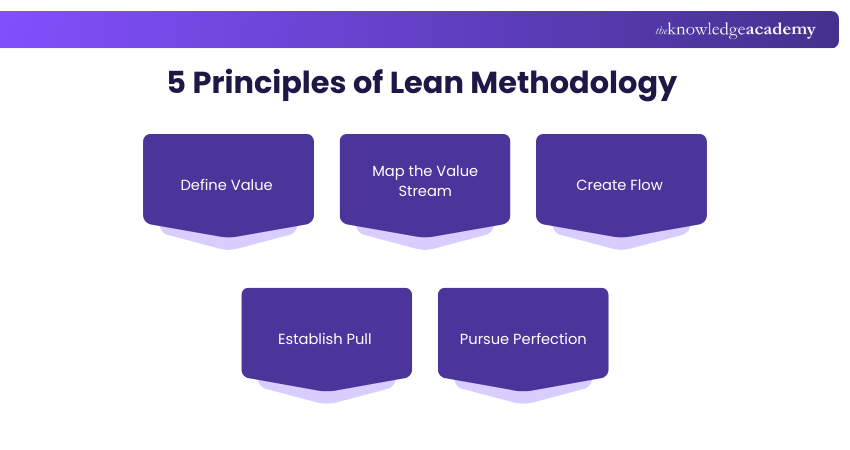
1) Define Value
The first step in Lean Methodology is to clearly define value. Value is what the customer perceives as beneficial. It is critical to understand what customers truly want. This understanding helps in identifying valuable features or services.
Focusing on customer value guides the entire process design. All efforts should align with enhancing this value.
2) Map the Value Stream
Once the value is defined, the next step is about mapping the value stream. A value stream encompasses all the actions needed to deliver a product or service. This includes both value-adding and non-value-adding activities.
By visualising the entire process, you can identify inefficiencies. Mapping helps to highlight where waste occurs. The goal is to streamline these processes for better efficiency.
3) Create Flow
Creating flow is about ensuring that the value-adding steps operate smoothly. In a Lean context, flow means that products or services move efficiently through the process. This can be achieved by reducing delays and eliminating bottlenecks.
A smooth flow leads to quicker service delivery. It improves productivity and customer satisfaction significantly. Maintaining flow requires continuous monitoring and adjustments.
4) Establish Pull
The principle of establishing pull means producing only what is needed. Instead of pushing products into the market, organisations should respond to customer demand. This reduces excess Inventory and waste.
Pull systems prioritise efficiency and ensure resources are used effectively. By aligning production with actual demand, companies can maximise their resources. It creates a more responsive and adaptable environment.
5) Pursue Perfection
The final principle of Lean Methodology is the pursuit of perfection. Lean is not a one-time event, it's an ongoing journey. Continuous improvement, or "Kaizen", is essential. Organisations must consistently evaluate and refine their processes.
This means encouraging feedback and fostering a culture of innovation. Striving for perfection leads to higher quality and enhanced customer satisfaction. The objective is to eliminate waste and improve every aspect of the business continually.
Enhance your Lean expertise and gain stronger customer insights with our Advanced Lean Techniques and Understanding Customers Training – Register today!
Lean Terminology and Tools
Lean uses a range of tools designed to improve workflows, eliminate waste, and enhance overall efficiency. These tools help organisations identify problems, streamline processes, and deliver better value to customers.
5S
5S is a workplace organisation tool that focuses on creating a clean, structured, and efficient working environment. It involves sorting unnecessary items, organising essential tools, maintaining cleanliness, standardising processes, and sustaining discipline. This helps improve productivity, safety, and consistency across operations.
Value Stream Mapping
Value Stream Mapping is a visual tool used to map and analyse the flow of materials, information, and activities within a process. It helps organisations identify delays, inefficiencies, and non-value-adding steps, allowing teams to improve workflows and deliver value more effectively.
Kaizen (PDSA cycle)
Kaizen refers to continuous improvement through small, incremental changes. It encourages employees at all levels to regularly assess processes and suggest improvements. The PDSA (Plan-Do-Study-Act) cycle supports this by providing a structured method to test changes, evaluate results, and implement improvements over time.
5 Whys
The 5 Whys is a simple problem-solving technique used to identify the root cause of an issue. It involves repeatedly asking “why” until the underlying cause is discovered. This approach helps teams move beyond surface-level problems and implement long-term solutions.
Benefits of Lean Methodology
Lean Methodology provides a framework for organisations to enhance their processes continually. Below, we delve into the numerous benefits of implementing Lean Methodology.
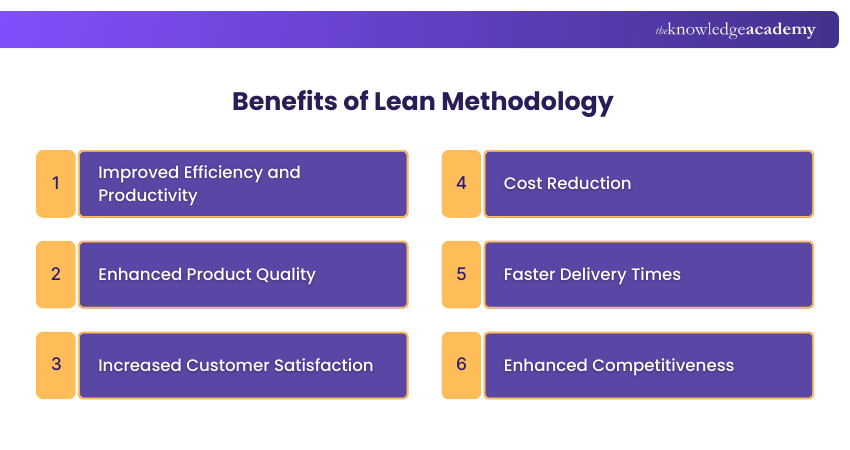
1) Improved Efficiency and Productivity
Lean Methodology focuses on streamlining processes. It helps organisations identify non-value-added activities. By minimising these activities, teams can concentrate on essential tasks.
This results in improved workflow and higher productivity levels. Increased efficiency also translates to quicker project completion. Ultimately, this boosts overall operational performance.
2) Enhanced Product Quality
Quality is a fundamental aspect of Lean Methodology. Lean encourages continuous improvement through regular feedback. This iterative approach helps identify quality issues early.
Teams can then address these concerns promptly. As a result, product defects decrease significantly. Customers receive higher-quality products that meet their expectations consistently.
3) Increased Customer Satisfaction
Customer Satisfaction is central to Lean principles. When companies focus on value, they meet customer needs more effectively. This leads to a better overall customer experience.
By continuously improving processes, organisations can respond to customer feedback efficiently. Happier customers are likely to become loyal repeat buyers. Therefore, investing in Lean practices can significantly enhance customer loyalty.
Learn the six key elements of workplace organisational excellence in our comprehensive 6S Training - Register now!
4) Cost Reduction
Lean Methodology helps identify wasteful spending in processes. By eliminating inefficiencies, organisations can reduce operational costs. This includes minimising excess inventory, overproduction, and rework.
Money saved can be redirected into other important parts of the company. Those savings enhance the overall financial health of the organisation. This creates a more sustainable business model over time.
5) Faster Delivery Times
Speed is a key advantage of Lean Methodology. By streamlining processes, organisations can deliver products faster. This meets market demands and keeps customers satisfied.
Shortened delivery times can give companies an edge over competitors. Speed also allows for quicker adaptations to changes in demand. Overall, faster execution enhances the agility of a business.
6) Enhanced Competitiveness
In today’s fast-paced market, competitiveness is crucial. Lean Methodology equips organisations with tools to stay ahead. By constantly improving and innovating, companies can differentiate themselves.
Lean practices help organisations respond better to consumer demands. A focus on quality and efficiency enhances brand reputation. This, in turn, solidifies a company’s position in the market.
Invest in a Leaner and a more sustainable tomorrow with our Certified Lean Foundation Course today – Sign up now!
Drawbacks of Lean Methodology
Lean Methodology has gained popularity for its focus on efficiency and waste reduction. However, it is not without challenges. Here are some common obstacles that organisations often encounter when implementing Lean practices.
1) Limited Support From Management
A successful Lean initiative requires strong Leadership. When Management lacks commitment, the entire process suffers. Employees may feel unsupported and demotivated. Without backing from the top, resources may be misallocated or insufficient.
Management must lead by example and actively participate in Lean activities. Their visible commitment encourages others to follow suit. Leadership has a major impact on promoting a culture of ongoing improvement.
2) Insufficient Training Support
Training is essential for a successful Lean implementation. Insufficient training can lead to misunderstandings of Lean principles. Employees may resort to old habits, negating the potential benefits of Lean Management methodology.
Investing in training ensures everyone is on the same page. Without proper training, employees may become frustrated, hindering progress. Regular refreshers and advanced training sessions can enhance skills over time.

3) Prioritising Tools Instead of Culture
Many organisations mistakenly focus solely on Lean tools. However, Lean is more about culture than just techniques. Emphasising tools can lead to a superficial understanding of Lean. Organisations might adopt practices without internalising the underlying philosophy.
A strong Lean culture prioritises people, teamwork, and continuous improvement. Employees should understand why changes are necessary, not just how to execute them. Fostering a Lean mindset creates sustainable growth and development.
4) Lack of Emphasis on Metrics
Metrics play a vital role in Lean Methodology. Without proper measurement, it becomes difficult to gauge success. Many organisations skip this step, relying on subjective assessments instead. This can result in complacency and missed opportunities for improvement.
Establishing clear, relevant metrics helps track progress effectively. Regularly reviewing metrics provides insights into operational effectiveness. Introducing a Lean Manager Job Description in this context highlights how metrics should focus on customer satisfaction, process efficiency, and quality. This analytical approach drives continuous improvement and accountability.
Master the art of organising a workspace for efficient, effective and safe work in our detailed 5S Training - Sign up now!
Lean vs Six Sigma
Lean and Six Sigma are both used to improve processes, but they focus on different aspects of performance. Lean aims to improve speed and workflow, while Six Sigma focuses on quality and reducing errors.
Focus:
a) Lean: Lean focuses on improving workflow, increasing process speed, and enhancing efficiency by removing unnecessary steps.
b) Six Sigma: Six Sigma focuses on reducing defects and minimising variation using data and statistical analysis.
Approach to Improvement:
a) Lean: Lean promotes continuous and quick improvements by simplifying processes and improving flow.
b) Six Sigma: Six Sigma uses a structured and data-driven approach, often following frameworks like DMAIC to solve problems.
Goal:
a) Lean: Lean aims to deliver faster processes and better efficiency across the system.
b) Six Sigma: Six Sigma aims to improve quality, accuracy, and consistency in outcomes.
Combined Approach:
Many organisations use Lean and Six Sigma together as Lean Six Sigma. This combines Lean’s efficiency with Six Sigma’s quality focus, helping achieve more balanced and sustainable improvements.
When Would Lean Methodology Be Used?
Lean Methodology is used when organisations want to improve efficiency, reduce waste, and deliver greater value to customers. It is especially useful when processes are slow, costly, or inconsistent, or when teams face frequent rework and delays.
Lean is also implemented during business growth, digital transformation, or process redesign. This is because it helps streamline workflows, improve quality, and build a culture of continuous improvement across the organisation.
Conclusion
Lean Methodology is more than a set of tools and software. It is a mindset focused on delivering value, reducing waste, and improving the way work is done. By respecting people and encouraging continuous improvement, organisations can create efficient, flexible, and customer-focused processes. When applied consistently, Lean helps teams work smarter, respond to change, and achieve long-term, sustainable success across any industry.
Lead continuous improvement initiatives with our Certified Lean Practitioner Course – Join now!
Frequently Asked Questions
What Are the 5S Pillars of Lean?

The 5S pillars of Lean are Sort (Seiri), Set in Order (Seiton), Shine (Seiso), Standardise (Seiketsu), and Sustain (Shitsuke). These pillars provide a methodology for organising, cleaning, developing, and sustaining a productive work environment.
What are the Three Main Aims of Lean?
The three main aims of Lean are to eliminate waste, maximise customer value, and continuously improve processes to deliver better quality, efficiency, and consistency using fewer resources across the organisation.
What are the Other Resources and Offers Provided by The Knowledge Academy?
The Knowledge Academy takes global learning to new heights, offering over 3,000+ online courses across 490+ locations in 190+ countries. This expansive reach ensures accessibility and convenience for learners worldwide.
Alongside our diverse Online Course Catalogue, encompassing 17 major categories, we go the extra mile by providing a plethora of free educational Online Resources like Blogs, eBooks, Interview Questions and Videos. Tailoring learning experiences further, professionals can unlock greater value through a wide range of special discounts, seasonal deals, and Exclusive Offers.
What is The Knowledge Pass, and How Does it Work?
The Knowledge Academy’s Knowledge Pass, a prepaid voucher, adds another layer of flexibility, allowing course bookings over a 12-month period. Join us on a journey where education knows no bounds.
What are the Related Courses and Blogs Provided by The Knowledge Academy?
The Knowledge Academy offers various Lean Training, including the Introduction to Lean Course, Certified Lean Foundation Training, and Certified Lean Practitioner Course. These courses cater to different skill levels and provide comprehensive insights into the Five Lean Principles.
Our Business Improvement Blogs cover a range of topics related to Lean Methodology, offering valuable resources, best practices, and industry insights. Whether you are a beginner or looking to advance your Business Improvement skills, The Knowledge Academy's diverse courses and informative blogs have got you covered.

The Knowledge Academy


Global Training Provider
The Knowledge Academy is a world-leading provider of professional training courses, offering globally recognised qualifications across a wide range of subjects. With expert trainers, up-to-date course material, and flexible learning options, we aim to empower professionals and organisations to achieve their goals through continuous learning.


 If you wish to make any changes to your course, please


