


 Top Rated Course

We may not have the course you’re looking for. If you enquire or give us a call on +918037244591 and speak to our training experts, we may still be able to help with your training requirements.
Forward Engineering vs Reverse Engineering: Key Differences
The Knowledge Academy 24 February 2026This blog explains the differences of Forward Engineering vs Reverse Engineering, their types, and key concepts. It also answers some frequently asked questions about these two approaches to Software Development.

Training Outcomes Within Your Budget!
We ensure quality, budget-alignment, and timely delivery by our expert instructors.
Table of Contents
Software Development is a complex and dynamic process that involves various methods and techniques to create or modify software systems. Two of the most common methods that are often debated are: Forward Engineering vs Reverse Engineering. Each method has distinct goals and processes.
Thus, understanding the differences between Reverse Engineering vs Forward Engineering can help developers find the most suitable approach for their projects. If you, too, are someone who is interested in learning the differences between these concepts, then this blog is for you. Explore this blog to learn about the key difference between Forward Engineering vs Reverse Engineering. Let's get started!
Table of Contents
1) Understanding what is Forward Engineering
2) Types of Forward Engineering
3) What is Reverse Engineering?
4) Types of Reverse Engineering
5) Difference between Forward Engineering and Reverse Engineering
6) Conclusion
Understanding what is Forward Engineering
Forward Engineering is the traditional method of Software Development. In this method, developers start with a concept and work through a sequence of steps to create a final software product. This process typically involves several stages, such as the following:
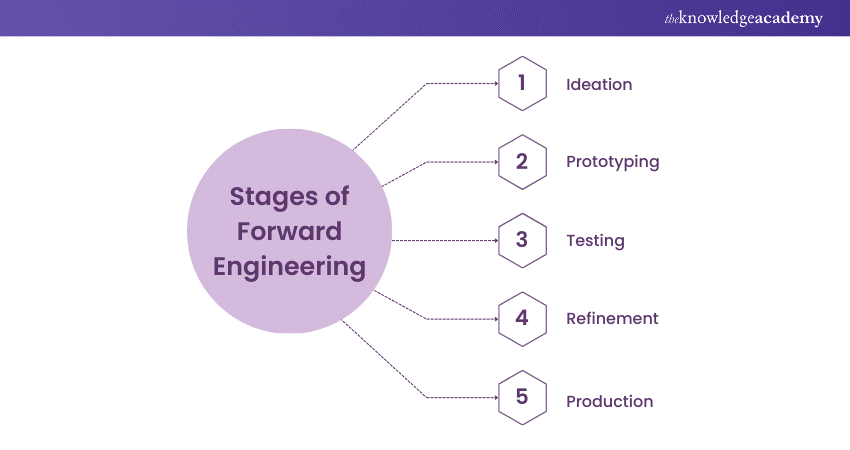
1) Ideation: Developers come up with a creative and innovative idea for a software product that meets the demands and expectations of the users and the market.
2) Prototyping: Developers create a prototype or a mock-up of the software product that demonstrates its basic features and functionality.
3) Testing: They test the prototype to ensure that it works as intended and meets the quality standards and specifications.
4) Refinement: Developers refine the prototype based on the feedback from testing and improve the design and performance of the software product.
5) Production: Developers finalise the software product and prepare it for deployment and distribution.
Forward Engineering is commonly used across various industries, such as manufacturing, electronics, and Web Development. The main advantage of Forward Engineering is that it allows developers to create customised software products to meet specific requirements and optimise the design for the intended purpose. Explore different Types of Engineering to understand its role across various domains.

Types of Forward Engineering
There are different types of Forward Engineering, depending on the level of abstraction and detail involved in the Software Development process. Some of the common types are as follows:
1) Model-driven Engineering: This type of Forward Engineering uses models or diagrams to represent the software system and its components, such as classes, objects, functions, and relationships. Models help developers visualise and understand the software system and generate code automatically or semi-automatically from the models.
2) Code-driven Engineering: Code-driven Engineering uses code as the primary source of information and documentation for the software system. Codes help developers to implement and execute the software system and to modify it as needed.
3) Test-driven Engineering: This type of Forward Engineering uses tests as the main driver for the Software Development process. Tests help developers to define and verify the requirements and specifications of the software system and to ensure its quality and reliability.
What is Reverse Engineering?
Reverse Engineering is the opposite method in Software Development, where developers start with an existing software product and analyse it to understand how it works, how it was built, and how to modify or improve it. This process typically involves several stages, such as the following:
1) Disassembly: Developers disassemble the software product and examine its components to understand its structure and behaviour. This may involve the use of Reverse Engineering Tools like decompilers, disassemblers, and code analysers.
2) Measurement: professionals measure the software product and its components to obtain quantitative and qualitative data, such as size, complexity, performance, and functionality.
3) Analysis: Developers analyse the software product and its components to extract the design and logic behind it. This may involve the use of Reverse Engineering tools, such as UML diagrams, flowcharts, and software specifications.
4) Replication: Developers replicate the software product or its components by creating a copy or a modified version of it. This may involve the use of Reverse Engineering tools, such as code generators, code editors, and testing frameworks.
Moreover, Reverse Engineering is commonly used in Software Development for various purposes. Let’s explore some of them below:
1) Interoperability: Reverse Engineering can help developers create software products that are compatible and interoperable with other software products or systems, especially when the original source code or documentation is not available or accessible.
2) Security: Reverse Engineering can help developers identify and fix software bugs or vulnerabilities that may compromise the security and privacy of the software product or the users.
3) Innovation: Reverse Engineering can help developers learn from the best practices and techniques of other software products or systems and apply them to their own Software Development projects.
Unlock the secrets of technology's inner workings with our Reverse Engineering Training – sign up now!
Types of Reverse Engineering
There are different types of Reverse Engineering, depending on the level of analysis and replication involved in the Software Development process. Understanding these different types is key to appreciating the various Benefits of Reverse Engineering. Some of the common types are as follows:
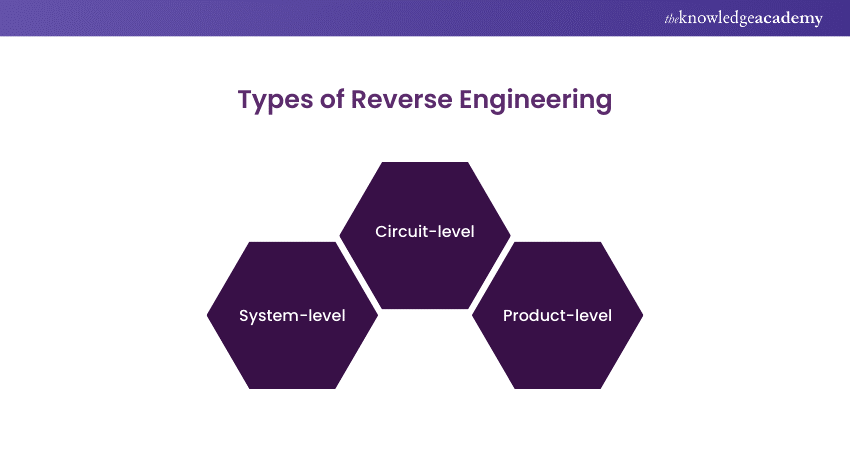
1) System-level Reverse Engineering: This type of Reverse Engineering focuses on the overall architecture and functionality of the software system and its components, such as modules, interfaces, and dependencies. It helps developers understand the big picture and the main goals of the software system.
2) Circuit-level Reverse Engineering: Circuit-level Reverse Engineering focuses on the low-level details and implementation of the software system and its components, such as instructions, registers, and memory. It helps developers understand the inner workings and logic of the software system.
3) Product-level Reverse Engineering: This type of Reverse Engineering focuses on the end-user experience and usability of the software product and its features, such as user interface, navigation, and interaction. It helps developers understand the user needs and expectations and improve the software product accordingly.
Ready to succeed? Nail your Reverse Engineering Interview Questions with these essential tips!
Difference between Forward Engineering and Reverse Engineering
Forward Engineering and Reverse Engineering are two diverse approaches to Software Development. They both have different goals and processes. Here are some key differences between Reverse Engineering vs Forward Engineering:
1) Definition
Forward Engineering is the procedure of creating a new software product from scratch based on requirements and specifications. In contrast, Reverse Engineering is the process of assessing an existing software product to understand its design, structure, and behaviour.
2) Proficiency skill
Forward Engineering requires high proficiency skills in Software Development, such as creativity, innovation, and problem-solving. On the other hand, Reverse Engineering requires high proficiency skills in software analysis, such as observation, deduction, and reasoning.
3) Nature
Forward Engineering is a proactive and constructive process in which developers create something new and original. In comparison, Reverse Engineering is a reactive and deconstructive process in which developers examine something existing and derived.
4) Example
An example of Forward Engineering is developing a new mobile app that provides a unique and useful service to the users. At the same time, an example of Reverse Engineering can involve examining a popular mobile app that provides a similar service to the users and learning how it works and how to improve it.
5) Executing time
Forward Engineering takes more time to execute, as it involves several stages of planning, designing, coding, testing, and refining. Reverse Engineering takes less time to execute as it involves fewer stages of disassembly, measurement, analysis, and replication.
Experience the future of Computing with our Introduction to Virtualisation Technologies Training – sign up today!
6) Reliability
Forward Engineering is more reliable, as it ensures that the software product meets the quality norms and specifications and works as intended. On the other hand, Reverse Engineering is less reliable, as it may introduce errors or inconsistencies in the software product or its components.
7) Starting point
Forward Engineering starts with a clear and well-defined starting point, such as a concept, an idea, or a requirement. In contrast, Reverse Engineering starts with an unclear and vague starting point, such as a software product, a component, or a feature.
8) Decision-making
Forward Engineering involves more decision-making, as developers have to choose the best methods and techniques to create the software product and optimise its design and performance. While no actual decisions are made in Reverse Engineering, developers follow the methods and techniques that are already used in the software product and replicate or modify them.
9) Levels of detail
Forward Engineering involves getting into different levels of detail, from high-level models or diagrams to low-level code or instructions. In contrast, Reverse Engineering doesn’t involve getting into extreme levels of detail, as it extracts the design and logic from the code or instructions.
10) Testing and verification
Forward Engineering involves more testing and verification, as developers ensure that the software product works as planned and meets the quality standards and specifications. On the other hand, Reverse Engineering involves less testing and verification. Here, developers have to ensure that the software product or its components are copied or modified correctly.
Conclusion
We hope you read and understand the differences between Forward Engineering vs Reverse Engineering. They are both unique methods of Software Development with different goals and processes. If you're preparing for Reverse Engineering Interview Questions, understanding these differences can help you showcase your expertise. Both methods have their advantages and disadvantages, and the decision to use one or the other depends on your specific needs and requirements.
Take your tech skills to the next level with our Advanced Technologies Courses – sign up now!
Frequently Asked Questions
Why do we need Forward Engineering?

We need Forward Engineering to create new and innovative software products that meet the needs and expectations of the users and the market. Forward Engineering allows us to customise and optimise the software product for the intended purpose and to ensure its quality and reliability.
What are the drawbacks of Forward Engineering?
The drawbacks of Forward Engineering are that it takes more time and resources to execute, as it involves several stages of planning, designing, coding, testing, and refining. Forward Engineering also requires high proficiency skills in Software Development, such as creativity, innovation, and problem-solving.
What are the other resources and offers provided by The Knowledge Academy?
The Knowledge Academy takes global learning to new heights, offering over 3,000+ online courses across 490+ locations in 190+ countries. This expansive reach ensures accessibility and convenience for learners worldwide.
Alongside our diverse Online Course Catalogue, encompassing 17 major categories, we go the extra mile by providing a plethora of free educational Online Resources like Blogs, eBooks, Interview Questions and Videos. Tailoring learning experiences further, professionals can unlock greater value through a wide range of special discounts, seasonal deals, and Exclusive Offers.
What is Knowledge Pass, and how does it work?
The Knowledge Academy’s Knowledge Pass, a prepaid voucher, adds another layer of flexibility, allowing course bookings over a 12-month period. Join us on a journey where education knows no bounds.
What are the related Advanced Technologies courses and blogs provided by The Knowledge Academy?
Discover Advanced Technologies Courses with The Knowledge Academy, offering Reverse Engineering courses, Virtual Reality training and LTE Fundamentals training. Designed for diverse skill levels, these courses provide a comprehensive understanding of Network Function Virtualisation.
Whether you are starting your journey or aiming to elevate your technological expertise, immerse yourself in our Advanced Technology blogs to discover more insights!

The Knowledge Academy


Global Training Provider
The Knowledge Academy is a world-leading provider of professional training courses, offering globally recognised qualifications across a wide range of subjects. With expert trainers, up-to-date course material, and flexible learning options, we aim to empower professionals and organisations to achieve their goals through continuous learning.

Upcoming Advanced Technology Resources Batches & Dates
Date
 Reverse Engineering Training
Reverse Engineering Training
Fri 7th Aug 2026
Reverse Engineering Training
Fri 6th Nov 2026

 If you wish to make any changes to your course, please


