


 Top Rated Course

We may not have the course you’re looking for. If you enquire or give us a call on +1 7204454674 and speak to our training experts, we may still be able to help with your training requirements.
What is SAP? A Detailed Explanation with Use Cases
John Davies 22 August 2026SAP is enterprise software that helps organisations manage and integrate core business processes. Learn what SAP is, how it works, its modules, benefits, uses, career opportunities and role in modern business.

Training Outcomes Within Your Budget!
We ensure quality, budget-alignment, and timely delivery by our expert instructors.
Table of Contents
Key Takeaways
1. SAP integrates core business processes and information across different organisational functions.2. SAP modules support areas such as finance, sales, procurement, manufacturing and human resources.3. SAP can improve visibility, process efficiency, data management and decision-making.4. Organisations use SAP across finance, supply chain, customer experience, HR, procurement and other business functions.5. SAP skills can lead to roles in functional consulting, technical development, system administration and business analysis.
How can one system connect Finance, Sales, Procurement, HR and Supply Chain across an entire organisation? That is where SAP comes in.
SAP is enterprise software that integrates core business processes and information, helping organisations manage operations more efficiently. In this blog we will explore What is SAP, how it works, its key modules, benefits, uses, major products and technologies, required skills and career opportunities.
What is SAP?
SAP stands for Systems, Applications, and Products in Data Processing. SAP is enterprise software that helps organisations integrate core business processes such as finance, sales, manufacturing, supply chain and HR. Founded in 1972 by five former IBM employees, SAP has evolved from early ERP systems into a broader portfolio of cloud applications and technologies.

SAP connects different business functions through integrated processes and shared information, helping organisations see how activities across departments affect one another. This integration can support more consistent data, smoother workflows, and better-informed business decisions across areas such as finance, sales, procurement, and supply chain.
Trainer Insight: Think of SAP as a connected business system, not just an accounting or finance tool.
History of SAP
SAP has a diverse history of innovation and growth since it was founded in the early 1970s. Here are the key milestones:
1) Founding and Early Goals (1972): SAP was founded by five former IBM employees with a vision of creating standard software that integrated business processes and enabled real-time data processing.
2) Introduction of R/1 (1973): SAP completed its first financial accounting system, RF, which became the foundation for what was later known as SAP R/1.
3) Launch of R/2 (1979): SAP began developing R/2, a mainframe-based business software system designed to integrate major business functions and support real-time processing.
4) Release of R/3 (1992): The release of R/3 marked a shift from mainframe computing to the client-server model, transitioning to a three-tier architecture with separate layers for presentation, applications, and data. R/3 was pivotal in propelling SAP onto the global stage.
5) Introduction of SAP NetWeaver (2004): SAP introduced NetWeaver as a technology platform supporting integration across SAP applications and business processes.
6) SAP Business Suite 7 (2009): SAP introduced HANA, an in-memory database platform designed to enable much faster data processing and analytics.
7) Launch of SAP HANA (2011): SAP introduced SAP HANA, an in-memory database platform that became a major milestone for the company, poised to replace traditional databases used in its business applications.
How Does SAP Work?
SAP works by connecting different business functions through integrated applications and shared business information. Rather than each department maintaining completely separate processes and records, SAP can connect activities so that information entered in one process can support related activities elsewhere.
For example, when a customer order is processed, the information can support activities across sales, inventory, delivery and finance. This integration helps create a more consistent view of business operations.
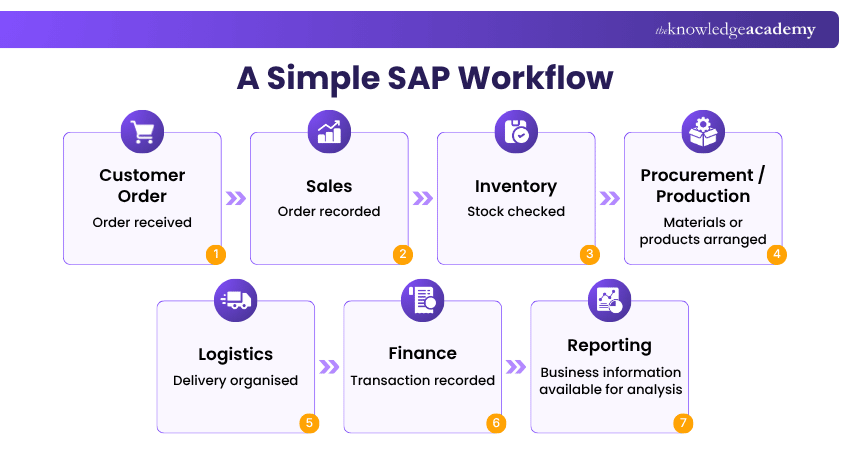
The exact workflow depends on the SAP products and modules implemented by an organisation.
In Simple Terms
SAP connects people, processes and business data so different functions can work from integrated information.
What Are the Main SAP Modules?
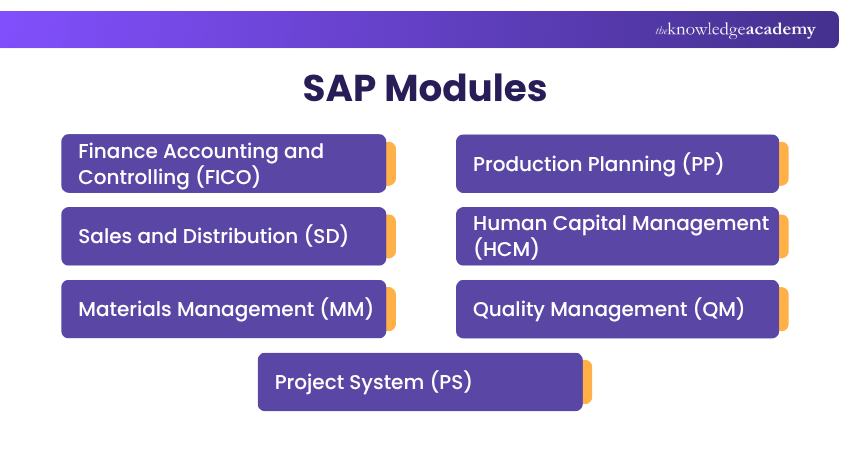
SAP uses different applications and modules to support specific business functions. Organisations can select the capabilities relevant to their requirements and integrate them as part of a broader enterprise environment. Some of the key modules are:
1) Finance Accounting and Controlling (FICO)
SAP FI supports financial accounting activities, while SAP CO focuses on management accounting and controlling. Together, these capabilities help organisations manage financial information and support financial analysis and decision-making.
2) Sales and Distribution (SD)
SAP SD supports sales-related processes such as order management, shipping and billing. It connects sales activities with other business processes to support the wider order-to-cash workflow.
3) Materials Management (MM)
SAP MM supports procurement and materials-related processes, including purchasing, inventory and goods movements. It can help organisations maintain visibility over materials and their availability.
Test Your Understanding
A customer places an order, but the sales, inventory and finance teams all maintain separate records.
What problem could an integrated SAP environment help address?
A. The need for more paper formsB. Disconnected business informationC. The need for more manual data entry
4) Production Planning (PP)
SAP PP supports manufacturing and production planning. It can help organisations coordinate production activities with material availability and other operational requirements.
5) Human Capital Management (HCM)
SAP HCM supports human resource processes such as employee administration, recruitment, payroll and workforce-related activities. SAP also provides SAP SuccessFactors for cloud-based human experience and HR capabilities.
6) Quality Management (QM)
SAP QM supports quality-related processes across areas such as procurement, production and sales. It can help organisations monitor and manage quality requirements.
7) Project System (PS)
SAP PS supports project-related activities such as planning, scheduling, budgeting, monitoring and reporting.
Develop practical knowledge of finance and controlling to support financial processes and business decision-making with our SAP Finance and Controlling (FICO) Training- Join now!
The Benefits of SAP
There are several benefits of SAP across different industries and functional areas. Listed below are a few key benefits of SAP implementation:
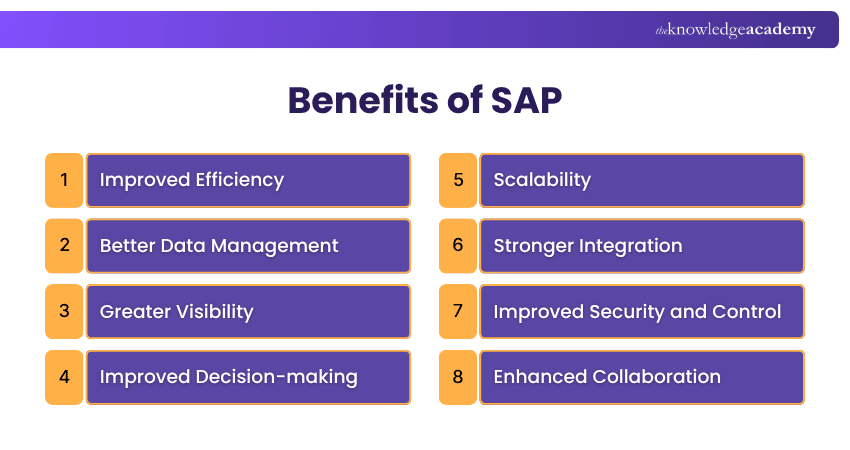
1) Improved Efficiency: SAP can automate and streamline repetitive business processes, reducing manual work and helping employees focus on higher-value activities.
2) Better Data Management: By bringing business information together, SAP can make data easier to access, organise and use across departments.
3) Greater Visibility: Integrated information can help organisations gain a clearer view of activities such as finance, sales, inventory and production.
4) Improved Decision-making: SAP solutions can provide access to business information and analytics that support reporting, forecasting and operational decisions.
5) Scalability: SAP solutions can support organisations as their business requirements change, including expansion into new markets or the addition of new capabilities.
6) Stronger Integration: SAP can connect business processes and integrate with other systems, helping organisations reduce disconnected workflows and improve information flow.
7) Improved Security and Control: SAP environments can include access controls, authorisation mechanisms and other capabilities that help organisations manage access to business information.
8) Enhanced Collaboration: When teams work with connected business information, they can collaborate more effectively across functional boundaries rather than relying entirely on separate records and systems.
Use Cases of SAP
SAP is used across a wide range of industries and business functions. SAP states that its ERP software supports areas including finance, manufacturing, supply chain, sales and procurement.
Which SAP Area Fits the Scenario?
A company is facing these challenges. Which SAP area would you associate with each one?
1) Scenario 1:The company wants better control over purchasing and supplier relationships.2) Scenario 2:The company needs better visibility of inventory, production and deliveries.
Keep reading to see how SAP is applied across different business functions.
1) Financial Management
Organisations use SAP to support accounting, financial reporting, budgeting, cash management and other finance processes. Integrated financial information can help finance teams monitor transactions and support business decisions.
2) Supply Chain Management
SAP solutions can support procurement, inventory, manufacturing, logistics and supply chain planning. This helps organisations coordinate activities from sourcing materials through production and delivery.
3) Customer Experience and CRM
SAP solutions can connect customer, sales, marketing and service information. This can help organisations create a more consistent view of customer interactions and support more informed decisions.
4) HR Management
SAP SuccessFactors provides cloud-based capabilities for areas such as human resources, talent management, employee experience and workforce processes.
5) Procurement and Contracts
SAP solutions such as SAP Ariba support procurement and spend-management activities. They can help organisations manage purchasing processes and relationships with suppliers.
6) Cloud and Data Management
SAP's cloud and technology portfolio supports data, integration, application development, automation and analytics. SAP Business Technology Platform, for example, brings together capabilities for application development, integration, data and analytics, automation and AI.
Prepare for Real-World SAP BASIS Administration with our SAP BASIS Course- Register now!
Different SAP Products and Technologies
SAP is not a single application. It is an ecosystem of products and technologies designed for different business and technical requirements and some of them are the following:
1) SAP S/4HANA: It is SAP's modern ERP platform. It runs on the SAP HANA database and supports core business processes with capabilities including analytics and intelligent technologies.
2) SAP HANA: It is an in-memory database and data platform designed to process data for SAP applications and other workloads. Its in-memory architecture supports fast data processing and analytics.
3) SAP SuccessFactors: It provides cloud-based solutions for human resources and human experience management, supporting areas such as talent and workforce processes.
4) SAP Ariba: It is part of SAP's spend-management portfolio and supports procurement and supplier-related activities. SAP acquired Ariba in 2012.
5) SAP Business Technology Platform (BTP): It provides capabilities for application development, integration, automation, data, analytics and AI. It helps organisations connect and extend SAP and third-party applications.
Don't Mix These Up
SAP = The broader company and software ecosystemSAP ERP = Enterprise resource planning softwareSAP S/4HANA = SAP's modern ERP platformSAP HANA = In-memory database/data platformSAP BTP = Technology platform for integration, data, applications, automation and AI
What Skills Are Needed to Work With SAP?
Working with SAP requires a combination of business knowledge, SAP-specific expertise and professional skills. The exact requirements depend on whether someone works in a functional, technical, analytical or administrative role.
Did You Know?
The worldwide ERP software market grew by 11.3% in 2024, reaching $66 billion.
Source: Market Share: Enterprise Resource Planning, Worldwide, 2024
1. SAP Functional Knowledge: Professionals should understand the SAP modules relevant to their role, such as finance, sales, materials management, production or HR.2. Business Process Understanding: SAP professionals need to understand how business activities work beyond the software itself. Knowing the process helps professionals configure, analyse or improve the right SAP workflows.3. Data and Analytical Skills: SAP environments generate and manage large volumes of business information. Data analysis and reporting skills can help professionals interpret this information and support decisions.4. Technical Skills: Technical SAP roles can require knowledge of areas such as ABAP, SAP Basis, databases, integration and SAP BTP, depending on the role.5. Problem-solving: SAP implementations and operations involve complex business and technical requirements. Strong problem-solving skills help professionals identify issues and develop practical solutions.6. Communication: SAP projects involve business users, technical teams, managers and external consultants. Clear communication helps these groups understand requirements and work towards common outcomes.
Conclusion
SAP is an enterprise software ecosystem that connects business processes, data and technology across areas such as finance, sales, procurement, manufacturing, supply chain and human resources. From its early ERP systems to modern solutions such as SAP S/4HANA, SuccessFactors and SAP BTP, it continues to support organisations in managing integrated business operations and using data for better decisions.
Manage cloud-based business processes with practical SAP knowledge with our SAP Cloud Platform Training- Sign in now!
Frequently Asked Questions
Is SAP an ERP?

Yes. SAP provides ERP software that helps organisations manage core business processes such as finance, procurement, manufacturing, supply chain, sales and HR. SAP S/4HANA is one of SAP's modern ERP platforms.
Is SAP Suitable For Small Businesses?
SAP offers solutions for organisations with different business requirements, but the appropriate SAP product depends on factors such as business size, processes, complexity and technology needs. Businesses should evaluate the required capabilities and implementation requirements before choosing a solution.
What Programming Language is Used in SAP?
ABAP is SAP's traditional programming language for developing business applications within SAP environments. Modern SAP development can also involve other technologies and programming languages depending on the platform and application being developed.

John Davies


Cyber Security Governance & Assurance Specialist
John Davies is a cybersecurity expert specialising in governance, risk management, and compliance. With over 15 years in the field, he has led enterprise-wide security programmes across finance, healthcare and public sector organisations. His content provides practical guidance on building secure environments, managing risk and aligning with regulatory frameworks.


 If you wish to make any changes to your course, please


