


 Top Rated Course

We may not have the course you’re looking for. If you enquire or give us a call on +32 35001305 and speak to our training experts, we may still be able to help with your training requirements.
What Is an Adjective? Definition, Types, and Examples
The Knowledge Academy 03 April 2026An Adjective is a word that modifies a noun or pronoun, describing qualities like size, colour, number, or opinion to make language clearer and more vivid. It adds more detail to sentences and helps readers easily imagine what is being described. Without Adjectives, language would feel plain, dull, and less expressive.

Training Outcomes Within Your Budget!
We ensure quality, budget-alignment, and timely delivery by our expert instructors.
Table of Contents
Language has the power to turn simple thoughts into vivid expressions that spark emotion and imagination. Every word we choose shapes how our ideas are felt and remembered. Among them, Adjectives stand out as the splash of colour, the spark of feeling, and the heartbeat that brings our words to life.
In this section, we’ll explore What is an Adjective and how to use them in daily language. You’ll also learn their degrees, types, uses, examples, and how they differ from adverbs to make your writing more expressive.
Table of Contents
1) What is an Adjective?
2) Degrees of Adjectives
3) Types of Adjectives
4) Adjective Uses
5) Adjective Examples
6) What is the Difference Between Adjectives and Adverbs?
7) Are Numbers Adjectives?
8) Conclusion
What is an Adjective?
An Adjective is a word that adds detail or description to a noun or pronoun, helping us understand more about what we’re talking about. Think of it as the word that tells us what something looks like, feels like, or even how many there are. For example, in the sentence, "The cosy blanket kept me warm," the Adjective cosy tells you exactly what kind of blanket it is. Without Adjectives, descriptions would be flat and uninteresting.
Adjectives help answer questions like "What kind?" "Which one?" and "How many?"; whether you are describing a tall building, a delicious meal, or several tasks on your to-do list. They can be used before the noun (like a busy street) or after a linking verb (like the sky is blue).
By using an Adjectives, you can bring your sentences to life, making your communication more engaging and impactful. The Communication Pyramid helps break down complex communication methods into simpler, more actionable steps, allowing you to connect more effectively with others.

Degrees of Adjectives
Adjectives come in different forms to show varying degrees of comparison. Let’s take a closer look:
Absolute Adjectives
This form shows a quality in its full or extreme sense, leaving no room for comparison. Absolute Adjectives describe traits that cannot be increased or reduced.
Example: “It was a perfect day”
Here, the Adjective stands complete on its own, expressing an unchangeable or total quality.
Comparative Degree of Comparison
The comparative degree is used to compare two things. Most short Adjectives add “-er,” while longer ones use more before the word.
Example: “She is taller than her brother.”
Here, the Adjective shows the difference between two people or things.
Superlative Degree of Comparison
The superlative degree compares more than two things to show the highest level of a quality. Short Adjectives add “-est,” and longer ones use most before the word.
Example: “She is the tallest in her class.”
Here, the Adjective shows the highest or best degree among all.
Types of Adjectives
Adjectives are wonderfully diverse, and their many types make our language rich and precise.

1) Comparative Adjectives
Comparative Adjectives are used to compare two individual, places, or things by indicating a higher or lower degree of a quality. They often end in “-er” or use “more” or “less” before the Adjective.
Example: "This book is better than that one."
2) Predicate Adjectives
Predicate Adjectives come after linking verbs (like is, looks, or feels) and describe or define the subject’s characteristics or condition.
Example: "The sky looks blue."
The Adjective blue is telling us about the sky.
3) Descriptive Adjectives
Descriptive Adjectives are used to provide more details about a noun’s quality, appearance, size, emotion, or condition.
Example: "The fluffy kitten purred contentedly."
4) Interrogative Adjectives
Interrogative Adjectives help ask questions and are used before nouns to request specific information. They include “which”, “what”, and “whose”.
Example: "Which colour do you prefer?"
5) Possessive Adjectives
Possessive Adjectives show ownership or connection to a noun and include “my”, “your”, “his”, “her”, “its”, “our”, and “their”.
Example: "This is her book."
6) Proper Adjectives
Proper Adjectives are come from proper nouns and always start with a capital letter, indicating specific origin or association.
Example: "I love Italian cuisine."
7) Compound Adjectives
Compound Adjectives contain of two or more words joined together, often with a hyphen, to form a single descriptive term.
Example: "She wore a well-tailored suit."
8) Demonstrative Adjectives
Demonstrative Adjectives point to specific nouns and help distinguish one item from another. Common examples are “this”, “that”, “these”, and “those”.
Example: "I’ll take that apple, please."
Develop skills for interviews, public speaking, and global conversations. Join our English Speaking Course now!
Adjective Uses
Adjectives aren’t just about making things sound pretty; they serve various purposes.
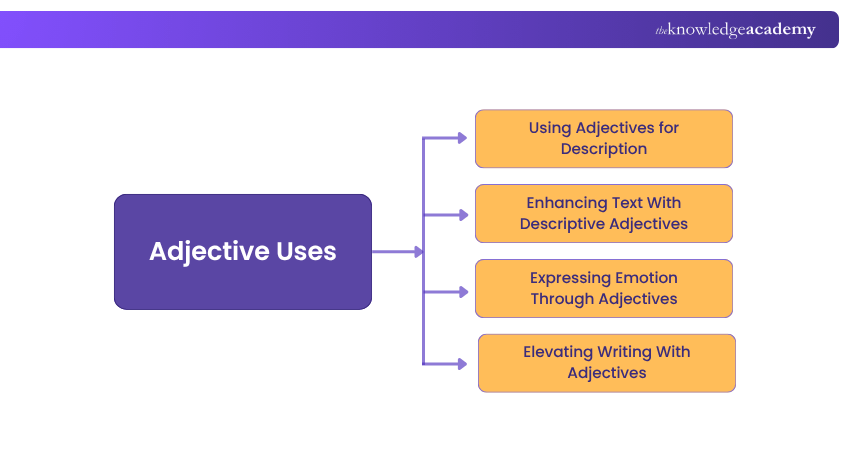
1) Using Adjectives for Description
Adjectives can create vivid imagery.
Example: "The vibrant Digital Photography captured every sharp detail of the golden sunset."
2) Enhancing Text With Descriptive Adjectives
Great writing often relies on well-chosen Adjectives. They make your text vibrant and engaging.
Example: "She stepped into a warm, inviting home after a long day."
3) Expressing Emotion Through Adjectives
Adjectives evoke feelings.
Example: "The heartbreaking news left everyone in silence."
4) Elevating Writing With Adjectives
Want to sound more sophisticated? Adjectives can do that.
Example: "The elaborate architecture of the cathedral was breathtaking."
Adjective Examples
Let’s dive into how Adjectives play their roles in sentences.
Adjectives as Complements
Adjectives complement a sentence’s subject or object.
Example: "The soup tastes delicious."
Adjectives as Coordinates
When two or more Adjectives are used together, they become coordinates.
Example: "It was a dark, stormy night."
Multifunctional Adjectives
Adjectives can fit into different contexts.
Example: "Golden opportunities come rarely."
Gain confidence in public speaking and daily interactions with our Effective Communication Skills Training – Join now!
What is the Difference Between Adjectives and Adverbs?
Adjectives define nouns or pronouns, while adverbs describe verbs, Adjectives or other adverbs. Adjectives tell us what kind or which one, and adverbs tell us how, when or where something happens. Many adverbs end with -ly (like quickly), but not all (like well or fast).
Examples of Adjectives:
Describe nouns or pronouns.
a) “A blue sky” – blue describes the sky
b) “A tall man” – tall describes a man
Examples of Adverbs:
Describe verbs, Adjectives, or other adverbs.
a) “He runs quickly”
b) “She is extremely smart”
c) “She sings very beautifully”
Are Numbers Adjectives?
Yes, numbers can act as an Adjectives when they describe how many or how much of something there is. When a number comes before a noun, it tells us quantity, and that’s what Adjectives do.
Examples of Adjectives:
a) In “three apples,” the number three describes how many apples.
b) In “ten students,” the number ten describes the noun students.
Conclusion
In essence understanding What is an Adjective is helps you see how words add life to language. Adjectives describe nouns or pronouns, making sentences more colourful and meaningful. They help express emotions, sizes, colours, and qualities, allowing readers or listeners to imagine things more clearly and making communication smooth, engaging, and easy to follow.
Gain the confidence to present ideas persuasively in any workplace scenario with our Communication Skills Course – Register today!
Frequently Asked Questions
What is the Main Purpose of an Adjective?

The main purpose of an Adjective is to describe, modify nouns or pronouns, adding detail, quality, quantity, or emotion to make sentences more precise and vivid.
What are the Basic Rules of Adjectives?
Adjectives are put before the noun they modify, agree in order when multiple Adjectives are used, and can also follow linking verbs as predicate Adjectives for descriptions.
What are the Other Resources and Offers Provided by The Knowledge Academy?
The Knowledge Academy takes global learning to new heights, offering over 3,000+ online courses across 490+ locations in 190+ countries. This expansive reach ensures accessibility and convenience for learners worldwide.
Alongside our diverse Online Course Catalogue, encompassing 19 major categories, we go the extra mile by providing a plethora of free educational Online Resources like Blogs, eBooks, Interview Questions and Videos. Tailoring learning experiences further, professionals can unlock greater value through a wide range of special discounts, seasonal deals, and Exclusive Offers.
What is The Knowledge Pass, and How Does it Work?
The Knowledge Academy’s Knowledge Pass, a prepaid voucher, adds another layer of flexibility, allowing course bookings over a 12-month period. Join us on a journey where education knows no bounds.
What are the Related Courses and Blogs Provided by The Knowledge Academy?
The Knowledge Academy offers various Communication Skills Courses, including the English Grammar Course, English Speaking Course, and the Effective Communication Skills Training. These courses cater to different skill levels, providing comprehensive insights into Types of Grammar.
Our Business Skills Blogs cover a range of topics related to Adjective, offering valuable resources, best practices, and industry insights. Whether you are a beginner or looking to advance your Communication skills, The Knowledge Academy's diverse courses and informative blogs have got you covered.

The Knowledge Academy


Global Training Provider
The Knowledge Academy is a world-leading provider of professional training courses, offering globally recognised qualifications across a wide range of subjects. With expert trainers, up-to-date course material, and flexible learning options, we aim to empower professionals and organisations to achieve their goals through continuous learning.

Upcoming Business Skills Resources Batches & Dates
Date
 English Grammar Course
English Grammar Course
Fri 14th Aug 2026
English Grammar Course
Fri 6th Nov 2026

 If you wish to make any changes to your course, please


