


 Top Rated Course

We may not have the course you’re looking for. If you enquire or give us a call on +32 35001305 and speak to our training experts, we may still be able to help with your training requirements.
What is a Risk Assessment? Steps, Examples, and Best Practices
The Knowledge Academy 16 July 2026A Risk Assessment identifies workplace hazards, evaluates risk levels, and implements controls to reduce harm. Learn the steps, examples, and best practices. It helps ensure employee safety and full regulatory compliance. It also supports better-informed decision-making and proactive risk management across all operations.

Training Outcomes Within Your Budget!
We ensure quality, budget-alignment, and timely delivery by our expert instructors.
Table of Contents
Workplace safety and risk management are key to maintaining a secure environment. If you are wondering What is a Risk Assessment, it is a process to identify hazards, evaluate risks, and prevent harm. Understanding this is essential for organisations.
This blog explores types of risk assessments, when to perform them, and how to carry them out effectively using the right tools and techniques.
Table of Contents
1) What is a Risk Assessment?
2) Why are Risk Assessments Important?
3) When Do You Perform a Risk Assessment?
4) How to Perform a Risk Assessment?
5) Risk Assessment Tools and Techniques
6) How to Use a Risk Matrix?
7) Conclusion
What is a Risk Assessment?
Risk Assessment is a structured process that is used to identify Hazardous Conditions and other hazards, evaluate them, and work on those risks. The main aim is to determine appropriate actions to manage or minimise them. It is a key component of Health and Safety Management in Workplaces, projects, and operational planning.
Key Takeaways:
1) Spotting anything that could cause harm
2) Judging the severity of each risk
3) Choosing actions to reduce or eliminate risks
4) Recording findings and steps taken
5) Keeping the assessment current and effective
6) Ensuring legal and safety standards are met
7) Helps prevent problems before they happen
Why are Risk Assessments Important?
Risk Assessment is the backbone of effective risk management and plays an important legal role for employers. It provides a clear and structured way to identify hazards and manage risks to health, safety, and well-being. It ensures risks are eliminated or reduced and properly controlled. The core importance of Risk Assessment includes:
1) Identifying health and safety hazards and evaluating the risk level in the workplace
2) Reviewing whether the existing control measures are suitable and effective
3) Providing additional controls, such as safe procedures
4) Prioritising resources to address higher risks and improve overall workplace safety
Types of Risk Assessment
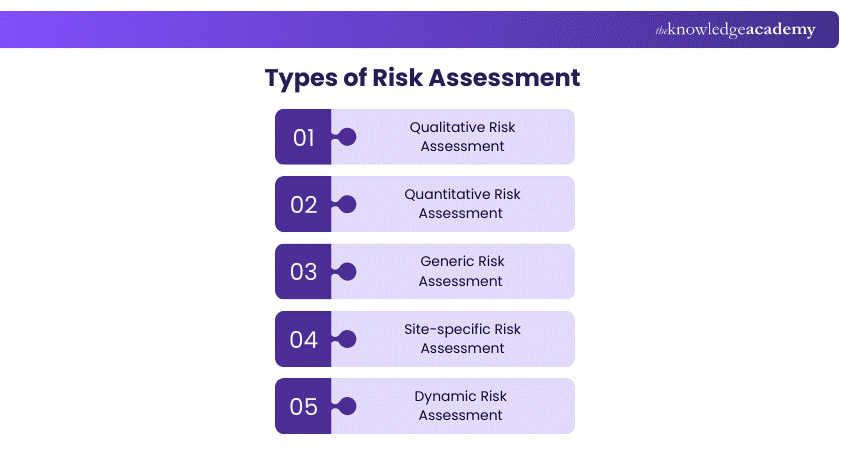
The Types of Risk Assessment processes are as follows:
1) Qualitative Risk Assessment
2) Quantitative Risk Assessment
3) Generic Risk Assessment
4) Site-Specific Risk Assessment
5) Dynamic Risk Assessment
Let's have a look at each of them in detail:
1) Qualitative Risk Assessment
This approach is more about intuition and experience than hard numbers. Risks are categorised based on subjective judgments about their severity and likelihood. It's like using a "gut feeling" backed by expertise to prioritise risks.
2) Quantitative Risk Assessment
In this assessment process, numbers take the front seat. This method assigns concrete values to risks by using statistical models. For example, determining there's a 20% chance of a server failure costing thousands provides a clear picture of the financial impact.
3) Generic Risk Assessment
This is a template-based approach that addresses common risks associated with specific tasks or industries. As it provides a solid starting point, it's essential to accommodate specific situations.
4) Site-specific Risk Assessment
This is customisable to locations or projects. It also considers unique factors of a site, such as its environment, equipment, and personnel. It ensures that the localised risks aren't overlooked and are treated in the right way for the future.
5) Dynamic Risk Assessment
Life is unpredictable, which means some situations evolve rapidly. Dynamic assessments offer continuous evaluations to adapt in real-time to changing circumstances. These are especially prevalent in high-risk professions like firefighting or emergency response.
Build practical Risk Management skills and enhance a secure workplace setting with the Management of Risk (MoR®) Foundation V3 Course – Join today!
When Do You Perform a Risk Assessment?
A Risk Assessment should be carried out regularly to make sure your current safety measures are still effective. It is also necessary whenever changes occur in the workplace, such as new equipment, substances, or procedures that could introduce new hazards. These checks help ensure risks remain controlled and legal requirements are met.
How to Perform a Risk Assessment?
Following the steps below ensures Risk Assessment is conducted effectively. Each step is vital in promoting a healthy and secure workplace setting.
Step 1: Identify Hazards
Begin by identifying hazards, including tasks, equipment, or substances. Hazards may not always be obvious, so it is crucial to use different methods to spot them, such as observing work activities, reviewing accidents, or checking ill-health records. Hazards are commonly grouped as:
1) Physical Hazards
2) Chemical Hazards
3) Biological Hazards
4) Ergonomic Hazards
5) Psychological Hazards
Step 2: Identify Who Might Be Harmed by Those Hazards
Once hazards are identified, it must be determined who may be affected by them and how. This involves identifying groups, such as employees, contractors, or visitors. Considering both direct and indirect exposure to hazards, extra care must be taken for higher-risk groups, such as young workers, new employees, or expectant mothers.
Step 3: Evaluate Risk Severity and Establish Precautions
Considering the likelihood of harm and severity of the consequences, risk must be assessed. Factors such as exposure time, people affected, competence, equipment condition, and emergency support must be reviewed. Accordingly, suitable control measures must be introduced to eliminate risk or reduce it to a reasonable level.
Step 4: Implement Changes and Record Your Findings
Control measures must be implemented proactively, and significant findings must be recorded. Records must clearly show identified hazards, who may be harmed, the controls in action, and who is responsible for monitoring them. Documentation must be proportionate to the level of risk involved.
Step 5: Review Your Assessment and Re-assess if Necessary
Regular reviews of Risk Assessments keep the process effective. It is required after changes in the workplace, accidents, cases of ill-health, or near-fatal incidents. Setting a review date prevents oversight and must be updated whenever new processes, equipment, or working arrangements are introduced.
Turn uncertainty into opportunity with Certified Risk Management Professional CRMP – Join now!
Risk Assessment Tools and Techniques
Effective Risk Assessment depends on practical tools and techniques that help organisations identify, evaluate, and prioritise potential hazards. Let’s explore them below:
a) Risk Matrix: A risk matrix maps risks by comparing likelihood and impact to support quick prioritisation.
b) Decision Tree: A decision tree outlines different decision paths and outcomes to guide safer choices.
c) Failure Modes and Effects Analysis (FMEA): FMEA identifies potential failures in processes or designs and evaluates their effects.
d) Bowtie Model: The bowtie model visualises risk causes, the central event, and resulting consequences.
e) ISO 31010 Techniques: ISO 31010 includes methods such as brainstorming, interviews, and the Delphi method for comprehensive assessments.
How to Use a Risk Matrix?
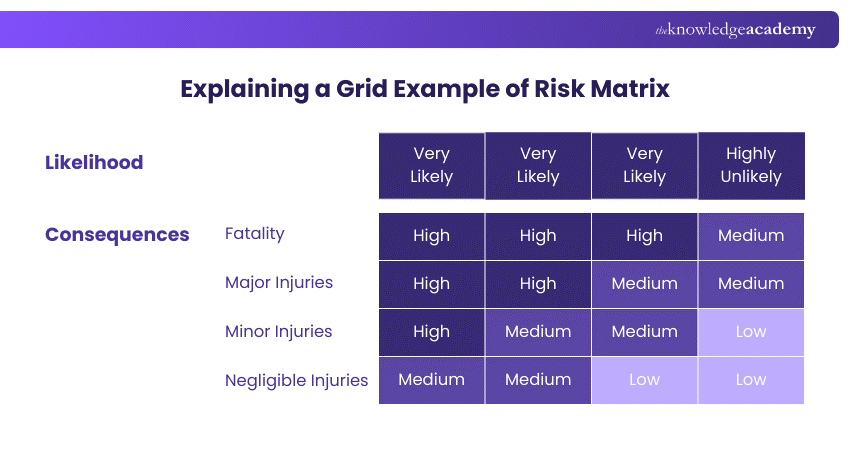
A risk matrix is a visual tool that aids in assessing and prioritising risks. You can understand this with a grid example:
a) X-Axis: Represents the likelihood of a risk occurring, ranging from rare to almost certain.
b) Y-Axis: Denotes the severity of the risk's impact from negligible to catastrophic.
By plotting risks onto this matrix, organisations can visualise which risks demand immediate attention and which don’t.
Conclusion
Knowing What is a Risk Assessment helps you identify hazards and protect your team effectively. By following the right steps, you can prevent potential risks before they escalate. A proactive approach ensures a safer and more productive workplace. We hope this blog helped you understand the essentials and feel confident to take action.
Build effective risk strategies and advance your risk management skills with MoR® Management of Risk Courses – Register now!
Frequently Asked Questions
What are the 5 C's of risk assessment?

The 5 C's are Character, Capacity, Capital, Collateral, and Conditions. They are used to evaluate a borrower’s ability to meet financial obligations.
What are the 5 P's of Risk Assessment?
The 5 P's are Presenting Problem, Predisposing factors, Precipitating factors, Perpetuating factors, and Protective factors. They help assess risks in mental health and supported living services.

The Knowledge Academy


Global Training Provider
The Knowledge Academy is a world-leading provider of professional training courses, offering globally recognised qualifications across a wide range of subjects. With expert trainers, up-to-date course material, and flexible learning options, we aim to empower professionals and organisations to achieve their goals through continuous learning.


 If you wish to make any changes to your course, please


