


 Top Rated Course

We may not have the course you’re looking for. If you enquire or give us a call on +32 35001305 and speak to our training experts, we may still be able to help with your training requirements.
Blockchain vs Data Science: A Complete Overview
Richard Harris 23 February 2026Blockchain and Data Science are two distinct but complementary technologies that play significant roles in today's digital landscape. Check out this blog on Blockchain vs Data Science and explore how these two juggernauts coexist and occasionally collide in the quest for technological supremacy.

Training Outcomes Within Your Budget!
We ensure quality, budget-alignment, and timely delivery by our expert instructors.
Table of Contents
Blockchain and Data Science are two sides of the same coin. Each has its own unique capabilities and applications. Thus, understanding the differences between Blockchain vs Data Science is essential for anyone seeking to harness their potential.
If you are interested in learning the differences between Blockchain and Data Science, then this blog is for you. In this blog, you will learn what are Blockchain and Data Science, their benefits, and the key differences between Blockchain vs Data Science.
Table of Contents
1) What is Blockchain?
2) Applications of Blockchain
3) Advantages of Blockchain
4) What is Data Science?
5) Applications of Data Science
6) Advantages of Data Science
7) Difference between Blockchain and Data Science
8) Blockchain vs Data Science: Which one is better?
9) Conclusion
What is Blockchain?
Blockchain is a distributed and unchangeable Digital Ledger System that logs transactions and data across a network of computers. It comprises a series of blocks, with each block containing a collection of transactions. Once a block becomes a part of the chain, it remains unmodifiable, guaranteeing the security and reliability of the stored data.

Applications of Blockchain
Blockchain technology has various applications across various industries. Some notable Blockchain applications include the following:
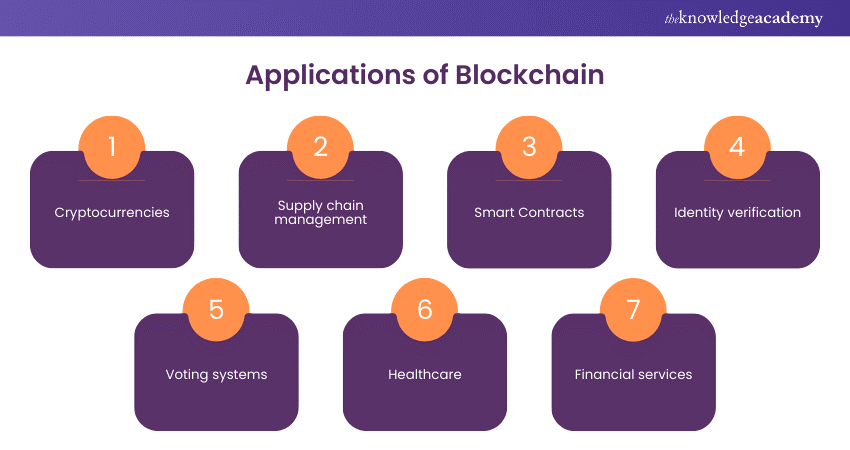
1) Cryptocurrencies: Blockchain's initial and most famous application is in popular Cryptocurrencies like Bitcoin and Ethereum. It enables secure and decentralised digital transactions, eliminating the need for traditional intermediaries.
2) Supply chain management: Blockchain helps track the production, shipment, and delivery of goods, reducing fraud and ensuring authenticity.
3) Smart Contracts: These self-executing contracts with predefined terms, encoded on the Blockchain, automate contract execution. Thus, they ensure trust and security in industries like real estate, insurance, and legal.
4) Identity verification: Blockchain is improving identity verification by providing individuals control over their digital identities, enhancing security, and providing secure access to services.
5) Voting systems: Blockchain-based voting systems enhance election security and transparency by recording votes on an immutable ledger, virtually eliminating the possibility of tampering with results.
6) Healthcare: In healthcare, Blockchain securely stores and shares patient records, preserving data integrity and privacy. It also facilitates drug traceability and clinical trial management.
7) Financial services: Blockchain is used in traditional finance for cross-border payments, trade finance, and asset tokenisation. It streamlines financial transactions and reduces fraud.
Advantages of Blockchain
From security to transparency, Blockchain technology offers many advantages. Here are some of its key advantages:
1) Security: Blockchain employs robust Cryptographic Techniques to secure data. This makes it nearly impossible to alter or delete once a transaction is recorded. This also ensures the integrity and immutability of data, enhancing trust in the system.
2) Transparency: Its decentralised nature ensures transparency, enabling all participants to access and verify transactions. This transparency fosters trust among parties, reducing the need for intermediaries and promoting openness.
3) Decentralisation: Operating on a distributed network of computers (nodes), Blockchain eliminates the reliance on a central authority. It also reduces the risk of a single point of failure and enhances the reliability of the system.
4) Reduced costs: Blockchain totally eliminates the need for intermediaries like banks or payment processors. This results in lower transaction fees and operational costs. This cost-saving feature makes it economically advantageous.
5) Efficiency: Transactions on a Blockchain can occur 24/7, providing speed and efficiency compared to traditional financial systems with limited operating hours. However, it’s important to consider the disadvantages of blockchain, especially when evaluating its use for cross-border transactions and global collaborations. This efficiency is particularly valuable in such scenarios.
Unleash the future of Blockchain with our Ethereum Developer Training– sign up now!
What is Data Science?
Data Science is a multidisciplinary domain that applies scientific techniques, algorithms, and procedures. It leverages systems to derive valuable insights, knowledge, and patterns from structured and unstructured data. This fusion of expertise from diverse fields, such as statistics, computer science, domain-specific knowledge, and data visualisation, enables the analysis of extensive datasets and informs data-driven decision-making.
Applications of Data Science
Data Science has various applications due to its ability to obtain valuable insights and patterns from data. Here are some prominent applications of Data Science:
1) Healthcare: In healthcare, Data Science is used to predict disease outbreaks, optimise treatment plans, and personalise patient care. It also plays a role in medical image analysis and drug discovery.
2) E-commerce: In the e-commerce industry, Data Science powers recommendation engines, helping users discover products they are likely to purchase. It also aids in inventory management and fraud detection.
3) Finance: Financial institutions use Data Science for risk assessment, fraud detection, algorithmic trading, and credit scoring. It helps in making data-driven investment decisions.
4) Marketing: Data Science enhances marketing efforts through customer segmentation, predictive analytics, and sentiment analysis. It helps marketers target their audience more effectively and optimise marketing campaigns.
5) Social media: Social media platforms utilise Data Science for content recommendation, user engagement analysis, and ad targeting. It also assists in sentiment analysis to understand user opinions.
Advantages of Data Science
From informed decision-making to optimising costs, Data Science has many advantages. Let's explore some of them below:
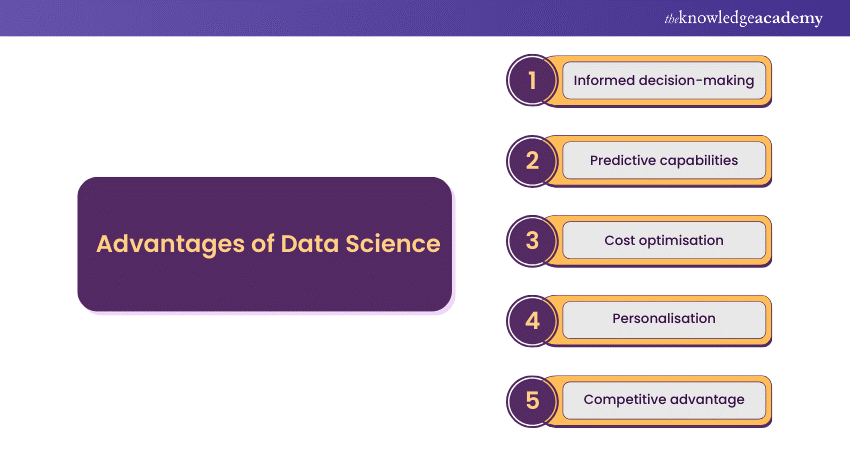
1) Informed decision-making: Data Science empowers organisations to make well-informed decisions by harnessing the power of data. This data-driven approach minimises guesswork and intuition, leading to more strategic and effective choices.
2) Predictive capabilities: Through advanced techniques like Machine Learning and Predictive Modelling, Data Science enables organisations to anticipate future trends and outcomes. This proactive approach allows businesses to adapt swiftly to changing conditions and seize opportunities.
3) Cost optimisation: Data Science plays a pivotal role in resource optimisation. By analysing data and identifying efficiencies, organisations can streamline operations, reduce costs, and improve profitability.
4) Personalisation: One of the key strengths of Data Science is its ability to deliver personalised experiences. Whether it's personalised product recommendations or tailored healthcare treatment plans, data-driven personalisation enhances customer satisfaction and engagement.
5) Competitive advantage: Organisations that embrace Data Science gain a significant competitive edge. They can identify market trends, consumer preferences, and emerging opportunities faster and more accurately than their competitors. This agility allows them to innovate and adapt swiftly to changing landscapes.
Unlock insights and innovation in every dataset with our Data Science Courses– sign up today!
Difference between Blockchain and Data Science
Blockchain and Data Science are two distinct domains in the technology landscape, each with its own unique characteristics and purposes. Understanding the differences between Data Science vs Blockchain is essential to grasping their respective roles and applications in today's data-driven world:
1) Emphasis and objectives
Blockchain primarily focuses on creating a secure and tamper-proof ledger for recording transactions. It emphasises data integrity and trust among participants. On the other hand, Data Science's main objective is to get valuable insights and knowledge from data to support decision-making, predictions, and optimisations across various domains.
2) Management and organisation of data
In Blockchain, data consists of structured information related to transactions and ledger entries. Data is added sequentially and is immutable once recorded. In contrast, Data Science deals with both structured and unstructured data. It encompasses a broader spectrum of information sources. It involves data cleaning, transformation, and analysis.
3) Tools and technological framework
Blockchain relies on Cryptographic Techniques, decentralised nodes, and consensus algorithms (e.g., Proof of Work or Proof of Stake) to secure and validate transactions. In comparison, Data Science employs a variety of tools and techniques, including Statistical Modelling, Machine Learning, and Data Visualisation. It often operates on a centralised computing infrastructure.
4) Proficiencies and knowledge
Proficiency in Cryptography, Blockchain development, and consensus mechanisms is crucial in Blockchain. It requires expertise in securing and maintaining distributed ledger systems. On the other hand, Data Science requires expertise in data analysis, statistics, Machine Learning, and domain-specific knowledge. It focuses on deriving insights from data to solve complex problems.
5) Implementations and industrial sectors
Blockchain finds applications in sectors such as finance (cryptocurrencies), supply chain management, healthcare (patient records), and digital identity management. In contrast, Data Science is applied in diverse industries, including healthcare (disease prediction), finance (algorithmic trading), e-commerce (recommendation systems), marketing (customer segmentation), and scientific research (climate modelling).
Blockchain vs Data Science: Which one is better?
Comparing Blockchain and Data Science is not a matter of one being better than the other, as they serve distinct purposes and have different applications. Rather, their value depends on the specific needs and objectives of an organisation or a project.
The Blockchain Career Guide explores how blockchain serves as a powerful technology for securing and validating transactions and data in a decentralized and tamper-proof manner. It is particularly valuable in scenarios where trust and security are essential, such as financial transactions, supply chain management, and maintaining the integrity of critical records. With its immutability and transparency, blockchain is an ideal solution for applications that require strong data integrity.
On the other hand, Data Science is a broader field focused on extracting insights, patterns, and knowledge from data. It involves techniques like machine learning and statistical analysis to make predictions, optimise processes, and improve decision-making. Data Science is ideal for scenarios where understanding data, making predictions, or optimising operations are the primary goals, such as in healthcare, marketing, and scientific research.
Overall, Blockchain and Data Science complement each other rather than compete. Data Science can analyse data stored on a Blockchain to extract insights, while Blockchain ensures the integrity and security of that data. The choice between them depends on the specific objectives of a project or organisation. It often involves using both technologies in tandem to address different aspects of data management and analysis.
Harness the power of Data Science and Blockchain with our Data Science and Blockchain Training– Sign up today!
Conclusion
Blockchain vs Data Science, each serves distinct purposes and excels in specific domains. Blockchain offers unparalleled security and data integrity, while Data Science provides valuable insights and predictive capabilities. The choice depends on the project's objectives and requirements, often involving the complementary use of both technologies for comprehensive data management and analysis.
Need quick references for data science? Get the Data Science Cheat Sheet today!
Frequently Asked Questions
In what ways are Blockchain and Data Science related?

Blockchain and Data Science are related through data management. While Blockchain focuses on securely recording and validating data, Data Science leverages that data to extract insights and make predictions. Together, they can provide end-to-end solutions for various industries.
Is Blockchain really in demand?
Yes, Blockchain is in demand, especially in sectors like finance, supply chain, and healthcare. Its capability to provide secure and transparent transactions and data management is increasingly valued by organisations seeking trust and efficiency in their operations.
What are the other resources and offers provided by The Knowledge Academy?
The Knowledge Academy takes global learning to new heights, offering over 3,000+ online courses across 490+ locations in 190+ countries. This expansive reach ensures accessibility and convenience for learners worldwide.
Alongside our diverse Online Course Catalogue, encompassing 17 major categories, we go the extra mile by providing a plethora of free educational Online Resources like Blogs, eBooks, Interview Questions and Videos. Tailoring learning experiences further, professionals can unlock greater value through a wide range of special discounts, seasonal deals, and Exclusive Offers.
What is the Knowledge Pass, and how does it work?
The Knowledge Academy’s Knowledge Pass, a prepaid voucher, adds another layer of flexibility, allowing course bookings over a 12-month period. Join us on a journey where education knows no bounds.
What are the related courses and blogs provided by The Knowledge Academy?
The Knowledge Academy offers various Blockchain Training, including Bitcoin and Cryptocurrency Course, Ethereum Developer Training and many more. These courses cater to different skill levels, providing comprehensive insights into Blockchain Developer Skills.
Our Advanced Technology Blogs cover a range of topics related to Blockchain, offering valuable resources, best practices, and industry insights. Whether you are a beginner or looking to advance your knowledge on Blockchain, The Knowledge Academy's diverse courses and informative blogs have you covered.

Richard Harris


Senior Full Stack Developer and Technology Educator
Richard Harris is a highly experienced full-stack developer with deep expertise in both frontend and backend technologies. Over his 12-year career, he has built scalable web applications for startups, enterprises and government organisations. Richard’s writing combines technical depth with clear explanations, ideal for developers looking to grow in modern frameworks and tools.

Upcoming Advanced Technology Resources Batches & Dates
Date
 Bitcoin and Cryptocurrency Course
Bitcoin and Cryptocurrency Course
Thu 20th Aug 2026
Bitcoin and Cryptocurrency Course
Thu 5th Nov 2026

 If you wish to make any changes to your course, please


