Who should attend this Analysis & Design using UML Training Course?
The Analysis & Design using UML training is a comprehensive course designed to equip participants with the skills and knowledge required to effectively utilize the Unified Modeling Language (UML) for the purpose of analyzing and designing software systems. This course is useful for the following professionals:
- Software Architects
- Software Designers
- Systems Analyst
- Project Managers
- Software Engineers
- Quality Assurance Engineers
- Business Analysts
Prerequisites of the Analysis & Design using UML Training Course
There are no formal prerequisites for the Analysis & Design using UML Course. However, a basic understanding of software development and UML can be beneficial.
Analysis & Design using UML Training Overview
Analysis & Design using UML in the United States is a pivotal course delving into the application of Unified Modeling Language in system design. Its relevance lies in providing professionals with a structured approach to analyze, design, and communicate complex software systems visually.
Professionals in Software Architecture, System Design, and Project Management should aim at mastering Analysis & Design using UML. This knowledge is imperative for those seeking to streamline the development process, ensuring efficiency and scalability in software projects. Attaining UML Certification in the United States becomes essential for showcasing expertise in system analysis and design.
The Knowledge Academy's 1-day training on Analysis & Design using UML in the United States offers a focused exploration of UML Certification Courses. Delegates will gain practical skills in creating and utilizing UML diagrams for effective analysis and design. This training equips participants with a UML Qualification, positioning them as adept professionals in system architecture.
Course Objectives
- To comprehend the principles of using UML for system analysis and design
- To apply UML diagrams in capturing and visualizing system requirements
- To master the use of UML for modeling different aspects of a software system
- To practice creating UML diagrams for real-world scenarios
- To integrate UML in the software development life cycle for enhanced design
- To prepare for and successfully achieve UML Certification
Upon completing the Analysis & Design using UML Course, delegates in the United States will hold a UML Qualification, empowering them to analyze, design, and communicate software systems effectively. This certification enhances professional standing, making participants valuable contributors to software development projects and teams.
Skills Gained from Analysis and Design using UML Training
Analysis & Design using UML Training equips learners with practical skills to model and design software systems using a standardized visual language. Professionals convert business and technical requirements into clear system designs that improve communication and development outcomes.
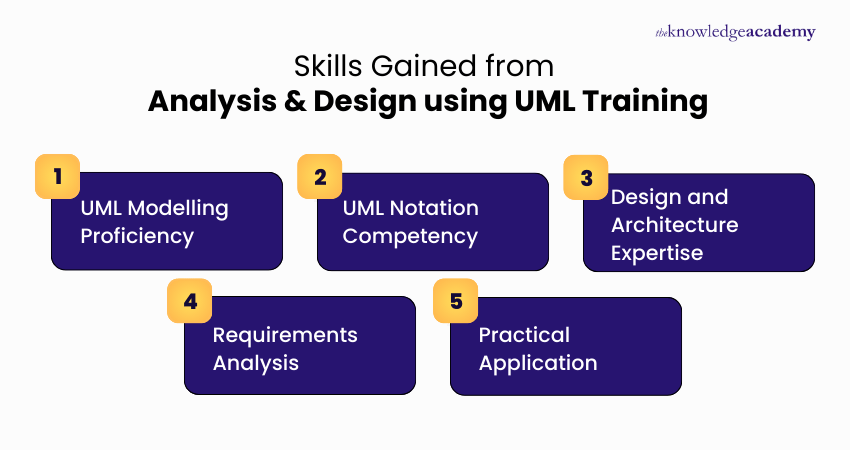
This course builds essential skills such as:
- UML Modeling Proficiency: Develop the ability to create and interpret core UML diagrams to represent system behavior and structure clearly.
- UML Notation Competency: Understand standard UML notation, including symbols, relationships, and diagram syntax, to create and interpret UML diagrams accurately.
- Design and Architecture Expertise: Build the skills to visualize system components, interactions, and workflows to support well-structured and scalable software designs.
- Requirements Analysis: Learn how to analyze the requirements of users and stakeholders and convert them into structured UML models.
- Practical Application: Apply UML techniques within real-world software development processes to support better planning, documentation, and design validation.





 If you miss out, enquire to get
yourself
on the waiting list for the next day!
If you miss out, enquire to get
yourself
on the waiting list for the next day!













 If you wish to make any changes to your course, please


