Who should attend this Mastering Metasploit Framework Course?
The Mastering Metasploit Framework Course in the United States teaches professionals how to harness the power of Metasploit to discover, exploit, and validate vulnerabilities. This Ethical Hacking Course is beneficial for various professionals, including:
- Penetration Testers
- Ethical Hackers
- Security Engineers
- Network Administrators
- Security Consultants
- Cybersecurity Researchers
- Red Team Members
- Blue Team Members (Defensive Security)
Prerequisites of the Mastering Metasploit Framework Course
There are no formal prerequisites for attending the Mastering Metasploit Framework Course.
Mastering Metasploit Framework Course Overview
The Metasploit Framework is a powerful tool used by Ethical Hackers in the United States to probe systematic vulnerabilities on servers and networks. It is an open-source project providing the content, infrastructure, and tools for performing penetration tests and extensive security auditing. It is a Ruby-based, modular penetration testing platform enabling you to write, test, and execute code.
Mastering the Metasploit Framework is indispensable for Cybersecurity Professionals, Ethical Hackers, and IT Specialists aiming to deepen their expertise. It equips them with the ability to identify vulnerabilities, simulate cyber-attacks, and implement robust security measures. This Ethical Hacking Training is not just a skill but a necessity in safeguarding organizations against cyber threats, making it a must-have proficiency in the arsenal of modern IT experts.
The Knowledge Academy's 1-day intensive Ethical Hacking Course in the United States is designed to empower delegates with comprehensive Metasploit skills. Our expert-led sessions delve into the Framework's core functionalities, covering topics such as exploitation techniques, post-exploitation tactics, and real-world applications.
Course Objectives
- To understand the fundamentals of Metasploit Framework
- To master the art of vulnerability assessment and exploitation using Metasploit
- To learn advanced post-exploitation strategies
- To explore real-world scenarios and case studies
- To develop proficiency in creating custom Metasploit modules
- To cultivate Ethical Hacking skills and an ethical mindset
Upon completion of this Ethical Hacking Course in the United States, delegates will benefit by gaining a comprehensive understanding of the Metasploit Framework and its applications. By the end of this course, delegates will possess advanced skills in vulnerability assessment, exploitation, and post-exploitation techniques, enabling them to ensure proper Cybersecurity.
Benefits of Mastering Metasploit Framework Certification
Mastering Metasploit Framework Certification provides hands-on skills to identify and remediate security vulnerabilities in real-world environments. It enables professionals to simulate cyberattacks, strengthen organizational defenses, and enhance overall cybersecurity posture.
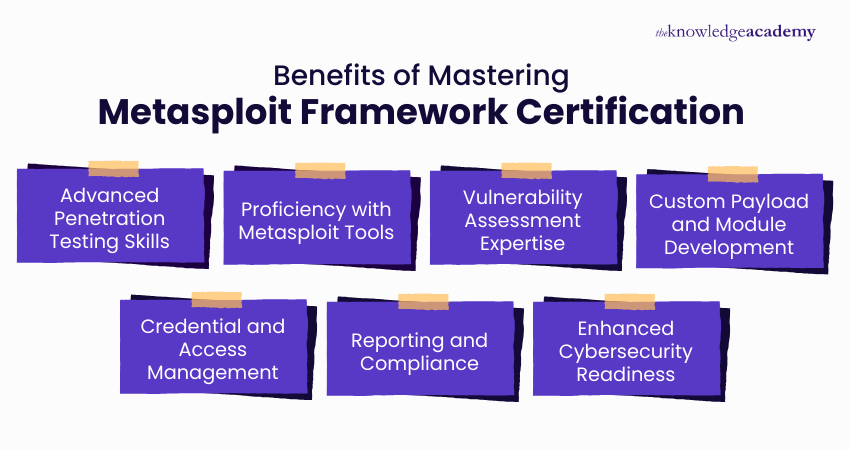
Key benefits of this training include:
- Advanced Penetration Testing Skills: Professionals gain expertise in network scanning, vulnerability identification, and safely executing controlled exploitation techniques.
- Proficiency with Metasploit Tools: Develop the ability to effectively use MSFconsole, Pro Console, and web interfaces to manage projects, hosts, and payloads efficiently.
- Vulnerability Assessment Expertise: Gain the ability to validate and prioritize discovered vulnerabilities, ensuring effective risk management.
- Custom Payload and Module Development: Strengthen practical capability to design, customize, and deploy Metasploit payloads and modules for targeted penetration testing.
- Credential and Access Management: Understanding of credential testing, brute-force techniques, and access validation to help secure sensitive systems.
- Reporting and Compliance: Acquire the skills to produce clear audit reports, compliance documentation, and assessment summaries to support organizational and regulatory requirements.
- Enhanced Cybersecurity Readiness: Learners gain the ability to anticipate potential threats, implement robust countermeasures, and proactively strengthen system security.





 If you miss out, enquire to get
yourself
on the waiting list for the next day!
If you miss out, enquire to get
yourself
on the waiting list for the next day!













 If you wish to make any changes to your course, please


