


 Top Rated Course

We may not have the course you’re looking for. If you enquire or give us a call on +1 7204454674 and speak to our training experts, we may still be able to help with your training requirements.
Types of Agile Methodology for Modern Businesses
David Evans 25 February 2026Agile methodologies are iterative approaches to software development, including Scrum, Kanban, XP, Lean, and SAFe, focused on flexibility and collaboration. They encourage teamwork, adaptability to change, regular feedback, and faster project delivery. This helps teams manage uncertainty and deliver high-quality outcomes efficiently.

Training Outcomes Within Your Budget!
We ensure quality, budget-alignment, and timely delivery by our expert instructors.
Table of Contents
Building something new, whether it’s an app, a campaign, or a product, is rarely smooth. Plans shift, feedback pours in, and you’re expected to keep up. That’s where the Types of Agile come in. They give teams a flexible, step-by-step way to create, improve, and deliver projects without getting stuck, no matter how fast things change.
In this blog, we’ll explore popular Types of Agile like Scrum, Kanban, XP, Lean, FDD, DSDM, Crystal, ASD, RAD, SAFe, and LeSS. Let's dive in to discover the right Agile approach for your team!
Table of Contents
1) What are Agile Methodologies?
2) Types of Agile Methodology
3) Benefits of Using Different Agile Methodologies
4) Which Type of Agile is Most Commonly Used?
5) What Type of Agile is Best for Small Teams?
6) Conclusion
What are Agile Methodologies?
Agile methodologies are flexible and iterative approaches to Project Management and Software Development that focus on delivering value in small, manageable increments. Instead of following a rigid, linear plan, Agile encourages continuous planning, testing, feedback, and improvement throughout the project lifecycle, allowing teams to respond quickly to change.
By promoting transparency and adaptability, Agile methodologies help organisations deliver high-quality results faster while better aligning outcomes with business and user needs.
Types of Agile Methodology
Agile has many types like Scrum with short sprints, Kanban with task boards, XP with testing, Lean to cut waste, Crystal for team needs, DSDM for fast delivery, and FDD to build step by step. Now let’s look at each of these Agile methodologies in detail.
1) Scrum
Scrum is an approach of working that helps teams stay focused and finish work in small steps. It breaks big projects into short time periods called sprints. A sprint can be 1 to 4 weeks long. At the end of each sprint, the team shows what they have finished.
Scrum is like Kanban because it uses a board to show the work. But in Scrum, the team plans only one sprint at a time.
Scrum Roles:
1) Product Owner: Decides what needs to be done and what is most important
2) Scrum Master: Helps the team follow the rules and solve problems
3) Team Members: People who do the work and build the product
Scrum Meetings:
1) Sprint Planning: Plan what to do in the sprint
2) Daily Stand-up: A short meeting every day to share progress
3) Sprint Review: Show what was done in the sprint
4) Sprint Retrospective: Talk about what went well and what can be better
Scrum also has a task list called a product backlog. It helps the team stay organised. Scrum is good for projects that change often and helps teams work well and improve every time.
Build strong Scrum skills and boost your career with our Scrum Certification – Register today!
2) Kanban
Kanban is an easy way to manage daily tasks. It uses a board with three columns: To Do, Doing, and Done. This helps teams see what work is left, what they are working on, and what is finished. Kanban does not use sprints. Work keeps moving without a set time limit.
Many tools have Kanban boards to help teams plan, see who is doing what, and stay organised. Many project tools include Kanban boards to help teams plan and manage their work. It also shows who is doing what and what still needs to be done.
Main Kanban Ideas:
1) Visualise Work: Show all tasks clearly on a board
2) Limit Work in Progress: Don’t do too many things at once
3) Manage Flow: Keep work moving smoothly
4) Make Rules Clear: Everyone should know how work is done
5) Use Feedback: Talk often and improve how you work
Kanban is great for teams that handle tasks that change often. It helps teams stay organised, work better, and finish tasks without feeling overloaded.
3) Extreme Programming (XP)
Extreme Programming (XP) is a way to build software in small steps. It is part of Agile, and the goal is to make good-quality software fast and listen to what the customer wants. The team works in short time periods (like sprints) and changes the product when needed.
Easy XP Ideas:
1) Talk Often: The team and customers should talk and share ideas
2) Keep it Simple: Make the work and code easy to understand
3) Get Feedback: Ask users what they think and make changes
4) Be Brave: Speak up if something can be better
5) Respect Everyone: Everyone’s ideas are important
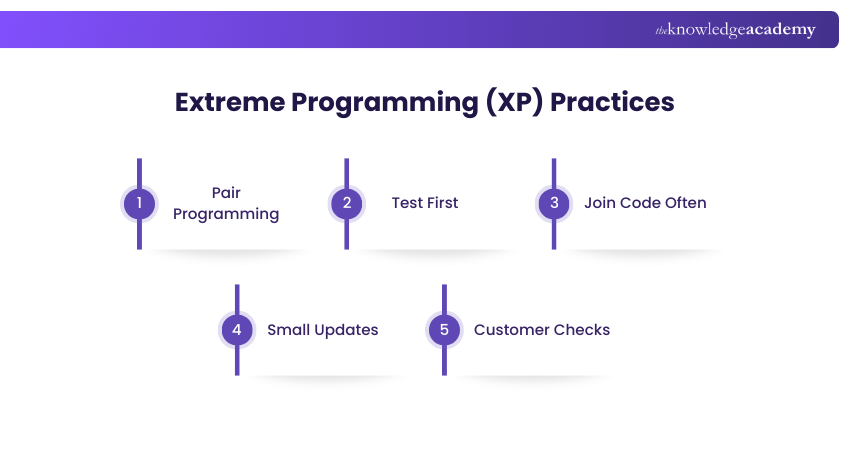
Easy XP Practices:
1) Pair Programming: Two people write code together
2) Test First: Write a test before writing code
3) Join Code Often: Add your work to the team’s code many times a day
4) Small Updates: Share small pieces of the product often
5) Customer Checks: The customer checks if it works how they want
XP is good when the customer wants to be involved and may change their mind often. It helps teams build better products that people really want.
4) Lean Software Development
Lean Software Development is a way to build software by doing only the work that is needed. It helps teams save time, do better work, and give customers what they want faster. Lean is not the same as Agile, but both share similar ideas.
Lean says teams should stop doing things that waste time and focus only on what helps the customer.
Lean Rules (Very Simple):
1) Remove Waste: Don’t do extra work that is not useful
2) Build Quality in: Make sure things are done well from the start
3) Keep Learning: Learn and get better as you go
4) Decide Late: Wait to decide until you know what’s best
5) Work Fast: Finish tasks quickly and get feedback
6) Respect the Team: Trust the people doing the work
7) Improve Everything: Make the whole process better, not just one part
Lean helps teams work better, avoid delays, and make products that people really need.
Learn Lean budgeting, governance, and value flow in portfolios. Join our Lean Portfolio Management SAFe® Training now!
5) Feature-driven Development
Feature-driven Development (FDD) is a way to build software by focusing on small parts called features. A feature is something the customer wants the software to do. The team builds one feature at a time and finishes it before starting the next.
FDD is good for big projects. It needs a lot of planning and clear steps. Teams usually build features every two weeks.
Simple Steps in FDD:
1) Make a Model: Plan how the full system will look
2) List Features: Write down all the things the software should do
3) Plan the Work: Decide who will do each feature and when
4) Design the Feature: Plan how each feature will work
5) Build the Feature: Create and test the feature
Why FDD is Useful:
1) It focuses on what the customer wants
2) It’s easy to see what is done
3) It works well for large projects
FDD helps teams stay clear, work in small parts, and build useful things for the customer.
6) Dynamic Systems Development Method (DSDM)
DSDM (Dynamic Systems Development Method) is an Agile framework used to build software quickly and deliver it on time. It helps teams complete projects efficiently, even when requirements change during development.
Like Scrum and XP, DSDM uses time-boxed iterations called sprints. The framework supports flexibility, allowing changes to be incorporated and addressed smoothly without disrupting the overall timeline.

DSDM Principles:
1) Focus on Business Needs: Always work on what matters most for the business
2) Deliver on Time: Stick to the schedule
3) Work Together: Team members and users should work closely
4) Don’t Lower Quality: Keep high standards for the product
5) Build Step by Step: Start with a strong base and grow the system
6) Be Flexible: Improve and adjust during the project
7) Keep Talking: Share updates and ideas often
8) Stay in Control: Keep track of everything that happens
DSDM Phases:
1) Feasibility and Business Study: Check if the project makes sense and is worth doing
2) Prototype Iteration: Build simple versions of the product to test ideas
3) Design and Build Iteration: Create, test, and improve the system
4) Implementation: Deliver and use the final product
7) Crystal
Crystal is a group of Agile methods. Some types are called Crystal Clear, Crystal Yellow, Crystal Orange, and Crystal Red. Each type is used for different team sizes and different kinds of projects. You choose the best one based on how big your team is and how important your project is.
Crystal focuses on people and teamwork. It believes that talking, sharing, and working together help make better software. It can change to fit what each team needs.
Crystal Main Ideas:
1) Give Updates Often: Show working software regularly
2) Keep Learning: Think about what went well and what can be better
3) Talk Freely: Everyone should share and listen
4) Feel Safe: Team members should feel okay to speak up
5) Focus on What Matters: Do the most important work first
6) Ask Users for Help: Get feedback from people who will use the product
Characteristics of Crystal Agile Methodology:
1) Flexible: Can change to match the team and project needs
2) Less Paperwork: Doesn’t require many documents or formal steps
3) Team-focused: Team members work closely and share ideas often
Improve teamwork between development and operations. Join our SAFe® DevOps Certification now!
8) Adaptive Software Development (ASD)
Adaptive Software Development (ASD) is an Agile method that helps teams work on projects where things change often. Like the Adaptive Project Framework (APF), it breaks work into small parts so teams can stop, check progress, and make changes if needed. Instead of following a strict plan, teams learn as they go and improve step by step. It’s great for complex projects with many changes.
ASD believes software projects can change anytime. Teams work together, learn step by step, and improve as they go. It’s great for projects with frequent changes.
Phases in ASD:
1) Speculate: Plan the project’s general goals and timeline, but stay open to change
2) Collaborate: Work together as a team to build the product
3) Learn: Review what worked and improve the next phase
Key Principles of ASD:
1) Mission-focused: Everyone works towards the same goal
2) Component-based: The system is built in parts; it can be worked on at the same time
3) Iterative: Work is done in small steps, allowing for quick changes
4) Time-boxed: Each phase has a fixed time to stay on schedule
ASD helps teams adjust quickly, keep learning, and stay on track even when project needs change. It’s a great choice when flexibility and fast response are more important than following a fixed plan.
9) Rapid Application Development (RAD)
Rapid Application Development (RAD) is a type of Agile method that focuses on building quick models (prototypes) and getting fast feedback. Instead of spending a lot of time on long planning and testing, RAD helps teams build and improve the product at the same time. This makes the process faster and more flexible.
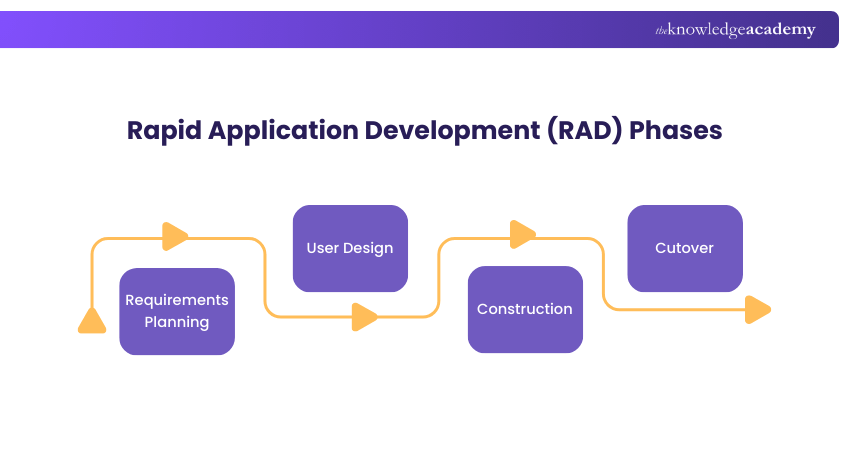
Phases:
1) Requirements Planning: Decide the main goals, needs, and limits of the project
2) User Design: Create models (prototypes), get user feedback, and improve the design
3) Construction: Build the actual product step by step
4) Cutover: Final checks, moving data, testing, and getting the product ready to use
Key Features of RAD:
1) Prototyping: Use sample versions of the product to test ideas and make changes
2) User Interaction: Users are involved throughout the process to give feedback
3) Iterative Development: Build the product in small parts, making changes as needed
RAD works well for projects where the needs are not clear at the start and may change later. It gives teams a flexible way to work. By talking to users often and getting feedback, Rapid Application Development helps make sure the final product is just what the users need.
10) Scaled Agile Framework (SAFe)
SAFe is a way for big companies to use Agile and Lean methods with many teams. It was made by Scaled Agile, Inc. SAFe helps teams work together, follow the same plan, and finish big projects faster and better. It is more useful than Scrum when many teams are working on the same large project. SAFe improves communication, planning, and teamwork. It helps everyone stay on the same page.
Levels in SAFe:
1) Team Level: Small Agile teams do their work and deliver value
2) Program Level: Teams work together toward one goal using a shared backlog
3) Large Solution Level: Helps many teams work together on big systems
4) Portfolio Level: Connects company strategy to the actual work being done
SAFe Principles:
1) Take an Economic View: Focus on delivering the most valuable work first
2) Apply Systems Thinking: Look at the whole system, not just one part
3) Assume Change and Stay Flexible: Be ready to adjust when needed
4) Build Step by Step: Create small parts, test them, and keep improving
SAFe is a good choice for large companies that want all their teams to follow Agile. It gives a clear plan, keeps everyone working together, and helps deliver big projects in a smart and organised way.
Understand effective management of product backlogs and features. Join our SAFe® Agile Product Management Training now!
11) Large-scale Scrum (LeSS)
LeSS is a bigger version of Scrum. It helps large companies use Scrum with many teams working on the same product. Even with more teams, LeSS keeps things simple and easy, just like regular Scrum. It helps teams stay flexible, deliver faster, and make customers happy.
LeSS Principles:
1) Whole Product Focus: All teams work together on the same product.
2) Customer Feedback: Teams talk to real customers to improve the product.
3) Keep Improving: Teams learn and get better over time.
LeSS Structure:
1) Feature Teams: Teams that have all the skills to build and deliver product features.
2) LeSS Framework: Simple rules, roles, and meetings to help teams work together.
LeSS is great for big companies that want to use Agile without making things too hard or complicated. It helps many teams work as one and build better products faster.
Benefits of Using Different Agile Methodologies
Each type of Agile methodology has its own unique strengths, helping teams work more efficiently, adapt to change, and deliver value consistently. Below are the key benefits of using Agile methodologies:
1) Improved Quality: Continuous testing helps find and fix problems early, resulting in better quality outcomes.
2) Faster Delivery: Work is divided into small parts, allowing teams to deliver results more quickly and consistently.
3) Reduced Risk: Problems are identified early through regular reviews, reducing the chances of major project failure.
4) Continuous Improvement: Regular reviews help teams learn from mistakes and improve their processes over time.
5) Better Teamwork: Agile encourages regular communication between team members and stakeholders, leading to clearer goals and smoother collaboration.
6) Flexibility to Handle Change: Agile methods help teams adjust easily when project requirements change, even at later stages.
7) Higher Customer Satisfaction: Regular feedback from customers ensures the product meets their needs and expectations.
Which Type of Agile is Most Commonly Used?
Scrum is the most commonly used Agile methodology across industries, especially in software development. It follows a structured approach with defined roles and works in short, time-boxed iterations called sprints. This structure makes Scrum easy to adapt and manage.
Scrum’s popularity comes from its strong focus on transparency and feedback. Practices such as daily stand-ups, sprint reviews, and retrospectives provide clear visibility into progress and encourage continuous improvement. This makes Scrum suitable for both small teams and large organisations.
What Type of Agile is Best for Small Teams?
Scrum and Kanban are the best Types of Agile methodologies for small teams. Scrum works well because it provides a simple structure with short sprints, helping small teams stay focused and organised while delivering work in manageable cycles.
Kanban is also ideal for small teams that need more flexibility. It uses visual boards to track tasks and allows work to flow continuously without fixed timelines, making it easier to handle changing priorities and improve efficiency over time.
Conclusion
Understanding the above discussed Types of Agile methodologies helps teams find the right way to plan, build, and deliver work successfully. Each method, like Scrum, Kanban, SAFe, or LeSS, fits different team sizes, goals, and work styles. By choosing the right approach, teams can improve teamwork, stay flexible, deliver faster, and meet changing customer needs more effectively.
Lead high-impact and value-driven projects with our AgilePM® Foundation & Practitioner (AgilePM® V3) Course – Begin your journey!
Frequently Asked Questions
Can I Blend Multiple Agile Frameworks Together?

Yes, you can. Many teams mix parts of different Agile frameworks to fit their way of working, this is called a hybrid approach. The most important thing is to stay true to Agile values like flexibility, teamwork, and continuous improvement, while building a process your team can follow and sustain.
What is the Difference Between Agile and Scrum?
Agile is a way of working that helps teams be flexible and work in small steps. Scrum is one method among the many Types of Agile methodologies used to follow the Agile way. So, Agile is the big idea, and Scrum is one of the ways to do it.
What are the Other Resources and Offers Provided by The Knowledge Academy?
The Knowledge Academy takes global learning to new heights, offering over 3,000 online courses across 490+ locations in 190+ countries. This expansive reach ensures accessibility and convenience for learners worldwide.
Alongside our diverse Online Course Catalogue, encompassing 19 major categories, we go the extra mile by providing a plethora of free educational Online Resources like Blogs, eBooks, Interview Questions and Videos. Tailoring learning experiences further, professionals can unlock greater value through a wide range of special discounts, seasonal deals, and Exclusive Offers.
What is The Knowledge Pass, and How Does it Work?
The Knowledge Academy’s Knowledge Pass, a prepaid voucher, adds another layer of flexibility, allowing course bookings over a 12-month period. Join us on a journey where education knows no bounds.
What are the Related Courses and Blogs Provided by The Knowledge Academy?
The Knowledge Academy offers various Agile Training, including Agile for Teams Training, SAFe® DevOps Certification, and the SAFe® Agile Product Management Training. These courses cater to different skill levels, providing comprehensive insights into Scrum Case Studies.
Our Project Management Blogs cover a range of topics related to Types of Agile, offering valuable resources, best practices, and industry insights. Whether you are a beginner or looking to advance your Project Management skills, The Knowledge Academy's diverse courses and informative blogs have got you covered.

David Evans


Certified Project Trainer and Agile Delivery Expert
David Evans brings over a decade of hands-on experience in project delivery, Agile transformation, and team leadership. With a background in technology and business consulting, David has led cross-functional teams through Agile and Waterfall projects in both public and private sectors. He combines technical knowledge with practical insights to help readers navigate the challenges of modern project environments.

Upcoming Project Management Resources Batches & Dates
Date
 AgilePM® Foundation & Practitioner (AgilePM® v3)
AgilePM® Foundation & Practitioner (AgilePM® v3)
Mon 28th Sep 2026
AgilePM® Foundation & Practitioner (AgilePM® v3)
Mon 14th Dec 2026

 If you wish to make any changes to your course, please


