


 Top Rated Course

We may not have the course you’re looking for. If you enquire or give us a call on +1 7204454674 and speak to our training experts, we may still be able to help with your training requirements.
What is Spatial Data? Everything You Need to Know
Lily Turner 21 April 2026Spatial Data, also known as geospatial data, represents the location, shape, and relationships of objects on Earth using coordinates, maps, or geometry. It is actively used in scientific research, healthcare, historical studies, policy-making, and many aspects of daily life. It helps in analysing patterns and tracking changes over time.

Training Outcomes Within Your Budget!
We ensure quality, budget-alignment, and timely delivery by our expert instructors.
Table of Contents
Have you ever wondered how Google Maps is able to provide accurate details of roads and streets? Do you know if it works with any techniques or software? If you believe that it is based on a technique, what technique was used for such massive details? Or, if you think that software was used, could you name the software? The answer lies in the use of Spatial Data to map and analyse locations with precision.
If you don’t know any of them, don’t worry. You have landed on the right page to learn it. If you are eager to know now, here is a hint for you. The technique that has been used by Google Maps is Spatial Data. This blog will walk you through its types and real-life usages in a way that circles around you.
Table of Contents
1) What is Spatial Data?
2) How Does Spatial Data Work?
3) Importance of Spatial Data
4) Types of Spatial Data
5) Spatial Data Use Cases
6) Software Tools for Spatial Data
7) Conclusion
What is Spatial Data?
Spatial Data, or Geospatial Data, could be defined as information that is related to specific geographical locations on Earth. It could be related either directly or indirectly and has characteristics of natural or constructed elements.
These Spatial Data are processed and analysed by Geographic Information Systems (GIS), and this helps in providing a better understanding of the geographic contexts. These data are presented in Cartesian formats of two-dimensional coordinates, respectively, of x and y coordinates.
The same data will be represented in numerical format when it is in the Geographic Coordinate System (GCS). Apart from these structures or forms, Spatial Data could also be in geometric shapes like lines, points, and polygons.

How Does Spatial Data Work?
Here is a detailed step-by-step overview of how Spatial Data works in storing and locating any data:
1) Data Collection: The initial step involves data collection from multiple sources like satellite images and geometric styles like points, lines, polygons, and solids.
2) Data Storage: Collected data is often stored either in databases or in GIS software systems in some special formats.
3) Data Analysis and Visualisation: Stored data is now analysed and visualised with GIS software or some other specialised software.
4) Querying and Filtering: This involves filtering Spatial Data with a query on some specifications like locations and other attributes.
5) Interoperability: Spatial Data can be shared among different networks, platforms, and organisations with certain protocols or frameworks.
Importance of Spatial Data
The presence of Spatial Data is everywhere, and it is crucial for understanding our surroundings and the world. Let's look at the importance of it in our daily life:
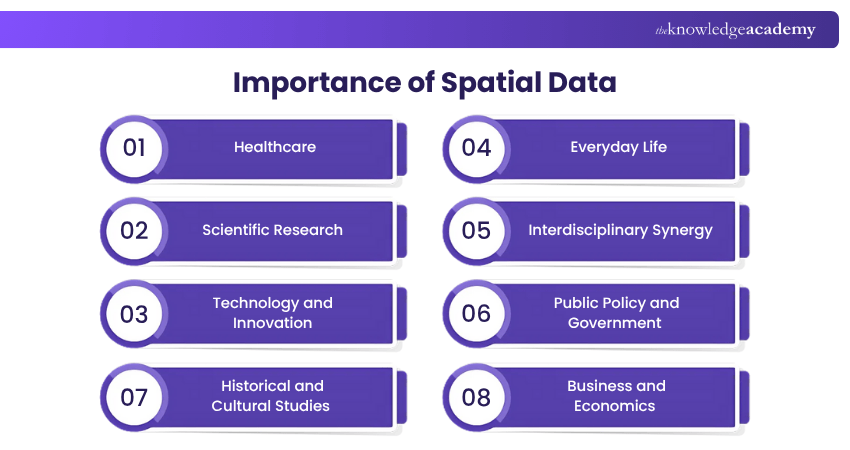
1) Healthcare
Health is one of the overrated qualities of human life. Spatial Data is even more prominent in epidemiology, which is a study related to health and diseases. Obviously, healthcare sectors require a lot of data on people and demographics to know how well people are and how fast a disease is attacking people.
1) Helps to track the spread of disease and its count among people
2) Can optimise resource allocation to the required places
3) Track hospital capacities and vacancies with real-time data mapping
2) Everyday Life
From dawn to dusk, people use Global Positioning System (GPS) navigation for their travel or Maps for finding and locating places to eat, stay, explore, or hang out. Spatial Data has become a part of everyday life in extending its services to each situation. Whenever you’re stuck between not knowing which path to lead, it has been your saviour.
1) Frees you from standing in the middle of the road to find the right direction
2) Explore the best and most suitable places and spots as per your preferences
3) Check the spot availability before making a visit
3) Scientific Research
Geographical data is always interrelated with science. Be it climatic changes, healthcare, or navigation, it is indulged with the principles of science. Having accurate and relevant data will help you make informed decisions and provide exact details of what the climate will be like today or how deforestation is affecting the world.
1) Understanding of climatic conditions and weather for everyday
2) Helps scientists to make better and more accurate predictions
3) Track the status of the environment and its destructive oblivions
Boost your proficiency in forecasting for strategic decision-making with our Predictive Analytics Course - Register now!
4) Interdisciplinary Synergy
The world belongs to none and everyone. It is common and available to everyone. The same goes for the data related to geographics. It allows the data to be accessible and usable for all streams or sections of everyday life. It helps in interdisciplinary synergy, which is collaborative work done by two or more disciplines or sections of life.
1) Acts as common data ground, facilitating interdisciplinary research
2) Broader analysis leads to different perspectives and ideas
3) Provides comprehensive insights into difficult issues or projects
5) Technology and Innovation
In this tech-savvy world, Spatial Data has gained a lot for its development in providing real-time data on demographics and environment. The implementation of the Internet of Things (IoT) and Artificial Intelligence (AI) are some of the advantages that Spatial Data possesses. With technology and innovation, results are quicker and more effective.
1) Get instant traffic updates along with your directions on Google Maps
2) Design your building by innovating and analysing your environment
3) Access remote controls or self-driven vehicles with proper navigation
6) Public Policy and Government
Public policies and Governments require a lot of data on people and surroundings to make any kind of decisions. From renovating the road to having a new building, all aspects are analysed. When a change is made with public property, it needs to estimate its duration and the effects that people might face because of this. Spatial Data drives to provide them all.
1) Understand your land and population for any urban development
2) Calculate the requirements of public resources of any locations
3) Estimate the counts of people and locations when there are any disasters
7) Historical and Cultural Studies
Human civilisation is not possible without its past histories and cultures. The fact that Spatial Data holds a record of human evolution is non-negotiable. With this record of information, it is easy to trace and locate any specific detail required for an analysis or case study. You can have a better understanding of the past with the data stored.
1) Trace the roots of culture and heritage of a culture or community
2) Find the precious belongings of the past with archaeological studies
3) Point out the growth factor from the past to the present
8) Business and Economics
Business and Economics are entirely dependent on people and statistics of their actions. With Spatial Data, both fields can predict, take any actions, and introduce any new processes. It supports you in taking informed decisions based on the data and, therefore, allocate logistics, expenses, and profits to aim or expect.
1) Identify the best spot and centre of attraction for your new business
2) Calculate the budget or expenses with the population count
3) Track the actions of your customers and enhance your marketing strategy
Types of Spatial Data
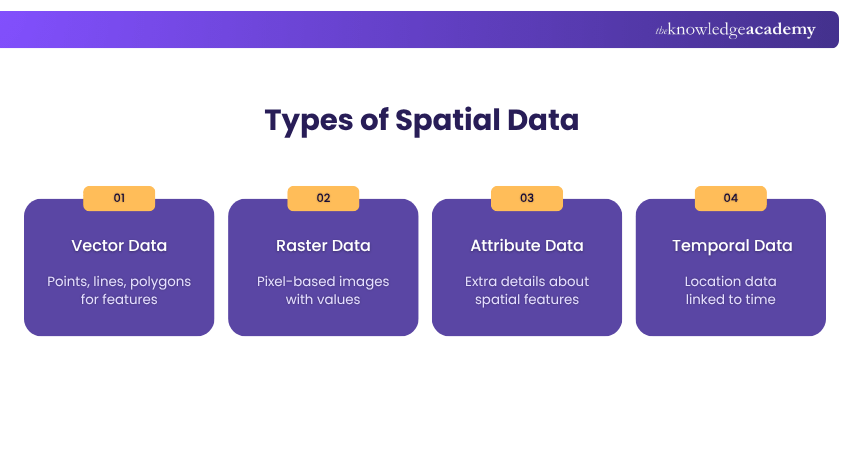
There are four types of Spatial Data: vector data, raster data, attribute data, and temporal data. Let's have an understanding of each type of Spatial Data.
1) Vector Data
Vector data represents the features of spatial elements using points, lines, and polygons. Often, vector data is used for objects that are on the Earth like natural objects, buildings, cities, roads, and so on. The points are used to refer to city centres, the position of a lake between the forest, etc. Lines describe roads and rivers. Polygons refer to an enclosed area like a building.
2) Raster Data
Raster data is an image representation of any information. They are stored in the format of pixel or pixel grids. Each pixel or pixel grid has some value attached to it. It can be either a colour, tone, or temperature. The number of pixels put together will form an image. Examples of this type are satellite pictures of the Solar System, buildings, and digital maps of locations.
3) Attribute Data
Sometimes, Spatial Data comes with additional information except locations. Those details are a form of nonspatial data and describe certain characteristics of central data. This type of data is termed attribute data. For instance, when you click on a polygon that refers to a mountain, details like tree names, its counts, and inhabitants of the mountain are provided additionally.
4) Temporal Data
When Spatial Data is related to a specific time period or a time range, it is referred to as temporal data. It provides an analysis of location in relation to time. To describe it better, information on the evolution of a particular city would fit in. Other simple instances, like the time when the picture was taken or what time a store might open, also define temporal data.
Spatial Data Use Cases
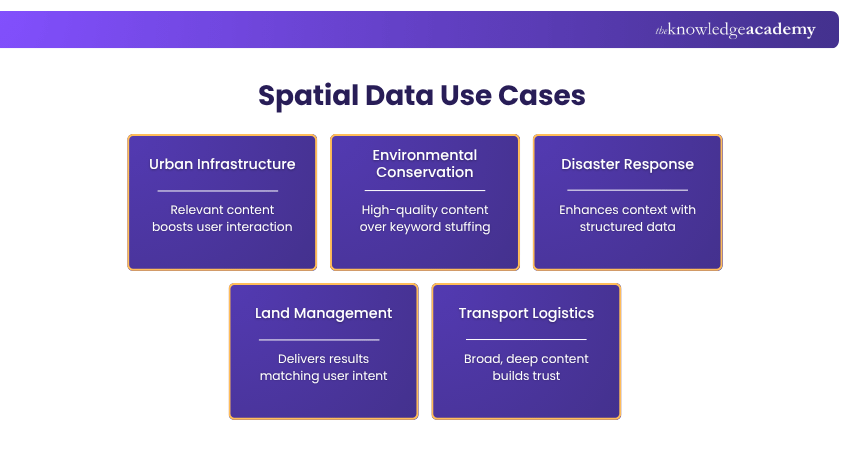
Here are some of the real-life usages of Spatial Data. Let's check those areas:
1) Urban Infrastructure
Urban infrastructure is one of the current situations all over the world. Professionals are working closely to implement new buildings and transportation for quick navigation and stay. Planning it effectively requires data on how significant it will be for people.
2) Environmental Conservation
In predicting and expecting weather, climatic changes, or any natural disasters, data is needed on how the environment is performing. With the collected data only, people will get notified or informed of how Nature is and what to expect in the upcoming days.
3) Disaster Response
When focusing on the environment, disaster is one of its segments, too. Be it natural or man-made, it needs to be predicted to prevent any damage to the lives of the people. It is used for risk management, finding where help is required in real-time.
4) Land Management
Agriculture is the backbone of a nation. Spatial Data helps in understanding the quality of the land and predicting the yield that it can contribute from farming. You can also check the quantity of water and fertilisers on a land based on its sustainability.
5) Transport Logistics
When the population is increasing, there is a proportional increase in the need for transportation. The government and transport sectors need to work together to provide enough transport facilities for an area by analysing its population.
Thinking of R programming skills to analyse and visualise data? Join our Data Science with R Training - Today!
Software Tools for Spatial Data
There are several tools that incorporate Spatial Data. Here are some of its lists:
1) GIS Software
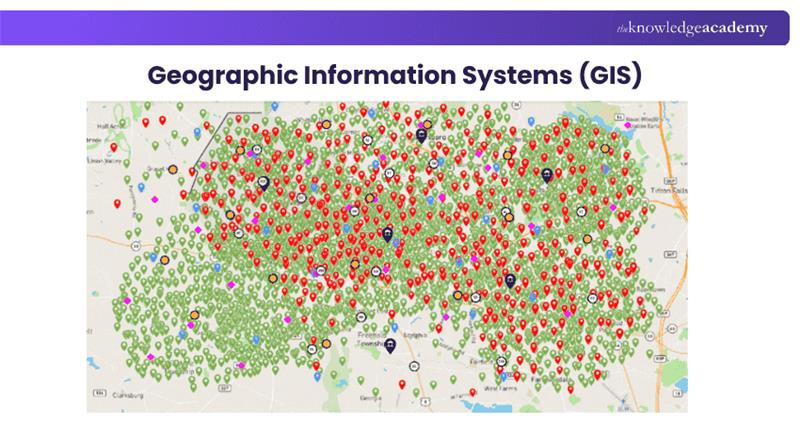
Geographic Information Systems (GIS) software uses Spatial Data in a versatile manner. It is used to visualise, analyse and share Spatial Data while creating interactive maps. Its variants are ArcGIS and Quantum Geographic Information System (QGIS). These are used in urban planning, disaster management, and research.
2) Web-based Mapping Platforms
Web-based mapping platforms like Leaflet are used for integrating Spatial Data into web applications. They are JavaScript libraries for maps and visualisations. They help to create complex and interactive maps and web-based visualisations.
3) Statistical Analysis Software
The widely used statistical analysis software is R libraries and Python libraries. It offers free and open-source services of advanced data analysis and visualisations. They are specialised in spatial selection, aggregation, and autocorrelation.
4) Data Visualisation Tools
Data visualisation tools like Tableau and Power BI are used for map visualisations, interactive dashboards, and other trends with geographic visuals. They are basic tools for Spatial Data analysis aimed specifically at map visualisations.
Conclusion
The whole world is in your hands! Yes, with the help of advanced mapping techniques, it is clearly evident that all the details of this world are documented and stored in an easily accessible format. This blog on What is Spatial Data would have provided you with a description of how exactly you’re locating your house or any destinations and the ways the climatic predictions are made. From individual purposes to professional reference, this technology has imprinted its strong existence.
Improvise your data visualisation in business intelligence by signing up for our Data Analysis and Visualisation with Python Course now!
Frequently Asked Questions
How Do You Collect Spatial Data?

Spatial Data can be collected in various methods. Those include remote sensing through satellites, surveying, and digitising of existing images or maps. Other options include field sensing using GPS devices or collecting data from existing data sources.
What are the Three Major Ways We Can Store Data?
Data storage can be done in three major ways. Those are file storage, block storage, and object storage. File storage saves data in a hierarchical folder structure; block storage breaks data into blocks for fast access and performance; and object storage stores data as objects with metadata.
What are the Other Resources and Offers Provided by The Knowledge Academy?
The Knowledge Academy takes global learning to new heights, offering over 3,000+ online courses across 490+ locations in 190+ countries. This expansive reach ensures accessibility and convenience for learners worldwide.
Alongside our diverse Online Course Catalogue, encompassing 17 major categories, we go the extra mile by providing a plethora of free educational Online Resources like Blogs, eBooks, Interview Questions and Videos. Tailoring learning experiences further, professionals can unlock greater value through a wide range of special discounts, seasonal deals, and Exclusive Offers.
What is The Knowledge Pass, and How Does it Work?
The Knowledge Academy’s Knowledge Pass, a prepaid voucher, adds another layer of flexibility, allowing course bookings over a 12-month period. Join us on a journey where education knows no bounds.
What are the Related Courses and Blogs Provided by The Knowledge Academy?
The Knowledge Academy offers various Data Science Courses, including GIS Development Training, Predictive Analytics Course and Data Science with R Training. These courses cater to different skill levels, providing comprehensive insights into Data Accuracy.
Our Data, Analytics & AI Blogs cover a range of topics related to Spatial Data, offering valuable resources, best practices, and industry insights. Whether you are a beginner or looking to advance your Data and Analytical skills, The Knowledge Academy's diverse courses and informative blogs have got you covered.

Lily Turner


Senior AI/ML Engineer and Data Science Author
Lily Turner is a data science professional with over 10 years of experience in artificial intelligence, machine learning, and big data analytics. Her work bridges academic research and industry innovation, with a focus on solving real-world problems using data-driven approaches. Lily’s content empowers aspiring data scientists to build practical, scalable models using the latest tools and techniques.
View Detail
Upcoming Data, Analytics & AI Resources Batches & Dates
Date
 GIS Development Training
GIS Development Training
Fri 10th Jul 2026
GIS Development Training
Fri 27th Nov 2026

 If you wish to make any changes to your course, please


