


 Top Rated Course

We may not have the course you’re looking for. If you enquire or give us a call on 44 1344 203 999 and speak to our training experts, we may still be able to help with your training requirements.
What is a Business Analyst: Roles, Responsibilities, and Skills
William Brown 14 July 2026A Business Analyst identifies business needs, analyses data, and recommends solutions to improve processes, boost performance, and deliver measurable value. They bridge stakeholders and technical teams to ensure requirements are clearly defined. Their insights support better decisions and successful project outcomes.

Training Outcomes Within Your Budget!
We ensure quality, budget-alignment, and timely delivery by our expert instructors.
Table of Contents

Have you ever been part of a project where everyone was busy, yet nothing seemed clear? Deadlines moved, requirements changed, and teams worked hard but still felt misaligned. That confusion often happens when no one connects bigger business goals with day-to-day work. This is where a Business Analyst makes a real difference by bringing clarity, structure, and direction to complex situations.
So, What is a Business Analyst and why do organisations need one? This blog explains how the role connects business ideas with practical solutions and turns challenges into clear, actionable steps. It also shows how organisations improve processes, reduce costs, and make smarter decisions in a competitive market.
Table of Contents
1) What is a Business Analyst?
2) What Does a Business Analyst do?
3) Skills and Qualifications of a Business Analyst
4) How to Become a Business Analyst?
5) Business Analytics Tools and Software
6) Conclusion
What is a Business Analyst?
A Business Analyst connects business requirements and IT solutions to address business objectives and make positive changes. They coordinate with top management, Project Managers, and clients to develop, understand, and establish the goals, milestones, and deliverables of a given project, much like the collaboration seen in Business Analyst vs Financial Analyst roles, where effective communication is key to aligning objectives and expectations.
Application areas involve analysis of data such as flow data; a BA primarily employs tools like process mapping to determine the points of improvement or lack thereof. When comparing Business Analyst vs. Data Scientist, a BA typically mediates between the stakeholders and provides input into solution development, while a Data Scientist focuses more on analysing complex data sets and creating predictive models.

What Does a Business Analyst do?
Business Analysts improve processes, analyse data, and support strategic decisions to help organisations achieve their goals. Key responsibilities include:
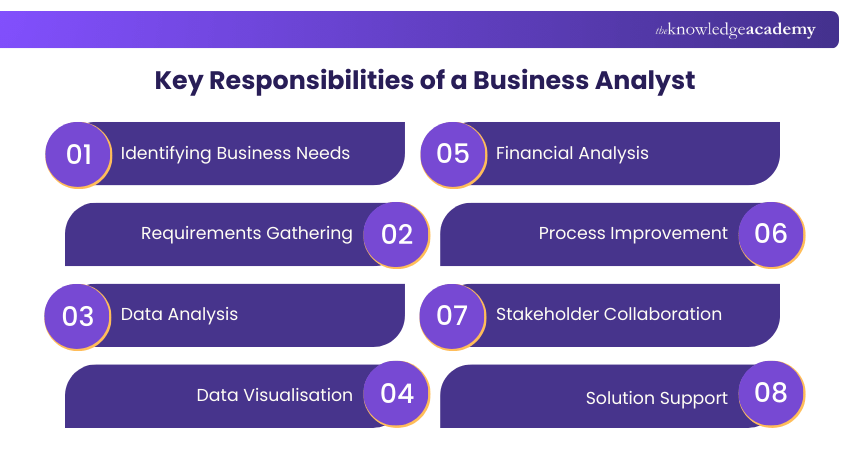
1) Identifying Business Needs: Understand organisational goals, strategies, and requirements to define functional and technical needs.
2) Requirements Gathering: Collect, prioritise, and document business and system requirements.
3) Data Analysis: Use tools such as SQL and Excel to analyse large data sets and identify trends and insights.
4) Data Visualisation: Create charts, tables, and reports to present findings clearly to stakeholders.
5) Financial Analysis: Develop financial models, support budgeting, forecasting, and variance analysis.
6) Process Improvement: Identify inefficiencies and redesign processes to enhance performance and productivity.
7) Stakeholder Collaboration: Work across departments to communicate insights and manage expectations.
8) Solution Support: Assist in implementing solutions and support User Acceptance Testing to ensure business needs are met.
9) Enterprise Planning: Contribute to enterprise architecture and long-term business planning.
10) Continuous Improvement: Promote ongoing enhancements in Business Analysis practices and organisational processes.
Unlock the full potential of your career with our Certified Business Analyst Professional (CBA-PRO) Course - Join to learn more today!
Skills and Qualifications of a Business Analyst
Being a successful Business Analyst requires a unique combination of technical expertise, analytical thinking, and Effective Communication skills. The following are some essential skills and qualifications that contribute to the success of a Business Analyst:
Skills of a Business Analyst
The following are the essential skills of a Business Analyst:
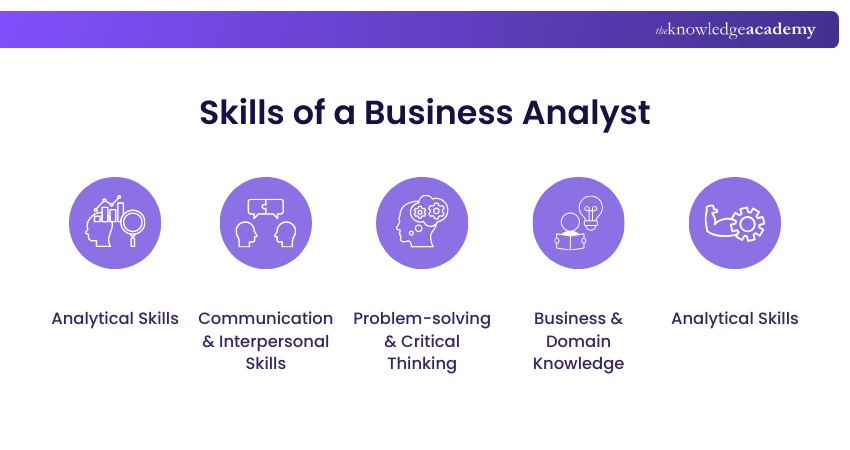
a) Analytical Skills: Business Analysts need to look at large amounts of business data, understand relationships, and come up with decisions based on that data.
b) Communication & Interpersonal Skills: There is a need to communicate effectively while dealing with the stakeholders. To build relationships and resolve conflicts, BAs are required to listen, encourage others to speak, and explain information searched.
c) Problem-solving & Critical Thinking: By way of critical evaluation, BAs analyse issues and define key problem areas before searching for the most optimal solutions satisfactory to business goals.
d) Business & Domain Knowledge: Knowledge of business and trends in the market allows a BA to find proper solutions to the problems they discover.
e) Technical Skills: It would not be mandatory to be an expert in technology, but BAs should have basic knowledge about technology and its related software, development methodology and tools in order to be in control during the project discussions with technical teams.
Qualifications of a Business Analyst
Becoming a Business Analyst does not require a specific degree, but many professionals hold a bachelor’s degree in business, finance, IT, Computer Science, or a related field. A strong analytical background is valuable. Certifications such as the CBAP from the International Institute of Business Analysis and the PMI-PBA from the Project Management Institute further enhance credibility and demonstrate recognised expertise.
In addition to education and certifications, practical experience in Data Analysis, systems, or operations is often expected. Continuous learning is equally important for Business Analysts. They must stay updated with evolving tools, industry trends, and best practices through regular training programmes. Engaging in professional communities also helps them remain competitive and continue growing in their careers.
Gain skills in documenting and analysing operations with our Business Process Mapping Training – Join today!
How to Become a Business Analyst?
Becoming a Business Analyst (BA) typically involves a combination of education, skills development, and gaining relevant work experience. Here are some of the pointers to keep a note of:
a) Education: Preliminary education should be a bachelor’s degree in business, IT or other related fields. One can gain additional skills and knowledge in Business Analysis to make specialisation in one of the fields.
b) Developing Skills: Socio, communication and technical skills are particularly relevant, including problem-solving abilities. Familiarity with working in tables like Excel, working with SQL, and comprehending Software Development Processes will be advantageous.
c) Gain Experience: There is an opportunity to start with basic positions in projects, such as a Project Coordinator or a Data Analyst (DA), to get an understanding of what business and a BA is.
d) Certifications: IIBA® Certified Business Analysis Professional (CBAP®) or PRINCE2 certifications make you more accredited and give you a better chance in the Business Analysis field.
e) Continuous Learning: Build your knowledge and increase the chances of getting a job or a promotion by participating in professional organisations and attending events with other professionals.
Business Analytics Tools and Software
Business Analytics tools and software enable organisations to collect, process, and analyse data to make informed decisions. Popular tools include Tableau, Power BI, Google Analytics, and Python, which are used for Data Visualisation, reporting, and Predictive Analysis. These tools enhance efficiency, identify trends, and support strategic decision-making.
Conclusion
Understanding What is a Business Analyst highlights their crucial role in bridging business needs with technology. They analyse data, improve processes, and drive strategic decisions. With high demand and growth opportunities, this career provides immense potential for professionals looking to make a meaningful impact in the business world.
Unlock your potential in the field of Business Analysis and propel your career forward with our comprehensive Business Analyst Black Belt Course – Join now!
Frequently Asked Questions
Should I Become a Data Analyst or a Business Analyst?

If you enjoy working with numbers, statistics, and data tools to uncover insights, consider becoming a Data Analyst. On the other hand, if you prefer bridging business needs with technology, solving problems, and improving processes, a Business Analyst role might be more suitable. Both positions are in high demand!
How Does the Role of a Business Analyst Vary Across Different Industries?
The role of a Business Analyst adapts to the unique needs of various industries. In finance, Analysts focus on risk management and compliance, while in technology, they emphasise system integration and software requirements. Healthcare Analysts delve into process optimisation for better patient care.

William Brown


Senior Business Analyst and Strategic Advisor
William Brown is a senior business analyst with over 15 years of experience driving process improvement and strategic transformation in complex business environments. He specialises in analysing operations, gathering requirements and delivering insights that support effective decision making. William’s practical approach helps bridge the gap between business goals and technical solutions.
View Detail

 If you wish to make any changes to your course, please


