
Automation & Penetration Testing

Online Instructor-led (2 days)

Classroom (2 days)

Online Self-paced (16 hours)

Tools and Techniques for Penetration Testing Course Outline

Module 1: Introduction to Penetration Testing

  • What is Penetration Testing?
  • Penetrating Testing vs Ethical Hacking?
  • Types of Penetration Testing
  • Area of Penetration Testing
  • Penetration Testing Process
  • Penetration Testing Methods
  • Why Perform Penetration Testing?
  • How Often to Perform Penetration Testing?
  • Rules of Engagement
  • Penetrating Testing Tools
  • Manual and Automated Penetration Testing
  • Roles of Penetration Testers

Module 2: Benefits and Limitations

  • Benefits of Penetration Testing
  • Limitations of Penetration Testing
  • Remediation in Penetration Testing
  • Legal Issues

Module 3: Vulnerabilities

  • Vulnerability Assessment
  • Pen Testing Vs Vulnerability Assessment
  • Vulnerability Scanning
  • Finding Vulnerabilities
  • Types of Vulnerabilities

Module 4: Analysing Risk

  • Prioritising Threats
    • Attain Relative System Information
    • Observe the System Regularly
    • Use Effective Tools
    • Ensure Personnel Training

Module 5: Attack Using Vulnerabilities

  • Exploitation Techniques
  • Exploiting Web Applications
  • Exploiting Network Services
  • Zero-Day Angle
  • Countermeasure Techniques

Module 6: Follow Up

  • Creating an Action Plan
  • Reporting Techniques
  • Recommended Countermeasures

Show moredown

Who should attend this Tools and Techniques for Penetrating Testing Course?

Tools and Techniques for Penetrating Testing Course can help you understand the different tools and techniques used in penetration testing and to evaluate the security of IT infrastructures effectively. This course can be beneficial for the following professionals:

  • Security Analysts
  • IT Auditors
  • Compliance Officers
  • Threat Intelligence Analysts
  • Cyber Security Consultants
  • Information Security Professionals
  • Security Researchers

Prerequisites of the Tools and Techniques for Penetrating Testing Course

There are no formal prerequisites for this Tools and Techniques for Penetrating Testing Course.

Tools and Techniques for Penetration Testing Course Overview

Penetration Testing, a critical aspect of cybersecurity, involves simulating attacks on systems to identify vulnerabilities before malicious actors exploit them. This 2-day course on Tools and Techniques for Penetration Testing provides hands-on training, ensuring participants gain practical experience in safeguarding digital assets, essential for maintaining robust security postures in today's cyber threat landscape.

Proficiency in Penetration Testing is vital for IT Security Professionals, Ethical Hackers, and Network Administrators. Mastery of this subject equips professionals to protect organisations from potential breaches, ensuring the integrity, confidentiality, and availability of information. Those aiming to advance their careers in cybersecurity should consider this course indispensable.

This intensive 2-day training empowers delegates with the knowledge and skills to identify and mitigate vulnerabilities using industry-standard tools and techniques. Participants will learn through practical exercises, case studies, and expert guidance, enabling them to apply these skills in real-world scenarios effectively. The course is designed to enhance their ability to conduct thorough security assessments.

Course Objectives

  • To understand the fundamentals of Penetration Testing and its importance
  • To identify various Penetration Testing methodologies and frameworks
  • To use key tools for network and application Penetration Testing
  • To simulate real-world attacks to uncover vulnerabilities
  • To apply effective techniques for vulnerability analysis and exploitation
  • To develop and implement robust security testing plans

Upon completing this course, participants will receive a certification, validating their expertise in Penetration Testing Tools and Techniques. This certification enhances their credentials, showcasing their ability to protect organisations from cyber threats effectively.

Show moredown

What’s included in this Tools and Techniques for Penetrating Testing Course?

  • World-Class Training Sessions from Experienced Instructors
  • Tools and Techniques for Penetrating Testing Certificate
  • Digital Delegate Pack

Show moredown

Online Instructor-led (1 days)

Classroom (1 days)

Online Self-paced (8 hours)

Fundamentals of Test Automation Course Outline

Module 1: Introduction to Test Automation

  • What is Test Automation?
  • What can the User Expect?
  • Why do we Need Test Automation?
  • Benefits of Test Automation
  • Managing Test Automation
  • Risk Identification Techniques
  • Risk–Contingency Planning

Module 2: Test Automation Tool Selection

  • Priorities in Tool Selection
  • Steps to Select the Right Automation Tool
  • Recognising Project Requirements
  • Using Existing Tools as a Base Standard
  • Identifying Key Criteria for a Project
  • Analysing Best-Suited Options
  • Automation Tool Selection Criteria
  • Who Should Be Involved?
  • Tool Selection Process
  • Automation Tool Selection Criteria

Module 3: Strategising for Successful Automation

  • Apply Software Development Process
  • Improve Testing Process
  • Define Requirements
  • Prove Concept
  • Champion Product Testability
  • Design for Sustainability
  • Plan for Deployment
  • Face Challenges of Success
  • Old Oak Tree Syndrome

Module 4: Automation Frameworks

  • Test Automation Framework
  • Advantages of Test Automation Framework
  • Human Resource
  • Error Handling
  • Benefits of Building a Test Framework
  • Types of Test Automation Frameworks

Show moredown

Who should attend this Fundamentals of Test Automation Course?

This Fundamentals of Test Automation Training is ideal for those seeking to understand the basics of Test Automation. It’s suitable for beginners interested in learning how to automate testing processes and enhance their software development skills. This course can be beneficial for a wide range of professionals, including:

  • Quality Assurance Engineers
  • Software Engineers
  • Software Developers
  • Project Managers
  • Systems Analysts
  • Automation Engineers
  • Test Architects

Prerequisites of the Fundamentals of Test Automation Course

There are no formal prerequisites for this Fundamentals of Test Automation Training.

Fundamentals of Test Automation Course Overview

Test Automation is a critical aspect of modern Software Development, allowing for efficient and consistent testing of applications. The Fundamentals of Test Automation Training provides a comprehensive introduction to Test Automation, highlighting its significance in ensuring software quality and reliability. This training is relevant for those looking to streamline testing processes and enhance the accuracy of their software testing efforts.

Understanding the Fundamentals of Test Automation Course is crucial for Software Developers, Quality Assurance Professionals, and Testers. Mastering Test Automation enables these professionals to reduce manual testing efforts, identify defects earlier, and improve overall software performance. Companies increasingly seek individuals with Test Automation skills to stay competitive and deliver high-quality products efficiently.

This 1-day training by The Knowledge Academy will equip delegates with essential skills and knowledge in Test Automation. Delegates will learn about automation tools, scripting, and best practices, enabling them to implement effective Test Automation strategies in their workplaces. The practical approach of the course ensures that delegates can immediately apply what they have learned to real-world scenarios, enhancing their professional capabilities.

Course Objectives

  • To understand the principles and benefits of Test Automation
  • To learn how to select and use appropriate Test Automation tools
  • To develop skills in writing and maintaining automated test scripts
  • To implement best practices in Test Automation
  • To analyse and report on automated test results effectively

Upon completing this training, delegates will have a solid foundation in test Automation concepts and techniques. They will be equipped to implement and manage automated testing processes, enhancing their ability to ensure software quality and reliability within their organisations.

Show moredown

What’s included in this Fundamentals of Test Automation Course?

  • World-Class Training Sessions from Experienced Instructors
  • Fundamentals of Test Automation Certificate
  • Digital Delegate Pack

Show moredown

Online Instructor-led (1 days)

Classroom (1 days)

Online Self-paced (8 hours)

Kali Linux Fundamentals Course Outline

Module 1: Getting Started with Kali Linux

  • Introduction to Kali Linux
  • Download and Install Virtual Box
  • Installing Kali Linux
  • Updating Kali
  • Laboratory Setup

Module 2: Information Gathering and Vulnerability Analysis Tools

  • NMAP and ZenMAP
  • Stealth Scan
  • Searchsploit
  • DNS and LBD Tools
  • Hping3
  • Cisco Auditing Tools
  • Cisco Global Exploiter
  • BED

Module 3: Kali Linux Wireless Attacks

  • Fern Wi-Fi Cracker
  • Kismet and GISKismet
  • Ghost Phisher
  • Wifite

Module 4: Website Penetration Testing

  • Vega Usage
  • ZapProxy
  • Database Tools Usage
  • CMS and SSL Scanning Tools

Module 5: Exploitation Testing

  • Metasploit
  • Armitage
  • BeEF
  • P0f and Pdf-Parser
  • Dumpzilla

Module 6: Kali Linux Social Engineering

  • Social Engineering Toolkit Usage

Module 7: Stressing Tools

  • Slowhttptest
  • Inviteflood
  • Iaxflood
  • thc-ssl-dos

Module 8: Sniffing and Spoofing

  • Burpsuite
  • mitmproxy
  • Wireshark

Module 9: Password Cracking Tools

  • Hydra
  • Johnny
  • John
  • Rainbowcrack
  • SQLdict
  • Hash-Identifier

Module 10: Maintaining Access

  • Powersploit
  • Sbd
  • Webshells
  • Weevely
  • HTTP-tunnel
  • dns2tcp
  • crypt

Module 11: Overview of Reverse Engineering

  • OllyDbg
  • dex2jar
  • jd-gui
  • apktool

Module 12: Kali Linux Reporting Tools

  • Dradis
  • Metagoofil

Show moredown

Who should attend this Kali Linux Fundamentals Course?

This course on Kali Linux Fundamentals course aims to provide you with an understanding of Kali Linux's core features and help you carry out penetration testing and security auditing. This course can be beneficial for professionals including:

  • Penetration Testers
  • Ethical Hackers
  • Developers
  • QA Engineers
  • IT Administrators
  • Network Engineers
  • Digital Forensic Investigators

Prerequisites of the Kali Linux Fundamentals Course

There are no formal prerequisites for this course on Kali Linux Fundamentals Course. However, it is beneficial to have a basic understanding of Linus operating system.

Kali Linux Fundamentals Course Overview

The Kali Linux Fundamentals Course offers a comprehensive introduction to the powerful and versatile Kali Linux Operating System. Designed for Cybersecurity professionals and enthusiasts, this course provides essential knowledge and practical skills for effectively using Kali Linux in various security testing scenarios. As a leading tool in the cybersecurity industry, Kali Linux is crucial for ethical hacking and Penetration Testing.

Proficiency in Kali Linux is essential for Cybersecurity Experts, Network Administrators, and IT Professionals. Mastering Kali Linux enhances one’s ability to perform advanced security assessments and mitigate potential threats. This course is ideal for those looking to strengthen their cybersecurity skills, including Ethical Hackers, Penetration Testers, and IT Security Consultants.

This 1-day intensive training by The Knowledge Academy equips delegates with the foundational skills to navigate and utilise Kali Linux for security tasks. Through hands-on exercises and expert guidance, participants will learn to deploy and configure Kali Linux, understand its various tools, and apply them in real-world scenarios. The course ensures that delegates gain practical experience and confidence in using Kali Linux effectively.

Course Objectives

  • To understand the basics of Kali Linux and its purpose
  • To install and configure Kali Linux on various platforms
  • To navigate the Kali Linux environment and its key features
  • To utilise essential Kali Linux tools for security testing
  • To conduct basic network reconnaissance using Kali Linux
  • To perform vulnerability scanning and analysis

Upon completing the course, delegates will receive a certification of completion, demonstrating their proficiency in Kali Linux fundamentals. This certification validates their skills and enhances their credibility in the cybersecurity field.

Show moredown

What’s included in this Kali Linux Fundamentals Course?

  • World-Class Training Sessions from Experienced Instructors
  • Kali Linux Fundamentals Certificate
  • Digital Delegate Pack

Show moredown

Not sure which course to choose?

Speak to a training expert for advice if you are unsure of what course is right for you. Give us a call on +65 6929 8747 or Enquire.

Benefits of Automation and Penetration Testing Courses

Completing Automation and Penetration Testing Courses through The Knowledge Academy enables learners to build strong technical capabilities in software testing, cybersecurity, and ethical hacking. This training enhances career readiness by developing skills that support secure, high-quality system performance. Below are the key benefits learners gain from these courses:

  • Enhanced Software Efficiency and Quality: This training helps learners automate repetitive tests, reduce manual effort, improve testing speed, and increase software stability. Automation ensures faster release cycles and strengthens product reliability.
  • Stronger Cybersecurity and Threat Detection Skills: These courses build practical skills in identifying vulnerabilities, conducting ethical hacking activities, analysing security risks, and preventing cyberattacks. Learners become capable of assessing systems before real threats emerge.
  • Improved Vulnerability Identification and Risk Management: Participants gain the ability to discover security gaps, prioritise risks, analyse system weaknesses, and recommend effective mitigation strategies. This strengthens an organisation’s overall security posture.
  • Broader Career Prospects Across IT and Cybersecurity Roles: Automation and penetration testing skills allow learners to pursue diverse career paths such as Ethical Hacker, Penetration Tester, Cybersecurity Analyst, Automation Test Engineer, and Security Consultant. These skills are in high demand across multiple industries.
  • Higher Earning Potential and Industry Recognition: Professionals equipped with advanced automation and cybersecurity skills are valued for their ability to optimise testing processes and safeguard digital environments. This often leads to better job opportunities, increased salary potential, and greater professional credibility.
     

Career Opportunities After Automation and Penetration Testing Courses

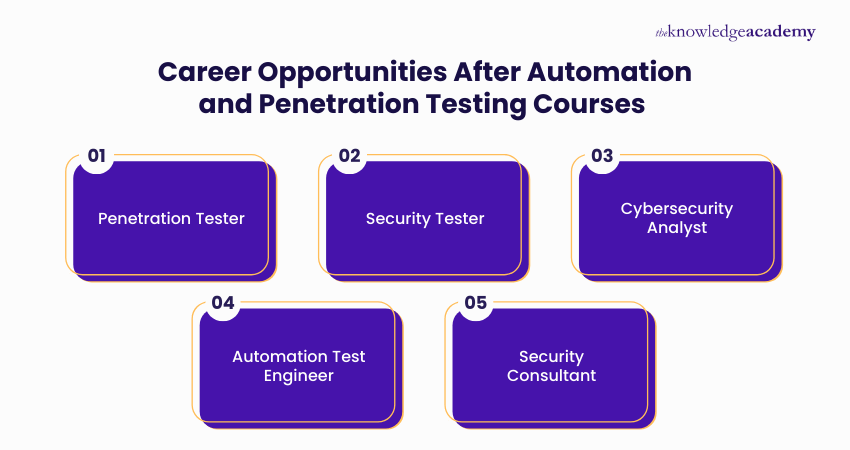
Completing Automation and Penetration Testing Courses through The Knowledge Academy equips professionals with the technical expertise needed to work in cybersecurity, ethical hacking, and automated software testing. Below are the top career opportunities learners can pursue:

Career Opportunities After Automation and Penetration Testing Courses

  • Penetration Tester: This role focuses on legally simulating cyberattacks to identify weaknesses in networks, systems, and applications before malicious actors can exploit them.
  • Security Tester: This position involves assessing the security posture of applications and networks, with a focus on identifying vulnerabilities across web, mobile, and enterprise environments.
  • Cybersecurity Analyst: This role is responsible for monitoring systems for threats, investigating security incidents, implementing security controls, and ensuring compliance with cybersecurity standards.
  • Automation Test Engineer: This position designs and develops automated test scripts and frameworks to improve software reliability, accelerate testing cycles, and enhance overall product quality.
  • Security Consultant: This role advises organisations on improving their cyber resilience by assessing security gaps, designing mitigation strategies, and supporting incident response efforts.
Show more blue-arrow

Automation & Penetration Testing FAQs

Taking these courses can enhances your cybersecurity skills, enabling individuals to identify vulnerabilities, automate security tasks, improve system defenses, and stay updated with the latest threats, ultimately boosting career prospects and organisational security.

These courses enhance your cybersecurity skills by teaching efficient vulnerability identification, exploitation techniques, and automated security processes, enabling professionals to proactively defend systems, identify weaknesses, and strengthen overall security posture effectively.

There are no formal prerequisites for attending these courses. However, a basic understanding of the Linus Operating System would be beneficial for the delegates.

Automation techniques improve Penetration Testing efficiency by streamlining repetitive tasks, increasing test coverage, reducing human error, and accelerating the detection of vulnerabilities. This allows security professionals to focus on more complex analysis and remediation efforts.

These Automation and Penetration Testing Courses by The Knowledge Academy, a trusted training provider, cover tools such as Selenium, Jenkins, and Ansible for automation, and Metasploit, Burp Suite, Nmap, and Wireshark for Penetration Testing, equipping learners with essential practical skills.

The Automation and Penetration Testing exam, delivered by The Knowledge Academy, one of the top training providers, includes multiple-choice, drag-and-drop, and simulation-based questions, assessing knowledge of automation, Penetration Testing techniques, security concepts, and tools across both practical and theoretical areas.

Manual Penetration Testing involves human testers identifying and exploiting vulnerabilities using their expertise. Automated Penetration Testing uses software tools to scan and identify vulnerabilities quickly. Manual testing is thorough and context-aware, while automated testing is faster but less nuanced.

Professionals skilled in Automation and Penetration Testing can pursue careers as Security Analysts, Penetration Testers, Cybersecurity Consultants, Red Team Operators, Automation Engineers, Vulnerability Assessors, and Security Architects, often leading to roles in high-demand industries like finance, tech, and government.

This course typically takes around 5 to 7 weeks to complete, depending on the course structure and intensity, including both theoretical lessons and practical hands-on exercises to master essential skills.

Automation and Penetration Testing Courses by The Knowledge Academy, one of the best training providers, include practical labs, real-world scenarios, and hands-on projects, ensuring learners gain experience through industry-relevant simulations.

Upon completion of these courses by The Knowledge Academy, one of the global training providers, learners receive a Certified Automation Tester certification and a Certified Penetration Testing Professional certification, both recognised credentials that enhance professional credibility.

The Knowledge Academy is one of the Leading global training provider for Automation & Penetration Testing.

The training fees for Automation & Penetration Testing in Singapore starts from SGD5195

Show more down

Why we're the go to training provider for you

icon

Best price in the industry

You won't find better value in the marketplace. If you do find a lower price, we will beat it.

icon

Trusted & Approved

Recognised by leading certification bodies, we deliver training you can trust.

icon

Many delivery methods

Flexible delivery methods are available depending on your learning style.

icon

High quality resources

Resources are included for a comprehensive learning experience.

barclays Logo
deloitte Logo
Thames Water Logo

"Really good course and well organised. Trainer was great with a sense of humour - his experience allowed a free flowing course, structured to help you gain as much information & relevant experience whilst helping prepare you for the exam"

Joshua Davies, Thames Water

santander logo
bmw Logo
Google Logo
cross

Upgrade Your Skills. Save More Today.

superSale Unlock up to 40% off today!

WHO WILL BE FUNDING THE COURSE?

close

close

Thank you for your enquiry!

One of our training experts will be in touch shortly to go over your training requirements.

close

close

Press esc to close

close close

Back to course information

Thank you for your enquiry!

One of our training experts will be in touch shortly to go overy your training requirements.

close close

Thank you for your enquiry!

One of our training experts will be in touch shortly to go over your training requirements.