


 Top Rated Course


We may not have the course you’re looking for. If you enquire or give us a call on +40 316317743 and speak to our training experts, we may still be able to help with your training requirements.
Firebase vs Couchbase: All the Differences You Must Know
Lily Turner 10 February 2026Couchbase and Firebase are powerful platforms for managing data, each with unique strengths. This blog explores the key differences in the "Firebase vs Couchbase" comparison, covering aspects like data storage, scalability and real-time functionality. Understanding these differences will help you select the right solution for your needs.

Training Outcomes Within Your Budget!
We ensure quality, budget-alignment, and timely delivery by our expert instructors.
Table of Contents
Choosing the right database platform is crucial for the success of your application, but with so many options out there, it can be tough to decide. In this blog, we discuss the "Firebase vs Couchbase" to help you figure out which one is the perfect fit for your project.
Firebase, a cloud-based platform, shines with its real-time database and seamless Google integration. Meanwhile, Couchbase offers a high-performance NoSQL database that’s perfect for scalability. Whether you're developing a small app or a large-scale solution, this blog gives you the insights you need to make the best choice.
Table of Contents
1) What is Firebase?
2) What is Couchbase?
3) Firebase vs Couchbase: Detailed Comparison
a) Data Storage Paradigms
b) Development Tools and Community
c) Offline Functionality
d) Data Security
e) Scalability Features
4) Conclusion
What is Firebase?
Firebase is a comprehensive app development platform owned by Google. It provides different tools and services that help developers build high-quality apps, improve user engagement, and grow their user base. Firebase is particularly known for its real-time database and backend services, making it a popular choice for mobile and web applications. However, if you're considering different solutions, there are several Firebase Alternatives worth exploring, each offering unique features tailored to different app development needs.
Key Features of Firebase
Key features include:
a) Real-time Database: Firebase offers a NoSQL cloud database that stores data in JSON format. The real-time database syncs data across all clients, making it suitable for applications that require live updates, such as chat apps or collaborative tools. This real-time database is a key feature that differentiates Firebase from other cloud platforms, a factor often considered in a Firebase vs AWS comparison.
b) Authentication: It provides easy-to-integrate authentication services, supporting multiple sign-in methods, including email, Google, Facebook, and Twitter. This simplifies the process of managing user identities.
c) Cloud Firestore: Firebase’s newer database solution, Cloud Firestore, offers a more flexible and scalable NoSQL Database. It supports real-time data syncing and offline capabilities, making it suitable for more complex applications.
d) Cloud Functions: It allows you to run backend code in response to events triggered by Firebase features or HTTPS requests. This serverless functionality is highly scalable and eliminates the need to manage servers.
e) Analytics: It integrates seamlessly with Google Analytics, providing detailed insights into user behaviour and app performance. This helps developers make decisions to improve their apps.

Benefits of Firebase
Here are the advantages of Firebase:
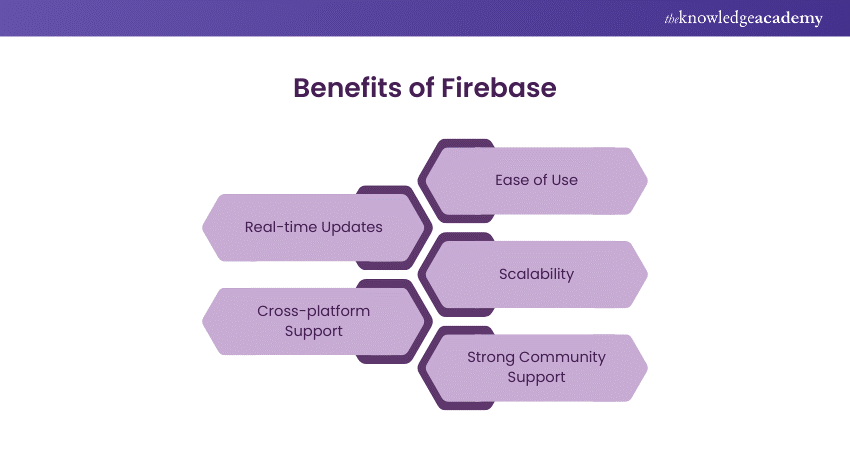
a) Ease of Use: Firebase is known for its simplicity and ease of integration. Developers can quickly set up and start using its services without deep knowledge of backend development.
b) Real-time Updates: Its real-time database makes it easy to build applications that require instant data synchronisation across multiple clients.
c) Scalability: It scales automatically with your app's usage, handling large amounts of data and traffic without requiring significant configuration or maintenance.
d) Cross-platform Support: Firebase supports iOS, Android, and web platforms. It makes it a versatile choice for building cross-platform apps.
e) Strong Community Support: As a Google product, Firebase has a large and active community of developers, offering plenty of resources, tutorials, and third-party integrations.
Choosing the Best Database? Understand Couchbase vs MongoDB for Smarter Decisions.
What is Couchbase?
Couchbase is a powerful NoSQL Database designed for enterprise-level applications. It offers a distributed architecture that ensures high performance, scalability, and flexibility. Couchbase is well-suited for applications that require complex queries, full-text search, and real-time analytics.
Key Features of Couchbase
Here are the key characteristics:
a) Distributed Database Architecture: Couchbase is built on a distributed architecture that provides high availability and fault tolerance. This makes it a great choice for mission-critical applications.
b) Multi-model Database: It supports multiple data models, including document, key-value, and graph, allowing developers to work with different types of data in a single database.
c) N1QL Query Language: It offers N1QL, a powerful SQL-like query language that allows developers to perform complex queries on JSON data. This makes it easier to retrieve and manipulate data in a flexible manner.
d) Full-text Search: It includes a full-text search engine that enables developers to build applications with advanced search capabilities, such as autocomplete, fuzzy search, and ranking.
e) Mobile Support with Couchbase Lite: It provides a lightweight version of its database, Couchbase Lite, for mobile devices. It supports offline-first applications by syncing data between the mobile device and the Couchbase server.
Learn to build network applications with our Node.JS Course – Join today!
Benefits of Couchbase
Some of the advantages of Couchbase include:

a) High Performance: Couchbase’s distributed architecture ensures low-latency data access and high throughput. It is ideal for applications that require fast response times.
b) Flexibility: Couchbase’s multi-model support and powerful query language give developers the flexibility to work with a wide variety of data types and structures.
c) Scalability: It can scale horizontally by adding more nodes to the cluster, allowing it to handle large datasets and high traffic loads efficiently.
d) Enterprise-grade Security: It offers robust security features, including role-based access control, encryption, and auditing, making it suitable for enterprise applications.
e) Real-time Analytics: With its integrated full-text search and real-time analytics capabilities, Couchbase is well-suited for applications that require complex Data Processing and analysis.
Boost Your Firebase Career – Familiarize yourself with the top Firebase Interview Questions for the ultimate interview prep.
Firebase vs Couchbase: Detailed Comparison
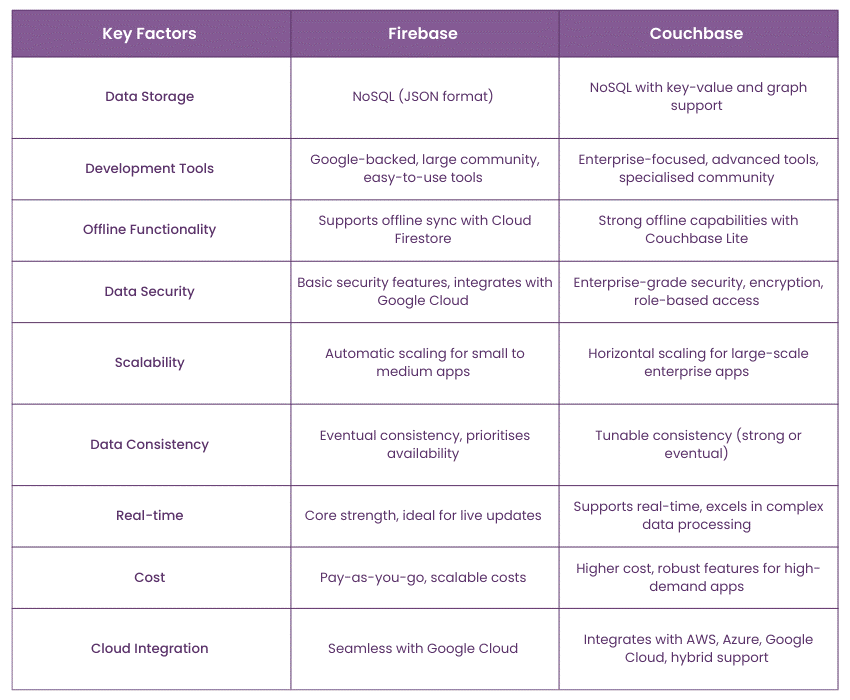
Now that we’ve covered the basics of Firebase and Couchbase let’s dive into a detailed comparison of the two platforms based on several key factors.
1) Data Storage Paradigms
Firebase uses a NoSQL document-based model where data is stored in JSON format. It’s ideal for real-time applications where data needs to be synced instantly across multiple clients.
In contrast, Couchbase also uses a NoSQL document-based model but supports additional data models like key-value and graphs. It offers more flexibility in how data is stored and accessed, making it suitable for complex applications.
2) Development Tools and Community
Firebase is backed by Google and has a large developer community. It provides a range of tools for app development, including real-time database, authentication, and analytics, all of which are easy to integrate.
On the other hand, Couchbase is more enterprise-focused and offers advanced tools like N1QL for querying full-text search, as well as mobile support. It has a smaller but highly specialised community of developers.
3) Offline Functionality
Firebase supports offline data synchronisation, particularly with its Cloud Firestore database. It is suitable for apps that need to function even without an internet connection.
In contrast, Couchbase excels in offline functionality with Couchbase Lite, a mobile version of its database that syncs data once the device is back online. This is particularly useful for mobile apps requiring robust offline capabilities.
4) Data Security
Firebase provides several security features, including user authentication, database rules, and integration with Google Cloud’s security services. It is designed with built-in security practices that protect user data.
On the other hand, Couchbase offers enterprise-grade security with features like encryption at rest and in transit, role-based access control, and auditing. It’s well-suited for applications that handle sensitive or regulated data.
5) Scalability Features
Firebase scales automatically based on the app’s demand. It is best for developers who want to focus on building their apps without worrying about backend infrastructure.
In contrast, Couchbase provides horizontal scalability, allowing you to add more nodes to handle increased load. This makes it ideal for large-scale enterprise applications that require high performance and reliability.
6) Data Consistency
Firebase prioritises availability over consistency, which can lead to eventual consistency in distributed environments. This is generally acceptable for applications that can tolerate slight delays in data consistency.
In contrast, Couchbase offers tunable consistency levels, allowing developers to select between strong and eventual consistency based on the needs of the application. This flexibility is beneficial for applications that need precise control over data consistency.
7) Real-time Functionality
Real-time functionality is one of Firebase’s core strengths. Its real-time database is designed to sync data across clients instantly, making it ideal for live-updating applications.
On the other hand, While Couchbase can support real-time data access, it’s not as inherently real-time-focused as Firebase. However, it excels in scenarios that require complex data processing and analysis.
8) Cost Considerations
Firebase operates on a pay-as-you-go model, which can be cost-effective for small to medium-sized applications. However, costs can scale quickly with increased usage, especially for real-time database operations.
In contrast, Couchbase is typically more expensive due to its enterprise focus, but it offers robust features and performance that justify the cost for large-scale, high-demand applications.
9) Cloud Integration
As a Google product, Firebase integrates seamlessly with Google Cloud services, making it easy to extend your application with additional cloud-based features and services.
On the other hand, Couchbase integrates well with major cloud providers like AWS, Azure, and Google Cloud Platform, offering flexibility in deployment. It also supports hybrid and multi-cloud environments, providing more control over your infrastructure.
Learn advanced analytical theory with our Big Data Analytics & Data Science Integration Course – Join today!
Conclusion
When deciding between Firebase and Couchbase, it's important to consider your project’s specific needs. Firebase is great for developers seeking an easy-to-use platform with real-time capabilities. On the other hand, Couchbase is ideal for enterprise-level applications that require high performance, flexibility, and robust security. Both platforms have their advantages, so your choice in the "Firebase vs Couchbase" debate should align with your application's requirements and long-term goals.
Learn how to manage clusters with our Couchbase Training – Join today!
Frequently Asked Questions
What is the Size Limit for the Couchbase Database?

Couchbase does not have a strict size limit for its database. It is designed to scale horizontally, allowing you to add more nodes to handle larger amounts of data as your needs grow.
When Should you not use Firebase?
You might not want to use Firebase for complex queries or when you need complete control over your backend infrastructure. It’s also less suitable for large-scale enterprise applications that require advanced data processing and robust security features.
What are the Other Resources and Offers Provided by The Knowledge Academy?
The Knowledge Academy takes global learning to new heights, offering over 3,000+ online courses across 490+ locations in 190+ countries. This expansive reach ensures accessibility and convenience for learners worldwide.
Alongside our diverse Online Course Catalogue, encompassing 19 major categories, we go the extra mile by providing a plethora of free educational Online Resources like Blogs, eBooks, Interview Questions and Videos. Tailoring learning experiences further, professionals can unlock greater value through a wide range of special discounts, seasonal deals, and Exclusive Offers.
What is the Knowledge Pass, and How Does it Work?
The Knowledge Academy’s Knowledge Pass, a prepaid voucher, adds another layer of flexibility, allowing course bookings over a 12-month period. Join us on a journey where education knows no bounds.
What are Related Courses and Blogs Provided by The Knowledge Academy?
The Knowledge Academy offers various Big Data and Analytics Training, including Big Data Analytics & Data Science Integration Course, Data Analysis Training Using MS Excel and Couchbase Training. These courses cater to different skill levels, providing comprehensive insights into Couchbase vs CouchDB.
Our Data, Analytics & AI Blogs cover a range of topics related to Couchbase, offering valuable resources, best practices, and industry insights. Whether you are a beginner or looking to advance your Data Analytics skills, The Knowledge Academy's diverse courses and informative blogs have got you covered.

Lily Turner


Senior AI/ML Engineer and Data Science Author
Lily Turner is a data science professional with over 10 years of experience in artificial intelligence, machine learning, and big data analytics. Her work bridges academic research and industry innovation, with a focus on solving real-world problems using data-driven approaches. Lily’s content empowers aspiring data scientists to build practical, scalable models using the latest tools and techniques.
View Detail

 If you wish to make any changes to your course, please


