


 Top Rated Course

We may not have the course you’re looking for. If you enquire or give us a call on +44 20 4538 6376 and speak to our training experts, we may still be able to help with your training requirements.
What is Management? A Complete Guide
William Brown 14 July 2026Management is the process of planning, organising, directing, and managing resources to accomplish objectives efficiently through coordination and teamwork. It involves setting clear goals, making informed decisions, and motivating people. Effective management ensures productivity, adaptability, and long-term business success.

Training Outcomes Within Your Budget!
We ensure quality, budget-alignment, and timely delivery by our expert instructors.
Table of Contents
What is it that is responsible for keeping businesses on course and teams working harmoniously toward shared goals? In the most fundamental sense, What is Management comes down to pulling together people, resources and processes to affect an outcome. It is performing effective planning, leading with intent, and making wise decisions. Adequate management provides structure, clarity and purpose to any organisation. So how do all these activities come together in practice? Let's take a closer look.
Table of Contents
1) What is Management?
2) Key Principles of Management
3) Levels of Management
4) Types of Management
5) Skills Required for Effective Management
6) Management Styles
7) What is an Example of Management?
8) How to Build a Career in Management?
9) Conclusion
What is Management?
The answer to the question 'what is management?' lies in its role as the process of guiding and coordinating teams to meet organisational objectives. Management serves several purposes, such as driving business goals, improving workflows, and tracking team performance. Managers play a crucial role in inspiring their teams and ensuring productive outcomes.
There are three core components of effective management:
1) Leadership Skills: Involve encouraging and guiding individuals to achieve company aims
2) Executive Skills: Focuses on improving efficiency and resource management
3) Business Skills: Centres on developing and applying strategies that boost engagement and profitability.

Key Principles of Management
Before learning about What is Management, it’s time to understand its core principles. The Principles of Management serve as the building blocks for effective organisational control and success.
Each principle is crucial in ensuring that an organisation operates efficiently, achieves its objectives, and maintains a positive work environment. Here is each Principle of Management explained in detail:
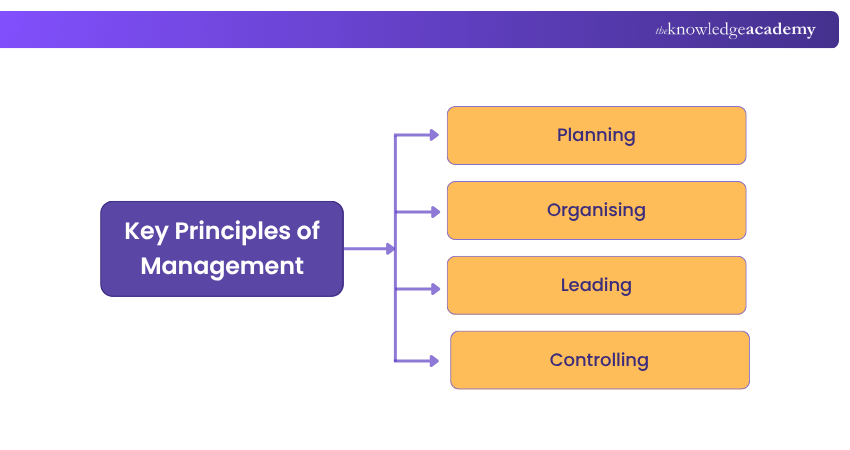
Planning
Planning is the first and foremost principle of Management. It involves setting clear, achievable objectives and developing a detailed strategy to accomplish them. A well-crafted plan outlines the tasks, resources, and timelines required to achieve the desired goals.
Further, effective planning provides direction to the organisation and helps in avoiding haphazard decision-making. It allows Managers and Employees to align their efforts towards a common purpose. As a result, it helps maximise productivity and reduce wastage of resources.
Organising
Organising is the process of arranging and allocating resources, tasks, and responsibilities to different individuals or departments within the organisation. A well-organised structure ensures that every member of the organisation understands their roles and contributions to the overall success.
It establishes clear lines of communication and authority, facilitating smooth coordination and collaboration among employees. Additionally, organising optimises the allocation of resources and supports effective Workflow Management, As a result, it leads to increased efficiency and reduced conflicts.
Leading
Leading is a critical principle that focuses on inspiring and guiding employees to work towards the organisation's objectives. Effective leaders motivate and empower their teams, providing a sense of direction and purpose.
They lead by example, exhibiting the desired values and behaviours that influence others positively. Leadership is not solely about Management positions; it can be displayed at all levels of an organisation. Inspiring leadership fosters a positive work culture, boosts employee morale, and encourages innovation and creativity.
Controlling
Controlling is the process of monitoring, measuring, and evaluating the organisation's performance against established standards and goals. It involves comparing actual results with planned outcomes and taking corrective actions if deviations occur.
Through effective control, Managers can identify potential issues and address them promptly. They can also ensure that the organisation stays on course. Therefore, controlling helps in maintaining efficiency, quality, and consistency in operations, contributing to the overall success of the organisation.
Learn about the roles and responsibilities of a Manager with our Introduction to Management Course - join now!
Levels of Management
In the majority of companies, management falls into one of the three levels, each of which comprises distinct responsibilities and scope.
1) Top-level Management: These are the senior executives, such as the CEOs, Managing Directors, or Board of Directors, who will develop the organisation’s long-term strategy, engage in strategic decision-making, and provide the organisation's overall direction and goals.
2) Middle Management: Led by middle managers, those also referred to as "first-line managers" (these would be department heads, plant managers or regional managers), adds an additional level of separation. These middle managers implement strategies, coordinate departmental plans, and, most importantly, act as a communication conduit throughout the organisation, all the while reporting to top management.
3) Lower-level Management: Also referred to as front-line or line managers (like supervisors, team leaders or forepersons), these managers manage daily operations, directly supervise employee performance to ensure work is completed on time.
Types of Management
Management is a diverse field that encompasses various specialised areas, each designed to serve distinct purposes within an organisation. Let's explore the different Types of Management in detail:
1) General Management
General Management is the broadest and most encompassing type of Management. General Managers are often responsible for the following:
a) Overseeing the overall performance of an organisation
b) Setting strategic goals and objectives
c) Formulating policies and guidelines
d) Making high-level decisions that impact the entire organisation
e) Working closely with department heads and team leads
By fulfilling these responsibilities, Managers ensure effective coordination and alignment of efforts towards achieving organisational goals. Moreover, they are skilled communicators and leaders who provide vision and direction to the organisation as a whole.
2) Operations Management
Operations Management focuses on the efficient Management of production processes and day-to-day operations within an organisation. Operations managers have the following duties:
a) Ensuring smooth and efficient production of goods or services
b) Planning production schedules
c) Managing inventory
d) Optimising resource allocation
e) Implementing quality control measures
Operations Management plays an important role in improving productivity, reducing costs, thus enhancing the overall efficiency of the organisation.
3) Project Management
Project Management involves planning, organising, and executing specific projects from initiation to completion. Project Managers are responsible for performing the following:
a) Establishing and defining the project objectives
b) Setting milestones
c) Creating detailed project plans
d) Leading project teams
e) Allocating resources
f) Managing risks
g) Ensuring the timely delivery of projects within the allocated budget
Project Management is essential for organisations that undertake various initiatives, as it ensures efficient project execution and successful achievement of project goals.
4) Strategic Management
Strategic Management is concerned with long-term planning and guiding the organisation in adapting to changing external environments. Strategic Managers analyse market trends, competitors, and internal strengths and weaknesses to formulate effective strategies.
These strategies align the organisation's resources and capabilities to create a sustainable competitive advantage. Strategic Management, guided by a well-defined Management Model, involves making critical decisions related to diversification, expansion, mergers, acquisitions, and partnerships, with a focus on achieving the organisation's long-term vision and objectives.
5) Human Resource Management (HRM)
Human Resource Management is responsible for managing the organisation's workforce. HR Managers handle various functions, including the following:
a) Recruitments
b) Candidate selections
c) Employee training
d) Performance evaluations
e) Handling compensation
Employee development
Creating and implementing HR policies and practices
Attracting and retaining a motivated and skilled workforce
By performing these activities, HR Managers promote a positive work environment and talent retention. As a result, HRM plays a pivotal role in an organisation's success.
6) Financial Management
Financial Management deals with the effective Management of an organisation's financial resources. Financial Managers are responsible for the following:
a) Budgeting
b) Financial analysis
c) Financial reporting
d) Making investment decisions
e) Ensuring the organisation's financial health
f) Optimally allocating financial resources
Therefore, Financial Management is essential for financial planning, Risk Management, and ensuring the organisation's stability and sustainability.
Learn how to bring the best out of people with our Introduction to Managing People Course - sign up today!
Skills Required for Effective Management
Effective Management requires a diverse skill set that empowers managers to navigate various challenges and drive organisational success. Let's explore the key Management Skills:
1) Technical Skills
Technical skills refer to the specific set of knowledge and expertise required to perform tasks related to the organisation's industry or field. For example, in a manufacturing setting, technical skills may include proficiency in operating machinery, understanding production processes, and implementing quality control measures. Similarly, in the business world, technical skills may encompass financial analysis, data interpretation, or marketing strategies. Additionally, Test Management Tools are essential for ensuring the proper execution of tasks in software development, as they help manage test cases, track defects, and improve overall process efficiency.
These skills provide Managers with the ability to understand and address the technical aspects of their roles. As a result, it ensures that they can make informed decisions and contribute efficiently to the organisation's operations.
2) Interpersonal Skills
Interpersonal skills are crucial for building positive relationships and effective communication with team members, colleagues, clients, and stakeholders. These skills involve the following:
a) Active listening
b) Empathy
c) Conflict resolution
d) Collaboration
Effective Managers are skilled communicators who can articulate ideas clearly, motivate their teams and foster a sense of trust and respect among different members of the team. Moreover, strong interpersonal skills enable Managers to create a supportive work environment where employees feel valued and motivated to contribute their best efforts.
3) Conceptual skills
Conceptual skills are the ability to think critically and understand the broader picture of the organisation and its industry. Effective managers possess the capacity to analyse complex situations, identify patterns, and conceptualise solutions.
They can see how various elements within the organisation are interconnected and how external factors can impact the business. Additionally, conceptual skills enable Managers to make strategic decisions, envision the organisation's future, and adapt to changing environments.
Learn how to bring structure and order to events with our Event Management Course – sign up now!
Management Styles
Solving problems, decision making, and guiding teams are all influenced by Management styles. Each style is for different environments, team dynamics, and organisational goals.
1) Authoritative
Authoritative managers actively and confidently direct. They make decisions unilaterally and want the team to follow the instructions. This style may feel like a top-down approach but is valuable in crisis or high-pressure environments. It ensures fewer decision makers and shared goals.
2) Coaching
A coaching manager focuses on developing employees for the future. They coach individuals along by offering constructive feedback, encouraging them to learn and develop to achieve their career goals. This style takes longer but also builds trust and loyalty. This style is best for developing talent and maximising team potential.
3) Democratic
Democratic members usually involve team members in decision-making. They listen, encourage discussions, and often take a vote or consensus approach. This style fosters collaboration and a sense of shared responsibility. It works best when innovation and team input are valuable.
4) Transformational
Transformational managers use their skills to inspire and energise the people they are placing in their charge. They paint a future in their leaders and followers' minds, motivate their followers through a sense of purpose and influence the correct people into going beyond their comfort zone. Transformational leadership is about being creative and adaptable.
5) Visionary
Visionary managers concentrate on the long-term direction of the organisation. They connect the work of teams to the larger organisational objectives and leverage Effective Communication to align everyone's work toward a common goal. This style can be useful for influencing culture and leading organisational transitions.
What is an Example of Management?
A real-world example of management in practice is a restaurant manager coordinating a busy Friday night shift. Before the shift begins, they need to plan the staffing hours and the roles of the team, monitor the food and service standards and react quickly to solve issues that appear, like a late delivery or employee call-offs.
Ultimately, the manager will use organisation, lead, and solve problems to ensure that the restaurant operation works smoothly, and customers have a positive and enjoyable experience. This illustrates how management uses planning, communication and decision-making, and how these interactive components can be used effectively to reach a common goal.
How to Build a Career in Management?
1) Understand What Management Involves: At its core, management is the process of planning, organising, leading, and controlling resources, people, time, and budgets, to meet an organisation’s objectives
2) Assess Your Strengths and Development Needs: Reflect honestly on your skills, values and motivations to identify what areas need improvement or focus.
3) Set Clear and SMART Goals: Define specific, measurable, attainable, relevant and time-bound milestones; e.g. aiming to step into a line manager role within two years.
4) Gain Experience and Build Skills: Take on tasks beyond your current role, volunteer to lead small projects, and seek feedback regularly. Consider formal qualifications such as leadership courses or even an MBA to strengthen your profile.
5) Network and Find Mentors: Connect with experienced professionals through industry events or informal mentoring. Their guidance can offer valuable insights and open doors for growth.
6) Review Your Progress Regularly: Every few months, re-evaluate goals and strategies. Update plans to reflect new interests, organisational shifts, or emerging opportunities.
Conclusion
Knowing What is Management improves our understanding of how organisations work effectively and accomplish their final objectives. Management works from the perspective of planning, organising, leading, and controlling to provide structure and direction. Executive Management is not just for executives. Each level of engagement reaps the benefits of good management skills. In a changing workplace, Management must evolve. Flexibility, people-focused, and strategy-driven Management will facilitate sustained success.
New to the Management process? Try our Management Training for New Managers Course - Now!
Frequently Asked Questions
What are the Four Key Management Practices?

Four Key Management Practices are:
a) Setting clear goals and expectations
b) Effective communication and feedback
c) Employee development and training
d) Performance monitoring and continuous improvement
What is the Difference Between Management and Leadership?
Management focuses on planning, organising, and controlling resources to achieve goals. Leadership inspires, motivates, and guides people toward a vision, emphasising influence over authority.

William Brown


Senior Business Analyst and Strategic Advisor
William Brown is a senior business analyst with over 15 years of experience driving process improvement and strategic transformation in complex business environments. He specialises in analysing operations, gathering requirements and delivering insights that support effective decision making. William’s practical approach helps bridge the gap between business goals and technical solutions.
View Detail

 If you wish to make any changes to your course, please


